Skip to content
DevMeme
630 of 7435
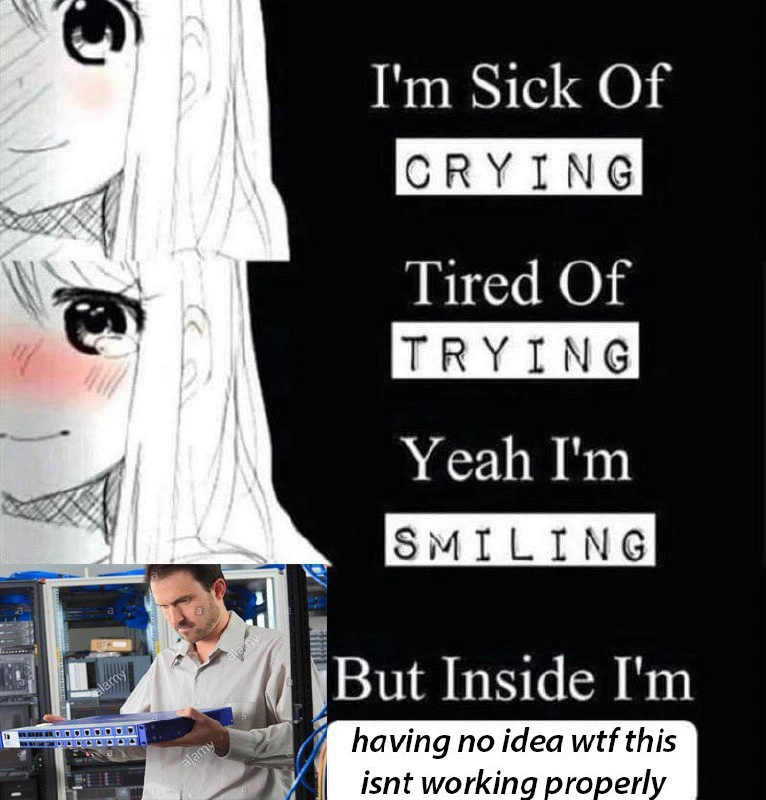
Smiling during the outage while clueless about the misbehaving network switch
Networking Post #718, on Sep 30, 2019 in TG

Smiling during the outage while clueless about the misbehaving network switch

Why is this Networking meme funny?

Level 1: Calm Outside, Chaos Inside

Imagine you’re watching a duck on a pond. Above the water, the duck looks serene and still, just gliding along happily – that’s like the smiling anime girl or the technician trying to look calm. But under the water, the duck’s little feet are paddling like crazy to keep it moving – that’s all the panic and confusion happening inside the engineer’s mind! This meme is funny because it shows a person acting like everything is okay on the outside, but inside they are super upset and don’t know what to do. It’s like if you were in class, and the teacher asks you a question you really don’t know the answer to. You might smile nervously and pretend you’re fine, but inside your heart is pounding because you’re freaking out. Here, instead of a school question, it’s a broken network switch (a box that connects computers, kind of like a big power strip for internet cables). The man in the picture is holding it and smiling a bit, but the text says he has “no idea why it isn’t working.” So he’s basically pretending “Yep, everything’s okay,” while inside he’s thinking “Oh no, oh no, everything is NOT okay!”

The emotional core is something anyone can understand: sometimes we hide our worry behind a smile. Maybe you’ve tried to fix your bike in front of your friends, acting like “I got this,” even though secretly you’re completely lost about why the chain keeps falling off. It’s that same feeling. In this meme, the stakes are higher – it’s about a big computer network outage – but the feeling is identical. We laugh because we know that feeling of pretending it’s fine when it really isn’t. The meme uses a dramatic style (big bold words like a sad poem) to make it extra clear: the person is exhausted and frustrated (“sick of crying, tired of trying”), yet they still put on a smile. It’s a bit like a cartoon where a character gives a thumbs up while everything burns behind them. Even if you don’t know anything about network switches or on-call jobs, you can relate to having a worried inside and a brave outside. That’s why this picture with the anime girl and the confused man is both funny and a little heartwarming – it says “Hey, we’ve all been there, trying our best to look confident even when we’re totally overwhelmed.”

Level 2: Plug and Pray

If you’re newer to Networking or still a junior dev, let’s break down what’s happening here. The image shows a guy in a server room holding a 24-port network switch – that’s basically a central box that all the computers and servers plug into so they can talk to each other. Think of a network switch like a busy traffic officer directing cars (data packets) at an intersection with 24 roads. If the switch stops working properly, none of the “cars” reach their destinations, and you’ve got a traffic jam of data! In a production_outage, which means a critical system is down in the real world (not just a test environment), everyone is stressed because real users are affected. The caption says “having no idea wtf this isn’t working properly” (with wtf conveying extreme confusion). That’s the unprofessional, blurted-out way of saying “I can’t figure out why this device is failing.” It’s a feeling every newbie in Debugging_Troubleshooting hits eventually: you’ve checked all the obvious things, and it still doesn’t make sense.

Now, being on call means it’s literally your job to respond at any hour when something breaks – yes, even at 3 a.m. 😴. The meme’s text about crying, trying, smiling is dramatizing how it feels to troubleshoot under that pressure. On the left, the anime girl is the external calm. On the right, the bold white text on black background is like an emotional poem turned meme. It usually ends with “inside I’m dying,” but here it’s replaced with our poor technician and his thought bubble of hidden_cluelessness (“I have no idea why this isn’t working!”). If you’ve ever been the junior person secretly panicking but trying to look composed in front of senior colleagues, this hits home. Maybe during your first OnCall_Nightmare you joined a bridge call for an outage, muted your mic, and frantically googled error messages while softly saying “oh no oh no…” to yourself – outwardly quiet, inwardly freaking out. That’s exactly what’s being shown.

Let’s define a few terms and scenario details: A network_switch is hardware that connects devices in a network and forwards traffic to the right place. They usually just quietly do their job. But if one misbehaves (like dropping connections or freezing up), it’s a big deal – akin to a broken power strip where none of the plugged-in devices can get power. Hardware_debugging means you might actually go to the physical machine (like our guy in the photo, who’s literally at the data center rack) to check things like cables, lights, or to reset the device. “Have you tried turning it off and on again?” is practically rule #1 of troubleshooting – often the first thing even a junior tech will attempt on a misbehaving switch or router. That’s the plug and pray ritual: you power-cycle the device and pray the network comes back up. The experienced folks joke about it, but trust me, we’ve all done it. Sometimes it actually works (maybe the switch had a software hiccup). Other times, you’re left even more confused.

In the meme, the technician’s face is blurred and he looks down at the switch with a confused frown. This is a pretty relatable SystemAdministration moment – double-checking each Ethernet cable, making sure the link lights are blinking correctly, maybe swapping out cables or moving a connection to a different port. For a junior person, picture the anxiety: an important website or service is down because of “network issues,” and you’ve been sent to fix this fancy blinking box and you’re not even sure how it’s broken. You feel pressure to act like “It’s fine, I got this” (thus the smiling outwardly), but inside you’re thinking “Oh no, I don’t got this at all.” The meme perfectly captures that contrast. It’s categorized under DebuggingFrustration and Troubleshooting because it highlights the frustration when nothing seems to fix the issue. This situation is unfortunately common enough that it’s become NetworkHumor. Everyone in IT remembers the first time they encountered a problem that didn’t match anything they learned in textbooks or Google searches. And in that stressful moment, you truly understand why your seniors joked about coffee-fueled 3 A.M. debugging sessions.

Even the style of the meme’s text – white uppercase letters on black – screams dramatic flair. It’s borrowing from a viral quote format to exaggerate the emotional state. This helps non-technical folks relate: it’s not just a machine problem, it feels like an emotional struggle too. As a junior developer or admin, you might not have held a broken network switch in your hands yet, but you probably have run into a smaller scale “why won’t this just work?!” scenario (like your code working locally but not on the server – classic works on my machine woes). The takeaway from this meme is: in IT, you’ll often need to stay calm on the outside while debugging crazy issues inside. And trust me, even the pros feel clueless sometimes – they’ve just learned to hide it better with a tired smile and a troubleshooting game face.

Level 3: Switch Witching Hour

At 3:00 a.m. in a silent data center, a network switch that won’t forward packets becomes the bane of your existence. This meme nails that on-call nightmare feeling: you’re outwardly composed, maybe even managing a half-smile on the bridge call, but inside you’re screaming “I have no idea why this isn’t working!” It’s a darkly comic slice of NetworkHumor drawn from real-life OncallNightmares. The left side anime girl is the calm facade – blushing and smiling through tears – while the right side’s dramatic text “I’m sick of crying, tired of trying, yeah I’m smiling, but inside I’m…” sets us up for a gut-punch twist. Instead of the expected “dying”, it drops a photo of a bewildered datacenter technician holding a 24-port network switch, captioned in despair: “having no idea wtf this isn’t working properly.” The juxtaposition parodies that melodramatic quote to highlight a truth every seasoned system administrator knows: during a production_outage you wear a brave face but inside you’re in full panic troubleshooting mode.

From a senior engineer’s perspective, the humor cuts deep. We’ve all been that blurry-eyed tech in the server room, tired of TRYING fix after fix, sick of CRYING (or wanting to) as each theory falls flat. The hidden_cluelessness is all too real – maybe the switch’s status lights are green across the board, yet no data is flowing. Everything looks fine externally (just like that forced smile), but internally the network fabric is in chaos and your mind is racing through a troubleshooting checklist that’s getting nowhere. Perhaps it’s a misconfigured VLAN, a rogue Spanning Tree Protocol loop, or the classic culprit: “Is it DNS again?” (because in Infrastructure crises, it’s always DNS until proven otherwise). The meme’s impact comes from this shared trauma: anyone who’s fought inexplicable network issues at ungodly hours recognizes the scenario. It’s a mix of DebuggingFrustration and dark comedy – you’re the competent professional supposed to know why the site’s down, yet here you are, poking at cables and staring at debug logs with that sinking wtf feeling.

Notice how the visual format amplifies the joke. The anime crying/trying template (a popular meme_format_overlay_text style) is intentionally over-the-top and emotional. By pairing it with a very real image of a confused engineer, the meme plays on contrast: dramatic inner turmoil meets mundane IT reality. In practice, being “on-call” often means you must project calm confidence to coworkers ("Yeah I’m SMILING") even if internally you’re one more reboot away from losing it. Those of us in networking or system administration have perfected this poker face. During an outage, your manager pings for status and you respond, “Investigating, all under control,” while you frantically swap SFP modules and scramble through the switch CLI for any hint of the fault. The text “having no idea wtf this isn’t working properly” in lowercase and an out-of-context font conveys that raw, unprofessional honest thought – the kind you’d never say on a public call, but absolutely scream inside your head. It’s funny because it’s true: behind many a confident “We’re working on it” update is a weary engineer thinking “Why on earth is this broken?!”

Technically speaking, debugging a misbehaving network_switch can be a nightmare even for veterans. Unlike a straightforward bug in code, network failures can be opaque. Maybe the switch’s MAC address table is freaking out, or a firmware bug has hung the forwarding plane. There’s no stack trace to Google at 3 AM – just cryptic blinking port LEDs and maybe a console prompt that decided to freeze. The seasoned folks reading this will nod knowingly at lines like “tired of trying” – because we’ve pulled cable after cable, reseated line cards, cross-checked firewall rules, all in desperation mode. The meme humorously captures that exact moment of helplessness: you’re physically holding the hardware (as in the photo) as if sheer proximity will reveal the answer, yet you’re utterly stumped. It’s a rite of passage in Troubleshooting that even the best runbooks can’t fully prepare you for. This is meme therapy for engineers: we laugh because we’ve all been that person feigning calm while internally one step away from either an epiphany or a breakdown.

Description

The meme is split vertically: on the left are two stacked anime-style faces of a blushing girl calmly smiling. The right side has white text on a black background reading, line by line, “I’m Sick Of CRYING / Tired Of TRYING / Yeah I’m SMILING / But Inside I’m”. Instead of the expected final word, a photo is embedded in the lower-left corner showing a blurred-face technician in a server room holding a 24-port network switch and looking confused. Beneath that photo, a white caption box adds lowercase text: “having no idea wtf this isnt working properly”. The juxtaposition parodies the melodramatic quote to capture a network engineer’s outward composure yet internal panic when onsite debugging hardware that refuses to pass traffic, a feeling familiar to anyone who has fought production networking issues at 3 a.m
Comments

6
Anonymous ★ Top Pick On the SEV-1 bridge I’m all zen emojis, but off-camera I’m cradling the core switch like Hamlet’s skull, muttering “To STP or not to STP - who hard-coded priority 0 in prod?”
  1. Anonymous ★ Top Pick

    On the SEV-1 bridge I’m all zen emojis, but off-camera I’m cradling the core switch like Hamlet’s skull, muttering “To STP or not to STP - who hard-coded priority 0 in prod?”

  2. Anonymous

    After twenty years, you master the art of confidently explaining to stakeholders why the system is experiencing "transient anomalies" while frantically grep-ing through logs from a distributed trace that spans seventeen microservices, three time zones, and somehow involves a YAML config that nobody remembers deploying

  3. Anonymous

    When you've checked the logs, restarted the service, cleared the cache, verified the environment variables, confirmed the database connections, reviewed the recent deployments, and the issue still persists - but stakeholders are asking for an ETA on the fix. At this point, you're not debugging code anymore; you're debugging reality itself while maintaining that 'everything is under control' smile in the war room

  4. Anonymous

    20 YoE and still can't distinguish MTU mismatch pain from a flaky SFP transceiver

  5. Anonymous

    SRE smile translation: calm on the outside, tcpdumping on the inside because the “mystery outage” is a trunk left in access mode

  6. Anonymous

    Senior mode is smiling for the tour while mentally diffing running-config vs startup-config and praying STP converges before anyone asks for an ETA

Use J and K for navigation