When 256 is an 'Oddly Specific' Number
Why is this CS Fundamentals meme funny?
Level 1: Dozen Dilemma
Imagine a kid sees that eggs are sold in cartons of 12 and asks, “Why 12? That’s such a weird number – why not 10 or 20?” To the child, 12 seems random because they’re used to counting by tens. But the egg carton is made to hold exactly a dozen eggs, so there’s a good reason for that number. The kid just doesn’t know the reason, so it feels mysterious. Now, the WhatsApp situation is the same idea. The article’s writer is like that kid, puzzled by 256 because it looks oddly specific. But to the people who built WhatsApp (the ones who made the “carton” for the group chat), 256 isn’t strange at all – it’s simply how their system was designed. It’s funny to us (who know the secret) because we see that number and immediately understand there’s a logical reason behind it, while the outsider is left scratching their head at what seems like a random choice.
Level 2: The Magic of 256
WhatsApp is a popular messaging app that lets you create group chats – basically, chat rooms with many people talking together. To keep things manageable, these group chats have a maximum size. In this news snippet, WhatsApp had raised the group member limit to 256 people. The tech reporter found “256” to be an oddly specific choice, maybe expecting a round number like 200 or 300. But here’s the key: 256 is a very round number in tech! It’s what we call a power of two.
A power of two means you get the number by multiplying 2 by itself a certain number of times. For example:
- 2^1 = 2
- 2^2 = 4
- 2^3 = 8
- 2^4 = 16
- 2^5 = 32
- 2^6 = 64
- 2^7 = 128
- 2^8 = 256
So 256 = 2^8 (two to the eighth power). Why is that significant? Because computers use binary, a base-2 counting system. In binary, everything is built from 0s and 1s (each 1 or 0 is a bit). When you have 8 bits together (that’s called a byte), there are 2^8 = 256 possible combinations of those bits. In plain terms, an 8-bit chunk of data can represent 256 different values. That’s why 256 pops up so often in technology:
- Ever notice how colors in images use values from 0 to 255? That’s 256 levels of intensity (8-bit color channels).
- An IPv4 address has four numbers in it (each ranging from 0–255) – each part is stored in one byte, giving 256 possibilities per part.
- Your phone’s storage options might be 32 GB, 64 GB, 128 GB… all powers of two. It’s not a coincidence; that’s how digital memory scales.
For WhatsApp’s group limit, 256 likely wasn’t chosen at random at all. It’s a technical choice. Perhaps the app’s code originally used an 8-bit value to track group members, which naturally maxes out at 255 (meaning 256 total possibilities if you count from zero). Or maybe the team simply doubled a previous limit (say from 128 to 256) as a straightforward upgrade. Engineers often prefer such binary-friendly numbers because they align with how data is structured under the hood.
The funny part here is the misunderstanding. The journalist sees 256 and scratches their head, calling it “oddly specific,” whereas anyone with a programming or computer science background instantly recognizes it and goes, “Oh, 256, that makes sense!” It’s a little example of tech humor where insider knowledge (like understanding binary boundaries) turns confusion into an inside joke. In short, 256 isn’t bizarre or random – it’s a number that computers love, even if it looks a bit quirky to the rest of us.
Level 3: No Mystery, It’s Binary
To an experienced developer, seeing 256 in this context immediately raises a knowing smile. The tech journalist’s sub-heading – “It’s not clear why WhatsApp settled on such an oddly specific number” – perfectly illustrates the disconnect between tech insiders and outsiders. In the programmer’s world, 256 is anything but odd; it’s practically a wink. We’ve encountered powers of two like 16, 64, 128, and 256 so often that they jump out as obvious engineering choices.
Tech Reporter: “256 people? Why such an oddly specific cap?”
Developer: “🤦 It’s not odd at all – it’s literally 2^8, a classic binary limit.”
This meme captures a classic industry in-joke. It pokes fun at how non-technical media can be baffled by what are essentially CS fundamentals. The headline treats the number as mysterious, while any software engineer reading it is chuckling. In the universe of software and MobileDevelopment, limits like a 256-user group chat often arise from practical technical boundaries:
- Data structures & protocols: Maybe WhatsApp’s group info packet or database field was originally one byte for member count, making 255 (or 256) a natural ceiling. Why redesign everything for 257+ when 256 covers most use cases?
- Performance constraints: Group chats with hundreds of members can spam a phone with notifications. Setting the cap at a binary-friendly point like 256 might balance ambition with server load and mobile performance limits.
- Developer habit: Engineers have a tendency to pick power-of-two sized limits because they align with how memory and algorithms scale. It’s an engineering comfort zone, where doubling capacity (128 → 256) is straightforward and predictable.
Anyone who’s debugged old systems knows these “oddly specific” numbers are often the result of bit limits. Seasoned devs might even swap war stories: “Remember that classic bug when an 8-bit counter overflowed after 255? Pac-Man’s infamous level 256 killscreen, anyone?” These tales underscore why 256 feels so familiar. It’s a number that carries technical baggage – from array indices starting at 0 (making 255 the max index in many loops) to configuration constants set as powers of two for no-nonsense efficiency.
So when engineers saw that headline, the humor was instant. It wasn’t just about one journalist’s confusion – it was a gentle jab at how the tech industry’s insider knowledge can seem like arcane trivia to outsiders. The humor in tech here comes from that shared smirk we geeks get when we spot something obvious (to us) that the rest of the world thinks is random. “256 people? Of course they chose 256!” we say, while the article treats it like a quirky enigma. It highlights a gulf in understanding: the article sees an unsolved mystery where developers see elementary binary logic. And that little collision of worlds is irresistibly funny to anyone who’s been on the inside of a confusing tech narrative before.
Level 4: Byte-Sized Boundaries
Underneath this seemingly oddly specific limit lies the fundamental binary nature of computer systems. WhatsApp’s decision to cap group chats at 256 people isn’t arbitrary at all to those versed in CS fundamentals – it screams of a power-of-two boundary deeply ingrained in computing. In binary (base-2), 256 is a very round number: it’s exactly $2^8$. This means that with 8 bits (binary digits) of data, you can represent 256 distinct values (typically 0 through 255).
Binary boundaries like 256 have a rich technical lineage. Early computer architectures were built on bytes (8-bit chunks), and many limits naturally fell on these boundaries. For example, an 8-bit unsigned integer in the C programming language (uint8_t) can hold values from 0 up to 255. If a programmer wanted a neat cap using one byte, they’d often allow either 255 or 256 entries depending on the indexing scheme. It’s no coincidence that 255 (0xFF in hexadecimal) and 256 crop up everywhere: they mark the rollover point where a single byte isn’t enough. Historically, memory pages, color channels, and network addresses all reflect this:
#include <limits.h>
printf("8-bit max: %u\n", UCHAR_MAX); // typically 255 (0xFF in hex)
This C snippet prints the maximum value of an 8-bit unsigned byte – 255. If a system wants to allow 256 distinct states (like 256 people in a group), it must handle that extra value by using more than one byte (e.g. 9 bits or a 16-bit integer). Engineers often choose such a limit not because 256 itself is magical, but because it fits nicely into the binary world of computers. A group size of 256 might imply an underlying array or data structure sized as a power of two, optimizing memory alignment or simplifying bitmask operations.
The choice of 256 harks back to design simplicity: computer hardware loves powers of two, and developers inherit that affinity in software design. For instance, early 8-bit microprocessors could directly address 256 memory locations per page, and extended ASCII defined 256 character codes (0–255). So when WhatsApp’s engineers picked 256 as a limit, they were following a long tradition of leveraging binary boundaries for efficiency and clarity. To a developer, 256 is as clean and natural as a dozen is in baking – it’s a full set in their number system. In technical terms, it’s far from “oddly specific” – it’s a logical, even elegant, result of how digital systems count.
Description
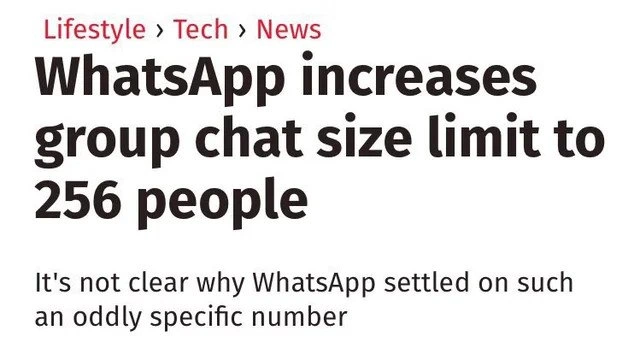
A screenshot of a tech news article with the headline 'WhatsApp increases group chat size limit to 256 people'. Below the headline, a sub-header reads: 'It's not clear why WhatsApp settled on such an oddly specific number'. The article is categorized under 'Lifestyle > Tech > News'. The humor stems from the journalist's complete lack of awareness of basic computer science principles. For anyone in tech, 256 is an instantly recognizable and very common number, as it is 2 to the power of 8 (2^8), representing the maximum value of an 8-bit unsigned integer. This number is fundamental in computing and appears everywhere from character sets to system limits. The joke is the stark contrast between a developer's immediate understanding and the reporter's cluelessness, highlighting a common disconnect between tech and mainstream media

Comments
7Comment deleted
It's a good thing they didn't set the limit to 255. A journalist trying to understand zero-based indexing might cause a singularity
256 isn’t a mystery - it’s the quiet victory of the engineer who convinced product that breaching an uint8 is scarier than shipping sharding on a Friday
Somewhere a WhatsApp engineer is explaining to their PM why they can't just make it 260 because "it would look rounder" and dying a little inside
Ah yes, the mysteriously 'oddly specific' number 256 - truly an enigma wrapped in a riddle, unless you've ever allocated a single byte of memory, worked with RGB color values, dealt with ASCII character sets, or literally written any code that touches hardware. It's almost as if WhatsApp's engineers chose 2^8 for reasons lost to the mists of time, like some ancient civilization's inexplicable fascination with base-2 arithmetic. One can only imagine the heated architectural debates: 'Should we use 255 or 256?' 'Well, do we want zero-indexed or one-indexed suffering?' Meanwhile, tech journalists everywhere remain baffled by this cosmic coincidence, completely unaware that their confusion is itself a perfect demonstration of why we can't have nice things - or accurate technical reporting
256 isn’t oddly specific; it’s “uint8 member IDs” and the last increase that doesn’t require changing the wire protocol - or canceling someone’s weekend
Never attribute to strategy what can be explained by a uint8 masquerading as a product decision
256: the sweet spot where your group chat fits in a uint8_t without risking that inevitable overflow crash