Skip to content
DevMeme
913 of 7435
The Duality of Stupid in Software Engineering
DevCommunities Post #1031, on Feb 20, 2020 in TG

The Duality of Stupid in Software Engineering

Why is this DevCommunities meme funny?

Level 1: Bad Toy or Bad Builder?

Imagine you’re trying to build a big LEGO castle from a kit, but it keeps falling apart. You start to wonder: “Is there something wrong with these LEGO pieces, or am I just bad at building this?” Usually, it’s a little of both. Maybe one LEGO piece was a weird shape and you also missed a step in the instructions. In the end, the castle isn’t working because the pieces weren’t perfect and you made a small mistake.

That’s exactly what coding feels like sometimes. The computer program you’re working on can be hard to understand (like a tricky puzzle piece), and you (the builder) might make a mistake putting it together. The funny tweet is saying that when something breaks, programmers ask if the “pieces” are dumb or if they are — and usually, both the pieces and the builder share the blame. It’s a silly way to say everyone has tough moments figuring things out, and we shouldn’t feel too bad about it. It makes us laugh because we’ve all felt that frustration, whether building a toy or fixing a computer bug.

Level 2: Code or Me Problem?

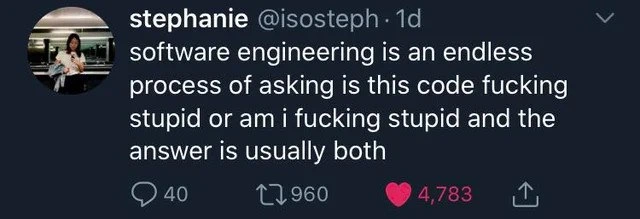
Let’s break down what this meme is saying in plain terms. Software engineering isn’t just about writing new features; a huge part of the job is debugging – finding and fixing things that went wrong. When something breaks, a developer often wonders: “Is the code acting stupid or did I do something stupid?” This is a very relatable humor in programming circles. The phrase “code or me problem” jokingly asks whether the bug is caused by a code mistake or by the developer not understanding something. The tweet claims the answer is usually both. That reflects a common reality: software is complicated and can be written in confusing ways (code stupidity), and at the same time, it’s easy for a person to make mistakes or overlook something (developer stupidity, said with self-deprecating humor).

For example, imagine you’re debugging why a feature isn’t working. The code might have a silly bug (like using the wrong variable name – the code’s “fault”), but you also spent two hours failing to notice that bug (the developer’s “fault”). The meme highlights this endless cycle of doubt. Programmers often alternate between blaming the computer program (“This language or library must be broken!”) and blaming themselves (“I must be too dumb to catch this!”). In reality, problems often come from a mix of both bad code and simple human oversight. Even an experienced developer with strong DeveloperExperience_DX gets stuck in this loop occasionally.

This meme being a Twitter screenshot with thousands of likes and retweets shows how widespread these feelings are. The numbers (40 replies, 960 retweets, 4,783 likes) mean many other developers replied “OMG so true!” or shared it, because they’ve all been there. The DeveloperFrustration and head-banging moments during debugging are near-universal. It’s basically describing the imposter syndrome many developers feel – a mental state where you doubt your own skills. You fix one bug and then find another, and you start wondering if the codebase is fundamentally messed up or if you’re just not smart enough to handle it. The meme reassures us with a smirk: it’s usually a bit of both. The code might be written in a confusing way (hello legacy code or weird APIs), and you might be tired or missing some context. Realizing that even experienced engineers feel this way normalizes the anxiety and makes it a bit easier to laugh off. After all, debugging sometimes feels like detective work where both the culprit (the bug in code) and the detective (you) are stumbling in the dark – no wonder it can get messy!

Level 3: Stack Overflow of Self-Doubt

In the trenches of debugging, every seasoned developer has faced that shamefully familiar thought loop: “Is this code f*cking stupid or am I f*cking stupid?” The meme nails it: debugging often feels like an infinite loop of mutual blame between you and the code. And as any battle-hardened engineer will tell you, the answer is usually “both”. Why both? Because real-world projects accumulate technical debt and quirky logic that can make the codebase look downright brain-dead at times — and simultaneously, the exhausted developer staring at it at 3 AM misses something obvious. It’s a double-edged sword of code complexity and human fallibility.

This tweet strikes a nerve in the developer community because it satirizes a daily reality: code can be objectively bad (poorly named variables, confusing control flow, mysterious off-by-one errors) while the person debugging it often feels subjectively bad about themselves. We’ve all inherited a stupid spaghetti code module that some genius (maybe our past self) wrote under deadline pressure. When it inevitably breaks, you curse the code’s sanity. But after hours of fruitless debugging, you start cursing your own intelligence: “Am I too dumb to fix this?” It’s the classic debugging existential crisis. This emotional rollercoaster is practically a rite of passage during on-call troubleshooting sessions and crunch-time sprints.

Importantly, imposter syndrome thrives in these moments. Even senior devs with years of experience secretly have that gut-wrenching doubt: “If I were a real programmer, I’d solve this bug in 5 minutes, right?” Meanwhile, the code is indeed doing something dumb — maybe an edge case nobody thought of or a silent failure due to a config file typo. Thus the painful truth: the code is kind of stupid and you did overlook something. As the tweet humorously implies, software engineering often means holding two truths at once: the system is flawed and so are we. This shared humbling experience is why 4,783 people smashed the heart on that tweet — it’s cathartic to see our developer frustration so accurately distilled. In an industry obsessed with genius and productivity, there’s comfort (and dark humor) in admitting that some days we’re all just debugging in the dark, alternating between yelling at the machine and facepalming at ourselves.

Description

This image is a screenshot of a viral tweet from the user stephanie (@isosteph). The tweet, set against a dark blue background typical of Twitter's night mode, reads: 'software engineering is an endless process of asking is this code fucking stupid or am i fucking stupid and the answer is usually both'. The post shows engagement metrics of 40 comments, 960 retweets, and 4,783 likes. The text captures a deeply relatable sentiment for software developers at all experience levels. The humor lies in its blunt honesty about the cyclical nature of self-doubt and frustration inherent in coding. It perfectly encapsulates the feeling of wrestling with a complex, poorly documented, or simply badly written piece of code (legacy or even your own from last week), where it's impossible to distinguish between the code's deficiencies and one's own inability to understand it
Comments

7
Anonymous ★ Top Pick The two hardest problems in computer science are cache invalidation, naming things, and figuring out if you're the reason the CI/CD pipeline has been red for the last hour
  1. Anonymous ★ Top Pick

    The two hardest problems in computer science are cache invalidation, naming things, and figuring out if you're the reason the CI/CD pipeline has been red for the last hour

  2. Anonymous

    Git blame is just the moment you realize you’ve been pair-programming with every past version of yourself - and none of you passed the code review

  3. Anonymous

    After 20 years in this industry, I've learned the real question isn't whether the code or I am stupid - it's which one of us will be easier to refactor

  4. Anonymous

    The real O(n²) complexity in software engineering isn't nested loops - it's the quadratic growth of self-doubt as you simultaneously question both your code's intelligence and your own, only to realize through painful experience that they're not mutually exclusive conditions. It's Schrödinger's competence: your code exists in a superposition of 'elegant solution' and 'technical debt' until a senior engineer collapses the wave function during code review

  5. Anonymous

    Seasoned answer to “is the code wrong or am I?”: it’s a split-brain cluster - the spec, the implementation, and your mental model are in different partitions; prod forms quorum at 3 a.m

  6. Anonymous

    Senior debugging workflow: blame the code, blame myself, then git blame and realize it’s past-me plus a stale config under eventual consistency

  7. Anonymous

    After 20 years, you realize the code's 60% stupid, you're 60% stupid - perfect overlap for distributed systems consensus

Use J and K for navigation