Skip to content
DevMeme
2358 of 7435
WhatsApp's Privacy Policy: The Brutally Honest Remix
DataPrivacy Post #2621, on Jan 17, 2021 in TG

WhatsApp's Privacy Policy: The Brutally Honest Remix

Why is this DataPrivacy meme funny?

Level 1: Secrets and Clues

Imagine you have a special secret letter that you want to send to your friend. You and your friend have a magical lockbox: you put the letter inside, lock it with a key only you two have, and give it to the mailman to deliver. The mailman (let’s call him WhatsApp) can’t open the box, so he can’t read your secret letter – that part is safe. This is like WhatsApp’s promise that your messages and calls are private: they’re all locked up so no one in the middle can peek at the secrets.

But here’s the catch: even if the mailman can’t read the letter, he can see some clues on the box. He sees who it’s going to, who sent it, and the time it was sent. He might notice you send a box to this friend every single day at 5 PM. He might even keep a little notebook of these deliveries. He could tell another person (say, his boss or a business) that you have a pen pal and you mail something every day. In our story, you might not want everyone to know that you’re writing to that friend so often – that’s personal info too!

Now, WhatsApp originally gave a flyer saying: “We keep your messages safe and private.” That sounds like “We won’t open your secret letter.” And that’s true – they have a good lock on it. But the funny meme adds subtitles like a cheeky friend whispering, “Yeah, they don’t read it, but they do tell others who you’re writing to!” It’s as if your mom promises, “I won’t read your diary,” but then asks your sibling to report who you’re texting and when. You’d feel that’s a bit sneaky, right? The meme is joking that WhatsApp’s promises are kind of like that. They protect the content of your messages (your diary pages stay closed), but they still share some facts about your activities (like the diary’s cover and when it’s opened) with others.

So the reason this meme is funny – even if it’s a bit of a facepalm kind of funny – is because WhatsApp is patting itself on the back for not peeking at secrets, while quietly lots of hints about those secrets are being passed around. It’s like someone saying, “I won’t eat your cookies,” and then you find out they’re just giving those cookies to their friend instead. For users, it’s a reminder that “private” doesn’t always mean completely private. And for developers and tech-savvy folks, it’s an “I knew it!” moment – they always suspected that while one hand locks the box, the other hand is writing things in a logbook. In the end, the meme uses a simple trick (green promises and snarky subtitles) to show that what’s said isn’t the whole story. It makes us laugh a little because we realize we should always look for the clues, not just the big bold promises, when someone says, “Trust me, your secrets are safe.”

Level 2: The Unencrypted Parts

Now let’s explain the key ideas in a simpler way. WhatsApp is telling users that their service is very secure and respects your privacy. Two big concepts are important here: end-to-end encryption and metadata. We’ll break those down and see why developers are still skeptical despite the promises.

  • End-to-End Encryption (E2EE): This is a technology that WhatsApp uses to protect message content. Imagine you write a message to a friend – your app scrambles (encrypts) the message using a special key before sending. Only your friend’s app has the matching key to descramble (decrypt) it. This means that when the message is traveling over the internet or sitting on WhatsApp’s servers waiting for delivery, it looks like nonsense to any outsider. Neither WhatsApp nor Facebook (which owns WhatsApp) can read that scrambled text or hear your call audio; only you and the person you’re talking to can understand it. This is what WhatsApp means by saying it “cannot see your private messages or hear your calls.” It’s a genuine privacy feature — content stays secret between you and the recipient. This has become a standard in messaging apps concerned with Security. So far, so good. However, it’s crucial to understand what E2EE doesn’t cover: that’s where metadata comes in.

  • Metadata (the Unencrypted Parts): Metadata is essentially data about the data. In the context of messaging, even if the content of your chats is locked up by encryption, the following information usually is not encrypted (because the system needs it to function): who you talk to, when you talk, how often you open the app, your phone number, your contacts, and possibly your location or device info. Think of it like an envelope for a letter: E2EE protects the letter inside (the message text), but the envelope still has addresses and a postmark on it (that’s metadata). WhatsApp’s servers handle delivering messages, so they inevitably see, for example, “User A sent a message to User B at 3:45 PM”. They might not keep a permanent record of the message content or even store that “envelope” info forever, but at least temporarily, they do know who you’re messaging and when. The flyer’s claim “does not keep logs of who everyone is messaging or calling” sounds like they don’t save this connection info. A newbie developer might think that means no data about your communication is retained. But in practice, WhatsApp can’t run the service without some logging or processing of that info — even if they don’t keep it in traditional logs, they might use it in real time for things like delivering calls, preventing spam, or syncing with Facebook’s systems. And importantly, WhatsApp is part of Facebook’s larger business. Facebook makes money by showing ads and suggesting connections based on user data. So even if WhatsApp itself isn’t handing out your chat histories, it’s widely believed (and confirmed by WhatsApp’s own policy updates) that they share certain details (like your account ID, your phone number, your list of WhatsApp contacts, and usage patterns) with Facebook. That’s one way Facebook can connect the dots between your WhatsApp usage and your Facebook profile or Instagram activity. Developers call this data sharing – and it’s why the meme jokes that WhatsApp might not keep logs, but “we share them with third parties” (i.e., others like their parent company or partners do get that data).

  • Privacy vs Reality – A Developer’s Take: The meme basically lists WhatsApp’s promises and then subverts them. For example, WhatsApp says “groups remain private.” In real terms, groups are intended to be private discussions among invited members, and the messages in groups are indeed encrypted like any other message. But there are a few catches. One, the app knows which people are in a group (otherwise it couldn’t deliver the messages), so that group membership info isn’t a secret. Two, earlier in 2020, it came out that invite links for WhatsApp groups could be found via Google search if they were shared somewhere public. That meant some supposedly private groups could be joined by strangers who found the link – a big privacy oops. Third, even with encryption, if any member of the group leaks messages (say, by showing their screen or backing up chat and it gets out), the privacy is broken. So “except they don’t” in the meme is summarizing all those ways group chats might not be as private as advertised. Another point, “You can set your messages to disappear,” refers to a feature WhatsApp added where you can have messages auto-delete after a set time (like 7 days). This is a nod to privacy – it limits how long the conversation lives. But a junior dev or user should note: disappearing messages can be saved by the recipient (through screenshots, copying text, or other means) and might not disappear from all places (for instance, if the chat was included in a backup before deletion). It’s a convenience feature, but not a guarantee that your messages leave no trace. And “You can download your data” is something many services offer now – you request a file with your account info. WhatsApp’s version of this will include things like your profile photo, settings, and the list of contacts/groups – but notably, it won’t include the content of your messages (those are on your phone, encrypted, or already deleted if ephemeral). Also, it likely doesn’t include all the behind-the-scenes data like connectivity logs or any analytics they’ve derived. That’s why the meme adds “not all but some,” implying you’re only getting a partial picture of your data.

  • Why developers are sarcastic about this: In the tech world, we have a saying: “If you’re not paying for the product, you are the product.” WhatsApp is free and has to justify a ~$19 billion acquisition by Facebook – obviously, it’s going to integrate with Facebook’s broader data ecosystem. Security vs Usability is another concept relevant here: maximizing privacy (security) often reduces convenience or features (usability). For example, if WhatsApp truly never kept any info about who you contact, it might not be able to quickly deliver messages, block spammers, or suggest group invites. To make the app robust and user-friendly, they compromise a bit on absolute privacy. So from a developer’s perspective, WhatsApp’s flyer was technically accurate in parts (yes, the encryption is solid) but also a bit misleading by omission. The meme is pointing out those omissions – especially the role of metadata collection and data sharing with Facebook/others that wasn’t highlighted in the pretty graphic.

In simpler terms, this level of analysis just wants you to understand that “private messages” doesn’t equal total privacy. WhatsApp (and any similar service) still knows who you talk to and when, even if they don’t read what you said. Those bits of data – the unencrypted parts – can still be very revealing. That’s at the heart of why this meme is funny to developers: it’s calling out the difference between what users think privacy means and how the system actually works. It’s a caution that just because a company says “we protect your data,” you should ask “which data, and how?” Often it turns out they protect one aspect (message text) but utilize another (metadata) to their advantage. The meme gives a voice to that realization in a tongue-in-cheek way.

Level 3: Marketing vs Metadata

This meme lands especially well with developers who have witnessed the gap between corporate marketing claims and real data practices. On the surface, WhatsApp’s flyer uses reassuring language about privacy – all those green checkmarks and promises sound like a dream for user DataPrivacy. But the black subtitles reveal what an experienced engineer or a skeptical user might suspect: much of that promise has fine print. The humor comes from the juxtaposition of each official claim with a blunt translation of what’s really happening behind the scenes. It’s a classic case of marketing vs. reality in tech, and anyone who’s worked in security or read a privacy policy’s footnotes will smirk at how spot-on it is.

Let’s break down a few of these points the meme satirizes:

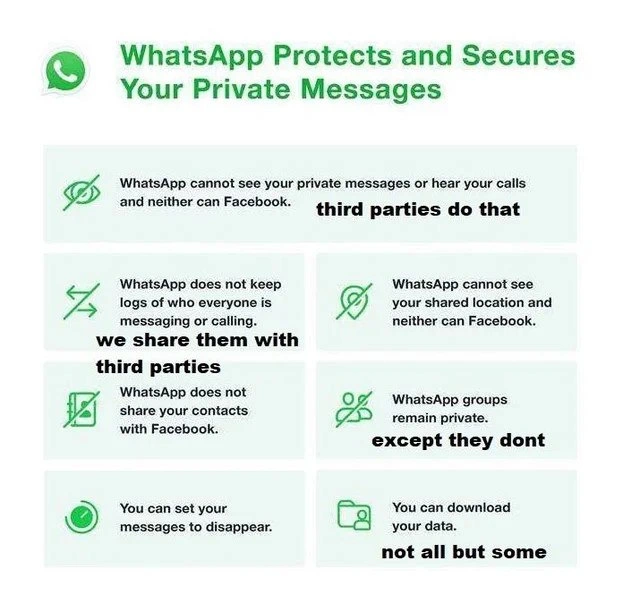
  • “WhatsApp cannot see your private messages or hear your calls and neither can Facebook.”
    Brutally honest subtitle: “third parties do that.”
    What’s going on: WhatsApp touts its use of end-to-end encryption here – a genuine security feature. The app truly can’t read your message content as it passes through their servers. But the subtitle quip “third parties do that” captures the developer cynicism that someone else might have access to those messages anyway. It’s pointing to issues like cloud backups or external tools. For instance, many users back up WhatsApp chats to external cloud services. As a result, even if WhatsApp isn’t reading your chats, Apple’s iCloud or Google’s servers might now hold an unencrypted copy (depending on settings). Those companies (or anyone who breaches them or subpoenas data from them) become the “third parties” who can see your private messages. Developers in the security field remember cases where encrypted messaging apps were undermined by such metadata leaks or backups – so the meme jokingly awards the snooping job to third parties. It’s a snarky way of saying: “Sure, WhatsApp doesn’t spy on you, but that doesn’t mean others can’t via other channels.” There’s also a nod to how law enforcement or spy agencies might target the endpoints (the phones) with malware to read messages – again, not WhatsApp itself, but still a third party reading your supposedly private chats. In essence, the user expectation of absolute privacy has an Achilles’ heel outside the core app, and devs know it.

  • “WhatsApp does not keep logs of who everyone is messaging or calling.”
    Brutally honest subtitle: “we share them with third parties.”
    What’s going on: This claim is meant to reassure users that WhatsApp isn’t hoarding a giant database mapping out all your interactions. But every developer who’s dealt with server logs or analytics raises an eyebrow here. The subtitle suggests that even if WhatsApp isn’t storing logs long-term, the information about who contacts whom doesn’t just evaporate – it’s being handed off elsewhere. The mention of “third parties” might include the parent company (Facebook is technically a first-party in the corporate family, but from a user perspective it’s an outside entity grabbing data), as well as various analytics and tracking services. Insiders know that modern apps rely on a web of integrated services: crash reporters, usage analytics, spam detection systems, etc. It’s quite possible that WhatsApp forwards metadata (like contact graphs or call durations) to other systems for analysis. The meme essentially cries out: “You might not keep the logs, but you give the logs to someone who will!” There’s an element of bitter humor for developers: many have been in meetings where privacy was discussed, and a product manager says, “We don’t store this sensitive info,” but then it turns out the info goes into a Kafka stream -> Big Data pipeline -> machine learning service. It’s not in a “log file” per se, but it’s certainly kept and used. For context, around the time of this meme (January 2021), WhatsApp’s updated privacy policy made headlines because it explicitly allowed sharing certain metadata with Facebook and its partners (like your account info, who you’ve been messaging, device details, etc.). So the dev community saw that and immediately translated “does not keep logs” into “they probably feed all that info into the Facebook data machine instead.” The trust in that claim was low, and this meme captures that mistrust.

  • “WhatsApp does not share your contacts with Facebook.”
    (Implied subtitle: skepticism).
    What’s going on: This line from the flyer addresses a very specific user fear: that WhatsApp would upload your entire phone address book to Facebook. The company insisted it doesn’t do that – likely they mean they don’t give Facebook the list of all phone numbers in your contacts outright. A seasoned dev knows this is a carefully worded promise. The meme doesn’t show a black subtitle here, but the eye-roll among developers was real. Why? Because even if WhatsApp isn’t literally sending a .csv of your contacts to Facebook, the integration between the services can achieve the same outcome via different means. For example, WhatsApp users are identified by phone number. Facebook could already have your phone number (from your Facebook profile or Instagram, or if someone else uploaded their contacts to Facebook and you were in it). By linking accounts behind the scenes, Facebook might figure out “Oh, this WhatsApp account with number +1234567890 is the same person as this Facebook user who added that number for 2FA.” Now they technically haven’t imported your address book, but they’ve connected the dots between your WhatsApp identity and Facebook identity. That enables all sorts of data blending – like recommending you Facebook friends based on WhatsApp contacts or targeting ads because you talk to certain businesses on WhatsApp. Developers reading that line might recall other instances of “we do not share X” being a half-truth: the data can be matched via hashed identifiers or accessed by “affiliates” rather than “third parties,” etc. In other words, WhatsApp could claim “we don’t share your contacts” while still leveraging the fact that you have contacts for Facebook’s benefit. The meme’s silence on this point (no obvious subtitle) is almost its own ironic statement – perhaps the meme creator thought the claim was self-discrediting given the climate of distrust. In any case, the overall sentiment is that marketing-speak is at play, and developers recognize the pattern of carefully orchestrated statements that skirt around full disclosure.

  • “WhatsApp groups remain private.”
    Brutally honest subtitle: “except they don’t.”
    What’s going on: Group chats are advertised as private spaces – only members should see the messages. And indeed, WhatsApp’s group messages are also end-to-end encrypted (each member’s app has the keys). However, the cynic subtitle “except they don’t” reflects known quirks and incidents that undercut this promise. One infamous example: not long before this meme, it was discovered that WhatsApp group invite links were being indexed by search engines. If someone created a shareable invite link for a group (say, to invite new members easily) and that link got posted on a public website, Google could index it. This meant random people could find some group links via search and potentially join private groups uninvited. That’s a pretty literal case of groups not remaining private. WhatsApp scrambled to fix that (by adding noindex tags to those pages), but the incident stuck in developers’ minds. On a more fundamental level, “groups remain private” ignores that the server still knows which phone numbers are in a group together (necessary for message delivery). That group membership metadata could be sensitive (imagine a group for a medical condition or a political activism cell – being known as a participant is revealing even if messages are secret). And if any one member of a group is compromised (their phone is taken over or they share screenshots), the group’s content is no longer private. Developers know that security is as strong as the weakest link: one careless or malicious participant can copy-paste chat logs. So the meme bluntly saying “except they don’t” is the jaded dev view that “in practice, assume group chats leak one way or another.” It’s an acknowledgment of the real-world security failures that often happen despite official guarantees.

  • “You can set your messages to disappear.” (No sarcastic subtitle given, but implied skepticism.)
    What’s going on: Disappearing messages (ephemeral chats) are touted as a privacy feature: you can make messages auto-delete after a set time. It’s a neat idea to minimize trace. But a developer will note the limitations: Are those messages truly gone? What if the recipient took a screenshot or had auto-backup on? Many apps introduced this feature due to user demand (and competition from apps like Snapchat), but there’s an inherent Security vs Usability trade-off. If messages vanish too quickly, users might lose important info; if the vanish period is long, it barely helps privacy. WhatsApp set it to something like 7 days by default – enough that users might forget messages will go poof. Also, ephemeral messages don’t prevent someone from simply copy-pasting the content before it’s gone. So while no black text subtitle was provided, the dev community’s inner voice might be: “Sure, you can make messages disappear on your screen, but there’s no guarantee they disappear from everywhere.” It’s a light feature, not a hardcore security tool, and tech folks know it. The presence of this point in the flyer felt a bit like padding the stats: “See, we have disappearing messages, we care about privacy!” – while a dev smirks knowing that’s not foolproof.

  • “You can download your data.”
    Brutally honest subtitle: “not all but some.”
    What’s going on: This refers to the ability for a user to request or export their data – a nod to transparency and regulations (like GDPR’s right to data portability). On paper, WhatsApp letting you download your data sounds empowering. But the meme points out that what you get is incomplete. A typical WhatsApp data download might include your profile info, groups, contacts, and some settings. It won’t include your message history (since that’s end-to-end encrypted and stored on your device, not their servers) and it definitely won’t include internal logs or analytics about you that Facebook Inc. has gleaned. The subtitle “not all but some” reflects the developer awareness that these data export tools often give you a thin slice of information – just enough to meet legal requirements, perhaps, but not the whole picture of what’s collected or inferred. It’s like a restaurant giving you a copy of the menu when you ask what’s in the secret sauce – you get something, but not the recipe. Developers who have implemented similar features know companies often exclude things like algorithmic scores, detailed activity logs, A/B test data, etc., from these downloads. So that line resonates as a sardonic “Yes, users can technically get their data, but it’s just the tip of the iceberg.”

Across all these points, the underlying humor is a mix of sarcasm and shared industry cynicism. The meme creator (and the developers laughing at it) are highlighting how user expectations have been managed with half-truths. WhatsApp’s flyer was a PR move after their privacy policy update caused uproar – early 2021 saw many users (and devs) flocking to alternative messengers like Signal or Telegram out of fear that WhatsApp would feed more data to Facebook. The official response was this kind of infographic to calm people down: reassuring everyone that “Your messages are still private, we’re not spying on you,” etc. But at that point, trust was thin. Developers in particular, familiar with Facebook’s track record (Cambridge Analytica, anyone?), were inclined to disbelieve anything short of an open-source audit. The sarcastic subtitles in the meme are basically the dev community saying, “We know how to read between the lines.” It’s darkly funny because it’s true — each green claim has a caveat that’s as important as the claim itself.

In summary, at this senior perspective, the meme is calling out the contrast between WhatsApp’s marketing and its actual data practices. It highlights known issues like metadata collection, Facebook data sharing, and functionality that undermines privacy (cloud backups, group link leaks). It’s humorous precisely because it’s brutally honest: developers often joke that "free services aren’t really free – you pay with your data." Here, WhatsApp proclaims privacy, but the dev joke is that behind the scenes, your data is still being used in other ways. The laughter (tinged with frustration) comes from recognizing those half-truths. For any programmer or security analyst, this meme is a reminder that “private message” doesn’t mean the service knows nothing about you — it just means they focus on what they don’t collect to appease users, while quietly profiting from what they do collect. It’s both a cautionary chuckle and a nod of commiseration among tech folks who’ve seen this pattern over and over.

Level 4: Encryption’s Blind Spot

At the deepest technical level, this meme pokes fun at the limits of end-to-end encryption and the inescapable trail of metadata left behind. WhatsApp’s messaging uses robust cryptography (the famed Signal Protocol) to ensure that message content is encrypted on the sender’s device and only decrypted by the recipient. This means neither WhatsApp’s servers nor its parent company (Facebook) can decipher your actual text or listen to your calls in transit. In cryptographic terms, WhatsApp generates unique public-private key pairs for users and employs a Double Ratchet algorithm to constantly rotate keys, making intercepted messages computationally impractical to decode. So far, so good – the green checkmark promises (“WhatsApp cannot see your private messages or hear your calls, and neither can Facebook”) are technically true for content, thanks to this end-to-end encryption (E2EE).

However, encryption has a blind spot: it doesn’t protect the context of the communication. Metadata – the data about your data – remains visible to the service. To route an encrypted message to your friend, WhatsApp’s servers must know who’s messaging whom, when, and often from where. These details (phone numbers, timestamps, IP addresses, the fact that you’re in a certain group, etc.) are not encrypted end-to-end. It’s a fundamental trade-off in distributed systems and network protocols: a centralized service can’t deliver messages without knowing the addresses. Unless an app re-engineers itself as a decentralized, onion-routed, or mix-net system (sacrificing speed and simplicity), some metadata inevitably leaks. WhatsApp, like most user-friendly messengers, opts for central servers for reliability – meaning the server inherently sees the social graph of who talks to whom. In security research, this is sometimes summarized as “E2EE hides content but not the envelope.” No matter how unbreakable the cipher, the pattern of your communications (the who, when, how often, how long) can paint a surprisingly intimate picture. In fact, intelligence agencies often say, “We don’t need to read your messages; metadata tells us enough,” highlighting that this metadata collection can be just as invasive.

This meme’s brutally honest subtitles expose that blind spot. Each cynical subtitle hints at ways user data sneaks out around encryption. For example, “third parties do that” jabs at the fact that while WhatsApp itself might not peek at messages, others might. Consider device backups: for years, WhatsApp encouraged cloud backups of chats (to Google Drive or iCloud) without end-to-end encryption. Those backups are essentially plaintext copies of your messages stored on third-party clouds – which could be accessible to entities like Apple, Google, or anyone with legal access to those cloud accounts. In effect, a third party could indeed “see your private messages” if they obtain the backup. Similarly, if a user reports a message as abusive, WhatsApp can receive an unencrypted snippet (they designed the app to forward the last few messages to moderators upon user reporting). So while the encryption claim is true in transit, the system intentionally provides side-doors for content moderation or convenience, involving parties beyond just the sender and receiver.

Another hidden reality is how WhatsApp’s business model leverages metadata. The platform famously doesn’t use ads in chats, but as part of Facebook it shares identifiers and usage patterns to enable things like friend suggestions, personalized ads on Facebook, or enabling businesses to reach you. The privacy policy updated in early 2021 explicitly allowed more data sharing with Facebook’s ecosystem – not the message content, but plenty of other data. So when the flyer insists “WhatsApp does not keep logs of who everyone is messaging or calling,” a seasoned engineer reads between the lines: even if WhatsApp doesn’t store long-term logs on their own servers, they inevitably process that data in real time and likely hand it off to analytics systems or partners (ahem, Facebook). Indeed, they may avoid saying “store logs” (perhaps they buffer events and stream them to a data warehouse instead – a linguistic loophole), but the social graph of your contacts is the real gold mine. By correlating who you talk to (and how often), a service can infer your relationships, interests, and even activities (talking to a doctor, a lawyer, certain support groups – all reveal personal information without needing message content). This metadata is essentially Facebook’s treasure trove: it feeds recommendations and ad targeting algorithms. The meme’s subtitle “we share them with third parties” under the no-logs claim hits this nail on the head – hinting that those messaging and calling patterns don’t just vanish; they find their way into someone else’s hands (affiliates, advertisers, or authorities).

From a security engineering perspective, the meme underscores that privacy isn’t absolute just because encryption is present. Effective privacy must cover not only content but also who interacts with whom – a much harder problem. Truly concealing metadata might require advanced techniques like metadata-resistant protocols, but these are notoriously challenging (they’d need to introduce artificial delays, dummy traffic, or peer-to-peer relays like Tor does, which would cripple WhatsApp’s speed and usability). WhatsApp doesn’t implement those, so metadata remains a leaky faucet. The Security vs Usability tension is evident: to keep an app easy and fast for a billion users, they compromise on absolute privacy. Features like “disappearing messages” add some privacy by auto-deleting chat history, but even those are voluntary and limited – if recipients take screenshots or if chats are backed up before vanishing, the messages haven’t truly disappeared. And while WhatsApp lets you download your data (to comply with data portability regulations), the meme wryly notes it’s “not all but some.” Indeed, a data export might give you basic account info and settings, but likely omits the rich analytics and metadata that the company has internally. As any developer knows, data that a company shares back to users is often just the tip of the iceberg compared to what’s collected. In summary, the deepest layer of this meme is about the architectural and cryptographic reality that even with strong encryption, user privacy has layers of exposure – a reality that seasoned developers and security researchers recognize behind the upbeat marketing.

Description

The image displays what appears to be an official infographic from WhatsApp titled 'WhatsApp Protects and Secures Your Private Messages.' The graphic is laid out in a clean, two-column grid with various privacy features listed. However, several of these claims have been sarcastically edited with bold, black text to contradict the original statements. For example, 'WhatsApp cannot see your private messages... and neither can Facebook' is amended with 'third parties do that.' Similarly, 'WhatsApp does not keep logs...' is altered to add 'we share them with third parties,' 'WhatsApp groups remain private' gets 'except they dont,' and 'You can download your data' is modified to 'not all but some.' This meme is a sharp critique of the perceived gap between the privacy marketing of large tech companies like WhatsApp (owned by Meta/Facebook) and the reality of their data practices, reflecting the deep-seated skepticism within the tech community about how user data is truly handled, shared, and monetized
Comments

12
Anonymous ★ Top Pick WhatsApp says it can't read your messages, and that's technically true. It's like saying you can't read a book; you just hired a thousand 'third party' contractors to read it for you and give you the cliff notes on what ads to sell
  1. Anonymous ★ Top Pick

    WhatsApp says it can't read your messages, and that's technically true. It's like saying you can't read a book; you just hired a thousand 'third party' contractors to read it for you and give you the cliff notes on what ads to sell

  2. Anonymous

    “Zero-knowledge” at WhatsApp apparently means they know zero about your message text - just who, when, where, how long, device fingerprint, and emoji entropy… you know, the only fields the graph DB actually indexes

  3. Anonymous

    End-to-end encryption is like having a perfectly secure tunnel between two points, except the tunnel owner installed glass walls, a gift shop at each exit, and a metadata harvesting operation that would make the NSA jealous

  4. Anonymous

    Ah yes, the classic 'end-to-end encryption' pitch where the encryption is technically sound but the metadata collection is so comprehensive that third parties can reconstruct your entire social graph, communication patterns, and behavioral profile without ever decrypting a single message. It's like saying 'we don't read your diary, we just catalog who you write about, when you write, how often, where you were when writing, and sell that analysis to advertisers.' The engineering is impeccable; the privacy theater is even more so

  5. Anonymous

    WhatsApp E2EE: Messages safe end-to-end, but your contact graph is Meta's unmetered BigQuery pipeline

  6. Anonymous

    WhatsApp: end-to-end encrypts the payload; the metadata’s basically a Kafka topic with third‑party consumer groups

  7. Anonymous

    E2EE is flawless; it’s the metadata ETL to 'partners' that ships over Kafka - Growth calls it personalization, Legal calls it compliance

  8. @feskow 5y

    Don't even start about metadata and privacy

  9. Deleted Account 5y

    They are disappearing for you, not for us

    1. @alexolexo 5y

      When you disable admin privileges for client by hiding admin panel view

      1. Deleted Account 5y

        by commenting out link to admin panel

  10. @feskow 5y

    They disappear for you, not for mine whatsapp hacked client

Use J and K for navigation