Skip to content
DevMeme
2317 of 7435
WhatsApp Whispering Metadata To Facebook
DataPrivacy Post #2576, on Jan 11, 2021 in TG

WhatsApp Whispering Metadata To Facebook

Why is this DataPrivacy meme funny?

Level 1: The Secret Is Not The Words

It is funny because WhatsApp looks like it is whispering secrets to Facebook. The trick is that the secret may not be the actual message you typed. It can be all the stuff around it, like who you talk to, when you talk, and what device you use. It is like sealing a note in an envelope but writing a lot of useful information on the outside.

Level 2: Encrypted But Not Invisible

WhatsApp is a messaging app owned by Facebook, now Meta. End-to-end encryption means that, for normal personal chats, the message content is encrypted so only the sender and receiver should be able to read it. That is a real security feature, not just marketing confetti.

But privacy is bigger than message text. Imagine sending a sealed letter. Nobody can read the paper inside, but the outside of the envelope may still show the sender, recipient, postmark, route, size, and delivery time. In messaging systems, that outside information is called metadata. It can include account identifiers, contact relationships, device details, usage patterns, and interactions with businesses.

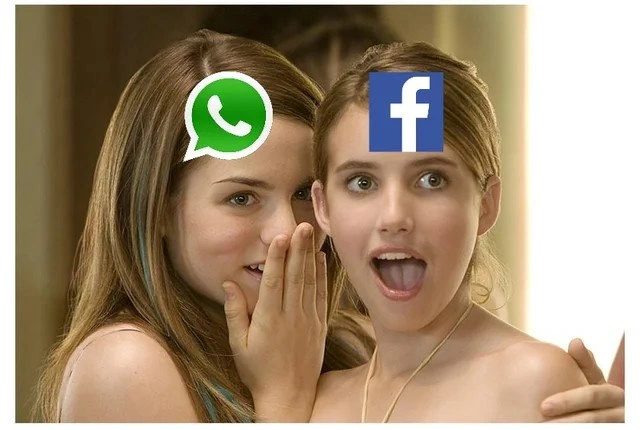
The image turns that idea into body language. WhatsApp is whispering, Facebook is listening, and the joke is that the whisper might not be the message content itself. It could be everything around the message: who uses the service, how they use it, and how that data fits into a bigger social-media platform.

For junior developers, this is a useful distinction. Security features answer specific questions. Encryption answers, “Can someone read this message content?” It does not automatically answer, “Can the platform collect account data?” or “Can two services correlate users?” or “Is the privacy policy understandable enough for normal humans?” That last one usually fails first, then everyone has a meeting.

Level 3: Metadata Whispers Louder

The image shows a whispering reaction meme with the WhatsApp logo placed over the girl doing the whispering and the Facebook f logo placed over the surprised listener. There is no caption in the image, which makes the composition blunt: WhatsApp is quietly telling Facebook something, and Facebook looks delighted to receive it. The local post message, Or may be no, adds a little uncertainty, as if the meme itself is shrugging at the corporate privacy explanation.

This one is strongly tied to its January 11, 2021 posting window. In early January 2021, WhatsApp users were receiving notices about updated terms and privacy policy changes, and the backlash centered on what WhatsApp could share with Facebook. The important technical nuance is that end-to-end encryption protects message content in normal private chats, but it does not magically erase every other kind of data. A service can still collect or process account details, phone numbers, device information, IP-derived location signals, app usage, contacts if uploaded, business interaction data, abuse reports, crash logs, and timing patterns. The payload may be encrypted while the envelope is still very chatty.

That is why the whispering pose works so well. The meme is not showing WhatsApp loudly publishing your messages on a billboard. It is showing a quiet side-channel: one platform passing context to another platform under the same corporate roof. Engineers know this distinction because privacy failures often do not require reading the encrypted text. Metadata can reveal who talks to whom, when they talk, how often, from where, and on what device. In many systems, that is enough to build profiles, recommendations, anti-spam decisions, ad segments, fraud models, and a headache for the privacy team.

The Facebook reaction also captures the corporate-culture layer. When a messaging app is acquired by an advertising giant, users become skeptical of any policy wording that sounds like “we value your privacy” followed by six paragraphs of data categories. Even if the actual change is narrower than the panic suggests, trust is not compiled from legal text. It is built from product history, incentives, ownership, defaults, and whether users believe the company benefits from restraint.

The technical joke, then, is not simply “encryption is fake.” That would be too easy and mostly wrong. The sharper joke is that encryption can be real, strong, and still coexist with extensive data collection around the encrypted channel. The front door may be locked; meanwhile the building logs every visitor, delivery, light switch, and suspiciously marketable sneeze.

Description

A reaction-image meme shows two girls, one leaning in to whisper while the other looks surprised with her mouth open. The whispering girl has the green WhatsApp logo over her forehead, and the surprised listener has the blue Facebook "f" logo over her forehead; there is no other visible written text. In the January 2021 posting context, the image reads as a joke about WhatsApp's privacy-policy backlash and concerns that account data or metadata could be shared with Facebook. The technical humor hinges on the uncomfortable distinction between end-to-end encrypted message content and the surrounding metadata, identity, device, and usage signals that platforms can still monetize or correlate.

Comments

4
Anonymous ★ Top Pick End-to-end encryption protects the payload; the ad model keeps a standing meeting with the metadata.
  1. Anonymous ★ Top Pick

    End-to-end encryption protects the payload; the ad model keeps a standing meeting with the metadata.

  2. @Mukherjee273 5y

    Epic 🤣

  3. @Roman_Millen 5y

    More like Facebook spying on your phone wholly.

  4. @Roman_Millen 5y

    Well, nothing special, aside of (yet) president Trump blocked everywhere, including these two services ¯\_(ツ)_/¯

Use J and K for navigation