Skip to content
DevMeme
2316 of 7435
Programmer's Choice: Unfinished Projects Over Dating
DevCommunities Post #2575, on Jan 11, 2021 in TG

Programmer's Choice: Unfinished Projects Over Dating

Why is this DevCommunities meme funny?

Level 1: Game vs Friends

Imagine you have a brand new video game that you absolutely love playing. It’s super fun and you feel really happy and excited every time you play it. Now, let’s say at the same time, one of your good friends invites you to play outside. You have two choices, kind of like two big buttons in front of you: one button means "keep playing the video game" and the other button means "go play with your friend". In a normal situation, you might feel torn – the game is fun, but you also don’t want to miss out on time with your friend. It’s a tough choice, right?

Now picture in a cartoon, a character has these two buttons in front of them. One says "New video game level" and the other says "Playing with friend". And guess what? The character – let’s call him the gamerslams the video game button immediately with a big grin on his face, not even considering the friend option. In a second panel below, we label that happy, button-smashing character as "Programmers". This is just like saying a programmer is like that gamer who chooses the video game over the friend without hesitation.

Why is this funny? It’s because it’s an exaggeration (we’re showing it in a really over-the-top way) of something relatable: sometimes people pick the fun, comfortable thing (like a game or toy) over the social or responsible thing (like hanging out with others or doing homework). We all know maybe we should spend time with friends and family, but the new fun thing is just so shiny and tempting! In real life, a programmer might choose to do more coding on a pet project instead of going out on a date or seeing friends. The meme makes it silly by showing it as a big obvious button choice – as if the programmer can’t help but press the “code more” button every time. It’s poking fun at programmers a bit, saying, "Haha, these coding folks would rather be with their computers than with people!" It’s like a playful tease.

So, the simple idea is: doing fun coding vs. spending time with a girlfriend is like choosing a video game over playing outside with friends. The meme makes us laugh because the programmer’s choice is so quick and exaggerated. It reminds us of when we or someone we know has done something similar, and we find it funny and a little bit true.

Level 2: Side Project Syndrome

If you’re a newer developer (or know one), this meme’s scenario might already feel familiar. Let’s break down what’s going on in simpler terms and define some jargon along the way. The meme shows a person faced with two choices: starting yet another side project or spending time on their social/romantic life (symbolized by "having a girlfriend"). The punchline is that "Programmers" impulsively hit the side project button. Why is that funny? Because it highlights a kind of quirky habit among developers: having lots of half-finished personal coding projects while maybe not going on many dates or seeing friends as often. It’s poking fun at the stereotype of a programmer who is so absorbed in coding that they neglect other parts of life.

Let’s explain some key terms and ideas here:

  • Side project: This is any programming project you work on outside of your main job or school assignments. For example, building a personal website, a game, or a mobile app just for fun or learning would be a side project. Developers love them because it’s a way to experiment with new technologies or create something of their own. In the meme, the side project is described as “new project that will remain unfinished.” That’s a tongue-in-cheek way of saying the person has started this project with excitement, but chances are high they won’t see it through to completion. And honestly, that’s very common! Many devs have folders or repositories full of projects that started strong and then fizzled out when interest or time ran dry.

  • Unfinished project problem: Why do so many side projects end up unfinished? One big reason is something called scope creep. Scope means the breadth or goals of your project — what you plan for it to do. Scope creep refers to the tendency of those goals to keep expanding over time. Say you set out to code a simple to-do list app. You finish the basics, but then think, "it would be cool if it also had user accounts," then "maybe it should sync to the cloud," then "I should integrate a voice assistant!" Suddenly your simple app’s scope has crept into a huge undertaking. The project becomes much larger and harder to complete. For an individual coding on nights and weekends, that often means progress slows and motivation drops. We call it feature creep when you keep tacking on more and more features. It’s like a snowball growing bigger and bigger – eventually it’s so big you can’t push it any further.

  • Productivity paradox: This phrase sounds fancy, but it’s basically pointing to a funny contradiction: sometimes doing what seems productive can actually be unproductive. In context, a programmer might feel proud that they’re using every spare minute to code (that developer hustle mindset). They might boast, "I’m super productive, I built three apps this month!" But if none of those apps are finished or usable, was that really productive? Or if coding constantly means they’re exhausted and lonely, did it really benefit them? The paradox is that more activity doesn’t always equal better results. In fact, juggling too many projects can mean you don’t fully succeed at any one of them. And spending all your energy on work or projects can sap the energy you need for other important things (friends, rest, health). So the meme ironically shows a programmer pressing the button that says “remain unfinished” — implying upfront that this effort might be a bit futile, but they can’t resist doing it anyway.

  • Procrastination: We usually use this word to mean putting off an important task by doing something else that’s easier or more fun. Developers have a known quirk of creative procrastination. Instead of, say, doing their actual work or errands, they might start tinkering with a new piece of code because it feels productive. It’s procrastination in disguise. Here, choosing the new project could itself be a way to procrastinate on other things (perhaps avoiding going out and socializing, or dodging that really tricky bug in the main project by distracting oneself with a fresh, simpler problem). It’s like telling yourself, "I’m not wasting time, I’m coding!" – but you might be coding the wrong thing. 🙃

  • Work-life balance: This is the concept of maintaining healthy boundaries and time distribution between your work (or study/coding) and your personal life (family, friends, hobbies, rest). It’s something people in tech talk about a lot because it’s easy for programming to turn into a 24/7 affair — especially if programming is both your work and your hobby. In the meme, "Having a girlfriend" represents the life part of that balance (time with loved ones, relationships), whereas the side project represents the work/hobby part. The stark either/or choice in the meme humorously illustrates an imbalanced scenario: all work/hobby, no life. In reality, of course, it’s not an absolute choice — you can have a coding hobby and a relationship. But achieving that balance is tricky and something many new developers eventually have to figure out.

  • Developer lifestyle stereotype: The meme leans on the stereotype that programmers are introverted or so passionate about coding that they prefer computers over people. The image literally shows "Programmers" as this gleeful character hitting the code button, implying we’re all a bit like mad scientists who would rather be in the glow of multiple monitors than on a date. While this is an exaggeration, it resonates because, truthfully, a lot of programmers do spend huge chunks of their free time on the computer. If you’ve ever gotten in “the zone” while coding a project, you know how hours can fly by. Friends might be at a party, but you’re at home happily debugging. That doesn’t mean all coders are recluses with poor social skills, but enough of us have had those nights to make the joke land.

  • Mental health angle: The categories hint at MentalHealth and indeed, there’s a gentle message under the humor. Constantly choosing projects over people can have downsides. Humans generally need social interaction and relationships to stay mentally healthy. If a developer isolates themselves too much (only interacting with code and not with people), it can lead to feelings of loneliness or anxiety in social situations. Also, the pressure to always be doing something "productive" (like coding nonstop) can contribute to burnout or stress. On the flip side, working on side projects can also be a positive creative outlet and a stress relief for many — it’s all about moderation. The meme isn’t a lecture, but it does shine light on this common balancing act: am I coding because I love it, or am I sometimes coding to avoid something or someone? It’s a good thing for junior devs to be mindful of as they grow in the field.

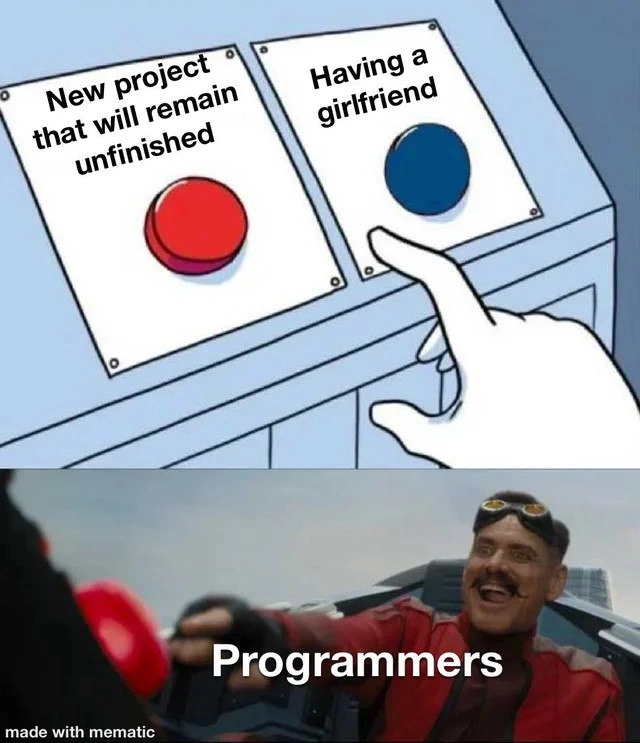
Bringing it back to the meme image: the top cartoon panel with two labeled buttons is a famous meme template for tough choices. Typically, a character’s hand hovers uncertainly between the two options. Here, the choices are humorous: one is essentially “Start another fun coding project (that probably won’t get finished)” and the other is “Go have a romantic relationship (spend time with girlfriend)”. The bottom panel shows a real-life image of someone in a cockpit absolutely smashing the red button with excitement. That person is labeled "Programmers", implying we (programmers) are the ones eagerly hitting the button for the new project. The joke is that for the programmer, this isn’t even a real dilemma — it’s portrayed as an instinctive, split-second decision in favor of coding. The absurdity makes us laugh: obviously, life isn’t so black-and-white, but seeing it depicted this way highlights the pull that coding can have on those who love it. It’s a mix of pride and self-mockery; many developers wear it as a badge of honor that they’re so into coding, but also laugh at themselves for sometimes ignoring the outside world.

In essence, the meme is a light-hearted self-own by developers. It says, "Yep, we know spending all weekend coding instead of going out is a bit ridiculous… but also, have you tried writing a compiler for fun? It’s hard to resist!" For a junior developer, it’s both a funny introduction to a common inside joke and a gentle caution: as you dive deeper into coding, don’t forget to occasionally hit the blue button (the life outside the screen).

Level 3: Commits vs Commitments

The meme cleverly uses the two-button dilemma format to poke fun at a classic developer predicament: coding projects vs personal life. In the top panel, each button represents a choice: one is labeled "New project that will remain unfinished" (the siren song of yet another side project), and the other is "Having a girlfriend" (shorthand for investing time in a relationship or social life). The bottom panel reveals the punchline: a figure eagerly slamming the button for the new unfinished project, labeled simply as "Programmers". The humor lands because it’s an exaggeration rooted in truth—many developers impulsively choose coding over social commitments, often without hesitation.

From a seasoned coder’s perspective, this is painfully relatable satire. We've all felt that electrifying jolt of inspiration at 1 AM: "What if I built my own game engine/library/app from scratch?" Next thing you know, you’ve got a freshly created repository or a new project directory, and hours (or weeks) vanish into that rabbit hole. Meanwhile, texts from friends or date plans languish unanswered. The industry pattern being lampooned here is the never-ending side project loop: developers often have a backlog of half-finished personal projects. Each started with grand ambitions and giddy enthusiasm, only to be abandoned when the next shiny technology or idea comes along (or when the boring parts of finishing set in). This meme labels it upfront: "a project that will remain unfinished"—we know from the start it's doomed to join the graveyard of abandoned code on GitHub.

Why is this so common? A big reason is the allure of novelty and the dopamine rush of creation. Starting a project is pure possibility: you’re playing with a new framework, solving fresh problems, learning cool tricks. It’s exciting. In contrast, maintaining a relationship (or even finishing a project) involves routine, incremental work, and sometimes uncomfortable effort. Shipping a complete product means debugging, writing tests, documentation, fixing edge-case bugs at 3 AM—all the unsexy stuff. Likewise, having a girlfriend (or any partner) means investing time, compromising, doing the effortful work of communication. In short, both finishing projects and building relationships require sustained commitment (there’s the pun: making a code commit vs. making a personal commitment). For a lot of developers, it’s just easier (and immediately rewarding) to hit that git init on a new idea than to venture into the more complex, less certain realm of human relationships.

There’s an implicit nod to the productivity paradox here. Many programmers pride themselves on being "productive" even in their free time—always building something, learning something, hustling. You’d think endlessly churning out side projects is a sign of high productivity. Ironically, if nothing ever gets finished, have you really been productive? It can become a form of procrastination wearing a productive disguise. You feel busy and industrious chasing a new idea, but you might be avoiding something else—could be the drudgery of polishing your current project, or perhaps the vulnerability of social interaction. It’s a paradox: doing more (starting another project) results in accomplishing less (zero finished projects and a neglected social life). Experienced engineers chuckle (and cringe) at this because many have lived that cycle of diminishing returns.

The shared joke in developer culture is that programmers can be fabulously focused on code and a bit clueless or negligent about personal life. It’s not universally true, of course, but it’s a common trope. This meme distills that trope perfectly: the obviousness of the programmer’s choice is the gag. In the classic "two buttons" meme format, the character is usually sweating, unable to decide between two tough options. Here, the twist is there’s no hesitation at all—the dev confidently smashes the red button (new project) as if the other option didn't exist. That comedic subversion signals that for this programmer, there is no real dilemma. The contrast between what outsiders might consider the “healthy” choice (have a social life) and the nerdy choice (more coding) provides the irony.

On a deeper level, this also hints at the work-life balance struggle in tech. Modern software development, especially passionate open-source or startup culture, can subtly encourage the idea that “Real programmers code all night” or that your worth is tied to how many side projects or GitHub contributions you have. New languages, frameworks, and technologies emerge almost daily, tempting developers to try them out ASAP. The result? Even your leisure time turns into an extension of work—always coding, learning, tinkering. Social activities, family, or dating can start to feel like optional side-quests in the game of coding. Senior developers have seen colleagues burn out or become isolated by falling into this trap. They laugh at memes like this, but also nod knowingly because balancing personal life against the endless onslaught of new tech to explore is a real challenge.

There’s a darkly humorous undertone touching on mental health: the meme highlights a form of escapism. It’s safer to lose oneself in a controllable world of code than to face the unpredictability of relationships. Computers are logical, problems have clear solutions (most of the time!), and if your code doesn’t work, you can usually fix it with enough effort. People, on the other hand, don’t come with a debugger. For someone socially anxious or emotionally drained, diving into an unfinished project can be a comforting retreat. The downside, as any battle-hardened dev will tell you, is that too many nights like that and you wake up realizing you haven’t called your friends in months, or pursued that romantic interest, or generally had a life. The meme is funny, but it also kind of points at a genuine issue: the struggle to prioritize self-care and relationships in a field that often glorifies the grind.

In summary, the humor works on multiple levels. Technically inclined folks chuckle at the absurd truism that given the choice between a new coding adventure and anything else, the coder brain screams “let’s code!” Everyone remembers their own “red button” moments — like choosing to refactor an app on a Saturday night instead of going to that party. It’s a form of community catharsis to laugh about it. And perhaps buried in the laugh is a little nugget of “yeah, I really should call my girlfriend back (or get one in the first place)”. But hey, no time for that now — there’s always a new project waiting! 🚀

Description

A two-panel meme illustrating a common developer stereotype. The first panel uses the 'Two Buttons' meme format, presenting a choice between a red button labeled 'New project that will remain unfinished' and a blue button labeled 'Having a girlfriend'. A finger is shown hovering over the blue button but ultimately moving towards the red one. The second panel shows the character Dr. Robotnik from the Sonic the Hedgehog movie, labeled 'Programmers', gleefully and emphatically slamming the red button. The joke satirizes the tendency for programmers to get excited about starting new side projects, often at the expense of their social or romantic lives, even with the self-aware knowledge that these projects will likely be abandoned

Comments

8
Anonymous ★ Top Pick My GitHub is a graveyard of brilliant ideas, each one a monument to a weekend I could have spent dating. At least the READMEs are immaculate
  1. Anonymous ★ Top Pick

    My GitHub is a graveyard of brilliant ideas, each one a monument to a weekend I could have spent dating. At least the READMEs are immaculate

  2. Anonymous

    Every quarter I add “start dating” to my personal OKRs, immediately spin up another half-baked Rust CLI, mark the relationship epic as WONTFIX, and call it agile prioritization

  3. Anonymous

    The real relationship status of senior engineers isn't 'single' or 'taken' - it's 'in a committed polyamorous relationship with 47 half-finished GitHub repos, each promising to revolutionize something but actually just reimplementing a todo app with the framework-of-the-week.'

  4. Anonymous

    Every senior engineer knows the real technical debt isn't in the codebase - it's the 47 half-finished side projects in your GitHub repos, each representing a weekend where you chose 'learning Rust/Go/Zig' over human interaction. The red button isn't just a choice; it's a lifestyle where your commit history is more active than your dating profile, and your most committed relationship is with your IDE's dark theme

  5. Anonymous

    Of course we hit “new repo” - it has zero stakeholders, instant dopamine from git init, and trivial rollback; relationships demand strong consistency, 24/7 SLOs, and a PR that never closes

  6. Anonymous

    Smash the “new side project” button - loose SLAs, eventual consistency, and a perpetual 0.1.0‑alpha means no Sev-1s when it never ships

  7. Anonymous

    Wise architects know: the ultimate sunk cost fallacy is starting another cathedral project you'll never finish

  8. @metalmatt 5y

    Ha ha classic

Use J and K for navigation