Skip to content
DevMeme
1158 of 7435
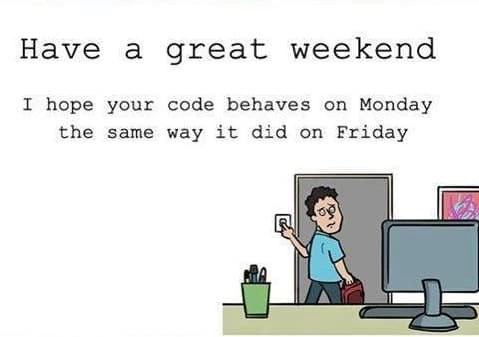
The Developer's Weekend Wish
Bugs Post #1292, on Apr 11, 2020 in TG

The Developer's Weekend Wish

Why is this Bugs meme funny?

Level 1: The Monday Surprise

Think of it like this: On Friday, you built a nice sandcastle at the beach and left it standing proudly. You go home for the weekend. By Monday, you come back and really hope that sandcastle is still exactly how you left it. But you’re a little worried, right? Maybe some waves, wind, or a pesky seagull knocked part of it down while you were away. In a child’s world, it’s like hoping your stack of blocks or your puzzle stays perfectly put together when you’re not in the room. That tiny worry in your stomach — “I hope nothing messed it up while I was gone” — is exactly how a developer feels about their code over the weekend. We joke about it, saying “Have a good weekend! I hope the code doesn’t secretly fall apart by Monday,” because it’s a funny way to deal with that anxious feeling. It’s both a friendly wish and a playful tease, since normally nothing should change… but if it does, Monday morning might be a bit of a mess.

Level 2: It Worked on Friday

Let’s break down why this meme is so relatable to anyone who’s written or deployed code. On Friday, our developer hero finished work, turned off the office lights, and left a program running that seemed completely fine. All the tests passed, no errors were popping up, and everything looked stable in the production environment (that’s the live system where real users or data are). Fast-forward to Monday morning: there’s a nervous hope that when they turn everything back on, the software will still run smoothly, exactly as it did before the weekend. The meme’s wish “I hope your code behaves on Monday the same way it did on Friday” speaks to that hope — and the underlying fear that things might go wrong when you’re not watching.

Why could code that worked on Friday suddenly have issues on Monday? A few common reasons that even junior devs quickly learn about:

  • Environment changes: The servers or machines running the code might have gotten updates or changed settings over the weekend. For example, maybe an operating system update or a scheduled task (like a database cleanup or a log rotation) ran on Sunday. If the code wasn’t prepared for that, it might act differently on Monday. This kind of change is called environment drift — when the setup gradually changes over time without an obvious, single cause that developers explicitly introduced.
  • Hidden bugs: Sometimes software has bugs that don’t show up right away. Maybe the bug only appears after the program has been running for 48 hours non-stop, or only when a specific condition occurs (like the date changing to a new week, or the first day of the month, etc.). A classic example is a memory leak – a bug where the application slowly eats up more and more memory the longer it runs. It might not crash in 8 hours on Friday, but after running for two days, it could run out of memory. Come Monday, the program could be struggling or have crashed overnight. Surprise! Now you have to figure out why.
  • Usage patterns: The number of users or workload on Friday might have been different from Monday. Many systems see lighter usage on weekends and then a big surge on Monday morning when everyone comes back online. So even if nothing in the code changed, Monday 9 AM could be the first time that part of the system gets hammered with heavy traffic or lots of requests all at once. If there’s a flaw in how the code handles high load, Monday will reveal it. It’s the classic “it works under light load, but did anyone test it under peak load?” scenario. A junior developer might experience this as: “It never happened when I tried it, but then all the users did something at once and it broke.”
  • Forgotten scenarios: Developers are human, and we sometimes miss certain scenarios when testing. Think of a feature that sends a weekly report email every Monday morning. If that part of the code wasn’t tested properly, the first real run might be Monday, and you find out then that, oops, it has a bug (maybe it tries to divide by zero or handle a date incorrectly). So the code slumbered fine until the calendar hit that specific trigger. This is basically a code_behavior_regression — something that was supposed to work didn’t, possibly due to a scenario we didn’t catch earlier.

Now, about that FridayDeployments anxiety: many teams advise “Don’t deploy on a Friday” to newbies. A deployment means releasing new code or changes to the production servers. If you deploy right before the weekend and something is wrong, guess what? You might get an emergency call on Saturday or have a very hectic Monday fixing the mess. Without full team support or with folks offline, a Friday evening bug can ruin your weekend. This is the essence of DeploymentAnxiety – being anxious about releasing changes at a time when you’re not readily available to monitor and fix them. Early-career devs quickly learn why a seemingly innocent Friday change can turn into a big deal Monday. It’s not that the code knows what day it is, but our work patterns (no one around to respond on Saturday/Sunday) make any late-week surprise much more painful.

In the meme’s picture, the developer is literally switching off for the weekend — the monitors are dark, the desk is clean, they’re heading out the door. This is a familiar ritual: you wrap up your tasks, maybe run a final quick test, and then you shut down hoping everything stays stable. That smaller caption, “I hope your code behaves on Monday the same way it did on Friday,” is really a friendly way of saying “fingers crossed nothing breaks while we’re gone!” It resonates with junior devs as a lesson: always double-check your work before the weekend and be aware that even if you’re not working, your code might be (or the computers running your code are). If an issue does pop up, often an on-call developer will have to address it. “On-call” means one team member is designated to be available in case production issues arise off-hours. Getting a phone alert about a crash on Sunday morning? That’s the on-call engineer’s duty, and it’s something everyone rotates through. Trust us, nobody wants that call, especially when you thought your code was fine.

So the meme is both a cheerful send-off and a caution. It acknowledges that sinking feeling when you arrive Monday and quickly open the dashboard or logs half-holding your breath. For a junior dev, it’s a relatable initiation into the realities of BugsInSoftware: code can be unpredictable and needs monitoring. The best takeaway is: test thoroughly, monitor your systems, and maybe avoid big risky changes right before you clock out on Friday. That way, your weekend stays a weekend, and Monday doesn’t start with a panicked bug hunt. After all, we all want our Mondays to be about new features and fresh coffee, not emergency patch fixes and cold sweats!

Level 3: Weekend Bit Rot

On late Friday afternoons, seasoned engineers often exchange this half-joking blessing: “Have a great weekend. I hope the code on Monday behaves the same as it did on Friday.” It’s a tongue-in-cheek way to acknowledge that software has a mischievous life of its own when left unsupervised. The humor lands because every experienced dev has returned on Monday to find something that was stable on Friday now inexplicably on fire. Welcome to the realm of DeploymentAnxiety and weekend OnCall_ProductionIssues.

Why would code change its behavior overnight (or over 48 hours of weekend)? In theory, it shouldn’t – if no one touched it, then Monday’s reality should equal Friday’s state. But in practice, complex systems can drift or decay, a phenomenon grizzled coders jokingly call bit rot. This isn’t literal corrosion of bits; it’s a catch-all for all the external entropy and hidden bugs that accumulate when you’re not looking. Maybe a background cron job ran on Sunday and cleaned up a “temporary” file the system actually relied on. Perhaps a third-party API the app calls quietly pushed an update on Saturday that introduces a breaking change (they assumed no one would notice over the weekend). Your cloud infrastructure might have auto-upgraded or rotated credentials. Heck, maybe a certificate expired at 00:01 AM Monday, turning secure connections into pumpkin mush. In large distributed systems, caches expire and database entries change. In short, the world around your code is always shifting — time is a variable we often forget to account for, and Monday can be a radically different environment even if you didn’t deploy new code.

This comic plays on that collective PTSD of developers who’ve wandered into the office Monday morning only to be greeted by monitoring alarms and a heap of error logs. The cartoon dev is symbolically flipping the lights off for the weekend, hoping nothing goes bump in the dark data center while they’re away. The FridayDeployments tag in the context is a well-known cautionary tale: deploying new code right before the weekend is like leaving on a long trip immediately after remodeling your kitchen — you’re likely to come home to a bursting pipe. Many teams enforce a “no deploy on Friday” rule because if something breaks, someone (quite possibly the one who wanted a peaceful weekend) will be called in to fix the production issue on their supposed day off. It’s a lesson learned from countless RelatableDeveloperExperience stories: that one time you pushed a change Friday 5 PM, and by Sunday noon the pager was blowing up.

Even absent a Friday release, things can still go sideways. There are those Heisenbug-like issues that only materialize after a system has been running for a while. Memory leaks are a classic example: your app ran fine during the day, but after running continuously all weekend, it gobbled up all the RAM and crashed. Come Monday, you’re staring at a downed service wondering “What changed?!” – The answer: time, usage, and hidden flaws changed the system’s conditions. DeveloperProductivity on Monday often gets hijacked by this kind of surprise firefighting. Instead of the fresh start to a week, people spend hours digging through logs, rolling back releases, or applying emergency patches. It’s practically a trope in IT departments that the first hour of Monday might be spent on a frantic bug hunt triggered by the weekend’s monday_surprises.

The phrase “I hope your code behaves on Monday the same way it did on Friday” is both a friendly send-off and a protective spell against the notorious monday_morning_bugs. It wryly acknowledges that between Friday and Monday lies a void where code_behavior_regression gremlins lurk. The joke’s absurdity lies in pretending we have to wish for something so basic — that our stable code remains stable — because experience says that’s not guaranteed at all. Seasoned devs chuckle because they’ve been there: the code was working perfectly when they left on Friday, but by Monday it’s acting like it partied hard over the weekend. Cue the cynical mantra: “Of course it broke… because it’s Monday.” 😅 In a way, we treat our codebase like a mischievous toddler or a pet that we’re leaving home alone: Please don’t break anything while I’m gone! This shared anxiety is what makes the meme funny and so true at the same time.

# Pseudo-code illustrating the dreaded Monday surprise:
if current_day == "Monday":
    trigger_mystery_bug()  # Something weird happens only on Monday...

In summary, the meme humorously encapsulates a hard-learned truth in tech: just because code was stable at 5 PM Friday doesn’t mean it won’t find a novel way to implode by 9 AM Monday. Seasoned developers have a bittersweet laugh because BugsInSoftware often operate on Murphy’s Law and a twisted calendar — and Monday is their favorite day to show up uninvited.

Description

A cartoon image with a white background. At the top, black text reads, 'Have a great weekend. I hope your code behaves on Monday the same way it did on Friday.' Below the text, a cartoon developer with glasses and a blue shirt is depicted leaving a room, looking back nervously at his computer. He's holding a red backpack and has one hand on the light switch. The scene includes a desk with a monitor and a pen holder. This meme captures the universal anxiety developers feel when leaving their work for the weekend. It humorously highlights the phenomenon where code that worked perfectly on Friday mysteriously breaks by Monday, often due to external factors like dependency updates, scheduled jobs, or subtle changes in the environment, leading to a sense of dread and distrust in the stability of complex systems

Comments

7
Anonymous ★ Top Pick The most powerful force in the universe isn't gravity, it's whatever scheduler runs at 3 AM on a Saturday to invalidate a cache that makes your perfectly good Friday code fail the Monday morning stand-up
  1. Anonymous ★ Top Pick

    The most powerful force in the universe isn't gravity, it's whatever scheduler runs at 3 AM on a Saturday to invalidate a cache that makes your perfectly good Friday code fail the Monday morning stand-up

  2. Anonymous

    May your Monday build be like a disciplined singleton - identical to Friday’s state, immune to rogue cron jobs, surprise cluster upgrades, and that 4:59 PM “just a quick tweak” merge

  3. Anonymous

    The only prayer more futile than hoping your code survives the weekend unchanged is hoping the SSL cert that expires Sunday at 3am was actually renewed by whoever left the company six months ago

  4. Anonymous

    The eternal optimism of a senior engineer who's seen enough Monday mornings to know that code doesn't just 'behave differently' over the weekend - it's usually a delightful combination of a cron job you forgot about, a cache that expired at midnight, a certificate that chose Sunday to expire, or that race condition that only manifests under weekend traffic patterns. The real question isn't whether your code will behave the same on Monday, but whether you remembered to set up proper monitoring before you left, because nothing says 'great weekend' like getting paged at 2 AM Saturday because someone deployed to prod at 4:55 PM Friday

  5. Anonymous

    May Monday be the rare sprint where the only thing flipped over the weekend is the office light switch - not the semver-loose transitive dependency, the cron-rotated cert, or the cache TTL

  6. Anonymous

    Have a great weekend - may Monday be a pure function of Friday’s SHA, not of cron jobs, unpinned dependencies, or a surprise feature-flag flip

  7. Anonymous

    Friday deploys: the subtle art where 'idempotent' meets 'idk what broke over the weekend'

Use J and K for navigation