JavaScript's Ambiguous Relationship with Semicolons
Why is this Languages meme funny?
Level 1: Mixed Signals
Imagine you’re writing sentences in three different made-up languages, each with a different rule for ending a sentence. In the first language, like C++, the teacher tells you, “You must end every sentence with a period. No matter what, put that dot at the end!” If you forget, the teacher immediately points it out as wrong. In the second language, like Python, the teacher says, “Oh, we don’t use periods at all. Just hop to a new line, and I’ll know it’s a new sentence.” Nice and simple – you never need to worry about that dot. Now the third language, like JavaScript, has a funny teacher: they say, “Well, you can put a period at the end... but if you forget, I’ll put one for you… most of the time.”
That sounds helpful, right? The teacher is basically saying you don’t always have to remember the period because they’ll handle it. But here’s the catch: imagine sometimes the teacher doesn’t realize you meant to end the sentence, so they don’t put a period when they should. Or other times, they put a period too early, thinking you finished your thought when you actually hadn’t. The result is your story can get a little messed up. Maybe one sentence runs into the next, or an idea gets cut off unexpectedly. It’s confusing! One moment the teacher is like “Sure, no period needed,” but the next moment they’re like “Oops, actually you did need one there.”
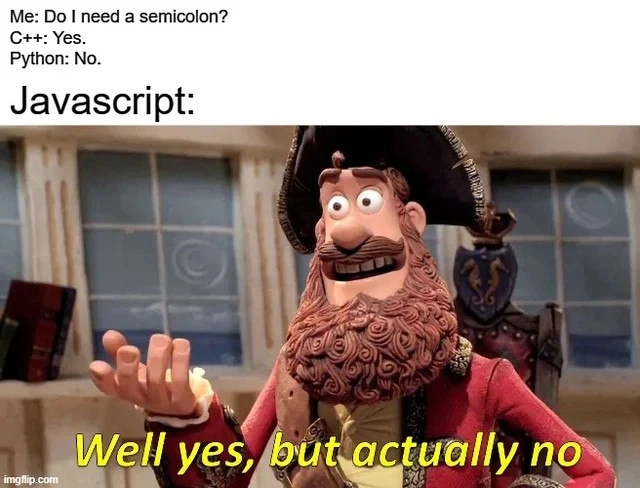
This meme is funny because JavaScript is being like that confusing teacher. The top part asks, “Do I need a semicolon?” (think of a semicolon as the period in programming grammar). C++ says “Yes” (always end your line with one, like always use a period), Python says “No” (never needed), and JavaScript essentially shrugs and says, “Well yes, but actually no.” That pirate character at the bottom is shrugging with a goofy look, which is exactly how a confused person might look. It’s a mixed signal – a yes and a no at the same time – which is silly. We usually expect a clear answer, but JavaScript’s answer is not clear, and that’s the joke.
For a simple real-world analogy: imagine asking three friends if you should bring an umbrella. One friend (C++) always says “Yes, definitely bring it every day.” Another friend (Python) says “No, it’s sunny, you won’t need it at all.” But the third friend (JavaScript) goes “Well, it might rain... but actually, it also might not.” That third answer isn’t very helpful, is it? It’s both yes and no. You’d probably laugh and say, “Thanks for nothing, buddy!” This meme makes us laugh for the same reason – JavaScript’s rule about that little semicolon isn’t a straight yes or no, and the pirate’s catchphrase “Well yes, but actually no” captures that hilarious contradiction in a single line.
So even if you’re not a coding expert, the core humor is about getting a confusing answer to a simple question. It’s funny because we’ve all experienced a time when someone gave us an answer that completely mixed messages. In coding, that someone is JavaScript when it comes to semicolons. The meme turns that confusion into something we can smirk at – basically saying, “JavaScript, make up your mind!”
Level 2: Semicolon Confusion 101
Let’s break down the basics for a newer developer or someone just learning about these languages. The meme names three popular programming languages — C++, Python, and JavaScript — and how each one handles the ; character (the semicolon) in code. In programming, a semicolon is often used like a period at the end of a sentence; it tells the computer “this statement is finished.” But not all languages treat it the same way! Here’s a quick comparison:
| Language | Semicolon Needed? | Behavior |
|---|---|---|
| C++ | Yes, required | Every statement must end with ;. Missing one causes a compile error. |
| Python | No, not needed | Newlines and indentation separate statements. Semicolons are optional and rare. |
| JavaScript | Both (optional) | Lines usually end without ; just fine thanks to Automatic Semicolon Insertion, but some situations do require them to avoid errors. |
Now, in a bit more detail:
C++ (and similarly C, Java, etc.) – In C++, you absolutely must put a semicolon at the end of each statement. For example:
int x = 5;If you writeint x = 5without the;, the compiler won’t run your program. It’s a strict rule; the language expects that;every time. This is why in the meme, for “C++” the answer to “Do I need a semicolon?” is a simple “Yes.” There’s no ambiguity or exceptions for C++ – it’s black-and-white.Python – Python took a different approach. It uses newline characters and indentation (spaces or tabs at the start of a line to define scope) to figure out where statements end and where blocks of code begin. In normal Python code, you do not end lines with a semicolon. For example:
x = 5 print(x)That’s perfectly valid. If you accidentally put a semicolon, like
x = 5;, the code will still run (Python will ignore it or treat it as an empty statement), but it’s considered unnecessary and stylistically odd. So for Python, the meme says “No.” – you don’t need a semicolon at the end of each line. (Fun fact: Python will let you put multiple commands on one line separated by semicolons, but that’s rarely done outside of quick one-liners. Generally, one statement per line keeps things readable, which is what Python encourages.)JavaScript – This one is the tricky middle ground. JavaScript’s official stance is that semicolons are optional most of the time, but the language will sometimes automatically insert them for you when you omit them, and occasionally it requires them to understand your code correctly. This feature is what we call automatic semicolon insertion. The result: if you ask a JavaScript guru “Should I put a semicolon here?”, the answer might genuinely be “Well, you usually don’t have to, but sometimes you should.” It depends on context!
In JavaScript, you could write:
let a = 5
let b = a + 3
console.log(b)
and it will run fine, even though we didn’t put any ; at the end of lines. The JS engine automatically treats each newline like an end-of-statement in most cases. However, certain patterns can confuse this mechanism. For instance:
return
42
In a JavaScript function, if you write return and then break the line, the engine will automatically add a semicolon after return (because it doesn’t see an immediate continuation on the same line). That means the function will return undefined (nothing) and the 42 below becomes unreachable code! The correct way would be return 42 on one line, or use parentheses. So JavaScript sometimes guesses wrong about what you intended when you omit a semicolon. Another example is if one line ends with a closing brace or parenthesis, and the next line starts with ( or [. The JavaScript interpreter might think those lines are actually one continuous statement if you didn’t put a ;. This leads to weird bugs.
So why does JavaScript allow you to not write ; if it can cause problems? This goes back to its design philosophy: JavaScript was meant to be easy for beginners, and having the freedom to not worry about a missing semicolon was seen as beginner-friendly. The language tries to be helpful by inserting them on the fly. You can almost imagine the JavaScript engine as a helpful friend reading your code and saying, “I think you meant to end the statement here, I’ll just put a semicolon for you.” Most of the time, that’s okay. But sometimes the friend (the JS engine) might misunderstand you and insert a semicolon where you didn’t want one, or not insert one where you did need one. That’s where the semicolon confusion comes in.
The meme’s punchline, “Well yes, but actually no,” is borrowed from a funny pirate meme to sum up JavaScript’s stance in a humorous way. It implies a mixed answer. For someone new: imagine asking two teachers the same yes/no question. One teacher (C++) says “Absolutely yes.” Another teacher (Python) says “Absolutely no.” But the third teacher (JavaScript) gives you a confusing answer that sounds like “Yes… and also no!” You’d be puzzled, right? That confusion is exactly what a lot of beginners feel when they realize JavaScript’s rules aren’t as straightforward as they thought. It literally sometimes says yes (you can leave it out) and then “actually no” (in certain situations that you have to learn to recognize).
In summary, the meme is highlighting a quirk of the JavaScript language in the context of other languages. It’s that quirky, both-are-true answer that makes the situation ripe for humor. And it lightly educates anyone who sees it: if you didn’t know about this issue, now you do (in a funny way). Programmers often use memes like this to share bits of knowledge and inside jokes. So don’t worry if it seems confusing at first — even experienced devs got tripped up by JavaScript’s semicolon rules at one point. It’s one of those things you learn and then laugh about when you see a meme like this.
Level 3: The Semicolon Wars
For seasoned developers, this meme evokes a knowing groan and a chuckle — it’s referencing one of the classic syntax wars in programming culture: to use semicolons, or not to use semicolons? The top text sets up a simple Q&A style contrast:
- C++ says “Yes.” – In C/C++, every statement must end with a semicolon. No ifs, ands, or buts. It’s a rigid rule inherited from the earliest days of languages like C; if you forget one, the compiler will throw an error faster than you can say “missing semicolon”.
- Python says “No.” – Python is very proud of its whitespace-significant syntax. Newlines and indentation are how you separate statements and blocks, not semicolons. In fact, putting unnecessary semicolons in Python is considered bad style (though Python will technically allow them to separate multiple statements on one line, real Pythonistas rarely do that). So Python’s answer is a confident “No need for that symbol at the end of each line”.
Then we get to JavaScript, and instead of a straight answer we get the meme punchline:
JavaScript: “Well yes, but actually no.”
This line, overlaid on the shrugging pirate, perfectly captures JavaScript’s indecisive stance on semicolons. It’s a direct quote from a popular “Well yes, but actually no” meme, which senior devs have seen a million times in forums and joke threads. Using that familiar phrase here is comedy gold because it matches JavaScript’s behavior so well. Every experienced JS developer knows the semicolon confusion this refers to. JavaScript allows you to omit semicolons (so in practice you can write code without ending each line with ; and it usually runs fine — hence “yes” you can skip them), but there are infamous cases where leaving out a semicolon can break your code or change its meaning (hence “actually no, you do need them in those cases”). The meme’s humor comes from this shared understanding that JavaScript is non-committal: it gives you freedom, then sometimes punishes you for using that freedom.
In the real world of development, this has led to something of a civil war among JavaScript coders. On one side, you have the semicolon enthusiasts (often more cautious or coming from languages like C++/Java) who say, “Just always put semicolons to be safe and explicit!” On the other side, you have the semicolon omitters (some influenced by stylistic conventions like StandardJS or just liking cleaner-looking code) who argue, “JavaScript doesn’t need them most of the time, so why clutter the code?” Whole teams have argued in code reviews over this trivial-looking choice – it’s almost a tabs vs spaces-level debate in the JS community. Linting tools and style guides often enforce one approach or the other just to keep the peace. In essence, the meme is summarizing years of developer arguments with a single pirate phrase. Who knew punctuation could cause such drama in a codebase?
Historically, the reason JavaScript ended up this way is rooted in its creation and use-cases. JavaScript was designed in the mid-90s for frontend web development, where HTML authors and designers (not just hardcore programmers) would be scripting interactivity. The language creators wanted to lower the barrier to entry – if a missing semicolon would crash the whole script, that’d be frustrating for a casual coder. So they introduced this forgiving parser that tries to make sense of your code even if you forget some ;. It was a pragmatic choice: make the language more error-tolerant for newbies quickly hacking something together in a <script> tag. Little did they know, this convenience would become a long-running joke and a source of subtle bugs for years to come.
Seasoned devs find this meme funny because it rings true to their experiences. Many can recall a nasty bug or a strange behavior caused by a missing semicolon in JS. Perhaps in a build process, two JavaScript files got concatenated without a semicolon between them, leading to a crazy error. Or someone wrote:
return
{
key: "value"
}
intending to return an object, but JavaScript inserted a semicolon after return, causing the function to return undefined and leaving the developer bewildered. These are almost rite-of-passage moments in a JavaScript programmer’s life. So when we see JavaScript: “Well yes, but actually no”, we smirk because we’ve lived that confusion. It’s a gentle roast of JavaScript’s design: simultaneously flexible and fickle. The pirate’s expression – a sort of apologetic shrug – is exactly how it feels when JavaScript explains its semicolon rule to you.
In summary, at this senior level the meme lands because it condenses a complex, weary topic (language syntax rules and their pitfalls) into a simple, witty format. It’s developer humor at its finest: LanguageQuirks exposed with a dash of pop culture. We laugh, perhaps a bit bitterly, because we’ve all asked at some point: “Do I need a semicolon here?” only for JavaScript to answer in frustratingly inconsistent ways. This shared pain and the absurdity of a programming language giving a pirate-style mixed answer create a perfect in-joke for those in the know.
Level 4: Schrödinger's Semicolon
At the deepest technical level, this meme is poking fun at JavaScript’s parser logic – specifically its Automatic Semicolon Insertion (ASI). In the ECMAScript language specification (the formal definition of JavaScript’s grammar), semicolons can be implicitly added by the interpreter when you, the programmer, omit them. Think of the JavaScript parser as a somewhat overzealous editor: it scans your code and, if it encounters a line break that would otherwise lead to a syntax error, it inserts a semicolon for you. This mechanism is why JavaScript can say "Well yes, but actually no" about needing semicolons – it conditionally decides whether to treat a missing ; as the end of a statement.
Under the hood, the rules for ASI are quite nuanced. For example, the spec defines certain points (called Line Termination or Line Break points) where if a newline appears, a semicolon may be inserted. One classic quirky case is the return statement: if you write return on one line and then put the value on the next line, JavaScript’s grammar will automatically insert a semicolon right after the return, effectively returning nothing and ignoring the next line. It’s like a grammar gremlin snuck in a ; when you weren’t looking. Similarly, if one line ends with something that could legally merge with the next line (say a closing parenthesis ) or an identifier) and the next line starts with ( or [ (which could be interpreted as a function call or array indexing continuing the previous line), then no semicolon is inserted. This is where the paradox bites: most of the time, the JavaScript engine guesses your intent correctly, but occasionally it guesses wrong (from the developer’s point of view) and the code does something unexpected.
To illustrate, consider this JavaScript snippet without semicolons:
// Two separate statements, but JavaScript might misinterpret them
console.log("Hello")
[1, 2, 3].forEach(n => console.log(n))
You might expect this to print "Hello" then print 1 2 3. However, without a semicolon, the JS parser doesn’t insert one after console.log("Hello") because the next line starts with [ which can attach to the previous expression. It instead interprets it as console.log("Hello")[1, 2, 3] – which actually means “call console.log("Hello"), then try to access element [1, 2, 3] of its return value”. The result? A runtime error, or at least not what you intended. In other words, JavaScript’s leniency has limits. The language quirk here is that the presence or absence of a tiny ; can radically change meaning due to how the code is parsed into an Abstract Syntax Tree (AST). This all stems from design decisions in the language’s early days: JavaScript wanted to be forgiving like a scripting language, inserting missing punctuation automatically, but that flexibility created an edge-case paradox – code might work without semicolons 99% of the time, then mysteriously break in the remaining 1%.
From a theoretical standpoint, this is a lesson in how compiler and interpreter design can affect language syntax. JavaScript’s grammar must balance being user-friendly (forgiving missing semicolons) with maintaining unambiguous parsing. It’s a fine line: too strict (like C++) and novices might be frustrated by minor errors; too lenient and you introduce weird ambiguities. The humor of "Well yes, but actually no" arises directly from these parsing rules – JavaScript both requires and doesn’t require semicolons depending on context, a kind of superposition that has earned it comparisons to Schrödinger's cat. In essence, the semicolon is there and not there at the same time until the parser decides which way to interpret a line break. This deep dive into JavaScript’s internals shows why the meme hits home for those who know the language’s spec: the automatic semicolon insertion is a clever idea that sometimes backfires, leaving developers scratching their heads (or cursing like pirates) when encountering a rare syntax surprise.
Description
This is a 'Well yes, but actually no' meme format featuring the Pirate Captain character from an Aardman animation. The top section presents a dialogue about programming syntax: 'Me: Do I need a semicolon? C++: Yes. Python: No.' followed by 'Javascript:'. The bottom image delivers the punchline, with the Pirate Captain saying 'Well yes, but actually no.' This meme humorously critiques JavaScript's optional semicolon feature, a mechanism known as Automatic Semicolon Insertion (ASI). While semicolons are not strictly required as they are in languages like C++, the ASI process can sometimes lead to unexpected behavior and subtle bugs, making their use a contentious topic and a best practice in many style guides. The meme perfectly captures this nuance, contrasting it with the clear, unambiguous rules of C++ and Python
Comments
7Comment deleted
Automatic Semicolon Insertion is the language feature equivalent of a non-committal partner. It's there for you most of the time, but will occasionally leave you for the line below, returning 'undefined' and breaking your heart in production
JavaScript’s ASI is that ghost intern who silently inserts semicolons at 2 AM and then says “well yes, but actually no” when your `return\n{ ok: true }` sends half the pods into CrashLoopBackOff
JavaScript's ASI rules are like that senior architect who says "we follow best practices" but then you find return statements on their own line wondering why undefined keeps showing up in production
JavaScript's ASI is the programming equivalent of autocorrect: it thinks it knows what you meant, confidently makes assumptions, and occasionally produces hilariously broken results when you forget that return statement on its own line. Senior engineers know the real answer isn't 'yes' or 'no' - it's 'configure your linter and never think about it again.'
JavaScript’s ASI is eventual consistency for parsers - fine until a return meets a newline and your hotfix 500s in prod
JavaScript semicolons: optional per ASI, mandatory per reality - add a newline after return, an IIFE, and Terser, and suddenly optional pages ops at 3am
JS ASI: optional semicolons today, inexplicable parser bugs rewriting your return statements tomorrow