HTML Was Naked For Four Years Before CSS Was Born
Why is this WebDev meme funny?
Level 1: Learning to Dress and Think
Imagine the early web as a simple toy doll. At first, this doll has no clothes on and no battery inside. It’s just a bare figure that doesn’t do much. After a while, someone gives the doll some clothes to wear – now it looks nicer and more colorful. Later on, they put a battery (or a little computer chip) into the doll – suddenly it can move or talk, almost like it just got a brain. Originally, the doll was plain and lifeless, but step by step it became stylish and lively. This is like how websites grew up. In the very beginning, a web page was just basic content on the screen, with no fancy design and nothing interactive to do. Then, a few years later, we got a way to dress those pages up with colors and layout (like putting clothes on the doll). A little after that, we got a way to make web pages smart and interactive, so they could react when you clicked things or do cool tricks (like giving the doll a brain and batteries). The meme is funny because it imagines the web itself as a person growing up slowly. It had an awkward childhood phase where it wasn’t wearing any clothes and didn’t have much going on in its head yet!
Level 2: Structure, Style, Script
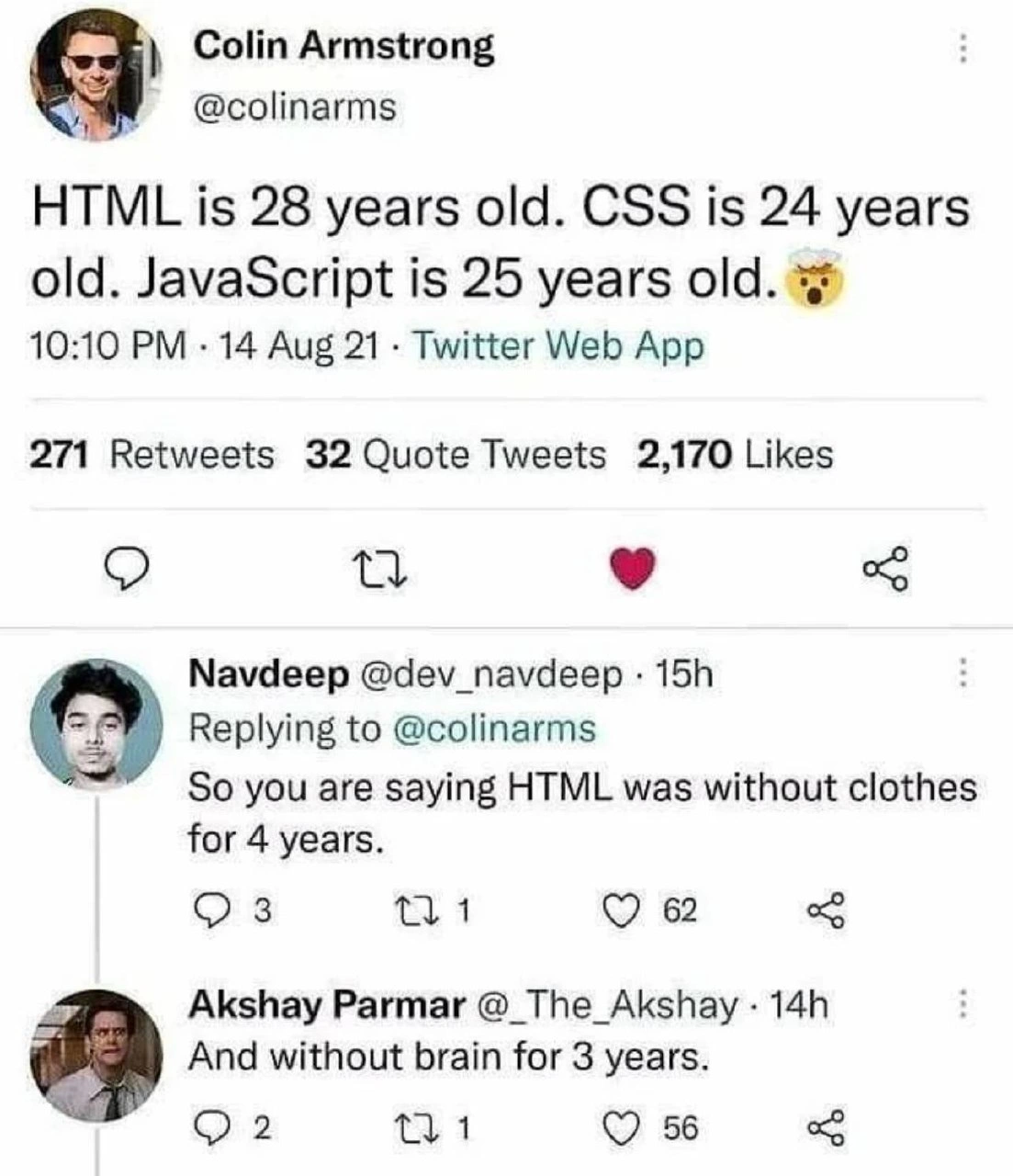
The tweet exchange uses a clever metaphor to describe the roles and birth order of the core web technologies HTML, CSS, and JavaScript. The original tweet lists their ages (28, 24, 25 years old respectively) to emphasize that these tools have been around for a long time — longer than many people realize. In the replies, someone jokes, “HTML was without clothes for 4 years.” Here, clothes represent CSS, because CSS (short for Cascading Style Sheets) is what makes a webpage look styled and visually polished. CSS lets developers dress up raw HTML content with colors, fonts, layouts, and other design details. So saying HTML had no clothes for 4 years is a funny way to note that for the first four years of the web, there were no style sheets! Early HTML pages had no separate CSS file to make them pretty – they were mostly just plain documents with the browser’s default look (usually black Times New Roman text on a white or gray background, with blue underlined links). It took four years before the web got a proper “wardrobe” in the form of CSS.
Another reply adds, “And without brain for 3 years.” This extends the analogy: the brain stands for JavaScript, which came along about three years after HTML was first created. JavaScript is the programming language that runs inside web browsers, giving web pages interactivity and logic. It’s what allows a page to respond when you click a button, to show an alert message, to update some content on the page without reloading – essentially making the page smart and reactive. In other words, JavaScript acts like the brain of the page, controlling its behavior. So if HTML was “without a brain” initially, it means that in the first few years of the web, there was no JavaScript available to handle things like form validation, dynamic content changes, or animations directly in the browser. Web pages couldn’t think on their own yet; any interactive features had to be handled by the web server or were simply impossible.
Put simply, HTML provides the structure and content of a webpage (think of it as the building blocks or skeleton of the page), CSS provides the style (the visual design, like clothing or paint that makes it look nice), and JavaScript provides the dynamic behavior (the interactivity, like the brain that lets the page respond and do things). Today, every modern website uses all three together: content, style, and logic working in harmony. But historically, they were introduced in that sequence over a few years in the mid-90s. The meme humorously points out this staggered timeline. It’s amusing because it makes us picture an early webpage as a person walking around without any clothes (no CSS styling) and without any brain activity (no scripting) for a while, until those features finally came along. It highlights how basic the early internet pages used to be compared to the rich, styled, interactive websites we take for granted now. For newer developers or casual internet users, it’s a fun reminder that websites weren’t always sleek and dynamic — at the start they were quite bare and simple!
Level 3: The Naked HTML Era
In this meme, a Twitter user highlights just how old the fundamentals of web development are: HTML is nearly three decades old, CSS about a quarter-century, and JavaScript around 25 years young. That revelation sparks replies joking that for a while, HTML had to survive without clothes or brain — a witty way to say that in its first years, HTML had no CSS to style it (no clothes) and no JavaScript to add intelligence (no brain). This isn't a random metaphor; it's grounded in tech history. HTML was born in the early ’90s (Tim Berners-Lee introduced it around 1991–1993) as a bare-bones markup language for sharing documents on the fledgling World Wide Web. CSS only arrived ~4 years later (mid-1996) to provide a dedicated styling system, and JavaScript emerged ~3 years in (1995) as a client-side scripting “brain.” For those initial years before CSS and JS showed up, web pages truly were plain and static — just black text on gray backgrounds with blue underlined links by default. The web literally had no fashion sense (no stylesheets to dress it up) and no front-end smarts (no scripts running in the browser) at the beginning.
For veteran developers, this meme triggers flashbacks to those primitive days of WebDev. Before CSS, we had to get creative (or desperate) to make pages look presentable. Layouts were achieved with cringe-worthy hacks like HTML <table> grids used to structure entire page layouts, and “styling” meant sprinkling presentational attributes directly into your markup (think <font color="red"> tags everywhere) since there was no external stylesheet to keep things consistent. We even deployed one-pixel transparent GIF images as invisible spacers to push content around — an ancient workaround that’s unimaginable in modern web development. And without JavaScript’s brain powering things, interactivity on early sites was almost non-existent. Any real logic had to run on the server side: common gateway interface scripts (CGI in languages like Perl/PHP) would handle form submissions or generate dynamic content, usually with a full page reload. On the client side, the most “dynamic” tricks were limited to goofy, browser-specific tags baked into early browsers themselves. Netscape introduced the infamous <blink> tag to make text flash like a neon sign, and Internet Explorer had the <marquee> tag to scroll text horizontally like a news ticker. These were the cheesy gimmicks of a pre-JS era – the web trying to move and dance before it had a proper brain to coordinate its limbs.
Even once CSS and JavaScript entered the scene, the front-end stack had its share of awkward teenage years. Throughout the late ’90s and early 2000s, CSS and JS were more like unruly adolescents than polished tools. Competing browsers (Internet Explorer vs. Netscape, among others) implemented these new features haphazardly, each with its own quirks and bugs. This led to the notorious "browser wars": writing CSS that worked everywhere felt like trying to dress an unruly teen who changes style every week (anyone remember wrestling with the inconsistent CSS box model in IE5?). Early JavaScript was similarly quirky — Netscape’s JavaScript and Microsoft’s JScript had slight differences, and the DOM (Document Object Model) implementations varied, meaning developers often had to write two sets of code or use lots of browser detection hacks to make a page think correctly on all browsers. In essence, the web’s new “clothes” sometimes didn’t fit right across different browsers, and its new “brain” often had trouble behaving consistently. It truly was an awkward phase, filled with broken layouts and script errors galore. Over time, thankfully, standards caught up: CSS2 and CSS3 introduced robust, consistent styling capabilities, and the ECMAScript specification (the standard for JavaScript) reined in many of the wild inconsistencies. The clumsy teenager that was the early web gradually grew into the sleek, sophisticated platform we know today – sporting a fashionable CSS wardrobe and a fully developed JavaScript brain. The meme’s joke lands so well because it reminds those of us who lived through that era just how far the web has come from its humble, half-dressed and brainless beginnings.
Description
A Twitter thread screenshot. Colin Armstrong (@colinarms) tweets: 'HTML is 28 years old. CSS is 24 years old. JavaScript is 25 years old.' (with a mind-blown emoji). Navdeep (@dev_navdeep) replies: 'So you are saying HTML was without clothes for 4 years.' (62 likes). Akshay Parmar (@_The_Akshay) adds: 'And without brain for 3 years.' (56 likes). The joke brilliantly personifies web technologies: CSS as HTML's clothing (visual styling) and JavaScript as its brain (logic/behavior), noting the gap years between their creation
Comments
26Comment deleted
HTML spent 4 years unstyled and 3 years brainless - or as we call it today, a successful MVP launch strategy
Given how many enterprise portals still look like 1995, it’s clear some products never scheduled that long-overdue wardrobe - or lobotomy - upgrade
After 28 years, HTML is finally old enough to realize that its mid-life crisis wasn't about getting a new framework every year, but accepting that tables were never meant for layout and divs aren't semantic enough for everything
This thread perfectly captures the awkward adolescence of the web stack: HTML strutting around in its semantic underwear for four years before CSS showed up with a wardrobe, then both of them sitting there like static mannequins for three more years until JavaScript finally gave them a personality. It's the tech equivalent of watching your framework mature from 'it renders' to 'it has opinions about everything' - except this evolution took nearly a decade and we're still dealing with the trauma of those formative years every time we have to support IE11
The web spent four years without CSS and three without JS, yet those pages still hit sub‑100ms TTFB - try that with a 2MB CSS‑in‑JS bundle
The web shipped structure first, styling later, and a JS brain last - then spent 25+ years inventing CSP, same‑origin, bundlers, and TypeScript to keep that brain from executing whatever the CDN sneezes in
HTML bootstrapped the web naked and brainless for years, yet it's still the only layer seniors trust when frameworks evaporate in prod
Those were beautiful and happy years Comment deleted
haunts you with ActiveX Comment deleted
Choose your way warrior: ActiveX, Java Applet, or Flash/AS Comment deleted
Silverlight Comment deleted
I will pretend that I never heard about Microsoft Flash 🌚 Comment deleted
That was a decade later Comment deleted
Only happy, not beautiful. Comment deleted
the internet 1.0... Comment deleted
I think we can all agree that it has brain now, but it is dumb as hell Comment deleted
HTML was great for 3 years Comment deleted
Document delivery platform with layer after layer of hack to make applications possible Comment deleted
We need to start over, the web is dead, now it’s just a way to deliver 50mb React apps Comment deleted
I feel the same to be honest with you. But backwards compatibility is a bitch. I feel like it’d have to be a huge project supported by the biggest tech companies where they’d develop something closer to Swift UI that initially transpiles to the regular old HTML, CSS, JS — but then just add direct support for it in the browser. So we’d be able to make full-blown apps and I think with such architecture these apps would be PWAs by default. If you want to install one — no need for additional config. Since it’s already an app. Comment deleted
Google tried something like that in the early 2010s with Dart, it was intend as a successor to Javascript Comment deleted
No, you’ve just layered more shit on the cake Comment deleted
Time was an OS and browser fit in 1.44MB Comment deleted
What if I told you you could install another program on your computer that uses the Internet but is not a web browser Comment deleted
We just need that new browser: designed for purpose rather than evolving into shape Comment deleted
I have mixed feelings about putting JS and brains in a single sentence. Comment deleted