Replacing Developers With an App: 'But It Might Work for Us'
Why is this AI ML meme funny?
Level 1: The Magic Kitchen Machine
Every few years, someone invents a machine that promises families will never need a cook again — a bread maker, a microwave, a meal-kit box. And every time, people still end up hiring cooks, because the machine makes the easy part easy and leaves the hard part (knowing what to make, fixing it when it burns, feeding fifty picky guests) exactly as hard as before. In this meme, one person lists every failed "no more cooks!" machine in history, the other nods along, agrees they all failed... and then says, with total confidence, "but OUR machine might work." That confidence — right after hearing the list — is the whole joke.
Level 2: A Field Guide to the Graveyard
The names in panel one, for anyone who wasn't shipping websites in the relevant decades:
- FrontPage — Microsoft's 90s visual webpage editor. You dragged things around; it generated messy
HTML that only rendered correctly in Internet Explorer. - Dreamweaver — Macromedia's (later Adobe's) more professional visual editor. Better output, same promise: design pages without writing code.
- Drupal / WordPress — open-source content management systems. Install once, click together a site from themes and plugins. WordPress still powers a colossal share of the web — maintained by armies of paid developers.
- Squarespace — modern hosted site builder; the "you don't need a programmer" pitch as a subscription.
Each of these was real, useful, and commercially successful. What none of them did was eliminate the job of developer, because the hard part of software was never typing the code — it's deciding what to build, handling the weird edge cases, integrating with the other seventeen systems, and maintaining the thing after the person who made it leaves. Tools compress the typing; the rest survives.
The two logos casting the players matter: the orange starburst (Claude/Anthropic) delivers the history lesson, and the OpenAI knot draws the doomed conclusion — a sly bit of inter-lab trash talk about whose marketing leans hardest on "replace your engineering team."
Level 3: This Time Is Different, Episode VI
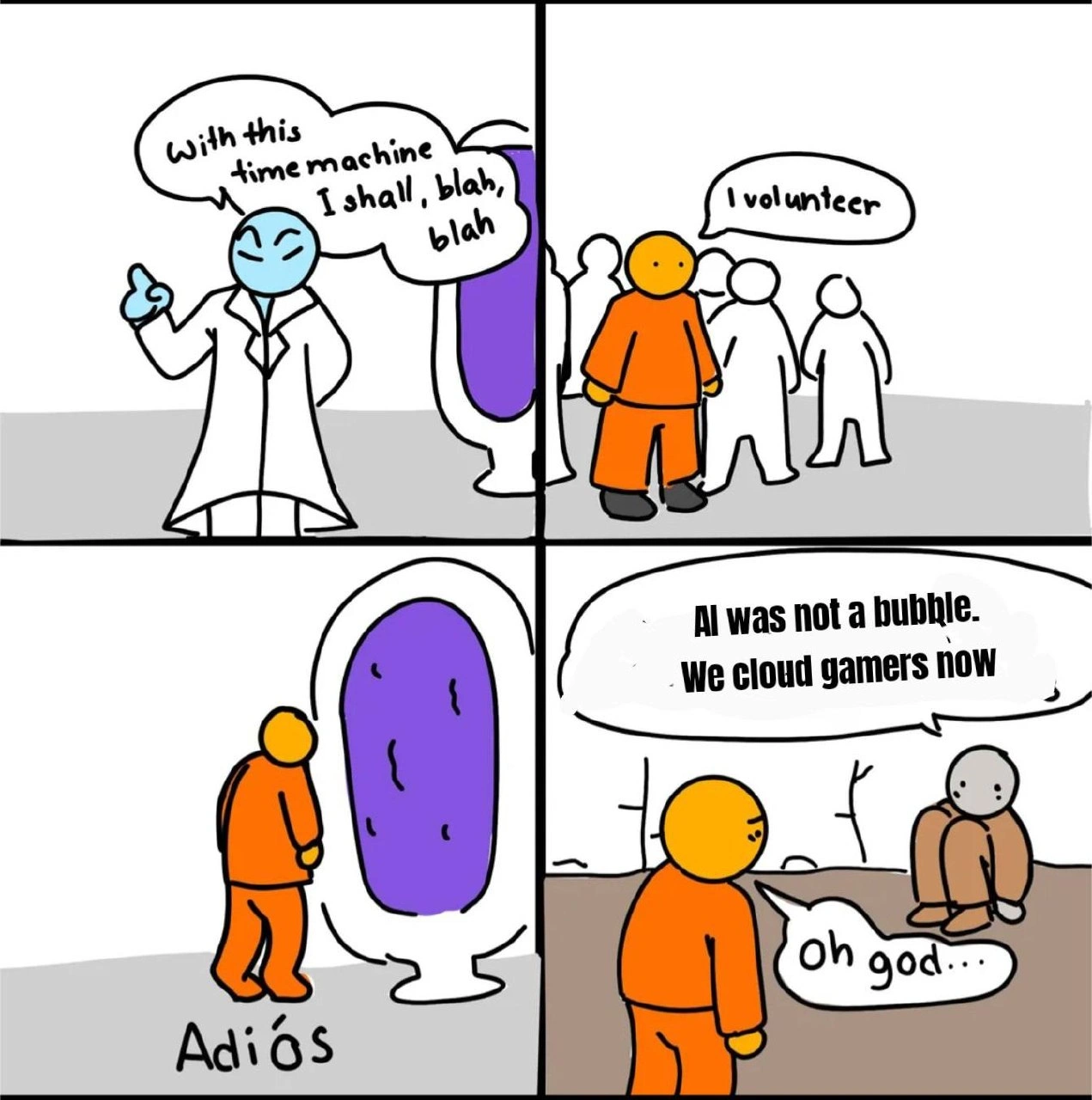
The genius of this meme is its source dialogue. The four-panel exchange is the famous pyramid-scheme conversation format — one partner patiently lists historical failures, the other absorbs every word and concludes with flawless anti-logic. Here, the human speaker (face covered by an orange Anthropic/Claude starburst) plays the historian:
"MANY COMPANIES TRIED TO REPLACE DEVELOPERS WITH AN APP BEFORE: FRONTPAGE, DREAMWEAVER, DRUPAL, WORDPRESS, SQUARESPACE..."
The OpenAI logo, pasted over the listener, asks the right question — "WELL DID IT WORK FOR THOSE COMPANIES?" — receives the right answer — "NO, IT NEVER DOES. THEY SOMEHOW DELUDE THEMSELVES INTO THINKING IT MIGHT, BUT..." — and delivers the immortal close:
"...BUT IT MIGHT WORK FOR US."
That list of tools is a precise archaeological core sample of "developers are obsolete now" claims, one per era. Microsoft FrontPage (1996): WYSIWYG webpages for everyone — produced tag-soup HTML that professionals spent the next decade un-writing. Dreamweaver (1997): the designer-friendly bridge that mostly trained a generation to eventually open the code view anyway. Drupal and WordPress (early 2000s): CMSes that promised site-building without programmers and instead spawned entire industries of specialized programmers — there are more WordPress developers than there ever were hand-coders of brochure sites. Squarespace (the no-code 2010s): genuinely killed the small-business brochure-site contract... and developer employment went up through that whole decade.
That's the pattern the meme weaponizes, and it has a name: the Jevons paradox dynamic of software demand. Every tool that lowers the floor of who can build something doesn't shrink the market for builders — it expands the universe of things people expect to be built, and complexity migrates upward. The tool absorbs the easy 80% and the remaining 20% becomes a profession. The historically literate critique embedded here isn't "LLMs are useless" (the meme conspicuously doesn't claim that); it's that the commercial thesis — replace the salaried developer — has been tried roughly every seven years since the <blink> tag, and each time it instead produced a new layer of abstraction that needed... developers.
The counter-argument, which the meme pre-loads into its own punchline, is the eternal exception clause: previous tools were templates and CMSes, while LLMs actually write arbitrary code — surely this time is different. Maybe! But "this time is different" is, verbatim, the fourth panel. The format chosen for that argument is the pyramid-scheme scene. The meme rests its case.
Description
A four-panel meme in 'The Other Guys' couple-conversation format, with the man's face covered by an orange Claude-style starburst logo and OpenAI logos pasted over the woman's position. Panel 1 (man): 'MANY COMPANIES TRIED TO REPLACE DEVELOPERS WITH AN APP BEFORE:' Panel 1 continued: 'FRONTPAGE, DREAMWEAVER, DRUPAL, WORDPRESS, SQUARESPACE...' Panel 2 (OpenAI logo speaking): 'WELL DID IT WORK FOR THOSE COMPANIES?' Panel 3 (man): 'NO, IT NEVER DOES. THEY SOMEHOW DELUDE THEMSELVES INTO THINKING IT MIGHT, BUT...' Panel 4 (OpenAI logo): '...BUT IT MIGHT WORK FOR US.' An imgflip.com watermark appears bottom-left. The meme maps the famous 'it might work for us' pyramid-scheme dialogue onto AI companies believing LLMs will finally succeed at replacing developers where decades of no-code and site-builder tools (FrontPage, Dreamweaver, Drupal, WordPress, Squarespace) failed
Comments
13Comment deleted
Every decade a new tool promises to eliminate developers, and every decade it instead creates a new specialty: someone has to maintain what the tool generated
Why not? Software engineering has already changed significantly and not in a better direction. When did you use stack overflow last time? Or read some lib documentation? Or write code without cloud? And it consumed actually 90% of working time before Comment deleted
today, today and today Comment deleted
Documentation is still required. Coding is rarely required, but when it is - gl hf. Architecture never ceased to be required... So better tools, but no substantial improvement Comment deleted
I probably read some library documentation 2 years ago last time. And architecture design will probably survive, yes, but only a small portion of engineers need to think about architecture, it's usually a work for tech leads. While small architectural decisions can be made by AI too Comment deleted
or when did you use a rubber duck for debugging last time? 😅 Comment deleted
I read documentations older than myself a lot Comment deleted
«give me a tldr summary focusing on …» Comment deleted
Rust docs 😎 Comment deleted
People need some time to adapt to new reality. Also, the ones who have adaptation problems, will not get their productivity boost - and will lose the job. Comment deleted
But the real massacre will begin when clients realize that all the estimates were based on human-only work, while in reality most of the work is already being done in a human-in-the-AI-loop paradigm. Comment deleted
Theyre good Comment deleted
Wordpress is still alive.. Am I out of touch? Comment deleted