Skip to content
DevMeme
6503 of 7435
Security Industry Turns 'As Is' Disclaimers Into Supply Chain Blame
Security Post #7128, on Sep 15, 2025 in TG

Security Industry Turns 'As Is' Disclaimers Into Supply Chain Blame

Why is this Security meme funny?

Level 1: The Blame Game

Imagine you borrow a toy block set from a friend to build a big tower. Your friend gave it for free and even said with a smile, “Here it is, take it as is. I’m not promising it’s unbreakable or anything!” You agree and use the blocks. They work great… until one day, one of the blocks in the middle was secretly cracked (you had no idea). The tower tumbles down and makes a mess of your room. Now, instead of just saying “Oops, let’s clean up and fix the block,” a strict teacher comes in and says angrily: “You used that cracked block – shame on you! You should’ve known better. You’re responsible for this whole mess!” 😠

Does that feel fair? Not really, right? Your friend warned you “no guarantees” on the blocks, and you didn’t break the block – it just had a hidden flaw. But the teacher still blames you for using it. In this story, the friend’s warning “take it as is, no warranty” is like the open source license saying the software might have issues and the creator isn’t liable. The tower collapse is like a supply chain attack or security problem that happens because something in what you built (one of those blocks) was faulty. And the teacher scolding you is like the security industry or bosses blaming the developer for not magically avoiding that bad block.

The meme is funny because it shows how silly this blame is. It’s like turning a helpful warning (“no promises this is perfect”) into an accusation (“it’s your fault for trusting it”). Anyone who’s ever been unfairly blamed for an honest mistake can chuckle at how ridiculous that is. It’s pointing out, in a simple way, the blame game that often happens in software: when things go wrong, people look for someone to point the finger at, even if that person played by the rules. In the end, it reminds us of a basic idea: if you were warned something might not be perfect, you shouldn’t be shamed when it isn’t – we should work together to fix the problem instead of just blaming.

Level 2: Blame-Shifting 101

Let’s break down the key ideas here for a less-experienced developer or someone new to these terms. The meme is contrasting two statements: one from an open-source license disclaimer and one from a security incident perspective.

  • “THE SOFTWARE IS PROVIDED AS IS, WITHOUT WARRANTY OF ANY KIND” – This is a classic line you’ll find in many open source licenses (like the MIT License). What it means is: “Hey, I’m giving you this software for free. I’m not promising it’s perfect or even that it works. I’m not responsible if something goes wrong when you use it.” This is called a liability_disclaimer. It’s there so that the author or maintainer can’t be sued or held legally accountable if the software has bugs, crashes your system, or has security holes. In simpler terms, no warranty means “use at your own risk.” OpenSource developers include this because they’re often sharing their work freely, and they can’t possibly guarantee it will work in every scenario or be updated forever.

  • Supply chain attack – This is a type of security breach where an attacker targets not you directly, but something in your supply chain. In software, the supply chain includes all the external components, libraries, and tools that you use to build your application. For example, if you’re building a web app and you include a popular open source library (say for logging or cryptography), a supply_chain_attack might be when a bad actor finds a way to compromise that library (hacking into it or sneaking malicious code into a new version). When you (unknowingly) update to that compromised version, the bad code enters your application. Now the attacker can exploit many projects at once via that single library. It’s like contaminating a raw ingredient that’s used in lots of recipes — suddenly all those dishes have the contaminant. 😬 SoftwareSupplyChainSecurity is all about trying to prevent this, by checking our dependencies for tampering or known issues.

  • “You are part of a supply chain attack, shame on you” – This is not an actual license or legal text; it’s a dramatized line capturing how some in the security industry might respond when they discover your software was involved in an incident. Basically, if one of your app’s dependencies was found to be vulnerable or hacked, you might hear something akin to “Your product was breached through that library — you’ve unwittingly helped the hackers. Shame!” It implies you should’ve somehow prevented it. This is where the BlameGame comes in. Instead of focusing on the attacker’s cleverness or how to improve processes, people start pointing fingers at whoever used the component or maintained it. The meme jokes that the security industry machine automatically converts the innocent “AS IS” clause into an accusation of culpability. Fault_shifting means they’re shifting the fault onto you (or the library developer) instead of the attacker or the situation.

  • Dependencies and transitive dependencies – A dependency is any external code library or component your project uses. Modern apps have a lot of these. A transitive dependency means a dependency of your dependency (like a friend-of-a-friend in code). For instance, you use Library A, but Library A itself uses Library B and C under the hood – B and C are transitive dependencies for you. It’s common to have a dependency tree or dependency graph with hundreds of nodes once you count all transitive ones. Managing these (making sure they’re up to date and secure) is called DependencyManagement. If any one of them has a SecurityVulnerability (like a known bug that hackers can exploit), then your app is indirectly vulnerable. Tools can warn if you’re UsingComponentsWithKnownVulnerabilities, which is generally a no-no in corporate environments (they’ll make you upgrade or patch ASAP). But early in your career, you might not realize you pulled in a vulnerable piece of code because it could be deeply nested in that tree.

So, an early-career dev might find this meme relatable once they’ve gone through their first “vulnerability fire drill.” Imagine you’re happily using an open source framework, and one morning your security team reports “Critical issue: our app depends on X v2.3, which has a known vulnerability. Update now!” Suddenly there’s pressure, maybe even an implication that by choosing X you made a mistake. But in reality, everyone was using X and nobody knew it had a flaw until that day. And X’s creators already told the world “use at your own risk.” This can feel overwhelming: How was I supposed to know? Am I in trouble for this?

The meme resonates by capturing that feeling in a tongue-in-cheek way. It’s saying: the security industry sometimes takes something you thought was safe to use (or simply ubiquitous) and after an incident, retrospectively labels it as a security sin. It turns the license’s as-is warning upside-down. Instead of protecting the developer from blame, it becomes “evidence” to blame them: “See? They even said ‘no warranty’! How irresponsible to use it!” 🤦‍♂️

Understanding this context, you can see why developers find the meme both funny and exasperating. It’s a lesson in how communication can break down between developers (who see disclaimers as standard and necessary) and security or legal teams (who might see those same disclaimers as red flags after the fact). It emphasizes the importance of good DependencyManagement and also empathizing with open source maintainers. After all, nobody can guarantee perfect security, and open source licenses remind us of that – it’s just ironic how those reminders get ignored until it’s time to assign blame.

Level 3: No Warranty, No Mercy

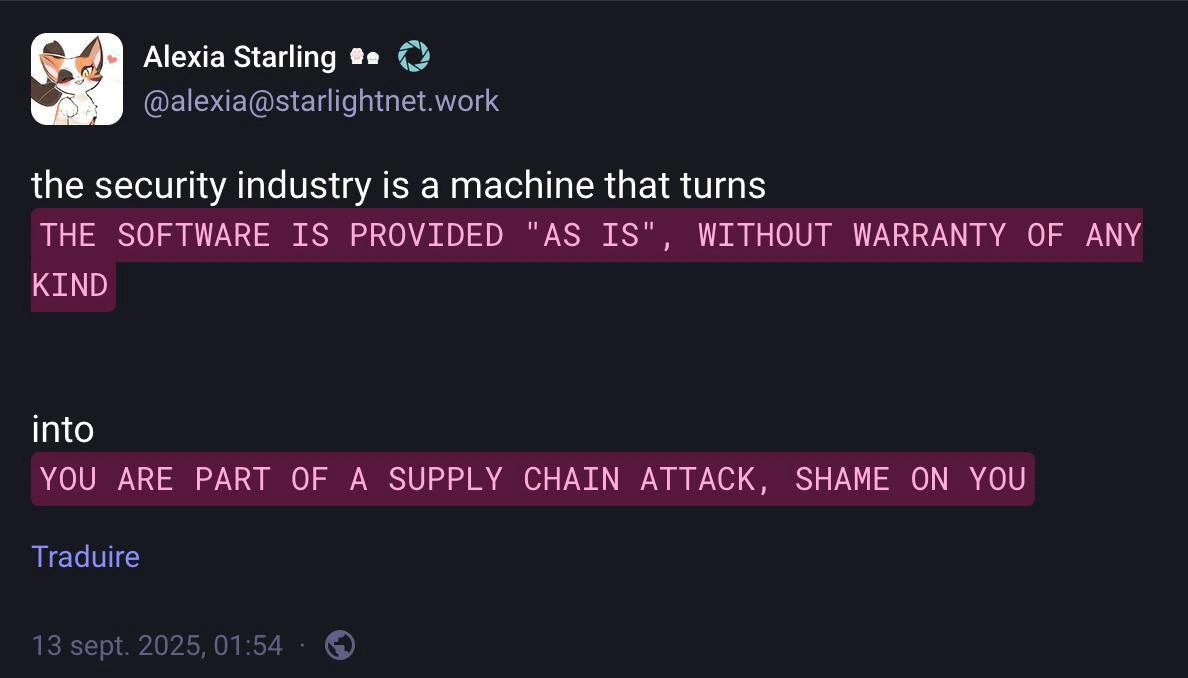
At the highest level, this meme skewers a painfully familiar scenario in modern software development: the collision between open-source liability disclaimers and corporate security blame culture. It highlights how the security industry can twist the well-known “no warranty” clause of OSS licenses into a guilt trip about supply chain attacks. Essentially, a phrase meant to abdicate developer liability gets magically reinterpreted as an accusation: “You included a vulnerable dependency; you’re complicit in a cyber attack — shame!” 😒

From a senior engineer’s perspective, the humor (and horror) comes from how transformative this blame machine can be. We’ve seen it in real incidents:

  • Log4Shell (Log4j vulnerability) – The widely-used Log4j library was offered “as is” under a permissive license. When a severe SecurityVulnerability was discovered (the infamous Log4Shell in 2021), enterprise security teams scrambled. Instead of just patching, some folks started pointing fingers at the volunteer maintainers of Log4j as if they had committed a crime. The meme’s highlighted text “THE SOFTWARE IS PROVIDED AS IS” was absolutely true for Log4j – no guarantees, no one on the hook. Yet the reaction practically morphed into “How dare you give us a library with a hole in it? This breach makes you part of a supply_chain_attack, shame!”

  • NPM Package Nightmares – In the JavaScript world, projects often have endless transitive dependencies. One small package can pull in dozens more. When a malicious update or hack happens (like the event-stream incident where an attacker inserted a backdoor into a popular NPM package), companies using it suddenly find themselves in a SoftwareSupplyChainSecurity crisis. Security auditors may imply those companies (and by extension the maintainers) were negligent: “Didn’t you know you were UsingComponentsWithKnownVulnerabilities?” It’s like you’re treated as an accomplice in a burglary because you left the key under the mat – even if everyone in the neighborhood does the same for convenience.

The meme’s format – “the security industry is a machine that turns X into Y” – nails this ironic conversion. X is the classic as_is_license_clause that virtually every open source project includes to disclaim liability (“use at your own risk; we owe you nothing if it breaks”). Y is the over-the-top interpretation by certain security folks or tools that if something goes wrong, you (the hapless user or maintainer) are now a supply-chain saboteur. It’s a form of fault_shifting: the blame shifts from the actual attacker or systemic issue onto the developers in the chain. The security_industry_snark here is palpable – it mocks those expensive security vendors and incident responders who leap to conclusions and indict everyone in sight when a breach happens via open source.

Why is this so funny to seasoned devs? Because it’s too real. Many have sat through post-mortems or security reviews where:

  • An open source dependency was flagged by an automated scanner like Snyk or OWASP Dependency-Check. The output essentially screams “Vulnerability found! Using this component is tantamount to joining the dark side!”
  • Management or security teams then demand to know “Who picked this library? How did we allow this?” – essentially shifting blame to the development team for trusting the very building blocks everyone uses. It’s the quintessential BlameGame.
  • The hapless dev points out the library’s license literally said “WITHOUT WARRANTY OF ANY KIND”, meaning the maintainers never promised it was flawless or safe for every use. That clause is supposed to warn “if it breaks or gets hacked, that’s not on us.” But in the heat of an incident, that context is lost and suddenly the narrative is “You brought a bomb into our supply chain.” 🙃

Another layer of humor is the absurdity of holding free contributors accountable. Open source maintainers often juggle projects in their spare time with zero payment. They include broad disclaimers to protect themselves legally. Yet, when a security flaw in one of their thousands of lines of code is exploited, some security pundits act like these maintainers deliberately aided hackers. It’s an infosec witch hunt: “How dare you, unpaid volunteer, not foresee this sophisticated attack vector!” This resonates darkly with veterans who have felt that thankless pressure.

The meme’s dark theme (literally a dark-mode screenshot with magenta highlight for the key phrases) underscores how this is a nightmare scenario. Security and OpenSource are in tension here: open source says “use at your own risk,” security says “any risk you introduced is your fault.” Senior devs laugh (or groan) because they’ve been on that bridge, watching the cold wind of blame blow down from C-suite or security auditors. They recognize that the real issue — the complexity of DependencyManagement and lack of proactive support for open source — gets ignored. Instead of addressing root causes (like funding maintainers, tightening supply chain verification, or limiting unnecessary dependencies), the industry often reaches for the simplest scapegoat. As the meme punchline suggests, that scapegoat is you, the developer whose only “crime” was trusting a widely-used library.

In essence, Level 3 exposes the bitter truth wrapped in humor: In today’s tangled web of software dependencies, an innocent OSS liability disclaimer can be perversely transformed by corporate panic into an indictment of developers’ judgment. The meme strikes a chord because it lampoons this unjust alchemy with knife-edge sarcasm — a reality every experienced engineer wishes was just a joke.

Description

A Mastodon/fediverse post by Alexia Starling (@[email protected]) dated 13 sept. 2025. The text reads: 'the security industry is a machine that turns THE SOFTWARE IS PROVIDED "AS IS", WITHOUT WARRANTY OF ANY KIND into YOU ARE PART OF A SUPPLY CHAIN ATTACK, SHAME ON YOU'. Both code-formatted phrases are highlighted in pink/magenta. The post critiques how the security industry weaponizes open source maintainers' standard MIT/BSD license disclaimers by holding them responsible for supply chain vulnerabilities despite explicitly disclaiming warranties

Comments

12
Anonymous ★ Top Pick Open source maintainer: ships free code with 'AS IS, NO WARRANTY'. Security vendor: 'That'll be $50k/year for us to tell your users you're a threat actor.'
  1. Anonymous ★ Top Pick

    Open source maintainer: ships free code with 'AS IS, NO WARRANTY'. Security vendor: 'That'll be $50k/year for us to tell your users you're a threat actor.'

  2. Anonymous

    Amazing how a two-line MIT disclaimer travels through the SBOM and comes back as a 200-page root-cause analysis naming you as APT-zero

  3. Anonymous

    After 20 years in tech, you realize the security industry's business model is essentially 'git blame' as a service - they ship CVEs faster than you can patch them, then invoice you for the privilege of being told it's your fault for using dependencies

  4. Anonymous

    The security industry has perfected the art of demanding enterprise-grade SLAs from volunteer maintainers who explicitly disclaimed all warranties. It's the only field where 'AS IS' means 'you're personally liable for nation-state attacks on code you wrote for free in 2003.'

  5. Anonymous

    Enterprise security alchemy: MIT's 'AS IS' gets translated to 'why didn't you SLSA, SBOM, notarize, and babysit every transitive npm dependency?' - and somehow the unpaid OSS maintainer becomes incident commander

  6. Anonymous

    Security’s newest optimizer turns 'AS IS' into 'AS INDICTED' - the SBOM shows 1,200 transitive deps and exactly zero maintainers on our payroll

  7. Anonymous

    From 'no warranty' to 'you're the supply chain weak link' faster than a zero-day in a transitive dep

  8. @RiedleroD 9mo

    hey I saw that post on fedi :3

    1. @ZgGPuo8dZef58K6hxxGVj3Z2 9mo

      Yow pm

      1. @RiedleroD 9mo

        ?

  9. @moosschan 9mo

    Haha, that's funny *casually leaks 7.5 petabytes of classified fbi documents*

    1. @chupasaurus 9mo

      I've got 3 passports' data by poking web email servers the day Heartbleed was revealed

Use J and K for navigation