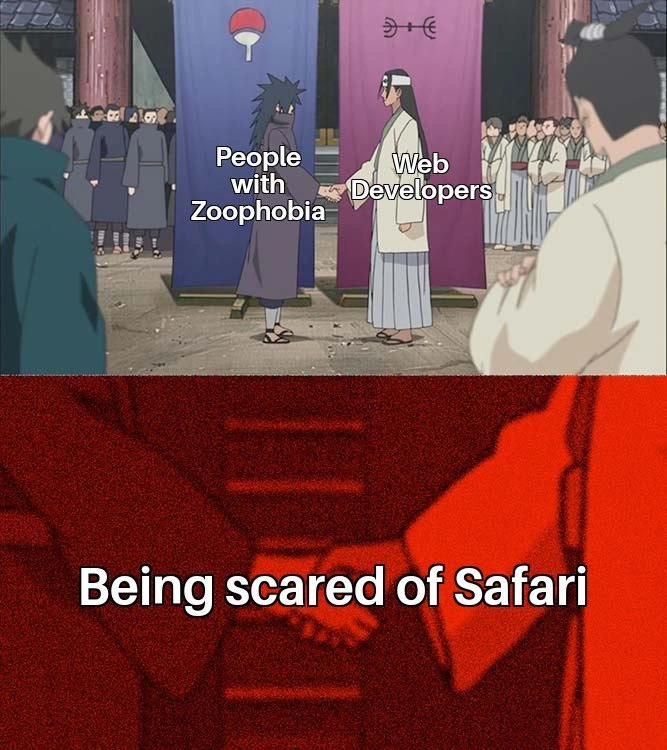
When even zoophobes and web devs bond over fear of Safari
Why is this WebDev meme funny?
Level 1: Bonded by Fear
Imagine two very different people becoming friends because they discover they’re both afraid of something called “Safari.” One person is scared of a safari in the wild – you know, a trip where you might encounter big scary lions or elephants. The other person is a coder who makes websites, and they’re “scared” of Safari, the web browser on Apple devices, because it often gives them trouble when making sites work. It’s funny because the word “Safari” means such different things to each of them, but the feeling of fear is the same!
In the picture, you see them shaking hands as if they’ve found common ground. It’s like two kids bonding on the playground: one says, “I’m afraid of Safari!” and the other says, “Really? Me too!” – even though one is thinking of wild animals and the other is thinking of a pesky computer program. They both laugh and team up, united by their shared scare. The humor is that a word can link two unrelated fears in a perfect, silly coincidence. In simple terms, both people feel nervous about “Safari,” and that unlikely connection makes them feel like allies. The meme makes us smile because it shows how even totally different folks can come together over a funny shared fear – turning fear into friendship, all thanks to the word Safari.
Level 2: Cross-Browser Headaches
When you build a website, you want it to look and work the same on every browser – whether it’s Google Chrome, Mozilla Firefox, Microsoft Edge, or Apple’s Safari. This goal is called browser compatibility, and achieving it can be a real headache for front-end developers. Each browser has a rendering engine under the hood (Safari’s engine is called WebKit, Chrome’s is Blink, Firefox’s is Gecko), and they don’t always agree on how to interpret the latest web standards. Safari browser quirks are those odd behaviors or missing features that only happen in Safari. For example, a fancy CSS effect or a new JavaScript API might work perfectly in Chrome and Firefox, but do absolutely nothing in Safari – or worse, break the layout of your page. Developers call these Safari-specific bugs. They’re infamous enough that “fear of Safari” is practically a running joke in the web development community (hence the meme).
To understand the meme’s layers: first, Zoophobia is an extreme fear of animals. Someone with zoophobia would dread going on a real-life safari (the kind where you ride a jeep and see lions – nope, too scary!). Meanwhile, a web developer might say they fear Safari, but they’re talking about Apple’s web browser. It’s a playful pun – two completely different safaris, one word. Yet both groups feel anxiety hearing that word! In real development work, saying “we need to support Safari” can make a newbie developer’s heart skip a beat, because it often means extra testing and debugging. Cross-browser testing is the process of checking your website in all major browsers. Seasoned devs will tell you: never skip testing on Safari, or it will come back to bite you.
Why is Safari so notorious? A lot of it comes down to delayed feature support and unique bugs. Apple tends to roll out Safari updates less frequently than Chrome or Firefox updates, and historically, Safari was slower to adopt certain features (like advanced grid layouts, certain HTML5 APIs, or proper debugging tools). On iPhones and iPads, Safari’s engine is the only one allowed – even “Chrome” on iPhone is really just Safari under the hood – so any Safari limitation affects all iOS users. This has led developers to treat Safari as a critical must-test browser. Many have been burned by something working everywhere else but mysteriously failing on an iPhone. For instance, early versions of Safari had issues with flexbox (a CSS layout mode): you’d design a nice responsive page, and Safari would shuffle things into weird places. To fix such issues, developers often resort to browser-specific CSS (like using -webkit- prefixes for Safari or special hacks detected via @supports rules) or include polyfills (bits of code that add missing features to a browser). These workarounds are extra effort that devs wish they didn’t need – hence the headache.
The top panel of the meme shows a scene from the anime Naruto where two rival clans form an alliance – here labeled “People with Zoophobia” and “Web Developers.” It’s an exaggerated visual metaphor: normally, those two groups have nothing to do with each other, but look – they’re shaking hands! Why? The answer is in the bottom panel: “Being scared of Safari.” The text is bold and the image is tinted ominous red for dramatic effect. It’s like saying, we’re bonded by this shared terror. In everyday coding life, this translates to developers universally groaning, “Ugh, Safari…”. Even a fresh junior dev, after their first project, will likely experience the moment where everything works on their computer (maybe using Chrome) and then someone opens the site in Safari and chaos ensues. It’s practically a rite of passage in Frontend work to mutter “Why is it always Safari?” and then head to Google or StackOverflow in search of a weird fix. The meme humorously ties that frustration to an actual phobia with the same name, making even non-developers chuckle once they get the double meaning. After all, whether it’s a lion on a safari or a layout bug in Safari, nobody wants a nasty surprise.
Level 3: The Common Enemy
In the browser wars, Safari has oddly become the common enemy that unites even the unlikeliest groups. The meme’s Naruto-inspired handshake highlights two very different clans – people with zoophobia (a fear of animals) and web developers – finding solidarity over a shared dread: Safari. It’s an absurd alliance rooted in real tech pain. Web devs often joke that Safari is the new IE6 – a modern Internet Explorer in sheep’s clothing. Why? Because Safari’s quirkiness and lagging support for web standards make it the browser everyone loves to hate (or rather, fears to support). Just as zoophobes break into a sweat at the thought of wild animals on an African safari, front-end engineers know the panic of a seemingly finished website breaking inexplicably on Apple’s Safari browser. In both cases, “Safari” triggers a fight-or-flight response!
To seasoned developers, this meme hits home. It’s pulling from years of shared trauma debugging Safari-specific issues at 3 AM. Imagine shipping a feature that works flawlessly in Chrome, Firefox, Edge… and then the QA team ominously asks, “But does it work on Safari?” – dread intensifies. Suddenly you’re embarking on a wild bug hunt through Safari’s unique ecosystem of bugs and missing features. It’s a rite of passage in web development: from weird flexbox gaps to unimplemented APIs, Safari has its own mind. The enemy-of-my-enemy dynamic is strong here: developers who might disagree on tabs vs. spaces will stand arm-in-arm complaining about Safari’s mouseleave event firing unpredictably or its outdated WebGL support. The war stories are plentiful: layout glitches that only manifest on an iPhone, or custom CSS hacks (looking at you, -webkit- prefixes) to tame Safari’s rendering. Each tale reinforces Safari’s reputation as that wild unpredictable beast lurking in your user base.
This unlikely camaraderie over “being scared of Safari” reflects an industry truth: cross-browser compatibility is a battlefield, and Safari often plays the final boss. The handshake meme format (from a famous Naruto truce scene) dramatizes it perfectly – mortal enemies setting aside differences to face a greater foe. It’s funny because it’s true: we’ve all cursed Safari under our breath. Apple’s browser has a stubborn habit of lagging on features (cough WebRTC and PWA support cough), forcing devs to write special case code. Many a cynical veteran dev has fond memories of sprinkling if (isSafari) { /* ...fix... */ } throughout their codebase, effectively signing a peace treaty with fellow frustrated colleagues. In short, Safari’s notorious incompatibilities have forged a bond of fear among developers – a shared understanding that if something bizarre is happening, it’s always Safari’s fault. The meme gets a knowing chuckle because we’ve all been there, shaking our head in disbelief at yet another Safari bug and thinking, “Even my worst enemies would sympathize with this nightmare.”
Description
Anime-style two-panel meme. Top panel shows a Naruto scene of two clans formally shaking hands; over the left character is white text “People with Zoophobia” and over the right character is “Web Developers”. They clasp hands in front of banners while onlookers stand behind them. Bottom panel zooms in on the handshake, tinted deep red with grain, and overlays bold white text: “Being scared of Safari”. The joke equates the phobia of wild-animal safaris with the notorious anxiety front-end engineers feel when dealing with Apple’s Safari browser quirks and compatibility bugs
Comments
6Comment deleted
Safari: the browser that makes veterans miss IE6 - back then you could tell users to upgrade; now you just file a Radar and pray Cupertino remembers what `position: sticky` means
Safari: the only browser where "it works on my machine" means "it works on everything except the CEO's iPhone"
Safari is the new IE6: it's the browser that makes you add `-webkit-` prefixes to everything, test on actual hardware because the simulator lies, and question every life choice that led you to web development. The real fear isn't the compass logo - it's opening DevTools and seeing your perfectly valid CSS Grid layout has decided to cosplay as a 1990s table-based design
Every frontend roadmap has a hidden line item called “WebKit tax” - two sprints to make the evergreen build behave on iOS Safari
Web devs' true spirit animal: the Safari bug that flexes harder than any savanna predator
Safari: the only compatibility bug whose remediation plan includes “upgrade iOS.”