A Web Developer's Public Service Announcement on Autoplay
Why is this UX UI meme funny?
Level 1: Nobody Likes Loud Surprises
Imagine you walk into a library and as soon as you open the door, a giant speaker above your head starts blasting music really loudly without warning. You’d probably jump in shock or get upset, right? You might even turn around and walk straight out! Well, that’s what it feels like when a website suddenly plays sound or music on its own. Nobody likes to be startled by a loud noise when they’re not expecting it. It’s rude and scary, like a jack-in-the-box popping when you didn’t wind it up.
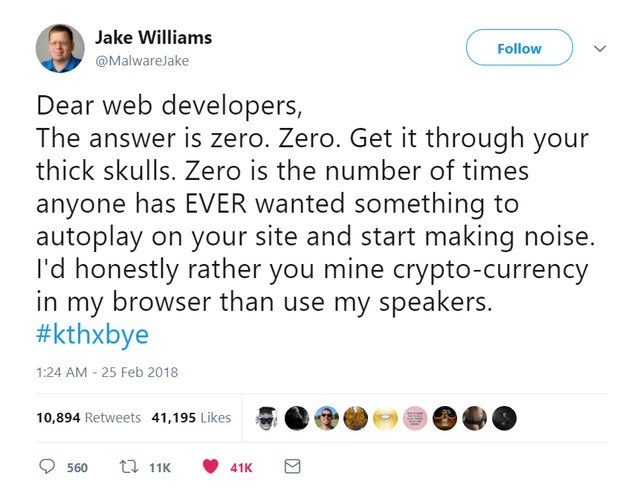
The picture here is a tweet (a message on Twitter) from someone who was really frustrated by this. He basically says: “Dear people who make websites, exactly zero people ever wanted your site to start making noise by itself. Seriously, not one person.” He’s using a bit of angry humor to make the point that no user wants auto‑play sound. In fact, he jokes that he’d rather have the website secretly use a bit of his computer’s power to do something bad (mining for digital coins, which is normally a big no-no) than have it make noise through his speakers. That’s a wild comparison, but it shows how annoying the sound is to him — he’d prefer even a sneaky bad thing as long as it’s quiet!
In simple terms, the tweet is telling all website makers: please don’t make things play sound without asking the user. It’s both funny and true. We laugh because we know how it feels — everyone has been startled by a loud website at some point and hated it. The lesson? Silence is golden on the web unless the user says otherwise. So if you ever create a webpage, remember this joke and keep the noise off by default. Your users will silently thank you!
Level 2: No Surprise Noise
Let’s break down what this meme is talking about in simpler terms. The tweet is complaining about websites that autoplay audio or video with sound as soon as you visit them. Autoplay means the media (like a song or a video) starts playing automatically, without you clicking a play button. For example, a developer might put something in the site’s code like:
<audio src="welcome_music.mp3" autoplay></audio>
This little snippet would make a file called welcome_music.mp3 start playing the moment the page loads. If you’ve ever opened a webpage and suddenly music or an ad jingle started blaring out of nowhere – that’s exactly what we mean by sound_on_load. It often makes you jump in your seat or rush to mute your speakers. Not fun, right?
Now, why do some websites do this if it annoys people? Sometimes site owners think it will grab your attention or they have a video ad that they want to make sure you hear. Other times, it’s just a bad design decision or an oversight. But almost all users find this behavior irritating. In user experience terms (UX), it’s considered a big mistake – a top-tier browser_ux_pet_peeve. Good UX/UI practice says: don’t surprise users with anything, especially not loud audio. Users generally expect a website to be quiet unless they choose to play a video or music.
The tweet’s author is basically shouting this message to “web developers” in frustration. He says, “The answer is zero. Zero. ... Zero is the number of times anyone has EVER wanted something to autoplay ... making noise.” In plain terms: nobody ever wanted your site to start making noise by itself. He’s using very strong language (“through your thick skulls”) because he’s fed up – it’s a bit of rage mixed with humor. A lot of people (judging by those retweet/like counts) obviously agreed strongly with him. They’ve been annoyed by the same thing. This is typical DeveloperHumor or FrontendHumor on Twitter: a sarcastic rant that calls out a common web developer mistake that affects users.
Now, here’s the twist that makes the meme extra funny: he says he’d honestly prefer if websites mined cryptocurrency in his browser than played audio. Mining cryptocurrency (like Bitcoin or Monero) in a browser means using the website visitor’s computer to do complex calculations that earn digital money. Some websites actually did this without asking – they’d run a hidden script to use your CPU power for mining (this sneaky practice is called cryptojacking or browser mining). It’s generally seen as pretty unethical and malware-like because it can slow down your computer a lot, make it run hot, and drain your battery. Normally, any user or developer would be horrified to have a site secretly do that.
So it’s a comedic exaggeration when the tweet says “I’d rather you mine crypto-currency in my browser than use my speakers.” He’s basically saying: “I’d take the lesser evil of a quiet theft of my computer’s resources over the immediate annoyance of unwanted sound.” Why? Because the crypto mining, while bad, doesn’t assault your ears or embarrass you in a quiet room. It’s a silent annoyance versus a noisy one. This comparison is absurd on purpose – it highlights just how much people hate unexpected sound. He even tags the post with #kthxbye, which is internet slang for “okay, thanks, bye” used in a snarky way. It’s like him saying, “that’s all, I’m out (and I hope you finally listen)”.
To put it simply: this meme is telling developers in a half-joking, half-serious way that auto-playing audio is a terrible idea. It’s been a long-running joke and complaint in WebDevelopment and UXDesign circles. So many people have been annoyed by it that browsers stepped in to curb it. Nowadays, if you notice, most browsers won’t let a random video clip blare sound unless you click “play” or have interacted with the site; that’s a direct response to this issue. Users demand control over their sound. And if a site violates that, users will be irritated or even leave immediately.
So for a junior developer or someone new to FrontEnd work: take this as a friendly warning from the community (wrapped in humor). Never build a site that auto-plays sound or video with sound without the user’s permission. It might seem like a small thing, but it’s one of the quickest ways to lose your audience’s trust (and have them close your page in a heartbeat). Keep the user in charge of the play button, and everyone will be happier. kthxbye! 😉
Level 3: Zero Tolerance for Autoplay
In the world of web development, this meme hits on a universal truth: autoplay audio on websites is almost universally despised. The tweet screenshot shows security expert Jake Williams (aka @MalwareJake) ranting that “Zero is the number of times anyone has EVER wanted something to autoplay on your site and start making noise.” Experienced developers and UX designers are nodding furiously because surprise sound is a notorious UX/UI sin. It’s a piece of classic FrontendHumor that rings true for any seasoned dev who’s been forced to add (or remove) some auto-playing video or music on a page.
Why is this so funny (and painfully true)? The author’s frustration is cranked to 11: “Get it through your thick skulls,” he says, calling out those developers or product managers who still think auto-playing sound is a good idea. The dramatic exaggeration — “zero means zero” — underscores a real UserExpectations failure. No user opens a page thinking, “Gee, I hope this site immediately blasts music at me.” In fact, many of us have experienced that heart-stopping moment: you click a link, maybe at work or late at night, and suddenly an ad or video starts blaring. Cue the frantic scramble for the mute button or closing the tab. It’s embarrassing (imagine your speakers inadvertently announcing a shampoo ad in a silent office) and startling (R.I.P. headphone users). This tweet perfectly captures that shared end_user_annoyance in a humorous rant format.
The humor goes into overdrive with the comparison Jake makes. He says he’d rather have the website mine cryptocurrency in his browser than use his speakers. 😮 This is a tongue-in-cheek reference to browser mining, also known as crypto-jacking when done without consent. To unpack that: some shady sites in the late 2010s found they could run JavaScript or WebAssembly to hijack your CPU and mine digital coins (like Monero) while you visit. It’s generally considered malware-adjacent and a huge violation of trust — it can make your computer super slow, overheat your device, and drain your battery. The fact that a security guy is jokingly saying “go ahead, steal my CPU cycles and power to get crypto, just don’t play sound” is hilarious because it’s choosing the lesser of two evils. Auto-play audio is portrayed as so bad that he’d prefer an outright UX failure and security abuse that remains silent. It’s an extreme way to say: unwanted noise is the absolute worst thing you can do on a site. It’s like telling someone, “I’d rather you pick my pocket (quietly) than you set off an air horn next to my ear.”
From a senior developer perspective, this tweet is cathartic. It’s venting about a battle we’ve fought for years. Many of us have horror stories of a Frontend project where a higher-up insisted: “Let’s have a video autoplay when the page loads, it’ll increase engagement!” – even though all the data and developer common sense screamed that it would just annoy users. This is why we classify surprise audio as a prime example of UXFailures. Users should be in control of sound on their devices; this is a fundamental UX design principle. Violating it not only scares or irritates people, it can also damage your site’s reputation or SEO metrics (since frustrated users bounce away immediately).
There’s also a bit of history and BrowserQuirks context here. In the wild-west early days of the web, auto-playing music (often via <embed> tags or Flash) was unfortunately common. Remember those personal MySpace or GeoCities pages that greeted you with a loud MIDI song? 😬 People quickly learned to hate it. Fast forward to the late 2010s: browsers finally took a stand. Around the time of this tweet (early 2018), Chrome and other browsers began implementing strict auto-play policies. Modern browsers often block auto-play audio by default now, requiring a user gesture (like a click) to initiate sound. They literally had to bake this into the browser engines because too many sites abused auto-play. This tweet’s popularity (10,000+ retweets, 41,000+ likes) helped drive home the point to any developers still living under a rock: no more surprise sound. The hashtag #kthxbye at the end of the tweet is the bitterly comedic cherry on top – internet slang for “okay, thanks, bye,” as if politely but firmly slamming the door on this practice.
In summary, the meme humorously delivers a serious PSA: Dear web devs, nobody wants your site to blare audio without permission. If you do that, expect users to flee – or even wish malware upon your site as payback! It’s an exaggerated senior-level gripe that reflects real user frustration. Everyone from hardcore developers to casual internet users can relate, which is why it’s such effective DeveloperHumor. The next time someone suggests auto-playing a promo video on your homepage, just remember this meme and confidently reply: “Zero. The answer is zero.” 🎤🏽⬇️ (mic drop).
Description
A screenshot of a popular tweet from user Jake Williams (@MalwareJake), dated February 25, 2018. The tweet is a strongly worded rant directed at web developers. The full text reads: 'Dear web developers, The answer is zero. Zero. Get it through your thick skulls. Zero is the number of times anyone has EVER wanted something to autoplay on your site and start making noise. I'd honestly rather you mine crypto-currency in my browser than use my speakers. #kthxbye'. The tweet shows significant engagement with over 10,000 retweets and 41,000 likes. The humor comes from its aggressive, relatable frustration with a universally hated web feature: autoplaying audio. It humorously escalates the bad user experience by comparing it unfavorably to cryptojacking, a malicious activity. This resonates with senior developers who champion good UX and often have to argue against such features demanded by non-technical stakeholders
Comments
7Comment deleted
The fastest way to get a user to close a tab is with autoplay audio. It's like a speedrun competition for bounce rate
Ran an A/B test: Variant A autoplayed audio, Variant B quietly mined Monero; engagement stayed at 0%, but only one covered the Kubernetes bill - so congrats, “background-music.js” is now a design guideline
The irony of preferring silent CPU-melting cryptojacking over a 3-second marketing video perfectly captures the hierarchy of web annoyances - at least malware has the decency to suffer in silence while it steals your electricity
The fact that a security researcher would rather have their CPU cycles stolen for cryptocurrency mining than deal with autoplay audio perfectly captures the hierarchy of web annoyances: at least cryptojacking is silent. It's the ultimate indictment of autoplay - when malicious resource exploitation is preferable to your UX decisions, you've achieved a special kind of anti-pattern that belongs in a museum of terrible design choices, right next to `<blink>` tags and Flash intros
If your growth hack needs autoplay with sound, it’s not engagement - it’s an integration test for the mute button and Chrome’s MEI heuristic
Autoplay audio: the only web 'feature' where cryptojacking wins on UX grounds by respecting the principle of least astonishment
Autoplay audio: the only growth hack where Chrome’s default is no, Safari’s is lol-no, and user feedback is Cmd+W. If you must steal cycles, mint Monero in WASM - at least it’s quiet