The Unrealistic Demands of JavaScript Job Postings
Why is this Career HR meme funny?
Level 1: Silly Wish List
Imagine you see a flyer looking for a soccer player for your school’s team, but at the bottom it says, “Ability to solve advanced math problems is a plus.” Huh? You’d probably laugh and think, “Why would doing hard math matter for playing soccer?” It feels completely unrelated and a bit silly. Maybe the coach just added it hoping to find a super-student, but really, it doesn’t make sense for the game.
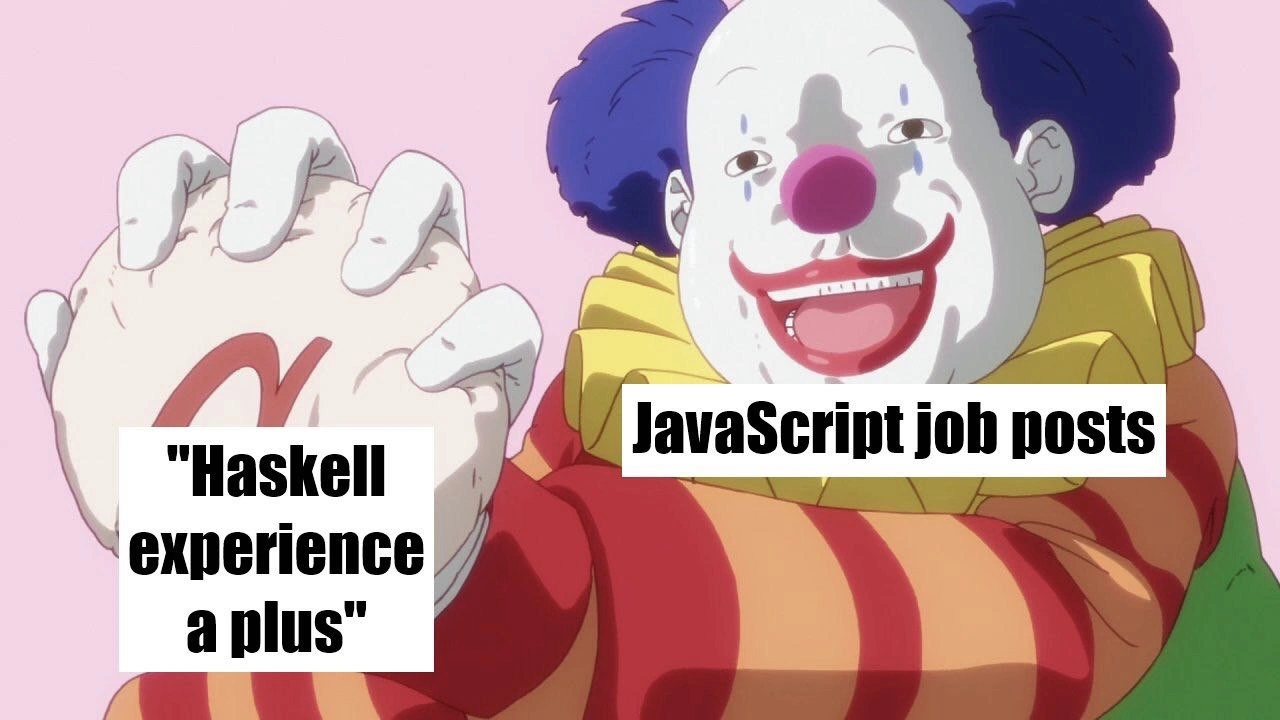
This meme is making fun of that same kind of situation, but in programming. A job ad for a JavaScript programmer threw in “Haskell experience a plus” like an oddball extra requirement. It’s funny because it doesn’t belong there – kind of like asking a clown at the circus to also know how to fix a car engine “just in case.” Both the soccer flyer and this clown meme show a silly wish list of skills. The core joke is: the people hiring are asking for something unnecessary (and maybe they don’t really know what they’re asking!). Developers laugh at this because it happens a lot in real life – companies list crazy, unrelated skills in job posts – and it’s always a head-scratcher. In simple terms, the meme is teasing those job postings for being unrealistic and goofy, just like that imaginary soccer ad asking for a math whiz.
Level 2: Haskell in JavaScript Land
For a newer developer or someone early in their career, let’s break down why this meme is funny. It’s all about a job advertisement that’s asking for skills that don’t really go together. JavaScript is the language of the web – it’s what you use to make websites interactive in browsers, build user interfaces, and generally it’s everywhere in front-end (and often back-end with Node.js too). A “JavaScript job” usually means you’ll be working on web applications using JavaScript and related technologies (like maybe React or Angular for the front-end).
Now enter Haskell – a completely different programming language that lives in a rather separate world. Haskell is known for functional programming, which is a programming style focused on math-like functions and avoiding changing state or mutable data. It’s a compiled, statically-typed language often used in academic settings, research, or very specialized industries (some finance or high-reliability systems) that appreciate its precision and correctness. Haskell code looks and feels nothing like JavaScript code. For example, in Haskell you might see functions with explicit type annotations and no side effects, whereas JavaScript is looser about types and side effects (like updating the webpage) are its bread and butter. They’re as different as two programming languages can be in terms of syntax and philosophy.
When a job post says “XYZ experience a plus,” it means “we don’t require XYZ, but it would be nice if you have it.” It’s a way for companies to list secondary skills that could be useful. For instance, a posting might say “CSS knowledge required, Photoshop experience a plus” for a web design role – Photoshop isn’t required, but someone who has it might be extra-helpful. That’s fine when the “plus” skill is somewhat relevant to the job. The joke here is that "Haskell experience a plus" is showing up in a JavaScript job requirements list, and those two have almost no overlap. It’s an example of a weird job posting requirement.
Why would they even add that? Sometimes, it’s a copy-paste error or a template gone wrong – maybe the company had a different role that wanted Haskell, and it accidentally slipped into the JavaScript role description. Other times, the people writing the job ad (recruiters or HR folks) might think “Haskell is a tough, respected language – if our new hire knows it, that means they’re really smart!” It could also be that the team has a tiny bit of functional programming work or just as a buzzword to sound cutting-edge. But to an informed reader, it mostly comes off as the company not understanding their own needs. If you’re a junior developer reading a JavaScript position description and you see a line about Haskell, you’re right to scratch your head. You might wonder, “Do I seriously need to know Haskell for this? I thought this was about building websites.” The answer is: probably not at all. It’s likely misaligned expectations or just an overly enthusiastic wish list item from the employer.
So in summary, the meme is highlighting this language_stack_mismatch: a JavaScript job asking for a totally unrelated skill, Haskell. Developers find it funny because it’s a common experience to see job ads list impractical combinations of skills – it’s the kind of thing you eventually learn to take with a grain of salt (and maybe chuckle about with fellow devs). The clown in the image represents those ridiculous job postings, and squeezing that “Haskell a plus” heart just exaggerates how out-of-place that requirement is (like a clown honking a random toy in a serious setting).
Level 3: Clown Car Requirements
Now, stepping down to a senior developer’s perspective, the humor becomes about hiring practices and unrealistic job postings. The meme shows a clownish figure labeled “JavaScript job posts” greedily squeezing a heart labeled “Haskell experience a plus.” It’s a perfect metaphor for how some job listings cram in every fancy tech skill they can think of – a clown car jam-packed with requirements vs. reality. Seasoned devs immediately recognize this as copy-paste culture: an HR or hiring manager takes a template (or someone else’s wishlist) and adds a dash of whatever trending language they recently heard about. The result? Absurd combinations like a basic JavaScript front-end role that casually suggests “Oh, by the way, Haskell would be a nice bonus.”
We’ve all seen these listings and done a double-take. You might find a posting for a web developer role that reads something like:
Job Ad: Seeking expert JavaScript developer, familiar with React and Node.js. Must have experience with REST APIs, HTML/CSS, and UI/UX principles. "Haskell experience a plus".
That last line hits like a pie in the face – a totally clownish surprise. Why Haskell?! It’s as if the hiring team thought, “We only want super-geniuses – and hey, people who know Haskell are smart, right? Stick that in there!” It’s a classic case of misaligned expectations. The language stack mismatch here is glaring: the job’s tech stack is JavaScript, a completely different ecosystem from Haskell’s. Including Haskell knowledge is about as useful as a trapeze in a cubicle – it doesn’t correlate with the actual work.
From a veteran’s viewpoint, this is both funny and frustrating. Funny, because it’s patently ridiculous – imagine a clown listing outlandish tricks they can do, unrelated to the show you’re hiring them for. Frustrating, because it signals that whoever wrote the job req might not really understand what they need. It’s hiring humor rooted in truth: companies sometimes ask for unicorn candidates fluent in every paradigm, hoping to cover all bases. In practice, this just discourages good candidates or becomes an industry joke. Experienced developers trade anecdotes about weird job postings like these the way war veterans trade battle stories. “Remember the ad for a junior dev that required 10+ years of Java experience?” “How about the one wanting a front-end dev with C++ and Assembly?” This JavaScript + Haskell combo is cut from the same silly cloth.
The clown imagery underscores the silliness: JavaScript job posts are being personified as a goofy clown gleefully clutching that irrelevant “Haskell” requirement. The clown’s exaggerated grin is basically the hiring manager saying, “Look how clever we are including a fancy language!” Meanwhile, any developer reading it wears a bemused smirk or an eye-roll. It’s a language wars gag too – JavaScript and Haskell come from such different universes that tossing them together feels like a bad joke. The meme nails the shared industry sentiment: these laundry-list job ads are a circus, and sometimes, the biggest clown is the job posting itself.
Level 4: Pure Functions, Impure Circus
At the most theoretical level, this meme spotlights a language paradigm mismatch. Haskell is a purely functional programming language with a strong static type system and heavy mathematical underpinnings (think lambda calculus and category theory). In Haskell, functions are first-class citizens that avoid side effects; even printing to the screen involves an IO monad to keep impurity contained. By contrast, JavaScript is a dynamic, impure language born for quick web scripting – it lets you modify a webpage, handle user events, and console.log to your heart’s content without formally structuring side effects. The two languages live on opposite ends of the spectrum: one enforces mathematical rigor and compile-time types, the other thrives in the wild west of runtime flexibility.
To illustrate, here’s a tiny example of how differently these languages express a simple idea, adding two numbers:
-- Haskell: statically typed, pure function
add :: Int -> Int -> Int
add x y = x + y
-- The type signature Int -> Int -> Int means add takes two Ints and returns an Int.
-- Haskell won't even compile this if types don't match or if impure actions happen.
// JavaScript: dynamic, no explicit types by default
function add(x, y) {
return x + y;
}
// JavaScript will run this even if you pass non-numbers at runtime (and give NaN).
// No compile-time type checks here, and side effects (like logging or DOM changes) can be anywhere.
In a theoretical CS context, asking for Haskell in a JavaScript role is like demanding knowledge of group theory to solve a simple addition problem. Sure, both Haskell and JavaScript can technically compute things, but Haskell’s world of monads, immutability, and Hindley-Milner type inference is overkill for the day-to-day needs of a typical web app built on JS. It’s a bit as if a circus clown (our JavaScript job post) is bragging about knowing some high-brow abstract algebra trick (Haskell) that won’t actually be used in the circus show. The pure functions of Haskell just don’t have a role in the impure event-driven frenzy of browser scripts. This deep mismatch is what makes seasoned developers smirk – it’s a fundamental disconnect, almost satirical in how it violates the principle of using the right tool for the job (or in this case, asking for a tool nobody in that job will use).
Description
An anime-style meme featuring a smiling, crazed-looking clown with blue hair and a red-and-yellow striped outfit. The clown represents 'JavaScript job posts', as indicated by a white label over its chest. In its hands, it's squeezing a small, flesh-colored ball that is labeled '"Haskell experience a plus"'. The humor stems from the extreme disconnect between the two technologies. JavaScript is the ubiquitous, multi-paradigm language of the web, while Haskell is a niche, purely functional programming language known for its steep learning curve and academic rigor. Listing Haskell experience as a 'plus' for a JavaScript role is seen by experienced developers as a sign of a clueless recruiter or a deeply confused job description, akin to asking for a chef's experience in molecular gastronomy for a job flipping burgers. It's a satire of poorly written job posts that are just a laundry list of unrelated buzzwords
Comments
7Comment deleted
That job post was probably written by someone who thinks 'monad' is a new JavaScript framework
Modern JS job ad: React, Node, vite - and, apparently, the ability to thread their callback hell through a Kleisli arrow just in case
We spent three years building a type-safe, purely functional hiring pipeline that guarantees no side effects, but somehow it still produces the same JavaScript developers who think undefined is a feature
Ah yes, the classic 'Haskell experience a plus' in JavaScript job posts - because nothing says 'we value monadic purity and strong type systems' quite like asking you to wrangle `this` binding and prototype chains in a codebase where `any` is the most common type annotation. It's the hiring equivalent of saying 'PhD in theoretical physics preferred' for a role that's 90% fighting webpack configs and explaining to stakeholders why their jQuery plugin from 2012 won't work in React 18
Haskell 'a plus' for JS gigs: because curried functions fix prototype chain breakage, right?
JavaScript job post: “Haskell experience a plus” - translation: there’s a mission‑critical Haskell daemon from the CTO’s FP phase, 90% monads and 0% maintainers; your first ticket is “just add logging.”
JavaScript role: 'Haskell a plus' - aka the ATS’s weighted scoring function for ‘knows monads,’ while the repo is callback hell wrapped in a Maybe