Patiently Waiting for AI to Filter the Regex-Averse
Why is this AI ML meme funny?
Level 1: Waiting for a Robot That Never Comes
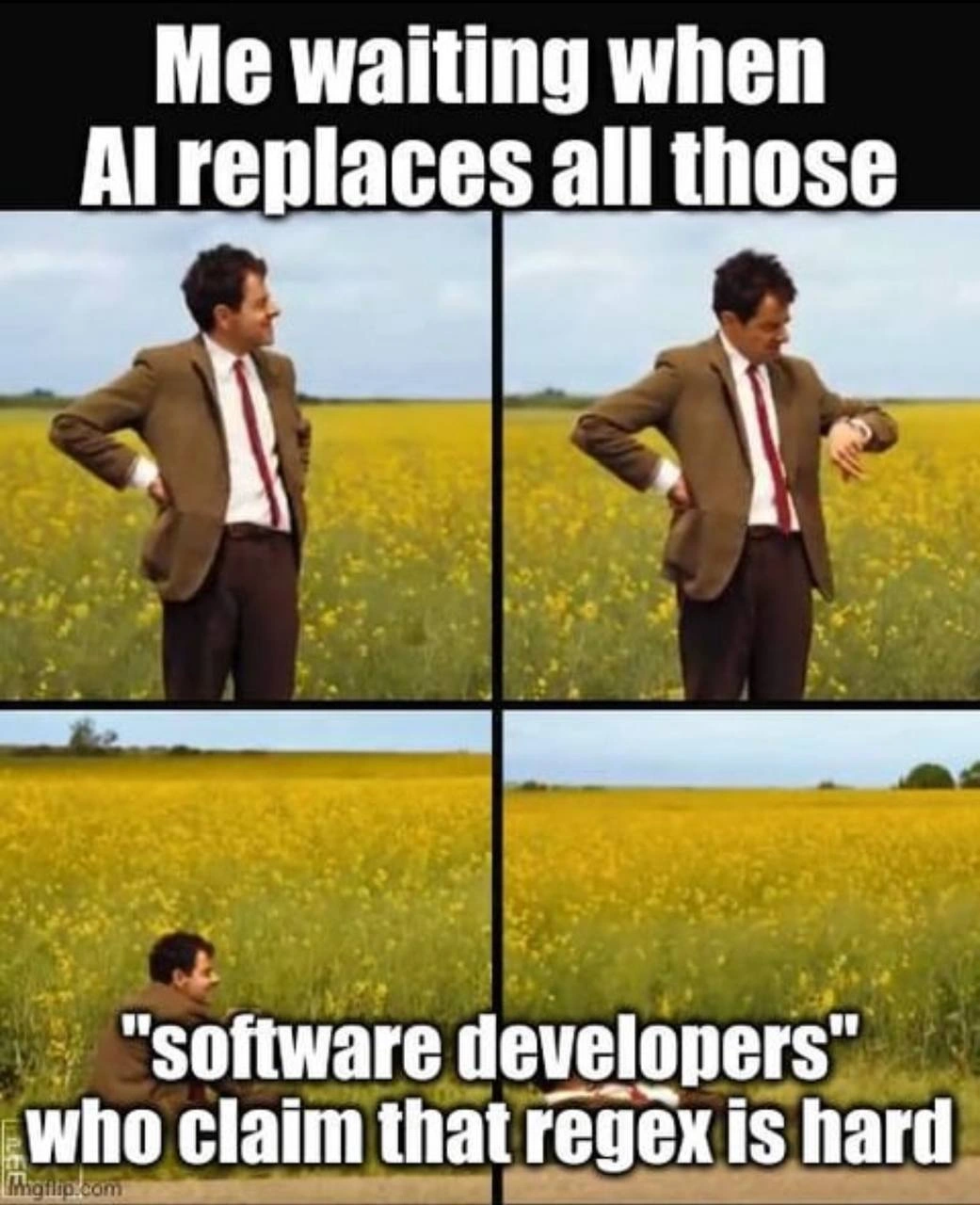
Imagine a kid in school who’s really good at solving a particular puzzle, like a tricky riddle. Now, this kid starts teasing others, saying, “If you guys can’t solve this riddle, maybe a robot should just come do your homework instead of you!” He’s acting like the other kids aren’t “real students” because they find the puzzle hard. So he goes outside and stands there, waiting for a magical robot teacher to appear and replace all the classmates who struggled. He waits… and waits… checks his watch… lies down on the ground… and of course, no robot ever comes. He’s basically waiting forever. It’s a silly image, right? He was so sure this super-smart robot would show up instantly to prove him right, but in the end he’s just alone in a field, looking a bit foolish.
This is funny because the kid was being kind of mean and braggy to begin with — and reality totally made him the punchline. He expected something unrealistic (a robot taking over immediately) just to get rid of people he was mocking. The fact that he waits so long that he gets bored and lies down shows how ridiculous his idea was. In simple terms, the meme is laughing at the idea of someone being overly proud about a skill and thinking a robot will swoop in to replace others who lack that skill. It reminds us of playground bragging: one kid saying “I’m so good at this and you’re not, haha!” — but taking it to such an extreme that it backfires on them. Watching Mr. Bean (the man in the suit) waiting in that big yellow field all day is like watching that bragging kid realize, “Huh, maybe I was wrong (and now I’m just lonely out here).” The humor comes from seeing someone act superior, then ending up in a comically pathetic situation because what they expected to happen didn’t happen at all. It’s a gentle way of saying, “Be careful about making fun of others and counting on crazy solutions — you might just be left waiting in the field!”
Level 2: Regex & AI in Plain Terms
Let’s break down the meme in simpler, practical language. Regular expressions, or regex, are basically little patterns that help software search for or manipulate text. Think of a regex pattern as a formula for matching strings. For example, if you want to check if a string looks like a phone number, you might use a regex like ^\d{3}-\d{3}-\d{4}$. That cryptic string basically means: “start of text, then 3 digits, a dash, 3 digits, a dash, 4 digits, then end of text.” Regex is like its own mini language - full of symbols (\d for digit, \w for word-character, * for "repeat", etc.) that all combine to mean “find text that fits this shape.” It’s incredibly useful for tasks like validating input formats, searching through logs, or find-and-replace operations. But here’s the catch: regex looks intimidating. All those squiggly symbols and punctuation packed together can be hard for a human to read or write correctly. Many developers, especially when they’re new or if they don’t use regex often, will say “ugh, regex is hard!” because it feels like deciphering gibberish. This is totally common – even experienced devs often have to test their regex patterns carefully or look up references.
Now, who are these developers in quotes – “software developers” who claim regex is hard? The quotes imply a sarcastic tone. It’s like the meme’s author is saying “so-called developers” in a teasing way, as if those folks aren’t real developers. This is a form of gatekeeping – implying that real devs should find regex easy. In reality, that’s a bit unfair. Regex can be challenging, and acknowledging that doesn’t make someone a fake developer! In fact, a good developer knows their tools’ limits. Regex is powerful but not always the right tool for every job, and it’s easy to make mistakes with it. So, lots of developers (probably the majority, honestly) will empathize with the idea that regex has a steep learning curve. There’s a sort of running joke in programming communities about regex being line noise or looking like someone swatted a fly on the keyboard. This meme taps into that common sentiment, but then adds an AI twist.
Speaking of AI, let’s clarify that part. When the meme says “Me waiting when AI replaces all those…”, it’s referencing the buzz in tech that Artificial Intelligence (particularly things like machine learning models or code-writing bots) might take over jobs or tasks done by humans. In the context of development, there are AI tools now that help write code. For example, GitHub Copilot or chatbots like ChatGPT can generate code snippets (including regex patterns) if you ask them. This has led to debates like “Will AI replace programmers?” Here, the meme’s narrator is jokingly eager for AI to automate away a certain group of developers (the ones complaining about regex). He’s essentially saying: “I can’t wait until AI gets good enough to do the job of these regex-whiners, so we don’t have to hear them anymore.” It’s a pretty snarky sentiment! But the joke is that this person is waiting… and waiting… and waiting. The meme uses the Mr. Bean waiting template – three panels of Mr. Bean in a field checking his watch, followed by him slumped on the ground from waiting so long. This template is classic for saying “I’m going to be waiting forever, aren’t I?” The bright yellow canola field surrounding Mr. Bean really emphasizes how alone and prolonged this wait is – it’s just him, nature, and time stretching on. In meme-speak, it visually screams: “any day now… (not).”
So, putting it together in plain terms: The meme-maker is poking fun at colleagues or internet commenters who always complain “regex is too hard.” The top text says, “Me waiting when AI replaces all those (people)...” and the bottom text punchline says, “‘software developers’ who claim that regex is hard.” It’s a tongue-in-cheek way of saying, “I wish an AI would just do these whiners’ jobs, because clearly they’re not real programmers — but look, I’ve been waiting forever, so maybe that’s never gonna happen.” The humor comes from exaggeration and irony. We know in reality that AI is not close to literally replacing developers wholesale, and certainly not just over one skill like regex. We also sense that calling people “not real devs” for struggling with a complex tool is an over-the-top, mean thing to say. The meme highlights that by showing the narrator waiting endlessly, essentially undercutting his own mockery. It’s like the joke is on the person who thought AI would vindicate his elitist stance. In developer communities, this meme is relatable because it touches on a couple of very current themes: frustration with hard tools (regex being a prime example of something that trips up devs a lot) and the almost comedic impatience some folks have with the AI revolution (“Why hasn’t the AI taken over already?!” said no serious engineer ever, but plenty of memes do).
To a junior developer or someone new: don’t be thrown by the snark. It’s okay to find regex hard! A lot of us use cheat sheets or Google to write complex patterns. And AI – while cool – is more of an assistant right now than a replacement. The meme is essentially combining those ideas to make a joke. It’s relatable humor mixed with a bit of satire. If you’ve ever struggled with a one-liner of code that someone else thought was easy, you can chuckle at the absurdity of wanting to replace folks over that. And if you’ve heard the buzz about AI taking jobs, you’ll recognize the meme’s dramatic waiting pose as saying, “Yeah... I’m not holding my breath.” 😅
Level 3: Hype & Gatekeeping
Stepping down to a senior developer’s perspective, this meme combines two familiar industry themes: AI hype cycles and developer gatekeeping. On one hand, we have the over-enthusiastic idea that “AI will replace developers” – a trope that surfaces with every new tech wave (from code-generators, to 4GLs, to today’s ML-driven copilots). On the other hand, we have the age-old gatekeeping attitude: implying that real software developers shouldn’t struggle with certain tools (“regex is easy for real devs”). By saying "software developers" in quotes, the meme’s narrator is mocking those who claim “regex is hard,” questioning their developer cred. It’s dripping with technical satire: a mix of arrogance and dark humor that seasoned devs recognize instantly. We’ve all seen characters in the tech community who pride themselves on wielding esoteric tools (like regex) and belittle others for not mastering them. This meme calls out that bravado, but it does so ironically: the very punchline is that our smug regex guru is waiting indefinitely for AI to purge these so-called unworthy devs. The absurdity is clear to experienced eyes – if every developer who groaned “Ugh, regex is tough” got replaced, would there be anyone left writing code? Probably not many, since even brilliant engineers have been flummoxed by a gnarly regex on a Friday afternoon.
Why is this combination funny to developers? For one, it’s a relatable humor scenario. Regular expressions are infamous in programmer culture. There’s the classic joke by Jamie Zawinski: “Some people, when confronted with a problem, think: ‘I know, I’ll use regular expressions.’ Now they have two problems.” 😂 This one-liner captures the reality that regex, while powerful, can be a pain to get right and maintain. Many of us have experienced that moment of developer schadenfreude – a mix of sympathy and amusement – when a colleague’s 20-character regex goes horribly wrong. So when the meme jabs at “the 'regex is hard' crowd,” seasoned devs smirk because we’ve all been in that crowd at some point (even if some won’t admit it).
Now, about the AI replacing devs angle: This has been a hot topic in the AI/ML era. Every few years, a tool comes along that supposedly will make programmers obsolete. Remember when GitHub Copilot was announced? People joked it would take our jobs. Before that, it was model-driven development or AI code generators. Industry veterans have the scar tissue from these hype cycles – they’ve seen grand promises fizzle out. Yes, AI can assist in generating code (including regex patterns). An AI humor trope is asking something like ChatGPT for a regex: sometimes it produces impressively correct patterns, other times it confidently outputs a flawed one. Senior devs know that current AI models have limits: they lack true understanding, can introduce subtle bugs, and often need a human in the loop for validation. So the meme’s image of Mr. Bean patiently waiting highlights the skepticism: “Sure, I’ll wait here until AI replaces those developers… any day now!” It’s an eye-roll at the notion that we can simply automate away people who have a hard time with a tricky tool.
There’s also a bit of organizational reality encapsulated here. In real teams, if someone struggles with regex, you don’t fire them; you might pair them with someone more experienced or use a different approach. Heck, plenty of senior developers themselves copy regex snippets from Stack Overflow or use online testers to verify patterns. That’s good Developer Experience (DX) – knowing when to use a tool or when to seek help. The meme’s gatekeeping stance (“they’re not real developers!”) is recognized by experienced devs as a tongue-in-cheek exaggeration. It ridicules the elitism that sometimes appears in tech circles. In truth, being a “real developer” doesn’t mean memorizing arcane syntax like an incantation; it means solving problems, often collaboratively and with the help of tools.
From a historical context, regex itself is an old technology (dating back to the 1950s in theoretical form, and to the 1960s and 70s in UNIX text processing). It’s been the source of both awe and agony for decades. Likewise, the idea of AI-driven programming has popped up repeatedly in history. Each time, when a new level of automation arrives (be it higher-level languages, IDE wizards, or AI code assistants), some proclaim the end of programmers. Yet here we are in 2025, and developers are still in demand – including those who say “regex is hard”! The meme is essentially a senior dev’s inside joke: combining a bit of regex gatekeeping (which we recognize as somewhat toxic) with the current fad of “AI will take our jobs”. The two together create a ridiculous scenario that highlights the folly in both – it’s making fun of the gatekeepers by showing them clinging to the latest hype to justify their attitude.
Finally, consider the visual exaggeration: Mr. Bean, a comedic figure known for being a bit absurd, stands all alone in a vast, bright yellow canola field. For experienced devs, this image conjures the feeling of waiting endlessly for some promised tech revolution or managerial miracle that never arrives. (We’ve waited for builds to finish, for bugs to magically fix themselves, for that one senior “10x developer” to join the team… we know the drill.) The longer you stare at Mr. Bean checking his watch and then lying down, the more you relate to that futile wait. It’s the perfect representation of hype meets reality. In the end, Level 3 insight: the meme humorously exposes that both *“regex is trivial” bragging and “AI will replace devs” predictions are hollow – and those clinging to either are in for a long, lonely wait.
Level 4: Finite Automata & Infinite Wait
At the deepest theoretical layer, this meme pokes at the intersection of formal language theory and the perennial AI hype. Regular expressions (regex) come straight from the realm of automata theory: they describe regular languages which can be recognized by finite automata. In formal terms, regex patterns are defined using operators like union, concatenation, and the famous Kleene star (the * symbol meaning "repeat indefinitely"). Amusingly, the Kleene star implies an arbitrary number of repetitions – a fitting metaphor for Mr. Bean’s infinite patience in that field. From a computational standpoint, pure regex (without crazy extensions) can be executed by a deterministic finite automaton in linear time relative to input size. Yet, modern "regex" engines (like PCRE in many languages) offer additional features like backreferences and lookahead that go beyond true regular languages. These additions make the engine use backtracking algorithms – which can lead to exponential time complexity in pathological cases. In other words, a poorly-crafted regex can indeed be hard in the algorithmic sense: it might cause catastrophic backtracking that grinds your CPU. Seasoned devs know that a seemingly innocuous pattern can turn into a ReDoS (Regular Expression Denial of Service) if it explodes in complexity for certain inputs. So when someone says “regex is hard,” they’re not entirely wrong – there’s genuine computational complexity hiding under that terse syntax.
On the AI side, replacing developers isn't just a technological challenge, it's bumping into theoretical limits. The notion of AI replacing programmers essentially means solving the general program synthesis problem: automatically generating correct, efficient code from high-level intentions. That problem is related to the Halting Problem and other undecidable or intractable problems in computer science. There’s no guaranteed algorithm to produce a perfect program for an arbitrary task – such a thing would amount to solving an unsolvable problem. Modern AI (like large language models) sidesteps this by statistical pattern matching rather than formal reasoning. It predicts code that looks right based on training data, but it doesn't truly "understand" the spec or prove the solution correct. From a theoretical lens, expecting an AI to fully automate away developers is like expecting a Turing machine to magically decide all halting scenarios. You’ll be waiting in that canola field forever if you’re hoping for a mathematically complete solution. In summary, at Level 4 we see the meme teasing two fundamental truths: regex packs more theoretical complexity than its compact notation suggests, and AI isn’t anywhere near cracking the hardest logical problems behind real software development. The punchline is essentially a nerdy one: the meme’s protagonist is as likely to witness AI perfectly replacing regex-challenged devs as he is to find a new deterministic solution to an NP-complete problem. That’s why Mr. Bean might as well get comfy in that field – he’s waiting for something that theory itself hints may never fully arrive.
Description
A four-panel meme using the 'Mr. Bean Waiting' format. The top text across all panels reads, 'Me waiting when AI replaces all those'. The first two panels show Mr. Bean standing in a vast yellow field, smiling and then checking his watch. The bottom-left panel shows him sitting down, implying a long wait. The bottom-right panel has the punchline overlaid: '"software developers" who claim that regex is hard'. The quotation marks around 'software developers' are sarcastic, suggesting the author doesn't consider them true developers. The meme is a form of gatekeeping humor, playfully asserting that a developer's inability to handle regular expressions - a notoriously complex but powerful tool for pattern matching - is a sign of incompetence, and that these individuals will be the first to be made obsolete by artificial intelligence

Comments
44Comment deleted
I'm not saying I agree, but I did once see a senior engineer try to parse an HTML string with regex, and now I believe some people deserve to be replaced by a well-trained `sed` command
Call me when the LLM can craft a single-line PCRE that validates nested parentheses *and* passes code review without a three-day bikeshed
The real regex here is /(senior|architect)/ matching developers who've spent years debugging someone else's 'clever' one-liner that could've been three readable lines - yet still waiting for AI to understand why (?<!\\)(?:\\\\)*\K@(?=\S) is perfectly reasonable for email validation in legacy Perl
The real irony? AI models are literally built on regex-like pattern matching at their core, yet somehow we're supposed to believe they'll replace the developers who understand those patterns. It's like saying calculators will replace mathematicians who understand addition - sure, the tool automates the execution, but someone still needs to know when and how to apply it. Besides, any senior engineer knows the hard part of regex isn't writing it - it's maintaining the one your predecessor wrote without comments six months later
I'll worry about AI taking my job when it writes a production-safe regex that avoids catastrophic backtracking, and then pushes back with 'use a parser'
AI will replace us right after it ships a regex that validates emails, avoids catastrophic backtracking on prod logs, and remains maintainable by someone other than the author
AI masters regex greedily, but those devs match the lazy quantifier: they'll be replaced first
It's not that regex is hard, it's just that we rarely need it and by the time we do, we have already forgotten it lol Comment deleted
You see thats a skill issue. Did you know the find and replace dialogs in modern IDEs support regex?😏 How can you forget it if you use it there frequently? Comment deleted
Maybe I don't use it as much in the IDEs either!? 😏 Comment deleted
Why would anybody use Search & Replace in IDE at all? Don't modern IDEs support "smart" renaming of identifiers, eliminating the need for "dumb" text-based approach? PS. Just kidding. Comment deleted
Lmfao Comment deleted
Regex is garbage and true developer won’t use it Comment deleted
Regex is one of the best tools for both find and replace and user input validation too. Comment deleted
Frontend monkeys aren’t developers Comment deleted
Ok you think your IDE which is a frontend too and your SQL server manager and your terminal and your belowed ssh is made without input validation? Comment deleted
have you ever worked with real software? Comment deleted
Doubt Comment deleted
if he did. I would be happy to know which one it was. I know how to break it in seconds Comment deleted
input validation is a topic far beyond frontend. I mean. one could just turn it off on frontend using dev console. you ultimately must validate it on backend Comment deleted
Input validation on frontend is iust a user convenience. (And maybe saving backend resources, by not letting it eat shit) Comment deleted
s/we/me/ Comment deleted
Honest question: how do you forget regex? It's incredibly simplistic, the only thing I sometimes forget is the syntax for negative look-aheads and look-behinds, but barring that, what is there to know? Comment deleted
I don't put in the time to learn it properly + there are usually more than one way to write a regex. It's now been a month since the last time I had to use regex 🤷♂️ Comment deleted
I mean, I haven't used regex in... months, probably? but it's like riding a bicycle to me Comment deleted
Regex is just ". means any character, pattern+ means 1 or more repetitions of (possibly distinct strings matching) the pattern, pattern* is >= 0, pattern? is 0 or 1, (pat1|...|patn) is either of patterns, [a-zA-Z0-9] is any character within the range" Comment deleted
I mean I guess you can also talk about +?/*? and (?:...) and look-ahead/behind but I don't think people who admit to struggling with regex even need those Comment deleted
you forgor {4,10} and similar for count repetition Comment deleted
I also forgor [^...] and ^/$ and \w and \b but yeah Comment deleted
and also . not matching newlines and [^\s\S] as a workaround Comment deleted
okay yeah maybe regex is for nerds Comment deleted
programming in general is for nerds too Comment deleted
(?s) — now dot matches new lines Comment deleted
my regex knowledge is from the time when web browsers didn't support any features like that, so I got used to [^\s\S] (and I was mostly working on frontend at the time), but yeah Comment deleted
and (?:pattern1)*?pattern2 or (?:pattern1)*+pattern2 Comment deleted
that's the first time I've seen anyone use *+ in the wild Comment deleted
I did that a lot on Data Engineering position. spares a lot of computing cycles if you know what you do Comment deleted
oh, fun. For some raason I thought that + is the opposite of ?, meaning that it's a no-op by default, but looks like I confused it with something else Comment deleted
it cancels backtracking. if the pattern2 is not found. it won't try to go back 1 step and try to look for it there. like you know exactly, you are looking for closing bracket. and everything before that is surely not a closing bracket. so there is no need to backtrack. you can declare — pattern not found immediately. Comment deleted
yeah, I googled it before replying Comment deleted
I'll probably incorporate it somewhere eventually, although I'm mostly writing parsers by hand these days Comment deleted
Thanks for teaching me something new! Comment deleted
depends on task. greedy / non greedy patterns atomic groups special character handling optimized regex is often much harder to write than just some regex. with data intensive tasks, performance can matter and the difference between .* and semantically optimized version can be immense. Comment deleted
there's variants, and sometimes I confuse them tbf Comment deleted