The Unlikely Alliance Forged by Gender Changers
Why is this Hardware meme funny?
Level 1: Different Worlds, Same Frustration
Imagine you have two completely different people, each with a problem. One is a computer person who needs a special little plug piece to connect their machine to a big network box. Without that tiny piece, the cables just can’t link up, and the computer person is super annoyed searching for it in a messy drawer. Now the other person is someone who feels like they were born as the wrong gender – maybe they were called a boy but in their heart they know they’re a girl, or vice versa. This person just wants to live life as who they really are, but it’s hard because they need things (like support, changes, or treatments) to help make that happen, and it can feel like searching for a missing puzzle piece.
The meme shows these two people shaking hands strongly like best buddies, even though they usually don’t have anything in common. Why? Because both of them are feeling the same kind of frustration: they’re both asking, “Where the heck is the thing I need to fix this?!” The computer person is saying, “Where on earth is my connector adapter? I need it right now!” At the same time, the trans person (the one trying to be themselves) is kinda symbolically saying, “Why isn’t there something to help me become who I truly am more easily?”
It’s funny because it’s so unexpected – we don’t normally compare a piece of computer hardware to a personal life change. But by using the same question for both, the meme points out that, deep down, both people know what it’s like to desperately search for something important that will make things right. It makes us smile because we see two very different individuals understanding each other’s frustration. In a simple way, it’s saying that sometimes people from different worlds can share the exact same feeling. And that little moment of “I know that feel!” between a tech problem and a life problem is both humorous and kind of sweet.
Level 2: Finding the Right Fit
Let’s break this down in simpler terms. On one side of the meme, we have network administrators dealing with a very real hardware headache: using a serial port. A serial port is an old-style connection on computers and network gear (think routers and switches) that has 9 pins in a D-shaped connector, commonly called a DB-9 port. These were once standard on PCs for things like modems and mice before USB took over. Many industrial machines and networking devices still include a serial console port for low-level access and configuration. It’s basic and reliable, but it comes with quirky parts. Cables for serial ports have “male” ends (with pins sticking out) or “female” ends (with holes), very much like plugs and sockets. Now, if you’re trying to connect two things and they both have the same type of end (for example, two male ends that both have pins), they won’t plug into each other – just like two identical puzzle pieces don’t join. That’s where a gender changer comes in. A gender changer is a small adapter that literally changes the gender of the connector: you plug it onto a male end to turn it into a female end, or vice versa. It’s basically a double-sided connector that lets two of the same type hook up.
For a junior dev or admin who hasn’t had the joy of rummaging through the cable closet yet, imagine you have a router with a serial console port and a laptop without a native serial port. You might use a USB-to-serial adapter cable to connect them. But surprise! Your USB-serial gadget ends in a female plug, and the router’s console cable also ends in a female plug – they can’t connect directly because they’re both “female”. You suddenly need a little gadget to go between them – a female-to-female DB9_adapter (also nicknamed a “gender changer” because it effectively turns one female end into a male). Network admins often keep a bunch of odd adapters like this in their toolkit. Yet, when the pressure is on, that specific adapter often goes missing. It might be hiding in a drawer, left in a different bag, or loaned to a coworker. Hence the shared refrain: “where TF is my gender changer?” – politely reading “where on Earth is that darn adapter?!” It’s a very relatable developer experience in Networking and SystemsAdministration roles. Every newbie eventually learns to carry spares of these weird little connectors, or you risk being unable to access a device when it matters most.
Now, the other side of the meme is about trans people trying to be themselves. “Trans” is short for transgender – people who identify as a different gender than the one they were labeled at birth. For example, someone assigned male at birth might know deep down that she’s female – so she’s a transgender woman. Trying to be themselves means they want to live authentically in that true gender. This often involves a journey we call transition – which can include changes like adopting a new name, using different pronouns, changing hairstyle or clothing style, and possibly medical steps like hormone therapy or surgery. It’s a process to “change” or affirm one’s gender in everyday life so that their outside presentation matches who they feel they are inside. It’s not an easy journey – there’s no single switch to flip or one tool that does it overnight.
The meme humorously uses the phrase “where TF is my gender changer” for trans folks in a figurative sense. Of course, there’s no literal gadget that instantly changes a person’s gender. It’s a tongue-in-cheek way to capture the frustration a trans person might feel wishing there were an easier, faster solution to align body and identity. It’s a playful exaggeration – as if a trans person is searching through a toolbox of life for something that will help them be seen as the gender they truly are.
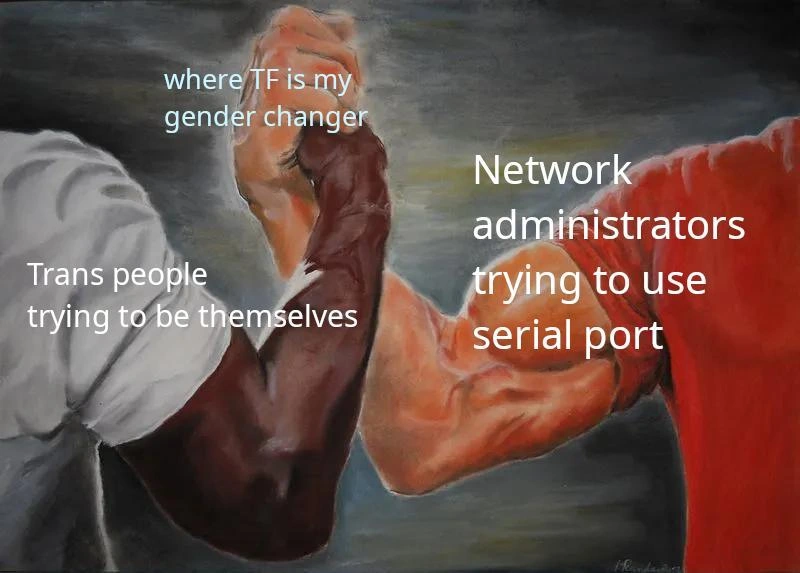
By putting these two very different scenarios side by side (the network admin with cables, and the trans person with their identity), the meme finds a common ground: the experience of urgently searching for a “gender changer.” The image of the two muscular arms clasped together comes from a famous movie handshake (that has become a meme template to show alliance). It implies that these two groups – who normally have nothing to do with each other – are bonding over the same sentiment. Both are saying, “I need this thing to make everything work right, and I can’t find it!” For the net admin, it’s that pesky adapter for the serial port. For the trans person, it’s the means to transition or be accepted as themselves. The humor comes from the unexpected connection between a very technical problem and a very human real-life problem. It’s a bit like a pun or double entendre: “gender changer” refers to hardware in one context and personal gender in the other. Seeing them collide is surprising, which is why it’s funny, but it’s also kind of heartwarming because it shows empathy. The meme isn’t making fun of either group; instead, it’s showing a little solidarity: even a network admin who’s never thought about gender identity knows what it’s like to desperately need that one missing piece. And vice versa, it suggests a trans person could chuckle and say, “Yep, I too wish it were as simple as finding an adapter.” In short, the meme educates lightly while it amuses: introducing a bit of hardware_adapter_search drama to those unfamiliar, and at the same time normalizing the idea of gender transition struggles in a techie-friendly way. Both sides meet in the middle with a shared expression that’s equal parts tech frustration and life frustration.
Level 3: The Gender Changer Alliance
In this Predator handshake-style scene, two muscled arms clasp together in solidarity. One arm is labeled "Trans people trying to be themselves", the other "Network administrators trying to use serial port". Over their joined hands floats the phrase "where TF is my gender changer". This meme brilliantly unites HardwareHumor with a nod to real trans_identity_humor, creating an unexpected alliance over a shared frustration.
On the tech side, any battle-hardened systems administrator or network gearhead knows the pain of digging through a drawer of ancient cables at 3 AM, muttering “Where the $%@& is that DB-9 gender changer?”. The term "gender changer" in Networking is an actual device: a small adapter used to connect two cables or ports when both are the same gender (both male or both female connectors). Serial ports, especially the old RS-232 ports with 9-pin DB-9 connectors, come in “male” (with pins) and “female” (with sockets) varieties. If your router’s console cable and your USB-to-serial adapter both have female ends, you’re stuck — unless you have that elusive gender-changer adapter to bridge them. It’s a tiny piece of hardware (often a beige or blue plastic block) that swaps the connector sex, letting two cables talk. Every old-school network admin has a tale of that one missing adapter preventing a crucial network fix. It’s the ultimate network_admin_struggles trope: the router’s down, the clock is ticking, and you know you saw that adapter in a dusty box of ~2003 era parts... but it’s nowhere to be found when you need it. Hardware folks find this hilarious because it’s so real: in the realm of rack mounts and server rooms, “gender changer” is not a progressive slogan, it’s literally a lifesaver piece of metal/plastic to make connectors fit.
Now, the genius of the meme is linking this hardware hassle to the deeply human experience of trans people seeking to live as their true gender. "Trans people trying to be themselves" speaks to the journey of transgender individuals aligning their lives and bodies with their gender identity. It’s a real-world quest for authenticity and comfort in one’s own skin. In that context, “where TF is my gender changer” is an empathetic, if cheeky, phrase — as if one could rummage in a drawer for a magical item that makes your body or appearance match your true self. Of course, real life is more complicated: there’s no single widget that instantly “changes gender” for a person; it’s a process involving personal, social, and often medical steps. But that’s what gives the meme its bittersweet punch: it juxtaposes a literal hardware fix with a figurative life fix. Both the sysadmin and the trans person are shown clasping hands, effectively saying, “I feel your pain; we’re both searching for that missing piece that makes things click.”
The humor here operates on multiple levels. There’s the surface pun on “gender changer”: a phrase that means wildly different things in tech vs. everyday life. For techies, it’s mundane and comically specific — a serial_port_gender_changer for a DB9_adapter. For trans folks, “gender change” is profound and personal — about identity and acceptance. The Predator-handshake meme format drives home the joke by showing camaraderie between these two seemingly unrelated struggles. It’s the classic predator_handshake_format: two unlikely groups united by a common phrase or experience. The absurdity that a Network technician’s cable problem is being equated (even metaphorically) with a transgender person’s life journey is exactly why it’s funny and oddly heartwarming. It’s humor rooted in empathy. Tech insiders often pride themselves on quirky RelatableDeveloperExperience memes, and this one adds a layer of social awareness. It acknowledges the existence of trans people in the developer/admin community (or at least in the meme audience) in a positive way — they’re literally given a seat at the table (or an arm in the handshake).
From a senior dev perspective, there’s also a historical wink here. The fact that in 2025 we still deal with serial ports and gender-changer doodads is itself a running joke in SystemsAdministration and hardware circles. (Who among us hasn’t faced a mission-critical device that only talks through a serial console at 9600 baud, right?) It’s a reminder that new tech doesn’t erase old tech — we layer on USB and Bluetooth, yet that one router in the rack only has a serial console, so the tumbleweed of adapters lives on. Meanwhile, society has been evolving too: conversations about gender identity are far more prominent now than when RS-232 was the state-of-the-art. By binding these timelines together, the meme cleverly contrasts an outdated tech annoyance with a modern human-rights journey. And in doing so, it gets a knowing chuckle from veterans: we laugh because it’s absurd, relatable, and actually kind of sweet. Two completely different battles, one shared meme-worthy cry of frustration. In the end, "The Gender Changer Alliance" forged in this meme is a testament to how even the most niche HardwareHumor can carry a deeper resonance, uniting people over both the silly and serious things we hunt for in life.
Description
This image uses the 'Epic Handshake' or 'Predator Handshake' meme format, which depicts two muscular arms clasping in a powerful handshake, symbolizing an unexpected point of agreement between two disparate groups. The left arm is labeled 'Trans people trying to be themselves,' and the right arm is labeled 'Network administrators trying to use serial port.' At the point where their hands meet, the central text reads, 'where TF is my gender changer.' The humor is a clever and niche pun. In the world of hardware and networking, a 'gender changer' is a small adapter used to convert a male connector (with pins) to a female connector (with holes), or vice versa, for cables like serial or VGA. The meme creates a hilarious and unexpected bridge between the lived experiences of transgender individuals and the very specific, often frustrating, technical needs of an IT professional working with legacy hardware

Comments
10Comment deleted
Both groups understand the unique frustration of having to explain pins, ports, and desired final states to someone who insists it should have just worked out of the box
Nothing like debugging at layer 1 of both the OSI stack and the human stack - you’re blocked until male-to-female finally snaps into place
The only time a senior network engineer and a trans person will both desperately search Amazon at 2 AM for the exact same thing - and both will end up with a drawer full of adapters that are almost, but not quite, what they actually needed
Every seasoned network admin knows the existential dread of needing a gender changer at 2 AM when troubleshooting a production router via serial console - only to discover your carefully organized cable drawer has every adapter *except* the one you need. It's the hardware equivalent of dependency hell, but with physical connectors that haven't changed since the Reagan administration, and somehow we're still hunting for them in 2024 like they're cryptographic keys to the kingdom
Sysadmins chasing gender changers to mate DTE laptops with DCE routers - pinout therapy no therapy session can match
Console CAP theorem: availability, consistency, or the right DB9 gender - pick two
3am lesson: you finally find the DB9 gender changer only to learn the switch wanted a null‑modem with RTS/CTS - enjoy your USB‑C→A→serial→RJ45 adapter matryoshka
well I could send a pic of my estrogen vials, there TF is my gender changer :3c Comment deleted
pov ur the estrogen vial Comment deleted
HRT that makes you fops Comment deleted