The Futile Search for Intelligent Security
Why is this Security meme funny?
Level 1: Locked Door, Open Windows
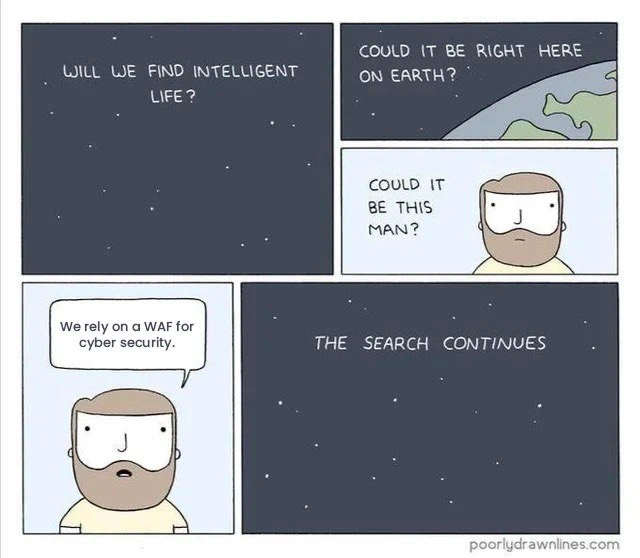
Imagine you’re protecting your house. You decide to lock the front door, and then you call it a day – feeling super secure, you go to sleep. But you left all the windows wide open, and maybe even the back door unlocked. 😬 Saying “We rely on a WAF for security” is like that. The front door lock (the WAF) is one good safety measure, but if that’s all you do, a burglar (hacker) can just crawl in through a window (find another way to attack your site). In the cartoon, the universe was looking for smart people who protect their “house” properly. When our guy only locked one door and ignored the other openings, it’s clear that wasn’t very smart – so the funny ending says, “The search continues.” In simple terms: one lock isn’t enough for a whole house, and one gadget isn’t enough for whole website security. The joke makes us laugh because it points out something obvious: a really intelligent plan would be to lock the doors and the windows (and maybe have an alarm too!).
Level 2: WAF Is Not Enough
Let’s break down why relying only on a WAF made the narrator resume the search for intelligent life. A WAF (Web Application Firewall) is a security tool that sits in front of a web application, monitoring and filtering incoming requests. In real life, a WAF can block common attack patterns – for example, it might detect a suspicious <script> tag in a request and block a potential XSS (Cross-Site Scripting) attack, or spot SQL command keywords to mitigate basic SQL injection attempts. That sounds handy, right? It is – but it’s not enough on its own. Security professionals follow a principle called defense in depth, meaning you deploy multiple layers of defense. Think of it like an onion: a WAF is just one layer (the outer skin). Deeper layers include writing secure code (sanitizing inputs so those attacks can’t work), using secure configurations, patching vulnerabilities promptly, running audits like the OWASP Top 10 checks (a famous list of the most critical web security risks), and having monitoring/alerts if something goes wrong.
In the cartoon, the man’s statement “We rely on a WAF for cyber security” suggests his team might not be doing those other important steps. That’s why it comes off as foolish to experienced folks. It’s the checkbox compliance mindset: maybe an auditor or boss said “we need web security,” so the team installed a WAF and checked the task off the list, without truly securing the application. This is dangerous because a WAF has limitations. Attackers constantly evolve their tactics – they can find ways to encode or hide malicious inputs that a WAF doesn’t recognize. If the developers ignored something like input validation (one of the OWASP recommended practices) because they assumed “the WAF will catch it,” an attacker could exploit that blind spot. Also, if the WAF ever goes down or is misconfigured (which does happen!), there’s nothing to stop bad traffic – that device became a single point of failure for security.
For a junior developer or anyone new to WebDev/Security, the key lesson here is: don’t put all your security eggs in one basket. Use a WAF as one defense, but also write your code securely and follow best practices. It’s okay to have tools that help (like WAFs, antiviruses, etc.), but imagine them as safety nets, not impenetrable shields. Security works best when you have multiple, redundant measures in case one fails. The meme jokes that anyone who doesn’t understand this is not exactly demonstrating wise intelligence – hence the space alien narrator humorously declaring that the quest for smart security people must continue elsewhere.
Level 3: No Signs of Intelligent Defense
In this cosmic comic strip, an unseen narrator scans the universe for intelligent life – only to land on a bearded developer who proudly proclaims, “We rely on a WAF for cyber security.” The punchline is a facepalm for anyone in Security or DevOps/SRE: treating a WAF (Web Application Firewall) as the sole savior is security theater at its finest. It’s as if the entire galaxy sighed and the narrator deadpanned, “The search continues.” Why is this funny (or terrifying)? Because seasoned engineers know that a WAF-as-silver-bullet approach is a hallmark of naive or checkbox-driven security.
This meme skewers a common anti-pattern: teams that buy a shiny WAF appliance, turn on some default rules, and declare the mission accomplished. It’s a perfect mix of checkbox compliance (“Did we secure the app? Sure, we put a WAF in front of it, check!”) and wishful thinking. The bearded man’s blank stare and one-liner encapsulate a lack of intelligent life in the security architecture – no defense in depth, no layered safeguards, just one lonely gatekeeper guarding the whole castle. Any veteran who’s been roused at 3 AM by an intrusion alert can tell you how that story ends. One single point of failure (the WAF) + one novel exploit that slips past its filters = one big incident on your hands.
The humor cuts deep: everyone in Web Security has seen management treat a WAF as a magical force field that stops everything. SQL injection? Cross-site scripting? “Don’t worry, the WAF’s got it!” 🙄 Meanwhile, the dev team might be ignoring the actual code fixes (hello, OWASP Top 10 vulnerabilities) because they assume the WAF will clean up their mess. It’s like putting all your faith in a fancy AI-driven lock while leaving the back door wide open. The security trade-offs here are completely lopsided – ease and false peace of mind for them, sleepless nights for the poor ops people when reality hits. In short, the comic implies that truly intelligent security practitioners wouldn’t stop at “We have a WAF.” They know better: real security is layered, continuously improved, and never reliant on just one tool. Until this guy learns that, the search for intelligent (security) life will indeed continue.
Description
A five-panel comic strip from 'poorlydrawnlines.com' narrating a cosmic search for intelligent life. The first panel shows a starry sky with the question, 'WILL WE FIND INTELLIGENT LIFE?'. The second panel zooms in on Earth, asking, 'COULD IT BE RIGHT HERE ON EARTH?'. The third panel focuses on a cartoon man with a beard, posing the question, 'COULD IT BE THIS MAN?'. In the fourth panel, the man reveals his flawed logic in a speech bubble, stating, 'We rely on a WAF for cyber security.'. The final panel cuts back to the starry sky with the definitive conclusion: 'THE SEARCH CONTINUES'. The humor is targeted at experienced engineers who understand that a Web Application Firewall (WAF) is merely one component of a robust, multi-layered security strategy (defense-in-depth). The comic mocks the naive belief that a single tool can be a complete cybersecurity solution, implying that such a simplistic view is a clear sign that intelligent life has not yet been found

Comments
7Comment deleted
Relying solely on a WAF is like hiring a bouncer who only checks IDs for the letter 'Q'. You'll stop a lot of Quentins, but you're not exactly secure
Treating a WAF as your entire security posture is like wrapping /dev/null in a mutex and calling it a data lake - looks protective until you actually need the data
After 20 years in the industry, you realize the real alien intelligence test isn't finding life in space - it's finding an enterprise that doesn't think a WAF alone constitutes a 'comprehensive security strategy' while their API keys are hardcoded in the frontend
Ah yes, the classic 'WAF-only' security strategy - because nothing says 'defense in depth' quite like putting all your eggs in one regex-matching basket. It's the cybersecurity equivalent of locking your front door while leaving every window wide open and the back door off its hinges. Sure, your WAF might block `'; DROP TABLE users;--`, but good luck when attackers pivot to business logic flaws, authentication bypasses, or that unpatched dependency from 2019. The search for intelligent security architecture continues, somewhere beyond the single-layer perimeter defense galaxy
WAF as your sole defense: like trusting a moat against quantum tunneling attackers
Hearing “we rely on a WAF” translates to “we outsourced the OWASP Top 10 to regex at the edge” - please continue scanning for intelligent life
“We have a WAF” is the AppSec version of “we did backups” - great until restore day and a JSON/GraphQL payload strolls around the regex