Skip to content
DevMeme
855 of 7435
Why Computer Science Trees Grow Downwards
CS Fundamentals Post #967, on Jan 16, 2020 in TG

Why Computer Science Trees Grow Downwards

Why is this CS Fundamentals meme funny?

Level 1: Never Saw a Real Tree

Imagine someone drawing a picture of a tree, but they draw it upside down – the trunk and “root” are at the top and the branches hang downward. Pretty silly, right? This meme is joking that computer scientists do exactly that when they draw their diagrams of a tree. The funny caption says they probably draw trees wrong because they never go outside to see real ones! It’s a playful tease: computer nerds spend so much time indoors with their computers that they might not know which way a real tree grows. In reality, it’s just a long-standing habit in computer science to draw a “tree” diagram starting from the top. The joke makes us laugh because it exaggerates how disconnected from nature tech folks can seem. It’s basically saying, “Haha, those programmers have been in their labs so long, they even think trees grow downwards!” It’s a simple bit of humor that anyone who’s seen a real tree (which is everyone!) can appreciate – the drawing is upside down, and that’s the whole gag. 🌳😋

Level 2: Root Up, Leaves Down

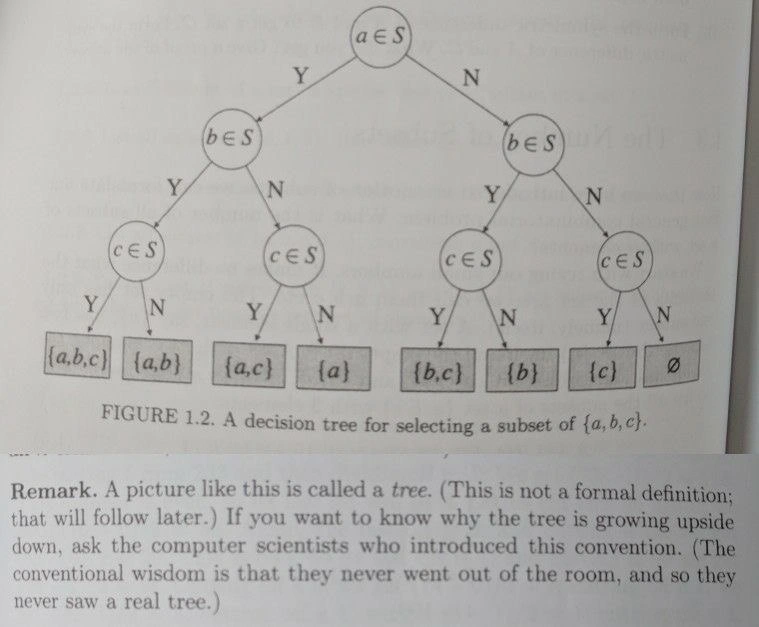
Let’s break down what’s going on in this image in simpler terms. This picture is a classic computer science tree diagram, often seen when learning basic algorithms. In computer science, a tree is a way to organize information hierarchically (like a family tree or an org chart). We have a special lingo for parts of a tree: the root is the starting point (usually drawn at the top of the diagram), a node is any point on the tree that can branch out, and a leaf is an ending point (a node with no further branches). A binary tree is a specific kind of tree where each node can have at most two branches (often called the left and right child). In this diagram, those two branches are labeled “Y” and “N”, which stand for Yes and No. That’s why we call it a decision tree: each branch is the answer to a yes/no question. Here the question at each node is whether a certain element is in a subset S. It’s basically a little flowchart to decide which items to include.

The tree in the meme is illustrating all possible choices of picking items from the set {a, b, c}. At the very top (the root node), it asks “Should we include a in our subset?” If you follow the left branch marked Y, that means “Yes, include a.” If you follow the right branch marked N, that means “No, do not include a.” After that first decision, at the next level down the diagram asks about b (“b ∈ S?” means “Is b in the subset?”) and splits again for Yes or No. Then it asks about c. By the time you’ve answered yes/no for a, b, and c, you’ve arrived at a leaf node—which represents one specific subset outcome. For example, following Y → Y → Y would include a, b, and c (all yes’s give the subset {a, b, c}), whereas following Y → N → Y would include a (yes), skip b (no), and include c (yes), resulting in the subset {a, c}. If you go N → N → N (saying “no” to everything), you end up at the leaf labeled , which is the empty set (no elements chosen). This way, the tree covers every combination of including or excluding each letter, which is a neat visual way to list out all subsets of {a, b, c}. There are 8 possible subsets total, and you can count 8 leaf boxes, each with a different subset listed – that checks out! 🎉

Now, why does the tree look upside down compared to a real tree? Well, that’s just how computer scientists draw them. In diagrams like this (and almost all algorithm_visualization sketches of trees), the root node is put at the top of the page, and the branches grow downward. It might feel a bit funny because in real life we expect tree roots to be at the bottom and branches to go up. But in computing, when we say “tree”, we’re talking about this abstract connected structure, not a literal oak or pine. By convention, information flows from top (general) to bottom (specific) in most diagrams. If you’ve seen file directory trees or family trees, those are often drawn top-down too. It makes the diagram easier to read: you start at the top and follow the decisions or hierarchy downward step by step. Actually, nobody in class really thinks it’s a plant – it just metaphorically “branches out” like a tree. Still, the folks writing this textbook knew it was a funny image, so they joked about it in the caption with a remark.

The caption’s remark basically says: “We call this structure a tree (we’ll define it properly later). And if you’re wondering why the tree in the picture is upside down, you should ask the computer scientists who came up with this style. People joke that those computer scientists never went outside to see a real tree.” This is a bit of inside humor in the CS world. It’s poking fun at the stereotype of the programmer or theorist who is always cooped up indoors, eyes glued to screens or math equations, and thus might be clueless about everyday things like how trees grow. Of course, it’s an exaggeration made for laughs – computer scientists do know what real trees look like (hopefully!). But the joke lands because it is true that we have lots of quirky terms and customs that don’t match the real world. This is a prime example: we talk about “root nodes” and “leaf nodes” in our binaryTrees, yet we draw them with the root on top and the leaves at the bottom. It’s as if we intentionally planted the tree upside down! 🌱🔄

For someone new to this stuff, it might be confusing at first: “Why call it a tree if it grows downward?” The key is to remember it’s just a naming metaphor. In practice, once you get used to it, you don’t even picture a botanical tree – you just think of the hierarchy. The academic_diagram shown here even pre-empts that confusion with a friendly joke, which is a nice way to let students know that feeling puzzled is okay and even the teachers find it a bit humorous. This kind of algorithm humor or textbook_snark is common in computing circles as a way to lighten the mood. It reminds learners that, yes, some terms in tech are weird (like how “bugs” in programs aren’t actual insects 🐛, and a “cloud” isn’t a fluffy thing in the sky ☁️). “Tree” is just another playful term in the coding culture lexicon. So the big takeaway: In computer science, a tree is an abstract structure that we almost always draw with the root at the top. We know real trees don’t grow that way – and that’s exactly why this meme (and the textbook remark) gets a laugh. It’s a gentle nod to the fact that us tech folks sometimes do things a bit upside-down, and we’re totally okay with it. 😄

Level 3: Rooted in Tradition

At first glance, this grayscale inverted tree diagram is a dead giveaway of an old-school CS textbook. Any seasoned developer can recall seeing a figure just like this in their CS fundamentals course. Here we have a binary decision tree systematically enumerating the power set of ${a,b,c}$. In plain English, it’s showing all possible subsets of the set {a, b, c} by branching on whether each element is included (Y) or not (N). The tree’s root node poses the question “a ∈ S?” (Is a in the subset S?). From there, two branches sprout: one path if the answer is Yes (Y) — include a — and the other if No (N) — exclude a. This binary branching continues with the next element “b ∈ S?”, then “c ∈ S?”, until we reach the leaf nodes at the bottom. Each leaf box lists one subset outcome: {a,b,c}, {a,b}, {a,c}, {a}, {b,c}, {b}, {c}, and (the empty set). As expected, there are 8 leaves for 3 elements, matching the formula $2^3 = 8$ for the size of a power set. It’s a classic algorithm visualization of a brute-force subset enumeration. The structure is a binary tree (each node splits into two), and this particular tree happens to be full and balanced – every decision yields two children until all elements have been considered. Algorithmically, it’s elegant; visually, it’s textbook.

What really makes this image special (and meme-worthy) isn’t the combinatorics – it’s the textbook snark hiding in the caption. Beneath the diagram, the author drops a tongue-in-cheek remark about the tree’s orientation:

“If you want to know why the tree is growing upside down, ask the computer scientists who introduced this convention. (The conventional wisdom is that they never went out of the room, and so they never saw a real tree.)”

This little quip carries a heap of inside jokes about computer scientists and their so-called coding culture. In computer science, we unapologetically draw our trees upside-down: the root node sits at the top, while the leaf nodes dangle at the bottom. It’s completely backwards from any botany textbook – in nature, roots go underground and leaves reach for the sky, but on a whiteboard or a PDF, our “trees” defy gravity. The remark jokingly blames this on the scholars who “never went out of the room”, riffing on the stereotype that developers and researchers are pale indoor creatures who rarely see the sun or a real tree. Geek humor at its finest! 🌳🤓

Why do we actually do this inverted tree thing? The real reason is pretty mundane: it’s a long-standing convention that likely arose from drawing hierarchical structures in a top-down flow. When you’re tracing logic or writing on paper, it feels natural to start at the top (with a general idea) and let details branch downwards. Think of organizational charts or family genealogies – they’re often drawn top-down as well. In graph theory terms, a tree is just an acyclic connected graph, and a rooted tree has one designated node as the start. There’s nothing that says we must draw the root at the bottom. In fact, printing the root at the top of the page makes it easier to read decision processes and avoids awkward upward arrows. But of course, explaining it that way isn’t nearly as fun as the joke version! Instead, we embrace the upside_down_tree_joke: that we CS folks have been indoors so long, we literally drew trees the wrong way round. The academic_diagram here is self-aware of that absurdity – the author pokes fun at their own field with a wink to the reader.

For veteran developers and computer science grads, this algorithm humor hits home because it’s a shared experience. We’ve all seen the bewildered look on a newcomer’s face when they first hear terms like “root node” and “leaf node” and then see a diagram like this. “Wait, why is the root on top? Aren’t roots supposed to be at the bottom?” – It’s the obvious question that we eventually stop asking. The joke in the caption is basically saying, “Yeah, we know it’s upside down – we did it on purpose (maybe), and we’re so used to our indoor logic that we don’t mind.” It’s an affectionate jab at ourselves: computer scientists can be so absorbed in abstract worlds that real-world analogies turn a bit… upside-down. Over time, this quip about devs never going outside has become a tiny piece of developer humor folklore. You might even catch it cited in lecture halls or Reddit threads whenever someone notices that all CS trees grow downward. We laugh because, deep down, we recognize a bit of truth in it (those all-night coding sessions in windowless labs have happened), and because it highlights the charmingly literal way our field co-opts everyday words. We take a “tree”, strip away the dirt and sunlight, and turn it into a neat triangle of nodes on a screen.

So, the humor here blossoms from a mix of technical convention and self-parody. It’s pointing out the absurdity that a group of super-smart people named something after a common tree but ended up with a diagram that no biologist would draw. And instead of changing the term, we double down and make it an inside joke about our habits. This is coding culture in a nutshell: we’re aware of our quirks and happy to laugh at them. After all, if you can’t change the upside-down tree convention, you might as well enjoy the shade it gives – even if that shade is coming from the root above rather than the leaves. 😉

Description

The image is a snapshot from a computer science or mathematics textbook page. It displays a diagram labeled 'FIGURE 1.2. A decision tree for selecting a subset of {a,b,c}.' The diagram is a classic binary tree, starting with a root node at the top and branching downwards to leaf nodes, which represent all possible subsets of the set {a,b,c}. Below the diagram, there is a 'Remark' section with text that reads: 'A picture like this is called a tree. (This is not a formal definition; that will follow later.) If you want to know why the tree is growing upside down, ask the computer scientists who introduced this convention. (The conventional wisdom is that they never went out of the room, and so they never saw a real tree.)' The humor lies in this witty, self-deprecating explanation for a long-standing convention in computer science, playing on the stereotype of academics and programmers being disconnected from the natural world
Comments

7
Anonymous ★ Top Pick We draw trees with the root at the top because traversing from the general case to the specific is just a recursive call. Also, it's easier to find the root of the problem when it's the first thing you see
  1. Anonymous ★ Top Pick

    We draw trees with the root at the top because traversing from the general case to the specific is just a recursive call. Also, it's easier to find the root of the problem when it's the first thing you see

  2. Anonymous

    Pro tip: any architecture diagram that grows roots upward is just foreshadowing - eventually the stack tips over and you’re pruning leaves at 2 a.m

  3. Anonymous

    After 20 years in tech, I finally understand why we call them 'decision trees' - because like real decisions in production, they branch everywhere, the root cause is always at the top, and by the time you reach the leaves, you're wondering how you got there and why everything is upside down

  4. Anonymous

    This textbook's savage burn perfectly captures why CS academics have such a fraught relationship with the physical world: they've been staring at upside-down trees for so long that when they finally venture outside, they probably try to traverse the park in O(log n) time and complain about the lack of proper parent pointers in the oak trees

  5. Anonymous

    Decision trees grow upside down because entropy splits downward - botany's loss, Gini's gain

  6. Anonymous

    CS trees grow upside down so the root cause is at the top - and so product doesn’t notice that “three toggles” just exploded into 2^n configurations

  7. Anonymous

    Peak CS: an upside‑down “decision tree” that’s really a power‑set generator (2^n leaves, zero impurity) - proof we’ll reinvent botany to avoid going outside

Use J and K for navigation