Skip to content
DevMeme
853 of 7435
The Pragmatic Definition of 'Shipped'
TechDebt Post #963, on Jan 14, 2020 in TG

The Pragmatic Definition of 'Shipped'

Why is this TechDebt meme funny?

Level 1: Held Together by Duct Tape

Imagine you have a big school project due, and your model castle keeps falling apart. You’re out of time, so you grab some tape and glue and frantically stick the pieces together just minutes before you have to hand it in. It’s wobbly and looks like it might collapse if someone even sneezes near it, but somehow you carry it to class and turn it in. You breathe a sigh of relief because hey, at least you delivered it on time.

This joke is saying a video game can be like that castle. The people making the game finished it at the last second by using whatever quick fixes they could find (their tape and glue) to stop it from breaking. “Shipped” means the game was sent out to the players, even though behind the scenes it’s held together by those hurried patches. It’s funny because everyone is clapping that the game is done, but they’re also kind of holding their breath. They know the game’s inside parts are a bit of a mess, and it might fall apart if anything else goes wrong. In simple terms: the developers just barely got the game to work and said “Okay, it’s done!” It’s a laugh of relief — the kind you have when something probably shouldn’t work, but surprise! it does (for now), so you call it a win and hope for the best.

Level 2: Just Ship It

When developers say code is “barely hanging together,” they mean it’s working by sheer luck and lots of quick fixes. This meme highlights how a game can reach release with a codebase full of band-aids. In other words, if the game finally compiles and runs (even if the code is ugly inside), then congrats – it’s shipped!

Why is that funny? Because it’s true more often than a newcomer might think. Under tight deadline pressure (like finishing a game for launch day), teams sometimes write messy, last-minute fixes just to prevent the game from crashing. Imagine building a sandcastle and patching every new crack with chewing gum. It’s not the ideal method, but it might hold up long enough to show the judges. In software terms, that chewing gum is what we call a workaround – a quick solution that bypasses a deeper problem just to keep things working. Stack enough hacks on top of each other, and you get a very fragile system.

Let’s break down some terms from the tweet for clarity:

  • Stupid layout – This means the code is organized poorly (“stupid” here implies a really bad design). For example, maybe all the game logic is crammed into one giant function or one big file. It technically works, but it’s hard to understand or improve.
  • Unscalable fixes – These are changes that solve an immediate issue but won’t hold up as the game grows or changes. For instance, a programmer might hard-code a solution that only works for Level 10 because Level 10 was buggy. If someone adds Level 11 later, that old fix won’t cover it, and the problem pops up again. In short, it doesn’t scale to new situations.
  • Workarounds – A workaround is like using duct tape to fix a leak instead of replacing the leaky pipe. In coding, it means that instead of solving a bug the proper way (which might take too long), you find a quick hacky way to avoid the bug. One or two workarounds might be okay, but when you pile workarounds on top of workarounds, the code becomes a shaky makeshift solution rather than a solid structure.

The meme calls the final product “shipped.” In developer lingo, to ship something means to release it to users — in this case, to launch the game. It marks the end of development when the game is delivered to players or put into production. The joke here is that even if the code is a complete mess, as long as it’s out the door and in players’ hands, the job is officially done. They slap the label “shipped” on it as if everything went perfectly, even though the developers know the truth about how shaky it really is.

This scenario is common during a game release crunch. “Crunch time” is an intense period of overtime work (late nights and weekends) right before a release date. During crunch, developers often don’t have the luxury to rewrite messy code or do thorough cleanup. Instead, they just keep patching any issues as fast as possible so the game doesn’t break. By Friday at 5 PM, everyone’s exhausted, and if the code finally compiles without errors, that’s a huge relief. That 5 PM Friday timing is part of the humor too — deploying a new version right before the weekend is notoriously risky, because if something goes wrong, the team might get emergency calls on Saturday. But in this story, they had no choice. They press the imaginary “Ship It” button, send the build out, and then nervously start their weekend, hoping nothing catches fire.

It’s a cautionary tale about code quality and technical debt. Technical debt is the extra workload you create for the future by taking shortcuts now. Every quick-and-dirty fix in the code is like borrowing time that you’ll have to pay back later when you finally clean up the mess (if you ever do). If you accumulate too much technical debt and never pay it off, the code becomes really hard to maintain or extend — kind of like adding more and more floors to a shaky tower without ever strengthening the foundation. Eventually, something’s going to give.

So when we say, “the workaround-tower finally compiles at 5 PM Friday,” it paints a vivid picture. It’s the final hours before launch, the code is like a wobbly tower of blocks, and by some miracle it hasn’t fallen over. The developers are relieved and maybe cracking nervous jokes: they got the game out in time, even though they know the insides are held together by threads and duct tape. It’s funny and cringe-worthy at the same time — funny because we often cheer for a release without looking too closely at how messy things got, and cringe-worthy because those messy parts can turn into real bugs for players later.

For a junior developer or someone new to GameDevelopment, the takeaway is this: sometimes getting a product out by the deadline means making compromises in the code. “Just ship it!” is what you hear when the team decides to release the product despite its flaws, usually because time’s up. It’s said with a mix of triumph (we made the deadline!) and anxiety (we know there are issues…). The meme gets a laugh because it pokes at that industry reality: shipping a game can feel like victory on the outside, even if inside the code is one big kludge. Developers find it funny because they’ve lived through it, and sometimes humor is how we cope with the stress of getting that shaky project out the door.

Level 3: Jenga Tower of Tech Debt

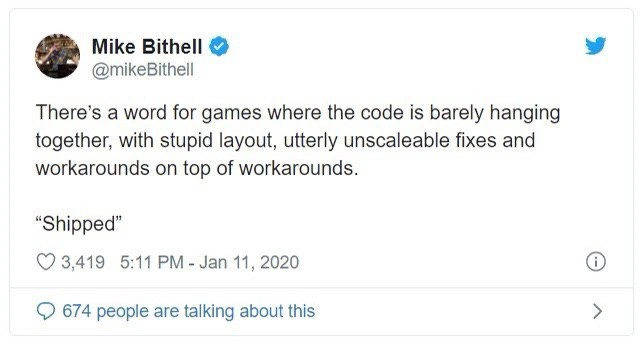
“There’s a word for games where the code is barely hanging together, with stupid layout, utterly unscaleable fixes and workarounds on top of workarounds. ‘Shipped’.”

This wry tweet from game developer Mike Bithell nails a painful truth. In the trenches of GameDev, “shipped” often means the codebase is a teetering Jenga tower of quick fixes. Under brutal release pressure, features get bolted on with workarounds on top of workarounds until, finally, at 5 PM Friday someone yells, “It compiles… ship it!” The result is a build that’s technically “done” — but only in the sense that a house of cards is built. One gentle nudge (or one more feature) and the whole thing could collapse.

Seasoned devs recognize this pattern as technical debt hitting critical mass. Every rushed fix and last-minute hack is like pulling out one more Jenga block and balancing it on top. The architecture might have started sane, but crunch-time realities turned it into spaghetti code: a tangled mess where one wrong move can trigger a cascade of bugs. Terms like “stupid layout” and “utterly unscalable fixes” are polite ways of saying all the good design principles got thrown out the window. By this stage, modularity and code quality have taken a back seat to “just make it run.” The code is fragile and barely holding together, but against all odds it passes the final compile and smoke tests. Good enough to push to production apparently! For good measure, imagine a big red Ship It button being slammed while everyone holds their breath.

This dark humor resonates with any senior developer who’s survived a death-march project. We’ve all seen those Friday evening deployments where everyone crosses their fingers. The team knows the code is a ticking time bomb of code smells — duplicated logic, magic numbers, monstrous classes — but the product has to launch on time. It’s the business reality: marketing campaigns and publisher deadlines won’t wait for a refactor. So you get absurd scenarios like disabling entire features as a “temporary fix” for a crash, or writing one-off conditions that only handle the exact scenario that was breaking at the eleventh hour. The code ends up littered with comments like // TODO: remove this hack that no one ever removes. As one colleague joked, “we turned our tech debt into a launch-day feature!”

One can practically smell the desperation in such a codebase. It’s ProductionReadyCode by the most minimal definition: it runs and doesn’t immediately explode. But it might be one user action away from a catastrophic glitch. The tweet’s popularity (thousands of likes and replies) shows how universal this experience is. Developers laugh (and cringe) because they’ve been there — shipping a product held together by digital duct tape. It’s funny in the same way gallows humor is: if you don’t laugh, you might cry about pushing such an unstable build out the door.

To give you a taste, here’s how that final commit might look:

// Final-hour hacks:
if (level == BOSS_LEVEL && crashOnBossIntro) {
    skipCutscene();  // Workaround: skip the intro cutscene to avoid crash
}
if (memoryLeakDetected) {
    restartLevel();  // Quick fix: reset the level periodically to clear memory
}
if (fps < 20) {
    enableLowResTextures();  // Emergency performance tweak for low-end machines
}
// ...and so on for every critical last-minute issue...

Each condition is a band-aid slapped on a gaping wound. Unscalable? Absolutely — change any little detail and these fixes will probably break. But at 5 PM on Friday, the priority isn’t elegance or future-proofing; it’s survival. The code doesn’t have to be pretty or extensible, it just has to hold together long enough to pass QA and get out the door.

In short, “shipped” in this context is a bittersweet victory. The game is out, but experienced engineers know what lies beneath: a shaky stack of quick fixes waiting to collapse under its own weight. The humor bites because it’s drawn from collective memory — that chaotic final push where shipping often means “we’ll fix it in the patch… maybe”. It’s a high-wire act many of us have performed, and seeing it called out so bluntly is both cathartic and comic.

Description

A screenshot of a tweet from Mike Bithell (@mikeBithell), a well-known game developer. The tweet, dated January 11, 2020, reads: 'There's a word for games where the code is barely hanging together, with stupid layout, utterly unscaleable fixes and workarounds on top of workarounds.' Below this, the punchline is delivered in a single, quoted word: '"Shipped"'. The image shows the tweet received significant engagement with 3,419 likes. This post humorously and cynically captures a universal truth in software development: the immense pressure to release a product often leads to compromises in code quality. It perfectly describes the accumulation of technical debt, where quick fixes and workarounds are prioritized over robust, scalable solutions to meet deadlines. For senior developers, this is a deeply relatable observation about the pragmatic, often painful, trade-offs made to get a product into the hands of users

Comments

7
Anonymous ★ Top Pick Our motto is 'move fast and break things.' We moved so fast we broke the architecture, and now it's a legacy system held together by a single CI pipeline that no one is brave enough to touch
  1. Anonymous ★ Top Pick

    Our motto is 'move fast and break things.' We moved so fast we broke the architecture, and now it's a legacy system held together by a single CI pipeline that no one is brave enough to touch

  2. Anonymous

    Gold master is just Latin for “we’ll patch it in day-one DLC and pray the shader cache holds.”

  3. Anonymous

    The difference between a prototype and production code? Production code has more TODO comments and the original developer has already left the company

  4. Anonymous

    Every senior engineer knows that 'shipped' is just a euphemism for 'we've successfully transferred the technical debt from our backlog to production, where it will accrue interest at compound rates until the next rewrite.' The real architectural pattern here isn't MVC or microservices - it's 'Jenga-Driven Development,' where each workaround carefully balances on the previous one, and everyone's terrified to refactor because nobody remembers which piece is load-bearing

  5. Anonymous

    Shipped: When your Big Ball of Mud architecture finally escapes the harbor, trailing workarounds like seaweed

  6. Anonymous

    Senior architecture heuristic: when a workaround has its own workaround behind a feature flag, it’s no longer a hack - it’s the release candidate

  7. Anonymous

    ‘Shipped’ is just technical debt refinanced into a perpetual on-call liability

Use J and K for navigation