Skip to content
DevMeme
5729 of 7435
The W3C's Controversial Decision on camelCase Abbreviations
WebDev Post #6282, on Sep 28, 2024 in TG

The W3C's Controversial Decision on camelCase Abbreviations

Why is this WebDev meme funny?

Level 1: When Weird Wins

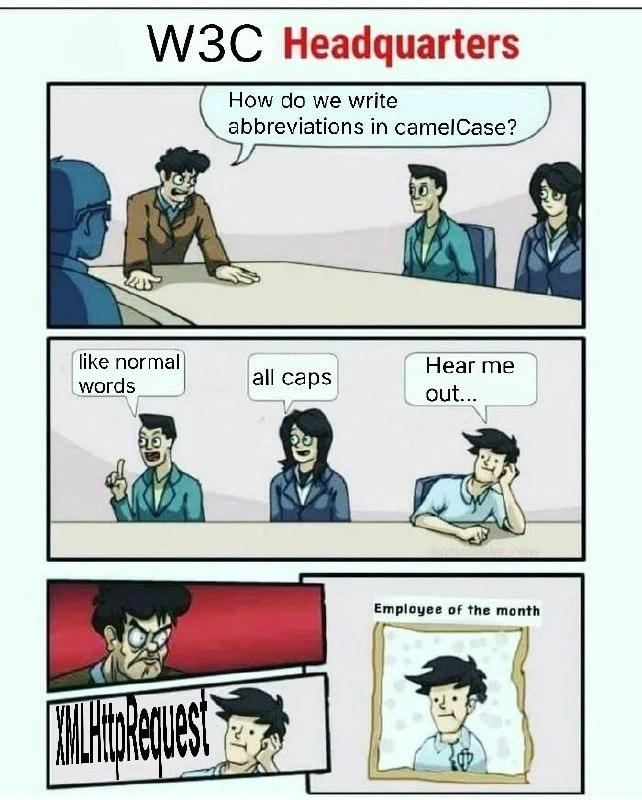
Imagine you’re in a classroom and the teacher asks, “We need a name for our project, something short. How should we write the short form?” One kid says, “Write it like a normal word.” Another kid says, “Use ALL big letters for the short form!” But then a third kid raises his hand and says, “Okay, hear me out… let’s use a mix of big letters and small letters in one word!” Everyone looks at him like that’s a crazy idea. The teacher even gets mad and throws him out of the room in the story (that’s the joke).

Now here’s the funny part: after all that, the teacher actually decides that the mixed-up crazy name is the one they’ll use! They even put the kid’s photo up as “Student of the Month” for coming up with it. Sounds silly, right? Normally, you’d think we’d pick one of the easy, normal ways to name it. But in this story, the strangest idea wins and becomes the rule.

This is just like a thing that happened in real life with naming a tool on the web. The people in charge couldn’t decide how to handle short-form words in a name, so they ended up with a wacky combination of styles. It made everyone who has to use that name go, “Huh? Why is it like this?” The meme is funny because it shows a ridiculous decision-making scene to explain why we wound up with such a weird name. In simple terms: a weird idea won the day, and all the grown-up programmers have been chuckling (and groaning) about it ever since.

Level 2: CamelCase Conundrum

Let’s break down why XMLHttpRequest looks so odd and why it’s funny to developers. It all comes down to camelCase and acronyms. CamelCase is a style for writing compound names without spaces, where each new word starts with a capital letter (the "humps" of the camel). For example, “webDevelopmentHumor” is in camelCase – the words “web”, “development”, “humor” are mashed together, and we capitalize the D and H to show the word boundaries. This is common in programming for naming things like variables and functions.

Now, acronyms (like XML or HTTP) are words formed from the first letters of a phrase. XML stands for “eXtensible Markup Language” and HTTP stands for “HyperText Transfer Protocol.” Normally, when written alone, we write acronyms in all caps. But how do we include them in a camelCase name? That’s the tricky question being asked in the meme: “How do we write abbreviations in camelCase?”

The engineers propose different naming conventions:

  • “like normal words” – This means treat the acronym as if it’s just a regular word in the name. Only capitalize the first letter of it (if it’s at the start or start of a new part). For example, XML would become “Xml” in the name, with only X uppercase and the rest lowercase. So following this rule, you’d write something like XmlHttpRequest.
  • “all caps” – This means keep the acronym fully uppercase even when it’s inside the name. Using that rule, you’d get XMLHTTPRequest (XML and HTTP both in all caps) as the name, which is very shouty.

The punchline is the third guy’s suggestion – he says “Hear me out…” and presumably suggests a compromise so bizarre it gets him thrown out the window. That compromise is displayed in the next panel as a big red banner: XMLHttpRequest. This final name literally mixes the two approaches:

  • It keeps XML in all caps (as if following the “all caps” rule for that part),
  • But then writes Http as if it were a normal word (H capital, ttp lowercase, instead of HTTP all caps),
  • Then continues with Request as a separate word with R capital.

So the final result XMLHttpRequest is a single identifier that contains an acronym in all-caps immediately followed by another acronym in CamelCase form – truly an inconsistent mashup. No wonder the manager in the meme was furious! It’s like breaking the naming rules they were discussing in the name itself.

Why does this matter? In code, consistency is key to CodeQuality. If everyone writing an API or library follows a standard convention, it’s easier for developers to read and remember. XMLHttpRequest flouts consistency – you have to remember that “XML” is uppercased but “Http” is not fully uppercased. Many a new developer has tried typing XMLHTTPREQUEST or XmlHttpRequest only to realize it doesn’t match the official name exactly (JavaScript is case-sensitive, so the capitalization must be exactly right). It’s a small headache, but an enduring one.

The meme’s last panel, “Employee of the month,” featuring the engineer who came up with XMLHttpRequest, is tongue-in-cheek. It implies that despite how crazy the idea sounded, that person’s suggestion became the accepted web standard and they’re getting applauded for it. This is funny because we usually expect the sensible suggestion (like “just treat it like a normal word”) to win out. Instead, the strangest option became the rule for an entire generation of web development. Web veterans laugh at this because they’ve lived with the outcome: an awkwardly named JavaScript API that every web coder had to use for years.

For context, W3C (World Wide Web Consortium) is the committee that standardizes technologies for the web (HTML, CSS, and many Web APIs like this one). And XMLHttpRequest is indeed the official name of a browser API (introduced in the mid-2000s) that lets JavaScript code send HTTP requests to a server and load data without refreshing the page. This capability is what enabled “AJAX” – which stands for Asynchronous JavaScript and XML – the technique that made web pages dynamic and interactive. Funny enough, even though AJAX has “XML” in the name (and so does XMLHttpRequest), developers often used it to fetch JSON (not XML) as time went on. The name didn’t keep up with its usage, adding to the oddity.

To a junior dev or someone new to WebDevelopment, here’s the relatable part: naming things in programming is hard, and groups often argue over the best naming style. The boardroom suggestion meme format exaggerates this by showing a boss asking for ideas and employees giving different answers. Usually, the punchline is the boss violently ejecting the one with the worst suggestion (in classic versions, that character is just seen flying out the window in the next frame). In this meme, they twist it: that “worst” suggestion (the mixed-case name) not only survived but got the suggester rewarded. It’s highlighting the irony that sometimes the least intuitive decision becomes official.

So, XMLHttpRequest is basically a running joke among web developers about awkward naming. It’s taught along with a sigh, and many of us jokingly call it “XHR” for short. The meme uses DeveloperHumor to turn that real-world annoyance into a laughing matter. Now when you see that weird capitalization in code, you’ll know there’s a bit of history – and humor – behind it.

Level 3: Naming by Committee

In the pantheon of web development oddities, XMLHttpRequest stands as a prime example of what happens when naming conventions meet committee decision-making. The meme portrays a W3C (World Wide Web Consortium) boardroom struggle over how to capitalize acronyms in CamelCase identifiers – a seemingly trivial detail that became legendary. The boss asks, “How do we write abbreviations in camelCase?” and the engineers offer answers: one says “like normal words” (meaning treat the acronym as a regular word with only an initial capital), another says “ALL CAPS” (meaning keep every letter of the acronym uppercase), and then a third cautiously goes “Hear me out…” – cue the outrageous hybrid XMLHttpRequest.

For veterans of WebDev, this name triggers a mix of nostalgia and annoyance. It breaks every sane naming rule by mixing cases: "XML" is fully uppercase, then "Http" starts with one capital and the rest lowercase, followed by "Request" with a capital R. It’s the bizarre compromise no one asked for:

// Possible naming approaches for the same idea:
let req1 = new XmlHttpRequest();   // Suggestion 1: treat acronyms like normal words (Xml + Http + Request)
let req2 = new XMLHTTPRequest();   // Suggestion 2: keep acronyms all-caps (XML + HTTP + Request)
let req3 = new XMLHttpRequest();   // Actual W3C choice: the weird hybrid (XML + Http + Request)

In any rational code style guide, you’d pick req1 or req2 and stick with it. The W3C, however, effectively combined both – giving us req3, the infamous XMLHttpRequest. This oddball casing was cemented into the web standard and lived on for two decades of AJAX calls. Every JavaScript veteran remembers typing new XMLHttpRequest() (often shortened to a xhr variable with a sigh) and thinking “Who came up with this name?!”.

The humor here is multi-layered. First, it satirizes the design-by-committee process: we imagine a standards committee actually having this absurd debate, then approving the wildest suggestion. In the meme, the manager literally tosses the bold engineer out the window in Panel 3 – yet the final panel reveals that idea not only survived but earned “Employee of the Month.” This twist perfectly captures how tech standards sometimes emerge: a crazy outlier idea ends up adopted and even celebrated, while common sense is defenestrated (quite literally, in the comic). Veteran developers are laughing (and crying) because they’ve lived with the outcome: an API name that nobody would defend in a code review today.

Historically, the real story isn’t far off. The XMLHttpRequest API originated around the early 2000s (first in Internet Explorer as an ActiveX object) when asynchronous web calls were novel. The name made a bit of sense at the time: it was primarily used to fetch XML data over HTTP. But as it became a formal W3C standard, there was no turning back on that wonky capitalization. It’s a classic example of legacy quirk ossified into the platform – once shipped, browsers had to support it forever. Even as usage shifted to fetching JSON or other data, the misleading name and odd casing stuck like a bad tattoo on the JavaScript API surface. Modern web APIs eventually gave us the cleaner fetch() function (all lowercase bliss!), but XMLHttpRequest is still there under the hood, a living fossil of early web 2.0.

For seasoned devs, this meme hits home because we’ve all encountered weird names born from compromise or backward compatibility. It pokes fun at the fact that “Naming things” – one of the classic hard problems in computer science – can stump even the world’s standard-setters. And once a naming decision is in the wild, however questionable, we’re stuck with it. The meme’s absurd boardroom scene isn’t just a joke – it’s a reflection of every frustrating standards meeting or API design review where the worst option somehow wins. The result? Code like XMLHttpRequest that makes newcomers scratch their heads and veterans wince, then laugh, because at this point what else can you do?

Description

This is a three-panel comic meme format, often called 'Boardroom Suggestion' or 'Employee of the Month'. The comic is titled 'W3C Headquarters' in large black and red text. In the first panel, a group is in a meeting, and the boss asks, 'How do we write abbreviations in camelCase?'. In the second panel, two employees offer logical suggestions: 'like normal words' and 'all caps'. A third, smug-looking employee leans back and says, 'Hear me out...'. The third panel is split. On the left, the boss has an angry, strained expression as the smug employee's suggestion is revealed: 'XMLHttpRequest'. On the right, a picture of the smug employee is shown with the caption 'Employee of the month'. The meme humorously blames the World Wide Web Consortium (W3C) for the famously inconsistent and awkward capitalization of the XMLHttpRequest API. The convention for handling acronyms within camelCase (e.g., XML, HTTP) is a common debate, and XMLHttpRequest violates all sensible conventions by capitalizing 'XML' but only the 'H' in 'Http'. The joke is that this terrible idea was not only accepted but celebrated, a relatable frustration for web developers who have dealt with this API for decades

Comments

20
Anonymous ★ Top Pick Some say the developer who named XMLHttpRequest was a genius, forcing two decades of engineers to pause and reflect on the arbitrary nature of standards every time they type it
  1. Anonymous ★ Top Pick

    Some say the developer who named XMLHttpRequest was a genius, forcing two decades of engineers to pause and reflect on the arbitrary nature of standards every time they type it

  2. Anonymous

    Proof that if your bikeshedding adds just enough entropy, the name survives long enough to become a browser API - and a generation of linters just sighs and skips the check

  3. Anonymous

    The real irony is that XMLHttpRequest became so successful despite its naming convention that we now have fetch() - proving that sometimes the best refactoring is just starting over with a completely new API rather than fixing 20 years of backwards compatibility

  4. Anonymous

    XMLHttpRequest perfectly encapsulates the W3C standardization process: take a Microsoft innovation, debate it for years, and emerge with a naming convention that violates every style guide while somehow becoming so entrenched that we're still teaching it to junior devs two decades later - right before explaining why they should use fetch() instead

  5. Anonymous

    XMLHttpRequest: the reason every style guide has a grandfatheredIdentifiers allowlist

  6. Anonymous

    XMLHttpRequest: W3C's camelCase 'standard' that's haunted enterprise refactors since dial-up days

  7. Anonymous

    Only in web standards can you fetch JSON over HTTP with an interface named XMLHttpRequest - proof that casing by committee outlives every linter

  8. @Ra_zor 1y

    Ah, that perfectly normal english word «http», just like Shakespeare intended

    1. @azizhakberdiev 1y

      a shitty pee

  9. @imfreetodowhatever 1y

    XMLH TITI PEE

  10. @erizpl 1y

    Http is an acronym to "hot potato", optionally Https = "hot potatoes", still relevant ✅

  11. @azizhakberdiev 1y

    XML_HTTP_Request SNAKE_camelCase

    1. @peajack 1y

      snamel

  12. @NickNirus 1y

    h titty pee 👌

    1. @ZgGPuo8dZef58K6hxxGVj3Z2 1y

      This took me as long to get as answering in 3 other chats

    2. @ZgGPuo8dZef58K6hxxGVj3Z2 1y

      The latin h letter in japan is literally a sex symbol

      1. @callofvoid0 1y

        Oh really?

        1. @ZgGPuo8dZef58K6hxxGVj3Z2 1y

          /s?

  13. @Diotost 1y

    Why was comment counter showing 30 and then 15?

    1. @SamsonovAnton 1y

      French government intervention.

Use J and K for navigation