The most honest user feedback tool is your payment processor
Why is this Stakeholders Clients meme funny?
Level 1: Money Talks
Imagine you open a little lemonade stand on your street. You ask your friends, "Do you like my lemonade?" and they all smile and say, "Yeah, it's great!" That makes you happy, but here’s the real test: do they actually buy a cup of lemonade? If everyone says nice things but nobody buys a cup, then those compliments don’t mean much – maybe they were just being polite. But if a bunch of kids line up with coins in their hands, excited to pay for a second or third cup, that tells you for sure your lemonade is really good. In other words, the money in your jar is the clearest feedback. It shows what people really think, because they’re willing to give something up (their allowance money) to get more of what you’re offering. That’s the funny idea in this meme: instead of just listening to what people say, look at what they do with their money. Money talks – when something is really great, people show their love by paying for it, loud and clear.
Level 2: Show Me the Money
For someone new to tech or startups, this meme’s answer might seem odd. Stripe.com is a website for payment processing, not a typical feedback tool. So why claim it's the best way to get user feedback? The joke here is that in a startup, money is the most honest feedback. In simple terms, if people are willing to pay for your product, that tells you they truly find it useful.
Let's break it down:
- Stripe is a popular online service that businesses use to accept credit card payments. Developers add Stripe to their apps or websites so users can buy things or subscribe. The Stripe dashboard is Stripe’s online interface where you see all your transactions – how many sales you made today, total revenue this month, new subscriptions, etc. Many small startup teams refresh this dashboard obsessively to see if they got a new sale.
- Collecting user feedback usually means asking users for their opinions. For example, you might use a survey tool like SurveyMonkey to ask "How do you like our app?". Or you might measure a Net Promoter Score (NPS) by asking users "How likely are you to recommend us on a scale from 0 to 10?". Product managers also do user interviews or look at app analytics (like which features people use) to understand what users think. These methods are all about what users say or how they behave in the app.
- Using Stripe as feedback is an unconventional idea: it means looking at who’s actually paying. If your Stripe dashboard shows an increase in revenue, that’s users giving positive feedback with their wallets. If it shows $0, that’s a form of feedback too (the product might not be compelling enough for anyone to buy). The meme is joking that this number on Stripe can be more important than any written survey response. It's like saying, "Don’t tell me you like the product, show me you like it by buying it!"
In the startup world, people talk about “product–market fit.” That’s basically the moment when your product satisfies a real need in the market so well that it practically sells itself. One way founders know they’re close to product–market fit is that sales start picking up fast. This is where revenue as validation comes in — making money from real customers validates that your product is on the right track. Imagine you launched a small app and 100 people said they loved it, but nobody spent a dime. Then you tweak something and suddenly 10 people subscribe and pay for a premium feature. Those subscriptions are a much stronger sign of success than the polite “I love it” comments. It’s users proving with action (payment) that your app is worth it. That idea is sometimes summed up as “user feedback is payment.”
So the meme gives a wink to that concept. It implies: skip all the fancy feedback tools; just see if the user clicks the buy button. This is common Startup Humor because early-stage founders often celebrate the first dollar they earn more than any amount of user praise. It’s not that surveys or user interviews aren’t helpful (they are!), but if the question is "Is our product any good?", the jokey answer here is "Well, are people paying for it? Check Stripe!"
To put it plainly, here are a few ways a team might gauge user feedback, and how they differ:
- Surveys and interviews: You ask users what they think. (Example: “Do you like the new feature?”) – This gives you ideas and opinions, but sometimes people are just being nice.
- Usage analytics: You watch what users actually do in your app (which pages they visit, how long they stay) – This shows interest, but doesn’t tell if they love it enough to pay.
- Revenue (Stripe dashboard): You see if users are spending money on the product – This is a very clear thumbs-up. If strangers are willing to pay for it, that’s strong evidence they find it valuable.
Think of an enthusiastic startup founder showing you their Stripe dashboard: “Look, we made $500 this week from real customers!” That number can speak louder than pages of user feedback because it directly answers whether the product is worth something to users. The meme has fun with this idea by literally treating the Stripe website as the “tool” for user feedback. It’s saying, in a tongue-in-cheek way, that the best feedback from users is cold, hard cash. If the cash isn’t coming in, all those nice survey answers aren’t telling the whole truth. That’s why in the last panel, the only answer given is “Stripe.com…” – implying “just check our Stripe account; it will tell you if users really like what we made.”
Level 3: Stripe Speaks Volumes
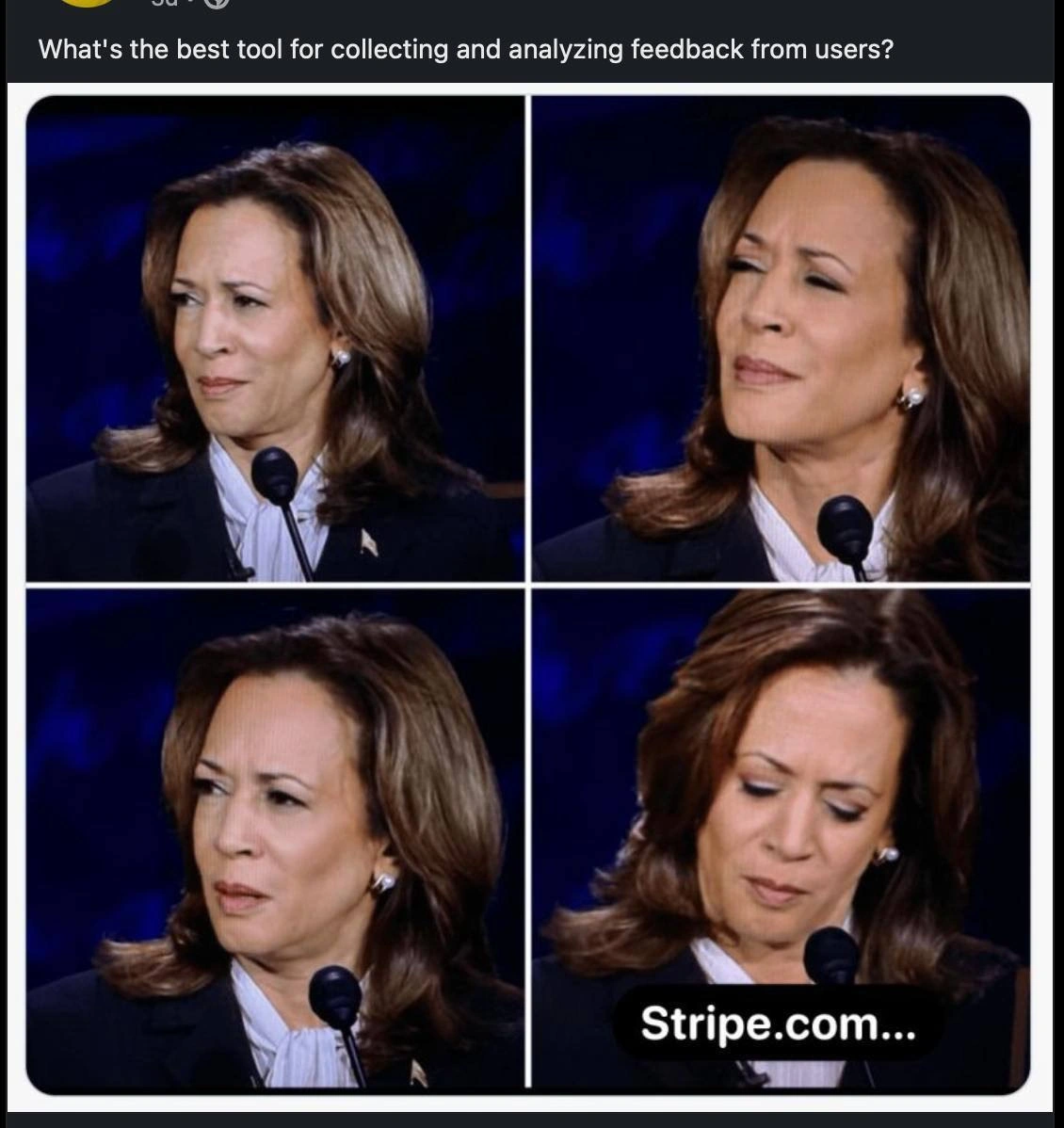
In the world of FinTech startups and lean Entrepreneurship, there's a cheeky mantra: the only user feedback that truly counts is the kind measured in dollars. The meme sets up a question, "What's the best tool for collecting and analyzing feedback from users?" and after a suspenseful pause, the deadpan punchline appears in the final panel: Stripe.com.... This flips the expected answer on its head. Instead of recommending a survey or analytics tool, it drops Stripe (the online payments platform) as the answer. It’s a humorous nod to the idea that, for a product seeking success, the Stripe revenue dashboard might be the ultimate source of truth.
By answering "Stripe.com," the meme implies that paying customers are the loudest form of user feedback. The debate speaker in the images stays stone-faced through the first three frames (as if no other tool even comes close) and then delivers the unexpected truth: the best feedback isn’t from user surveys or fancy NPS scores – it’s from Stripe’s payment notifications. This satirizes the fixation many founders and Product Management teams have on one metric that really matters: revenue. Why fuss over detailed survey responses or ambiguous user interviews when your Stripe dashboard can tell you in real time whether people are voting for your product with their wallets? It highlights a common industry pattern, focusing on revenue as validation. In startup lore, one measure of achieving product–market fit is when users start voting with their credit cards. You can have glowing survey results or a high Net Promoter Score (NPS), but if the Stripe revenue graph is flat, something's off. Conversely, when that revenue curve on Stripe shoots upward, it's a strong signal you've built something people truly want (and will pay for). It’s a playful jab at vanity metrics vs. real Key Performance Indicators (KPIs). Many vanity metrics (like app downloads or social media likes) feel good but don't guarantee a sustainable business. Transaction volume on Stripe, though, is an actionable metric that even skeptical stakeholders (clients or investors) immediately respect – because as the saying goes, money talks.
The humor resonates with seasoned developers and founders because it’s an exaggeration wrapped around a core truth. They've all sat through meetings poring over user feedback forms, analytics dashboards, and feature requests. Yet at the end of the day, someone inevitably asks, "So... are users paying for this?". The meme’s punchline cuts through that noise. It suggests that all those feedback tools and charts are nice, but the cleanest indicator of product success is cash in the bank. The phrase “and nothing else matters” (as the title puts it) is a tongue-in-cheek exaggeration — of course user feedback and engagement matter, but if nobody is swiping their card, the business won’t survive to care. It’s a very relatable joke in startup and product management circles. Essentially, the meme compresses the entire conversation about stakeholder expectations into one line. Investors or product leads might politely ask for user research and feedback analysis, but what they really want to see is that Stripe chart trending up (in other words, "Show me the money!"). If users truly love your product, they'll prove it by pulling out their credit cards. If they don’t, no amount of enthusiastic survey comments can cover that gap. So the meme wryly suggests: skip the fluff and check the Stripe dashboard — the real answer lies there.
Description
A four-panel meme featuring images of US Vice President Kamala Harris, each showing a different expression of contemplation, discomfort, and reluctance. Above the panels, a question is posed: 'What's the best tool for collecting and analyzing feedback from users?'. The first three panels show her looking progressively more pained and hesitant as if struggling with a difficult truth. In the final, bottom-right panel, she looks down with a grimace, and the text 'Stripe.com...' is overlaid, delivering the punchline. The humor is derived from a cynical but relatable industry insight. While product managers seek qualitative feedback through dedicated tools, the meme suggests that the most brutally honest and impactful user feedback comes from the quantitative data in a payment processing system like Stripe. High churn rates, failed payments, and refund requests are the ultimate, albeit painful, form of user feedback, directly indicating a product's perceived value. The meme format perfectly captures the founder's or product owner's reluctance to admit this
Comments
16Comment deleted
Product wants to add a feedback survey modal. Engineering knows the real user sentiment is just a Stripe API call away and has a 100% response rate
Because nothing says "actionable user insight" quite like a Daily Gross Volume graph edging up and to the right
When your PM's entire understanding of user feedback comes from reading chargeback disputes in the Stripe dashboard
The most honest A/B test is whether users actually open their wallets. You can have perfect NPS scores, glowing user interviews, and a Slack channel full of feature requests, but Stripe's webhook events tell you what people *actually* value. It's the ultimate product-market fit validator: users voting with their credit cards is the only survey response that truly matters. As they say in SaaS: 'Show me your Stripe dashboard, not your user research deck.'
Call me old-fashioned, but payment_intent.succeeded is a higher-signal metric than 10,000 NPS responses - wallet_opened=true beats every heatmap
When the PM asks for a VoC tool, the CFO points at charge.succeeded - AARRR’s last R quietly ate the rest
Unburdened by surveys, Stripe webhooks stream the real user feedback: churn events and chargeback disputes
? Comment deleted
Tech savy president explain how tech works to the developer Comment deleted
But how is feedback connected to the payment? Like "I don't give a shit about the feedback until they pay"? Comment deleted
That's actually true about many companies. Dev resources are limited, bug queue seems to be unlimited... So, you prioritize the ones that bother your paying customers, and the bugs that prevent free ones from upgrading to the paid ones. Forever-free users don't matter. That's nature. Animals have to eat and breed - that rules their lives. Companies have to make money - that rules their lives. The meme is totally correct. And yet, it's funny :) Comment deleted
Oh. So then maybe I should donate to Opera so they finally add an option to disable fucking win11 context menu ._. Comment deleted
Why Opera? It was sold to China and the original developers started Vivaldi Comment deleted
Has Vivaldi stopped to fall apart every now and then? I mean, I appreciate what guys are doing, but their browser was barely usable for years. The last time I checked, it was more stable, but I'm still not sure about long-term use. And it still feels under-responsive (like unsatisfying or no mouse-over feedback on interactive elements). Plus, with dozens of tab display preferences, there's still no expand button to manage hundreds of tabs. I do admire some functionality of Vivaldi tho. But some years ago I wasn't able to switch to it as a primary browser, and I'm not sure I could give it a try right now. Comment deleted
Waht Comment deleted
Because people may say all sorts of good words about you and your product, they all doesn’t matter until they pay 🌚 Comment deleted