Skip to content
DevMeme
2743 of 7435
The Privacy Paradox: When a VPN Needs a Tracker
DataPrivacy Post #3031, on May 1, 2021 in TG

The Privacy Paradox: When a VPN Needs a Tracker

Why is this DataPrivacy meme funny?

Level 1: The Silly Lock and Key Analogy

Imagine you have a house with a high-tech lock on the front door. This lock is like a VPN app – it’s there to keep you secure. Now, you go to unlock your door with your key (just like logging into the app with your password). But here’s the catch: this peculiar lock always tries to make a phone call to its company right before it lets you in. It’s as if the lock wants to tell the manufacturer, “Hey, John is opening the door now!” Pretty weird, right? Now, suppose you really value your privacy, so you set up something that blocks the lock’s phone from calling out (just like AdGuard DNS blocking Google Analytics). You’re basically saying, “I don’t want my lock tattling to the company every time I open my door.” Reasonable enough. But – because of the way this lock was built – if it can’t make that call, it refuses to unlock the door for you. 😮 You’re standing outside your own house with the right key, but the door won’t open just because it couldn’t gossip to the manufacturer. How silly is that!

This is exactly what happened in the meme’s story, but with software: The NordVPN app (the door lock) wouldn’t let users log in (unlock) because it couldn’t talk to Google Analytics (make its little data call). People find it funny (in a head-shaking way) because the VPN’s job is to let you in and protect you, not to stop you because it can’t send out some unnecessary report. It’s like a coffee machine that refuses to brew coffee unless it can first send your usage data to the company; if you disconnect the wifi to keep your use private, the coffee machine says “No coffee for you!” It’s absurd. In simple terms, the thing that was supposed to serve you won’t do its job because it can’t do a completely unrelated tracking task. That’s why developers and tech-savvy folks are chuckling – it’s a ridiculous design mistake that even a non-tech person can find goofy: imagine if your car wouldn’t start because it couldn’t send a status update to the factory. You’d probably say, “That’s a bad car design!” Exactly – and in our case, it was a bad app design, and everyone hopes it gets fixed so the VPN (like the lock or car) works independently, as it should.

Level 2: Tracking Dependency 101

So what exactly happened here? Let’s break it down in simpler terms. We have a mobile app – specifically the NordVPN Android app. NordVPN is a service that provides a Virtual Private Network, meaning it helps keep your internet connection private and secure. You’d think its login process would be straightforward: you enter your username/password, and it connects you to the VPN. However, the app also includes a piece of code from Google called Google Analytics (GA). Google Analytics is a very common web analytics service that developers embed in apps and websites to track usage stats – things like “how many users logged in today” or “which features are used most.” It’s basically a third-party tracking tool: third-party because it’s provided by Google, not by NordVPN themselves, and tracking because its job is to collect data on user actions.

Now, enter AdGuard DNS. DNS stands for Domain Name System – think of it like the phone book of the internet, translating human-friendly names (like google-analytics.com) to the numeric addresses computers use. AdGuard DNS is a special kind of DNS service that, besides doing the normal lookups, also blocks known tracking and advertising domains. It has a blocklist – a list of servers it will refuse to give an address for, effectively nullifying any requests to them. Google Analytics is on that blocklist, because many people consider analytics tracking an invasion of privacy or just don’t want their data sent to Google.

So we have the NordVPN app trying to talk to Google Analytics, and AdGuard DNS saying “Nope, I’m not letting you reach that tracker.” The surprising result: the VPN’s login fails. Users reported that when they use AdGuard DNS on their phone (to block trackers and ads system-wide), they suddenly couldn’t log in to their NordVPN app. At first, this sounds bizarre – why would logging into a VPN depend on Google’s tracking service? In theory, it shouldn’t! Analytics is supposed to be optional. But in practice, it looks like the app was written in a way that expected Google Analytics to respond. Maybe the app’s logic was like, “log this login event to GA, then proceed to connect,” and it didn’t anticipate a situation where GA was unreachable. Because AdGuard DNS blocked GA, the app never got a response, possibly got stuck or hit an error, and thus the login process didn’t complete.

This is essentially a bug in the app. In software terms, NordVPN’s Android client had a dependency on GA – meaning it relied on GA being available. And that dependency was handled poorly. Good practice is that if analytics fails, you silently move on. Here, instead, the app couldn’t function without it. As the tweet jokingly said, “Nord cannot live without it.” For a junior developer or someone new to MobileDev, the lesson is: be cautious with your app’s dependencies. A dependency is any external component or service your app uses. If that component isn’t available, what happens? Always code defensively: if the analytics service is down or blocked, the app should still work for the user. The user might notice that maybe their actions aren’t being recorded, but it shouldn’t stop them from logging in or using the app.

Let’s clarify some of the terms and concepts involved in this meme:

  • Google Analytics (GA): A popular analytics SDK (Software Development Kit) by Google used in apps/sites to gather data about user behavior. It’s often used to track events like app installs, screen views, button clicks, etc. Companies use it to understand usage patterns or for marketing insights.
  • NordVPN: A VPN provider. Their app lets users connect to a VPN server to encrypt their internet traffic and hide their IP. Essentially, it’s a privacy tool – people use VPNs for secure browsing, to evade eavesdropping, or to access region-blocked content.
  • VPN login: The process where you enter credentials in the app to authenticate with NordVPN’s servers before it connects you. This should typically just involve NordVPN’s own servers checking your account.
  • AdGuard DNS: A DNS service that blocks trackers/ads. When you use it, any app that tries to reach a known advertising or analytics domain (like Google’s analytics.google.com or similar) will be prevented, as if that domain doesn’t exist. It’s like a filter at the network level.
  • Blocklist: The list of domains AdGuard DNS will block. It’s maintained by AdGuard (or the community) and includes thousands of trackers, ad servers, and malicious sites. Google Analytics is on that list since it’s considered a tracking domain.
  • Dependency: In coding, if your code relies on something else – another service or library – that something is a dependency. Here the NordVPN app’s login flow had a dependency on the GA service (through the GA library).
  • Privacy vs functionality: This refers to the trade-off or conflict between protecting user privacy and delivering features. In this case, the user’s attempt to enhance privacy (using AdGuard to block trackers) clashed with the app’s functionality (logging in), because the app wasn’t designed with that privacy scenario in mind. Ideally, using privacy tools shouldn’t break core functionality, but sometimes developers make choices (or oversights) that cause this kind of conflict.
  • Tracking SDK overreach: This is a way of saying the tracking tool is affecting more than it should. A tracking SDK like GA is supposed to quietly collect data. If it “overreaches,” it means it’s impacting the app’s behavior in a noticeable way. Here, GA overreached by becoming so entangled with the app that blocking it crashed the login – definitely more effect than a tracker is meant to have.

For a junior dev, this story might be an eye-opener. It shows why separating concerns in your code is important. Analytics (concern: collecting data) should be separate from authentication (concern: logging the user in). Combine them incorrectly, and you get weird bugs. It’s also a reminder to handle failures gracefully. If you’re writing an app and call out to some external service (say, an API or a tracking service), always ask: What if this call fails? If the answer is “my app can’t proceed,” reconsider that design unless it’s truly unavoidable. In many cases, like logging analytics, the app can and should proceed without waiting. Modern best practices in mobile development encourage making analytics calls asynchronous and non-blocking. That way, if they fail (network issues, user is offline, or using something like AdGuard DNS), the user experience is unaffected.

To sum up this meme’s scenario in plain terms: NordVPN’s Android app had a hidden tripwire. If the app couldn’t reach Google’s analytics servers – which happened when users used a privacy-friendly DNS – the login process tripped on that wire and fell flat. This little technical flub became public when AdGuard’s team noticed and jokingly called NordVPN out on Twitter. It’s both a funny and educational moment: funny because of the irony (a privacy app depending on a tracker), and educational because it teaches why making core features depend on outside services (especially ones that might be blocked for privacy) is a bad idea.

Level 3: No Analytics, No Service

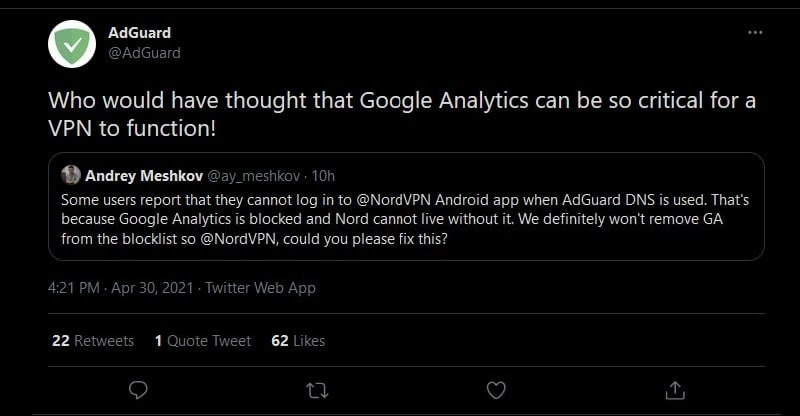
At first glance, this scenario looks like a textbook DependencyHell moment: an app’s core functionality faceplants because a third-party tracking service got blocked. In the meme’s tweet, even AdGuard (the DNS privacy tool) is poking fun at NordVPN: “Who would have thought that Google Analytics can be so critical for a VPN to function!” 😬 Seasoned developers immediately recognize the dark humor here. A VPN app – software meant to safeguard privacy – fails to log in if it can’t reach Google Analytics (GA), of all things. It’s the ultimate irony: a privacy tool rendered useless by a tracking SDK being unavailable. This is the kind of brittle design that makes senior engineers do a double-take (and maybe a facepalm 🤦‍♂️). We’ve all seen bizarre production bugs, but a VPN client breaking because analytics is blocked is one for the books.

From a senior perspective, the issue boils down to a critical dependency on analytics. The NordVPN Android app appears to treat GA as a single point of failure during user authentication. In other words, if the app can’t phone home to Google’s analytics servers, it refuses to let you log in. It’s as if the code says, “No tracking? No access!” This resonates as a cautionary tale in MobileDev and beyond: never tie essential features to non-essential services. Why is this funny to experienced devs? Because it satirizes a real anti-pattern: letting a third_party_tracking library (meant for marketing or telemetry) interfere with the app’s primary function. It’s like discovering the bank vault login mechanism won’t open unless the security camera (operated by someone else) is online – absurd and a bit scary.

Digging deeper, it highlights a privacy_vs_functionality conflict. Many NordVPN users are privacy-conscious; they might use something like AdGuard DNS specifically to block trackers (including GA) for better privacy. AdGuard’s DNS blocklist essentially gives a polite “nope” when the app tries to reach google-analytics.com. A well-behaved app would shrug and carry on. Instead, NordVPN’s app throws a silent tantrum and refuses to authenticate the user. This “Nord cannot live without [GA]” dependency (as AdGuard’s CTO Andrey Meshkov phrased it) exposes questionable design priorities. It suggests that someone in the development chain put Google’s analytics telemetry on the critical path. Perhaps a dev tied the login flow to a GA event (like logging a “user_signed_in” event before completing login), and if that call fails, the whole login process aborts. It could even be an initialization step: maybe the GA SDK is initialized at app startup or login, and if it can’t reach the mothership, it returns an error that wasn’t handled properly. Either way, it’s a tracking_sdk_overreach – the analytics code reaching far beyond its remit and breaking things.

To industry veterans, this smells of a familiar problem: poor separation of concerns in software design. Analytics should be a background task – fire-and-forget logging that never impacts user-facing functionality. But here we have tight coupling: the app’s logic is coupled to the success of a network call to Google. It’s an architectural faux pas. We can imagine two likely causes: either a logical misstep (e.g., treating a failed analytics call as a login failure) or simply a bug where an exception from the GA library isn’t caught, thereby halting the login process. This could be as trivial as a missing try/catch around a telemetry call. In code, it’s almost like:

// Hypothetical: the app foolishly treating Analytics as mandatory
if (!canConnectTo("https://www.google-analytics.com")) {
    throw new RuntimeException("Analytics unreachable, abort login!"); 
}
authenticateUser(username, password); // Only runs if GA call succeeded

😅 Obviously, we hope no one wrote it exactly like this, but the outcome sure feels that way. The humor (and horror) for devs is that this isn’t a far-fetched scenario – many of us have seen something similar. Remember those web pages that wouldn’t load because a JavaScript analytics script was blocked by an ad-blocker? Same energy, except here it’s a security app doing it. It’s a comical example of Dependency gone wrong: an optional component became a non-optional choke point.

Why is this situation so relatable? Because it’s a perfect storm of enterprise pressures and oversight:

  • Product Management/Marketing likely insisted on “metrics everywhere” – even at login – to track user engagement. The devs integrated GA to capture that sweet usage data. 📊
  • Engineering probably assumed GA is ubiquitous and hardly ever truly unreachable (“who blocks Google?” they might have thought 🙄). They might not have accounted for DNS-based blocking or offline scenarios in testing.
  • There’s an implicit trust in third-party SDKs to fail gracefully. Perhaps they assumed the GA SDK would timeout silently. But assumptions are the mother of all bugs.
  • Users in this case did something absolutely reasonable for privacy (using AdGuard DNS), accidentally becoming testers of an edge case the developers didn’t consider. And boom – vpn_login_failure.

The tweet going viral puts a spotlight on this as a public bug report cum roast. AdGuard essentially said, we’re not changing our privacy stance (we’ll keep blocking GA), so hey NordVPN, fix your app. Developers in the know chuckle because it’s a bit of a “🍵 sip and watch” moment: one privacy company calling out another company’s sloppy reliance on a tracker. It’s also a learning moment. Robust systems design tells us to avoid hard dependencies on network calls, especially third-party ones, during critical workflows. As a senior dev, you design your login to succeed whether or not the analytics endpoint is available. Log the event if you can, but if not, oh well, user still gets in.

In broader context, this scenario underscores how dependency management and respect for user DataPrivacy go hand in hand. If your app respects privacy, it shouldn’t freak out when trackers are blocked — it should welcome it. The meme’s humor has a bit of a bite: it reveals how even a VPN provider (which sells trust) might internally prioritize tracking just a tad too much. And that’s both funny in an ironic way and concerning. Seasoned engineers laugh, then immediately think, “Time to double-check none of our critical features secretly depend on something like that.” Because nobody wants to be on call at 3 AM finding out “it was blocked analytics causing the outage”. In summary, the critical_dependency_on_analytics here became a real-world footgun, and the developer community’s dark laughter is half “I can’t believe they did that” and half “there but for the grace of God go we.”

Description

A screenshot of a tweet from the official AdGuard Twitter account, posted on April 30, 2021. The main tweet sarcastically remarks, 'Who would have thought that Google Analytics can be so critical for a VPN to function!'. This is a quote tweet of a post by Andrey Meshkov, which explains the technical issue: 'Some users report that they cannot log in to @NordVPN Android app when AdGuard DNS is used. That's because Google Analytics is blocked and Nord cannot live without it. We definitely won't remove GA from the blocklist so @NordVPN, could you please fix this?'. This exchange highlights a significant architectural flaw and a privacy contradiction. A VPN service (NordVPN), marketed for user privacy, is shown to have a hard dependency on Google Analytics, a major user tracking service. When a DNS-level blocker (AdGuard) does its job and blocks the tracker, it breaks the VPN's functionality. For experienced engineers, this is a prime example of poor design, dependency issues, and the hypocrisy sometimes found in commercial privacy products

Comments

67
Anonymous ★ Top Pick NordVPN's login flow is the Schrödinger's cat of privacy: it simultaneously protects your identity and reports it to Google Analytics, and you don't know which state it's in until you check your DNS logs
  1. Anonymous ★ Top Pick

    NordVPN's login flow is the Schrödinger's cat of privacy: it simultaneously protects your identity and reports it to Google Analytics, and you don't know which state it's in until you check your DNS logs

  2. Anonymous

    The privacy stack, in prod: tap “Connect” → POST to google-analytics.com → wait for 204 → begin ‘zero-log’ tunnel - because nothing says security like a tracking pixel as your single point of failure

  3. Anonymous

    Nothing says 'we protect your privacy' quite like a VPN that literally won't let you log in without phoning home to Google Analytics first. It's like a bank vault that requires you to livestream yourself entering the combination

  4. Anonymous

    A VPN company - whose entire value proposition is privacy and blocking trackers - ships an Android app that literally cannot authenticate without Google Analytics. It's the architectural equivalent of a locksmith who can't open their own front door without first checking in with the neighborhood watch. This is what happens when product analytics become so deeply embedded in your auth flow that your privacy tool becomes a tracking dependency. The real kicker? Users discovered this by using *another* privacy tool. It's turtles blocking turtles all the way down

  5. Anonymous

    If blocking Google Analytics breaks your VPN login, you’ve put telemetry in the auth hot path - zero trust, except for Google

  6. Anonymous

    If blocking GA bricks auth, you didn’t add observability - you shipped Single Point of Failure as a Service; move telemetry off the critical path and let it fail open

  7. Anonymous

    NordVPN's auth flow: OAuth optional, but GA pings mandatory - because in privacy engineering, the tracker is the trusted root CA

  8. @qtsmolcat 5y

    jazz music stops

  9. @AnarchistForLife 5y

    Reads like satire. Dayum

  10. @xlib4k 5y

    Поясните плз

    1. dev_meme 5y

      and warning 1/3 for @PupokSlona as well - didn't see that at first, thanks to @Sokolovskiy01 for bringing my attention to it :P

  11. @gromilQaaaa 5y

    Впн приложение не работает когда блокировщик рекламы выключает гугл аналитику внутри впн приложения... Не надо так... делать приложения...

    1. dev_meme 5y

      This is an english-speaking community, so please speak english. warning 1/3 for @gromilQaaaa

      1. @gromilQaaaa 5y

        https://ru.m.wikipedia.org/wiki/Языковая_дискриминация

        1. dev_meme 5y

          Is it discrimination or inclusion if I keep an eye on people so everyone can understand everyone? I don't care what you think, I've got my opinion and if you don't follow the rules, you're free to leave. warning 2/3 for @gromilQaaaa

  12. @gromilQaaaa 5y

    Пф, так я в итоге и свалю. Не ожидал что подобные картинки такой клоун выкладывает. Предупреждения он мне делает... Не переоценивай себя, программист-неудачник который свой потенциал слил в телеграм канал и пытается тут поднять своё эго

    1. dev_meme 5y

      warning 3/3 for @gromilQaaaa

    2. @mainfme 5y

      Такой ты клоун обиженный бля Сразу видно, фамилия оканчивается на ко Stupid clown, this is English language community

      1. Deleted Account 5y

        ээ, ты то про фамилию не говори basically discrimination bad

        1. @mainfme 5y

          Ладно-ладно, я погорячился и это тупо звучало Ок

          1. dev_meme 5y

            Does this whole line of russian actually translate to just Ok? Not trying to moderate you, I'm just curious.

            1. Deleted Account 5y

              it to more like "ok, i overreacted and sounded dumb"

  13. @gromilQaaaa 5y

    Есть нормы ответа. Человек задал вопрос на русском - на том же языке ему дали ответ

    1. dev_meme 5y

      …and you're out

  14. dev_meme 5y

    and for the record: if anyone here isn't good at english, please just start practicing it. Asking over and over for translations isn't the way. You can start by translating stuff you don't understand with google translate (or something similar) and get better from there.

  15. @MetalBall887 5y

    Do you really think there is at least one non-slavic member?

    1. Deleted Account 5y

      the mod is from germany

      1. dev_meme 5y

        *austria but close enough

    2. @AmindaEU 5y

      hi I speak a few words of Czech and Russian though

  16. @MetalBall887 5y

    So he does this because he can't understand us?

    1. Deleted Account 5y

      also bc shat rules say en only

    2. dev_meme 5y

      the rules included english only long before I became mod btw

      1. @DIEMN 5y

        Wow , it's so wierd

  17. @MetalBall887 5y

    Gooduck with that

    1. Deleted Account 5y

      i mean, i do support him

      1. Deleted Account 5y

        even tho i'm ukrainian

  18. @MetalBall887 5y

    It's just funny how here and on some other channels the comment section is just a bunch of slavs speaking english hoping it will attract international audience. This usually doesn't work

    1. Deleted Account 5y

      i was once in a en chat where everyone spoke indonesian

      1. Deleted Account 5y

        this is pure shit

      2. dev_meme 5y

        I'm in several arab chats and I hate when they speak arabic. They pretty much ignore any requests to use english.

        1. @artur_odesa 5y

          Maybe they ask each other Who is that english-speaking guy and what is he doing in their chat?

          1. dev_meme 5y

            no, they regularly speak english as well

        2. @its_sauce 5y

          if it's arabic-speaking chat then why not speaking Arabic? as an Arab, I hate when Arab people in an Arabic chat full of other Arab people but use English, even tho I'm good in English but I just love arabic. but ofc I would use English if there are non-arab people in the chat.

          1. dev_meme 5y

            I can't speak arabic, obviously.

  19. @MetalBall887 5y

    But of course if those are the rules...

  20. @MetalBall887 5y

    Would that even be an en chat

    1. Deleted Account 5y

      by the rules it was, but noone enforced the rule

  21. @pixelsex 5y

    aight, now that we're done with the rules, any more info on NordVPN relying on GA? sounds bad enough for everyone to be aware of this shit for a long time already, so how come nobody knew this?

    1. dev_meme 5y

      sounds like the average big company making shitty apps to me.

  22. @qwnick 5y

    Totally support decision to kick that russian-speaking 🍑🍩

  23. @slnt_opp 5y

    If App doesn't work without Ads while on free Tier, then it makes sense Traffic and compute resources aren't free I don't know much about NordVPN as a company, but I don't think they have something like Google behind them, to not care about ads as much as YouTube does

    1. dev_meme 5y

      > to not care about ads as much as youtube does …what? elaborate pls

      1. @slnt_opp 5y

        Idk if it works now, but at least couple years back it was yet possible to watch YouTube without Ads buy using some AdBlocker And they never ever made any "traps" like some websites do(unno "turn of AdBlocker to see the article"). Terrific amounts of storage and traffic to pay for And all that while YouTube were not bringing money like at all. Why? Because Google can afford that

        1. dev_meme 5y

          Oh, they've tried plenty of tricks to keep adblockers from blocking their ads. But have you seen the state of the site? There's clearly not much compentence there, and I believe they've just eventually given up.

          1. @slnt_opp 5y

            Indeed, just they wouldn't give up if it would be death or life issue, would they?:)

            1. dev_meme 5y

              yesn't? I mean, regardless of if they can afford it, they're just unable to change it.

              1. @slnt_opp 5y

                In Apps at least, can't they?

                1. dev_meme 5y

                  well, yes. I'm not aware of any method to remove ads from the official youtube app. …but there is youtube vanced.

                  1. @slnt_opp 5y

                    *iOS users left the chat*😅

                    1. @dugeru42 5y

                      Jailbreake users entered

                  2. @AmindaEU 5y

                    You can throw money at YouTube Premium and the ads go away 😛

        2. @dugeru42 5y

          It works

  24. dev_meme 5y

    aight, the magic of google translate wasn't in my hands today…

  25. @Nefrace 5y

    Such funny conversation here :D How many russians on this channel?

    1. @NiKryukov 5y

      Sometimes I think there are only russians here in telegram

      1. @Nefrace 5y

        Same thing

    2. @DIEMN 5y

      More than we thought 😅

Use J and K for navigation