Microsoft Says Linux Is Its Friend
Why is this OperatingSystems meme funny?
Level 1: The Uneven Playdate
Imagine one kid says, "We are best friends now," while the other kid says, "No, you used to take my toys." They might be playing together today, but the second kid still remembers the old fights. This meme is funny because Microsoft is acting friendly toward Linux through tools like WSL, while Linux is pictured as still not fully convinced.
Level 2: WSL Trust Issues
Linux is an open-source operating-system family widely used for servers, cloud infrastructure, containers, embedded systems, and developer machines. It is strongly associated with community-driven development, transparency, and control over the computing environment.
Microsoft is historically associated with Windows, proprietary software, enterprise licensing, and platform control. That history matters because many developers remember Microsoft and Linux as competitors, not natural allies.
WSL, or Windows Subsystem for Linux, lets Windows users run Linux command-line tools and environments without leaving Windows. For developers, that can be extremely convenient. You can edit code on Windows, run Linux-oriented tools, use familiar shell commands, and develop for server environments that look more like production.
The meme's labels make the roles clear:
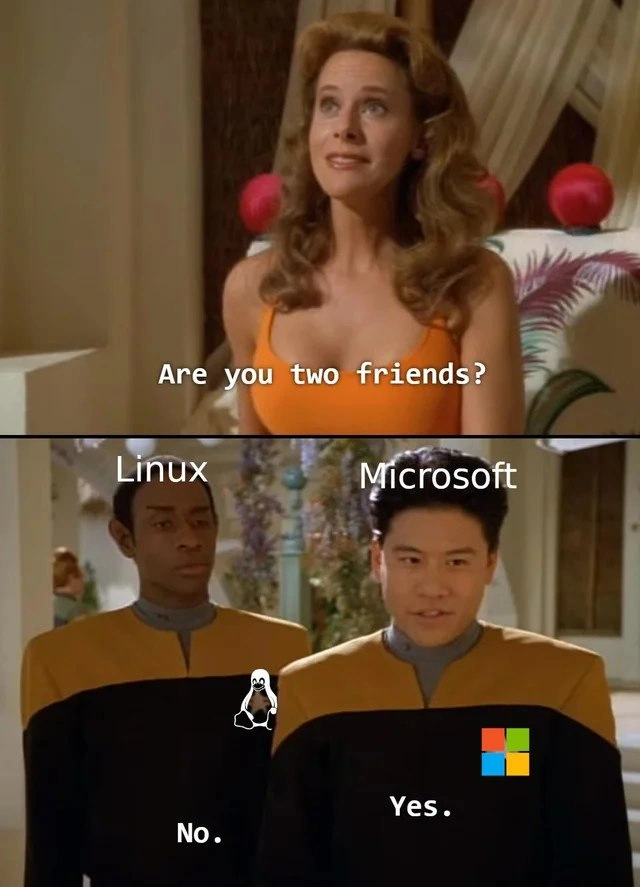
Linuxis the cautious side.Microsoftis the eager side.Are you two friends?frames the relationship as social, not technical.No.andYes.show that the two sides interpret the same relationship differently.
For a newer developer, this is a reminder that technical features exist inside history. WSL is not just a compatibility layer; it is also a symbol of how much the industry changed. The old "Windows versus Linux" argument became more complicated once cloud platforms, containers, open-source tooling, and developer experience all started overlapping. The result is useful, but still awkward enough to deserve a meme.
Level 3: Asymmetric Friendship Handshake
The image stages the entire Microsoft-Linux relationship as one awkward social question:
Are you two friends?
Linux, marked with the Tux logo, answers:
No.
Microsoft, marked with the four-color logo, answers:
Yes.
That mismatch is the joke. It captures the difference between corporate strategy and community memory. Modern Microsoft has strong reasons to present itself as friendly to Linux and open source: developers use Linux tooling, cloud workloads often run on Linux, containers are built around Linux primitives, and Azure needs to meet customers where their software already lives. The post message says WSL be like, pointing at Windows Subsystem for Linux as the most literal version of that embrace: Microsoft putting a Linux-compatible developer environment inside Windows.
The Linux side's No. carries decades of baggage in one syllable. For a long time, Microsoft represented proprietary lock-in, Windows-first assumptions, closed platforms, and a competitive posture toward open-source operating systems. Even after real technical changes, trust does not recompile instantly. Communities remember old licensing fights, platform wars, file-format battles, browser bundling, and the general feeling that "interoperability" sometimes meant "please enter our ecosystem through this Microsoft-shaped doorway."
WSL makes the meme especially sharp because it is both genuinely useful and symbolically strange. For many developers, WSL removes friction: run Bash, use Linux package managers, execute common CLI tools, develop against Linux-like environments, and stay on a Windows desktop. That is practical and valuable. It also gives Microsoft a way to keep developers on Windows while satisfying their need for Linux workflows. From Microsoft's perspective, this is friendship. From the suspicious Linux perspective, it is friendship with a product roadmap attached.
The two characters standing side by side reinforce that asymmetry. They are in the same frame and wearing similar uniforms, but their answers disagree. That is how a lot of cross-platform strategy feels in practice: the vendor announces partnership, the community asks what the catch is, and the developers in the middle just want grep, Docker, SSH keys, and a terminal that does not ruin their day.
The humor is not that Microsoft support for Linux is fake. A lot of it is real, technically serious, and useful. The humor is that institutional trust has a long half-life. Microsoft can say "Yes" because today's business incentives align with Linux adoption. Linux says "No" because open-source culture learned to inspect incentives before accepting hugs from platform giants.
Description
A two-panel Star Trek-style meme shows a woman asking, "Are you two friends?" In the lower panel, two uniformed characters are labeled "Linux" and "Microsoft" with a Tux penguin logo on the Linux character and a Microsoft four-color logo on the Microsoft character; Linux answers "No." while Microsoft answers "Yes." The humor comes from Microsoft's modern embrace of Linux through WSL, Azure, GitHub, and open-source positioning, contrasted with the Linux community's long memory of proprietary lock-in and old platform wars.
Comments
4Comment deleted
Microsoft saying it loves Linux is just `embrace` and `extend` trying very hard not to autocomplete the third argument.
Did you mean undefined? Comment deleted
Not sure what's wrong with microsoft but man I spent a day trying to deploy a server on azure linux and that shit didn't work and just pulled it on AWS and Heroku just to make sure I wasn't the dumb one and man it did work in a second. Comment deleted
Just went to Azure cause the company I was doing that for had Azure credits, not to mention they didn't give me a Heroku service and I ended up deploying it on my Personal Plan. Comment deleted