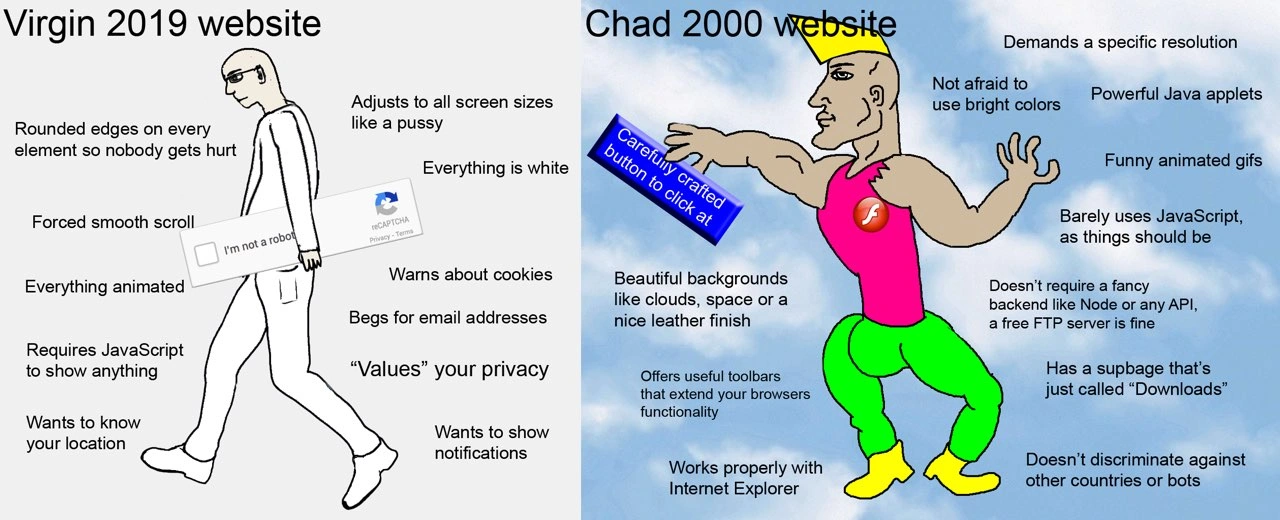
Virgin Modern Website vs. Chad Retro Website
Why is this WebDev meme funny?
Level 1: The Polite Restaurant vs. the Loud Diner
Imagine a fancy new restaurant where, before you can eat, you must sign a form about your privacy, give them your address, agree to receive mail forever, and wait while they slowly assemble your table — and everything on the menu is plain and white. Down the street there's a loud old diner with neon signs, sticky vinyl booths, and a giant shiny button that says PRESS ME. It only has one table size and the cook yells at you, but your food appears instantly. The joke is that everyone says they prefer the fancy place, while secretly missing the diner — because it never asked for anything, it just fed you.
Level 2: Decoding Both Panels
- Flash / Java applets: browser plugins of the late 90s–2000s that ran animations, games, and full apps inside web pages. Powerful for their time, riddled with security holes; both are now dead tech (Flash was fully sunset in 2020).
- FTP server: the old way to publish a site — copy HTML files to a folder on a server. No build pipeline, no Node backend, no API; the page is the file. Modern sites typically render through JavaScript frameworks talking to APIs, which is why disabling JS on many 2019 sites shows literally nothing.
- Cookie banners / notification prompts: the pop-ups asking to track you or send you alerts. Born from privacy regulation and growth-hacking respectively; collectively, the toll booths of the modern web.
- reCAPTCHA: the "I'm not a robot" gate, here carried by the Virgin like luggage — note the Chad counterpoint, "Doesn't discriminate against other countries or bots." The old web served everyone, scrapers included.
- Responsive design: layouts adapting to any screen size — mocked here ("like a pussy") precisely because it's universally correct practice; the Chad demanding a specific resolution is confidence indistinguishable from rudeness.
- The format itself: Virgin vs Chad memes deliberately overpraise the "Chad" for traits that are objectively flaws. Reading it straight misses the irony — it's nostalgia laughing at both eras at once.
Level 3: Nostalgia as Architecture Review
The Virgin-vs-Chad format is satire by asymmetric annotation, and this one is a remarkably complete archaeology of two web eras. The hunched "Virgin 2019 website" carries a reCAPTCHA checkbox like a burden and is indicted line by line: "Requires JavaScript to show anything," "Warns about cookies," "Begs for email addresses," "'Values' your privacy" (the scare quotes doing felony-level work), "Wants to show notifications." The swaggering "Chad 2000 website," Flash logo on its tank top, "Demands a specific resolution," runs "Powerful Java applets," needs no "fancy backend like Node or any API, a free FTP server is fine," and — the deepest cut — "Has a subpage that's just called 'Downloads'."
The joke's engine is that every Chad trait is objectively worse engineering, yet emotionally it wins anyway. Fixed 800×600 layouts, Flash and Java applets (both security catastrophes that browsers eventually executed in public), IE-specific markup, and browser toolbars — the actual malware delivery vector of the 2000s — were genuinely bad. But the meme isn't really defending them; it's prosecuting what replaced them. The 2019 web's sins are consent-theater sins: cookie banners mandated by GDPR (months old when this was posted) but implemented as dark-pattern obstacle courses; notification permission prompts on blogs; newsletter modals interrupting the first paragraph; client-side rendering so heavy that a text article ships a megabyte of JavaScript and shows a white void without it. The 2000 site was crude but honest — it wanted to show you a shiny beveled button, and it did, immediately.
Senior developers feel the sting because the regression was systemic, not individual. No one chose web bloat; it emerged from incentives. Ad-tech and analytics demanded scripts; growth teams demanded email capture; legal demanded consent banners; engineering demanded React because hiring; and "everything is white, rounded edges so nobody gets hurt" is what happens when every design system converges on the same risk-free minimalism. Meanwhile the static-HTML-on-cheap-hosting model the Chad embodies quietly returned as best practice wearing new clothes — static site generators, JAMstack, "use less JavaScript" performance budgets. The industry spent two decades reinventing the FTP-served homepage with extra steps, which is the kind of joke that writes itself on a fifteen-year delay.
Description
A classic 'Virgin vs. Chad' meme comparing web design philosophies of different eras. On the left, the 'Virgin 2019 website' is a frail, slouched character burdened by modern web tropes. Text points out features like 'Rounded edges on every element so nobody gets hurt,' 'Adjusts to all screen sizes like a pussy,' 'Requires JavaScript to show anything,' 'Warns about cookies,' 'Begs for email addresses,' and holds a reCAPTCHA checkbox. On the right, the 'Chad 2000 website' is a muscular, confident figure against a cloud background, sporting a Flash logo. His strengths are ironically listed as outdated practices: 'Demands a specific resolution,' 'Powerful Java applets,' 'Funny animated gifs,' 'Barely uses JavaScript,' 'Works properly with Internet Explorer,' and being hosted on a simple 'FTP server.' The meme satirizes the evolution of web development, contrasting the perceived over-engineered, bloated, and user-intrusive nature of modern websites with the simpler, albeit chaotic and often garish, websites of the early 2000s. It’s a nostalgic joke for developers who have seen the web transition from simple HTML/FTP sites to complex client-side applications
Comments
8Comment deleted
The 2000s website was 200KB of HTML and a dancing baby GIF that worked offline. The 2019 site is a 5MB JavaScript bundle that needs three cloud services just to render a cookie consent banner
2000: drop index.html onto an FTP server and you’ve got a blinky Flash masterpiece online; 2023: need a 2 MB React bundle, GDPR banner, geolocation prompt, reCAPTCHA, and a canary rollout on Kubernetes just to say “Hello.”
The 2000s website had 99 problems but a lighthouse score ain't one - it loaded instantly, worked offline by default, and never needed a service worker because the entire site WAS the service
The 2000 site shipped 40KB over FTP and still loads today; the 2019 site ships 4MB of JavaScript to render a cookie banner asking permission to render the rest
The real tragedy is that the 'Chad 2000 website' would actually load faster on modern hardware than most SPAs today, even after accounting for the 56k modem. Sometimes I wonder if we traded our <marquee> tags for webpack configs and somehow ended up with a worse user experience - just with better lighthouse scores to justify it to stakeholders who've never heard of the 14KB rule
We replaced FTP + index.html with a micro-frontend that needs Node, three consent modals, and 300KB of JS just to render a button - progress measured in bundle size and cookie banners
Chad 2000 applet crashes one JVM; Virgin 2019 SPA bundles 47 frameworks just to say 'Loading...'
2000: a “Downloads” FTP link. 2019: a SPA, fifteen microservices, reCAPTCHA, and a cookie banner - still just to deliver a zip