Linkin Park's Ode to Drastic Git Commands
Why is this VersionControl meme funny?
Level 1: Knocking Over Your Own Sandcastle
Imagine spending the whole day building a sandcastle, and right at the end you press a button that smooths the entire beach back to flat — on purpose, because the castle was getting messy and starting over felt easier. The joke sets this to a famously dramatic rock song about how you tried so hard, got so far, and in the end it didn't even matter. Every programmer laughs because every programmer has pressed that button, watched a day of work vanish in one second, and had that exact song play in their head.
Level 2: The Command That Deletes Your Afternoon
- Git: the version-control system that records snapshots (commits) of your project so you can travel back in time. Crucially, it can only travel to moments you explicitly saved.
- HEAD: a pointer to the commit you're currently standing on — "the last saved checkpoint."
git reset --hard: "throw away everything I've changed since that checkpoint." Your edited files are forcibly rewritten to match the last commit. Unlike almost everything else in Git, this has no undo for work you never committed — there's no trash bin, no Ctrl+Z.- Uncommitted changes: edits you've made but not yet saved into a commit. They exist only in your working folder. This is why mentors nag juniors to commit early, commit often — small, even messy commits are save points;
git reflogcan resurrect any committed state, but it cannot resurrect what was never committed. - The classic early-career arc: you learn
reset --hardas the magic fix for a confusing repo state, use it happily for months, and then one day run it while forgetting about the afternoon of changes sitting unstaged. That day you learn the difference betweengit stash(reversible shelf) and--hard(shredder), and you never fully trust your own fingers again.
Level 3: Three Trees, One Power Chord
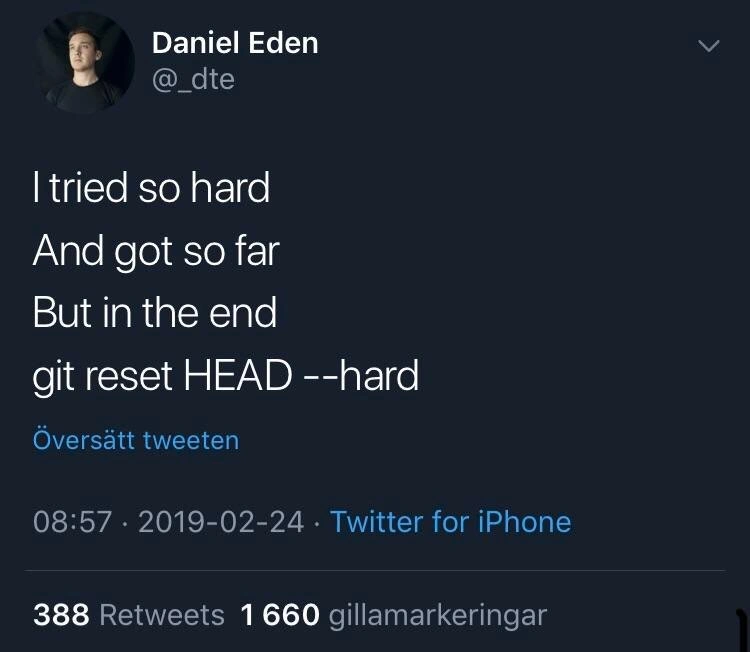
I tried so hard And got so far But in the end git reset HEAD --hard
The parody is structurally perfect because the song and the command share a thesis: effort, then annihilation, then it doesn't even matter. But the technical payload deserves unpacking, because git reset --hard is the sharpest blade in Git's drawer and the meme audience flinches for a precise reason.
Git maintains three "trees": HEAD (the last commit), the index (staged changes), and the working tree (your actual files). git reset comes in escalating severities: --soft moves HEAD only, --mixed (default) also resets the index, and --hard overwrites all three — including the working tree. That last step is the irreversible one. Commits are recoverable via git reflog, staged blobs can sometimes be exhumed with git fsck --lost-found, but uncommitted, unstaged changes have no object in the database at all. There is nothing to recover from. Six hours of refactoring becomes a cache miss against reality. The Linkin Park mapping is therefore not approximate; it is exact. You tried so hard (working tree), you got so far (maybe even staged), and then one muscle-memory command made it not matter.
The senior-developer wince comes from why this command gets run. Nobody types --hard carefully; it's typed in frustration — the branch is "weird," a merge went sideways, there are conflict markers everywhere, and reset --hard is the percussive maintenance of version control: turn it off and on again, violently. Git's CLI design shares the blame. The same verb, reset, spans operations from "unstage a file" to "destroy all local work," differentiated by flags — a UX decision that has cost the industry untold engineer-hours. (Pedants will also note the tweet's argument order, git reset HEAD --hard, is slightly off the canonical git reset --hard HEAD; Git accepts it anyway, because of course the destructive command is the forgiving parser.) The channel's caption — "Good morning to all who wasn't working through the whole night!" — completes the picture: this command's natural habitat is 4 AM, when judgment is depleted and the working tree is full of regret.
That the parody comes from a well-known design-systems engineer and pulled 388 retweets confirms the universality: there is no Git user, junior or principal, without a --hard scar.
Description
This image is a screenshot of a tweet from user Daniel Eden (@_dte). The tweet parodies the lyrics of the Linkin Park song 'In The End'. The text reads, 'I tried so hard / And got so far / But in the end / git reset HEAD --hard'. The background is a dark navy blue, and the text is white. Below the main text, there is metadata indicating the tweet was sent at '08:57 · 2019-02-24' from 'Twitter for iPhone' and has '388 Retweets' and '1 660 gillamarkeringar' (likes in Swedish). The joke lies in replacing the melancholic song lyric 'it doesn't even matter' with a destructive and desperate Git command. For developers, `git reset HEAD --hard` is a powerful command that discards all changes in the working directory and staging area, effectively resetting the branch to its last committed state. It's often used as a last resort when a developer has made a mess of their local changes and wants a clean slate, making the parody relatable to the feeling of frustrating work being wiped away
Comments
8Comment deleted
The main difference between Linkin Park's original lyrics and this version is that with 'git reset --hard', it really does matter... to the uncommitted code you just obliterated
When the rookie croons “git reset --hard,” the seniors harmonize with `git reflog`, restore the branch, and add “karaoke isn’t a backup strategy” to the runbook
The real tragedy isn't the lost commits - it's explaining to the PM why yesterday's "90% complete" feature is now back at the design phase because you thought you could refactor the entire architecture at 3 AM without branching
It doesn't even matter - unless you'd staged it, in which case git reflog is the resurrection arc Linkin Park never wrote
The beautiful irony here is that 'git reset HEAD --hard' is the nuclear option that literally undoes all that hard work and progress - a perfect metaphor for those moments when you've spent hours debugging, finally got everything working, then accidentally nuke your uncommitted changes. It's the developer equivalent of Chester Bennington screaming 'I had to fall to lose it all' - except in our case, we voluntarily pulled the trigger on our own work. At least with Linkin Park, the emotional damage was intentional; with git reset --hard, it's usually a 3 AM mistake followed by the five stages of grief and a frantic search for local history in your IDE
git reset --hard: Making 'undo' a philosophical debate since Git's birth, because reflog is for mere mortals who haven't internalized the pain
Senior move: call git reset HEAD --hard a 'stateless local cache purge' and you’ve turned despair into architecture
Senior dev therapy: sing Linkin Park, then git reset --hard HEAD - rebrand it as “rollback strategy” and let the reflog write the real postmortem