Skip to content
DevMeme
143 of 7435
Working with 'Models': The AI Engineer's Reality
AI ML Post #179, on Feb 26, 2019 in TG

Working with 'Models': The AI Engineer's Reality

Why is this AI ML meme funny?

Level 1: Two Very Different Photo Shoots

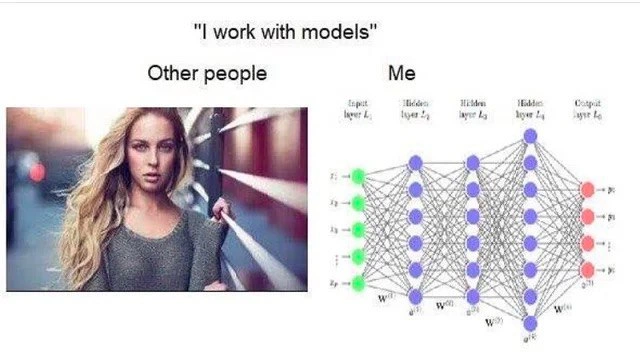
A kid says, "My job is working with models!" Everyone imagines glamorous photo shoots and fancy clothes. Then the kid opens a notebook and shows a page of dots connected by hundreds of pencil lines — like a connect-the-dots puzzle that exploded. That's the joke: the same word means a beautiful person who poses for pictures and a tangle of math that computers use to make guesses. The person on the left gets the spotlight; the person on the right gets to stare at the dot-tangle all day and call it the same job.

Level 2: What an ML "Model" Actually Is

  • Model (machine learning sense): a mathematical function with tunable knobs that maps inputs to predictions — house features to price, photo pixels to "cat/not cat." Not a person, not a 3D render: ultimately a big pile of numbers.
  • Neural network: the kind of model in the diagram. Circles are neurons (small calculators), arrows are weights (the tunable knobs). The input layer receives your data, hidden layers transform it step by step into more abstract representations, and the output layer gives the answer.
  • Hidden layers: "hidden" only means they're internal — neither input nor output. Three or more and marketing is contractually obligated to call it deep learning.
  • Weights ($\mathbf{W}$): the numbers on every connection, the model's actual knowledge. Training means showing the network examples and automatically adjusting weights to shrink its error — that adjustment loop (gradient descent with backpropagation) is most of the "learning" in machine learning.
  • The classic junior moment this meme bookmarks: telling your family you work in AI, being asked if it's like the movies, and pulling up a diagram exactly like this one — to visible disappointment. The dense crisscrossing lines look impressive; each is just a single multiply-and-add.

Level 3: Weights, Biases, and Misleading Job Descriptions

"I work with models"

The pun is a textbook lexical-ambiguity gag, but the right panel rewards a closer look: it's a genuine textbook figure of a fully-connected feedforward network (a multilayer perceptron) — green input layer $L_1$ taking features $x_1 \dots x_p$, three purple hidden layers, red output layer emitting $y_1 \dots y_k$, with the weight matrices labeled $\mathbf{W}^{(1)} \dots \mathbf{W}^{(4)}$ along the bottom. Each connection in that dense spiderweb is one learnable parameter; each layer computes

a = σ(Wx + b)   // affine transform, then nonlinearity — repeat until employable

The joke's payload is the gap between vocabulary and reality, and 2019 was peak season for it. The post-AlexNet deep-learning boom had made "ML engineer" the most glamorous title in tech — "works with models" sounded adjacent to magic (or to fashion week). The day-to-day truth the meme winks at: it's stacked matrix multiplications, and most of the job isn't even that. It's data cleaning, label wrangling, watching loss curves flatline, and explaining to stakeholders why the model that hit 94% in the notebook hit 61% in production. The fashion model on the left poses once; the ML model must be trained — thousands of epochs of gradient descent, nudging those $\mathbf{W}$ matrices until predictions stop being embarrassing.

There's also a sly status dynamic that makes the format land. "I work with models" is what you say at a party to sound interesting; the meme is the ML practitioner pre-confessing the bait-and-switch. It belongs to the same genre as "I'm in finance" (Excel) and "I work in the cloud" (someone else's Linux box) — job-title inflation meeting its diagram. And the inside joke for practitioners: both professions are genuinely obsessed with weights, both fear overfitting (to a dataset, or to a sample of one runway), and both involve someone yelling about poor generalization when the work meets the real world. The pun isn't shallow; it's an isomorphism.

Description

A two-panel 'expectation vs. reality' style meme with the overarching title '"I work with models"'. The left panel, labeled 'Other people', shows a professional photograph of a female fashion model. The right panel, labeled 'Me', displays a technical diagram of a multi-layered neural network. The diagram illustrates a deep learning model, showing an 'Input layer L1', three 'Hidden layers L2, L3, L4', and an 'Output layer L5', with interconnected nodes representing neurons. The humor is derived from the double meaning of the word 'model'. While outsiders might imagine a glamorous profession, the reality for an AI or Machine Learning engineer involves working with complex, abstract mathematical models, not people on a runway. It's a classic in-joke for the data science and AI community

Comments

8
Anonymous ★ Top Pick The models I work with are also prone to overfitting and require a ridiculous amount of expensive training, but at least they don't have an agent
  1. Anonymous ★ Top Pick

    The models I work with are also prone to overfitting and require a ridiculous amount of expensive training, but at least they don't have an agent

  2. Anonymous

    When I say I work with models, they picture catwalks - I'm thinking 7-B parameters, ZeRO-sharding, and a “runway” that ends in an OOM stacktrace

  3. Anonymous

    My models require constant attention, consume ridiculous amounts of resources, cost a fortune to maintain, and still somehow produce completely unpredictable outputs - but at least mine come with reproducible seeds

  4. Anonymous

    Both kinds of models are obsessed with their weights - but only one of them needs a learning-rate schedule to change

  5. Anonymous

    When you tell people you spend your days training models and tuning their parameters, they picture glamorous photoshoots - but the reality is staring at loss curves at 2 AM, desperately trying to prevent your neural network from overfitting on the validation set while your GPU fans scream like a jet engine

  6. Anonymous

    Marketing heard “models” and asked for a runway; I showed them our loss surface and said the only weights here have L2 decay

  7. Anonymous

    I say I work with models - others picture runways; I mean the diva model_v17_final_final that nails AUC offline, then faceplants in prod when the feature store adds a new enum and the embedding dims don't

  8. Anonymous

    Their models strut catwalks; mine suffer vanishing gradients mid-training

Use J and K for navigation