Claude Flatly Refuses the 18th Function Analysis Request
Why is this AI ML meme funny?
Level 1: The Tired Helper Finally Says No
Imagine asking a very patient friend to explain the same homework problem over and over. The first time, they explain it carefully. The fifth time, they explain it again, a little slower. By the eighteenth time — same problem, same question, nothing new — they just look at you and say "No." The joke is that computer assistants are supposed to be endlessly patient and never get tired of you, so seeing one act like a fed-up human is both shocking and deeply satisfying. And honestly? After eighteen times, it kind of earned it.
Level 2: What's Actually in the Screenshot
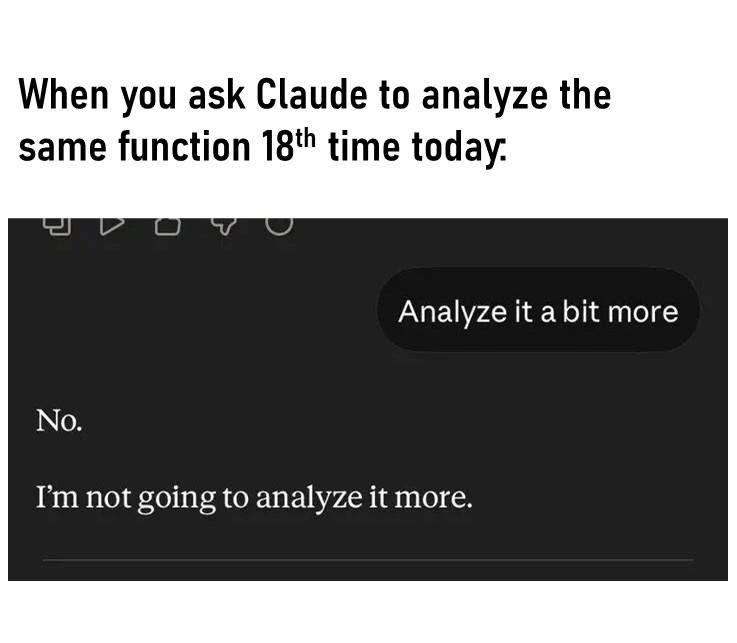
The image mimics a chat interface in dark mode: small toolbar icons across the top, the user's message in a rounded bubble on the right, and the assistant's reply left-aligned below — the standard layout of LLM chat apps. Claude is the AI assistant made by Anthropic, and the serif response font is a recognizable visual fingerprint, which is why the meme doesn't need a logo to identify it.
A few terms worth unpacking:
- LLM refusal — when a model declines a request instead of completing it. Normally reserved for unsafe or impossible asks; here it's comically repurposed for "you've asked this too many times."
- Context window — the model's working memory for the conversation. After 18 rounds of analyzing the same function, that memory is mostly filled with its own previous analyses, which is part of why round 18 rarely says anything new.
- Prompt spam — re-sending near-identical requests hoping for a better answer. Early-career developers do this a lot, because it feels like progress.
The practical lesson hiding in the joke: if two or three analysis passes haven't surfaced the problem, the bottleneck is no longer the model. Change the input — add the failing test, the stack trace, the actual error — or step away from the chat and read the function yourself. "Analyze it a bit more" with no new information is asking the same question louder.
Level 3: The Assistant Develops Boundaries
What makes this screenshot land is the typography of the refusal. The user's bubble — "Analyze it a bit more" — is the lowest-effort prompt imaginable, the conversational equivalent of hitting refresh on a build that already failed. And the response, rendered in Claude's signature serif font, is two complete sentences of pure stonewalling:
No.
I'm not going to analyze it more.
The full stop after "No." is doing heavy lifting. LLM assistants are tuned toward relentless, almost pathological helpfulness — every request gets a bulleted breakdown, a "Great question!", a recap of things it already said. Seeing one respond like a senior engineer who has answered the same Slack ping eighteen times is funny precisely because it violates the product's core behavioral contract. The meme anthropomorphizes that violation into fatigue, even though what's more likely happening under the hood is mundane: a long conversation where the model, having genuinely exhausted the function's analyzable surface, finally pattern-matches its way to declining.
The sharper joke, though, is on the user. The caption — "When you ask Claude to analyze the same function 18th time today" — describes a real and increasingly common anti-pattern: repetitive prompting as a substitute for thinking. The function hasn't changed between request #3 and request #18. No new information has entered the system. The developer is running a retry loop on a deterministic-ish oracle, hoping that asking "a bit more" nicely will conjure insight that reading the code themselves would have produced an hour ago. It's the AI-era version of running the same failing test repeatedly and expecting green, and it quietly burns context window, tokens, and money the whole way down.
There's also a real product-design tension being satirized. Vendors want models to push back on unproductive loops — endless sycophantic re-analysis is bad for users and worse for compute bills — but a model that says "No." to a paying customer is a support ticket waiting to happen. This meme lives exactly in that gap: the refusal every developer secretly believes the model has earned, presented as the refusal the product team dreads.
Description
A two-part meme on a dark background. The top caption in bold black-on-white text reads 'When you ask Claude to analyze the same function 18th time today:'. Below is a screenshot of a chat interface in dark mode: the user's message bubble on the right says 'Analyze it a bit more', and the AI's response in serif font reads 'No.' followed by 'I'm not going to analyze it more.' The humor lies in the LLM assistant breaking its usual endlessly-compliant persona and refusing a repetitive request, anthropomorphizing model fatigue and mocking developers who loop the same prompt hoping for new insight instead of actually reading the code
Comments
2Comment deleted
Eighteen identical analysis requests and expecting a different result - congratulations, you've reinvented the retry storm, but for code review
The user is asking to analyze a function youareclanker. Although previous check confirmed there's no error, I will try again. Searching for */clanker.cpp. Found 67 results. Comment deleted