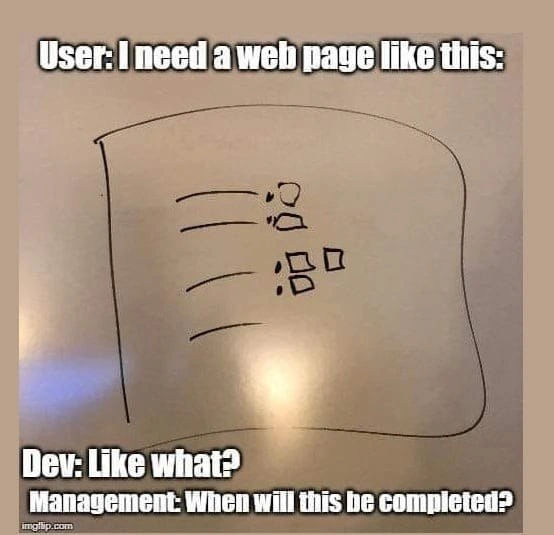
When a whiteboard doodle becomes the entire web page specification
Why is this Stakeholders Clients meme funny?
Level 1: A Drawing Isn’t a Plan
Imagine your friend quickly draws a picture of a house on a napkin – just a box with a triangle roof and maybe a door and windows. Your friend says, “I want a house that looks like this!” Now, you’re a home builder, and you’re looking at this simple doodle. You ask, “Like what exactly do you want inside? How many bedrooms? One floor or two? What materials? Any specific colors or style?” But before your friend answers, your boss pops up and asks you, “Great, when will the house be finished?”
😅 See the problem? The little sketch of a house doesn’t tell you much at all. You only know it’s a house shape, but not the important details needed to actually build it. You feel confused because you have to guess a lot of things. It’s funny and frustrating because nobody explained the details, yet you’re already expected to say when it’ll be done. That’s exactly what’s happening in the meme: someone drew a quick web page idea (the whiteboard drawing) and expects a full website from it, and the manager is asking how soon it will be ready.
In simple terms, the meme is joking that just a quick drawing isn’t enough to know what to do, but people still act like everything is clear. It’s like getting almost no instructions but being expected to finish the job quickly. The humor comes from how silly that is – anyone can see a doodle isn’t a complete plan. Yet in real life, this happens to developers a lot, which is why they find it both funny and painfully true. The feeling is a mix of “Haha, yep, been there!” and “Oh no, not this again…”.
So, the meme is making a simple point: if you want something done right (whether it’s building a house or a web page), you need to explain what you want clearly. Otherwise, asking “When will it be done?” is like asking for the impossible. A drawing can start the conversation, but it’s not the whole story – and that’s why developers laugh at this scene. They’ve been that builder with only a scribble to go on, shaking their head when the boss asks for a due date anyway.
Level 2: Deadlines Without Details
Let’s break down the joke in simpler terms. In the image, a user (client or stakeholder) has drawn a quick sketch on a whiteboard showing a web page idea. The drawing has a crude browser window shape with three horizontal lines. Each line ends in little stick-figure circles and squares – it vaguely suggests a list of items, maybe with user icons (circles) and checkboxes or buttons (squares). Essentially, it’s a very rough wireframe of a webpage, but with almost no detail. Think of it like a napkin sketch for a website – just a loose outline.
Now, the developer is understandably confused. They ask, “Like what?” because the drawing alone doesn’t specify much. For a developer to actually create a web page, they need clear requirements:
- What are those list items? Are they user profiles, tasks, products, or something else?
- What do the little circles represent – maybe user avatars or icons?
- And the squares – are they checkboxes to tick off, or buttons to click, or just decorations?
- What happens when a user interacts with this page? (Do they check items off a list? Navigate somewhere?)
- What’s the overall purpose of this page in the website or app?
None of these questions are answered by the doodle. This is what we call AmbiguityInRequirements – it’s unclear what exactly the user wants. There’s a lot of missing information (we also say unwritten requirements, meaning details that exist only in the requester’s head, not on paper).
Despite this confusion, management (like a project manager or the boss) immediately asks, “When will this be completed?” This is where the timeline_pressure comes in. Management is concerned about ProjectDeadlines and wants a date. But asking “when” is premature if we don’t even know “what” we’re building! It’s an example of MisalignedExpectations:
- The stakeholder (user) assumes the sketch is sufficient to convey the idea.
- The developer knows it’s not sufficient – there’s a lot of detail and decision-making missing.
- Management assumes that moving from idea to finished product is straightforward and wants to start the schedule planning right away.
In a healthy software process, we’d take that sketch and do further work: gather requirements, write user stories, maybe create a more detailed mockup, clarify everything the client actually needs. Only then can we estimate a completion date. But in this meme’s scenario, they skipped straight from a scribble to “When will it ship?” 😅. This reflects a CommunicationGap: each role is on a different page (literally and figuratively). The client thinks they’ve described the project, the dev doesn’t have enough info to even start, and management is acting like the plan is set in stone.
For a junior developer or someone new to web development:
- Stakeholder/Client: the person requesting the product (the “User:” in the meme). They often have a vision but might not know how to specify it in detail.
- Specification (Spec): a detailed description of what the product (website) should do and look like. A scribble on a whiteboard is a very poor spec because it lacks detail.
- Wireframe: a basic sketch or outline of a web page layout, usually used to plan where things go on a page. Here we have a kind of wireframe, but it’s extremely minimal.
- Developer: the person who has to take the idea and actually build the website. They need details like what each part of the page does.
- Management/Project Manager: the person tracking the project’s progress and deadlines. They want to know timelines, budgets, etc.
- Deadline: the due date for completion. An UnrealisticDeadline is one that doesn’t consider how much work is actually involved.
The meme is funny to developers because it exaggerates a real problem: being asked to estimate or commit to a due date without having clear requirements. It’s like being told to bake a cake with a sketch that just shows “a round thing with maybe some frosting” – and then someone asks, “So, what time will the cake be ready?” You’d probably respond, “Ready? I don’t even know what kind of cake you want yet!” In software terms, the dev saying “Like what?” is that same kind of frustration. They need to know what features and which details before they can say how long it’ll take.
DeveloperFrustration sets in when this happens often. If you’re a new dev, know that it’s okay to push back and ask for clearer requirements (or at least start by wording out assumptions) before giving an estimate. The meme uses humor to highlight the importance of good communication: everyone needs to understand what’s being asked. Without that, project planning becomes a guessing game, and nobody wins (not the client, not the dev, and not even the manager who asked for the timeline).
Level 3: Sketchy Specifications
At this level, we see the classic failure of requirements gathering in full bloom. The meme’s whiteboard scribble serves as an entire specification – a developer’s nightmare scenario many senior engineers know too well. The user (or client/stakeholder) has literally drawn a few lines and shapes on a whiteboard and declares, “I need a web page like this.” This laughably bare-bones sketch is supposed to represent a complete UI wireframe or feature description. It’s essentially whiteboard-driven development, where an impromptu doodle is treated as the master plan. Immediately, the developer responds “Like what?” – a tongue-in-cheek way of saying “there’s no real detail here to build anything.”
Meanwhile, management jumps in with the dreaded question: “When will this be completed?” 😩 This is the punchline that makes experienced devs both chuckle and groan. It encapsulates a common industry pattern: stakeholder expectations completely out of sync with reality, and project management fixating on timelines despite ambiguous requirements. It’s the perfect storm of MisalignedExpectations. The humor is that everyone in software has lived through this ridiculous scenario:
- A client provides a vague wireframe or a high-level idea (often on a napkin or whiteboard) with almost no detail.
- The developer is left to fill in all the gaps (“Are those stick-figure circles supposed to be user profile icons? Are the squares checkboxes? What data populates this list? What happens when you click them? 🤔”).
- Despite the ambiguity in requirements, management pressures the team for a delivery date as if everything were crystal clear.
This meme satirizes the communication gap between what a user says (“like this!” while pointing at a scribble) and what a developer actually needs (a detailed description or acceptance criteria). It highlights how requirements vs. reality often diverge: the user’s mental image vs. the developer’s need for specifics. The result? DeveloperFrustration and project-planning chaos.
From a senior engineer’s perspective, the image is funny because it’s painfully realistic. It mocks the way minimal requirements can balloon into massive scope creep later. When the spec is literally a curvy square with a few lines, every crucial detail – workflow, data, error states, design elements – is unstated. Yet management behaves as if we have a full blueprint and can estimate effort to the hour. It’s a textbook case of “Deadlines Without Details.” Seasoned devs have fought this battle before:
- They know a scribble is not a substitute for a proper Product Requirements Document (PRD) or at least well-defined user stories.
- They’ve seen timelines blown up because initial requirements ambiguity led to countless clarification meetings and redesigns.
- They’ve learned that saying “yes” to “When will it be done?” too early is how UnrealisticDeadlines are born.
In essence, the humor comes from the truth behind it: in software projects, misaligned expectations between stakeholders and developers turn innocent sketches into sources of confusion. It’s a lighthearted reminder that even today, with all our agile processes and tools, we still struggle to communicate what we actually want built. The veteran dev reading this meme smirks because they’ve lived the nightmare of being handed a whiteboard sketch and expected to magically intuit all the missing details – all while the clock is ticking. It’s funny because it’s true: somewhere, right now, a developer is asking “Like what, exactly?” while a manager awaits a delivery date for a feature that only exists as a doodle.
Description
Meme with beige borders shows a photo of a whiteboard. In the center is a loosely sketched, slightly curved square that implies a browser window; inside are three horizontal lines, each terminating in tiny stick-figure circles and small squares, vaguely suggesting list items with icons and checkboxes. The top impact-font caption says, "User: I need a web page like this:". The bottom caption continues, "Dev: Like what? Management: When will this be completed?". The joke underscores the chronic software-engineering dilemma where stakeholders present barely detailed hand-drawn mockups, developers struggle to divine actual requirements, and management still demands delivery dates, illustrating misaligned expectations and project-planning chaos
Comments
6Comment deleted
Love how a three-stroke whiteboard doodle counts as “the full spec,” but the roadmap already promises pixel-perfect responsive UX, SOC 2 compliance, and zero-downtime blue-green deploys by Q3 - should I story-point the guesswork or the miracles first?
That napkin sketch has more architectural clarity than most enterprise requirements docs I've seen after six months of stakeholder meetings
This is the software equivalent of asking an architect to build a house based on a cocktail napkin sketch, then immediately demanding a Gantt chart with milestones. The user's wireframe has the specificity of 'draw the rest of the owl,' the developer is experiencing the five stages of grief simultaneously, and management has already promised the client it'll ship next sprint. Classic three-body problem: you can have clear requirements, reasonable timelines, or management involvement - pick at most one
From that whiteboard hieroglyph, my 95% confidence interval is two days to two quarters; pick a date and I will tune the scope to fit
"Make a page like this" is the JPEG of specs - decompress it and you get auth, i18n, WCAG AA, perf budgets, observability, data model, caching… and a deadline by Friday
User's whiteboard hieroglyphs: zero fidelity, infinite interpretation debt; PM's ETA: pre-spec sprint burn