Users Always Find Another Interface
Why is this UX UI meme funny?
Level 1: Instructions Meet Real Life
It is like giving someone a paper plate for cake and watching them use it as a fan because the room is hot. The plate was designed for one job, but the person had a different problem. The joke is funny because the mask instructions are clear, yet the passenger uses it in a totally unexpected way that still makes sense to him.
Level 2: Affordance Escape Hatch
In product design, a use case is the situation a product is designed for. In the top panel, the expected use case is obvious: the mask should cover the mouth and nose, with straps around the ears.
An affordance is a clue about how something can be used. The mask's shape, folds, ear loops, and nose strip all suggest face covering. But users also notice other properties: it is soft, light-blocking, and already attached to the head. That makes it accidentally useful as a blindfold.
This is where QA and UX design overlap. QA asks, "Does the system do what the spec says?" UX asks, "Can real users understand and use it correctly?" The meme shows why both matter. A product can technically work as designed while still producing surprising user behavior.
For a junior developer, this is like building a form where the date field expects MM/DD/YYYY, then discovering users paste entire sentences into it because they are trying to explain their schedule. The software is not "broken" in the narrow sense, but the interaction failed. The user found a path nobody wrote down.
The image is especially good developer humor because software teams see this constantly. Users do not care about your intended architecture. They care about getting through their day. If your interface gives them a weird shortcut, they will take it, document it in a team chat, and eventually depend on it in production.
Level 3: Happy Path Casualty
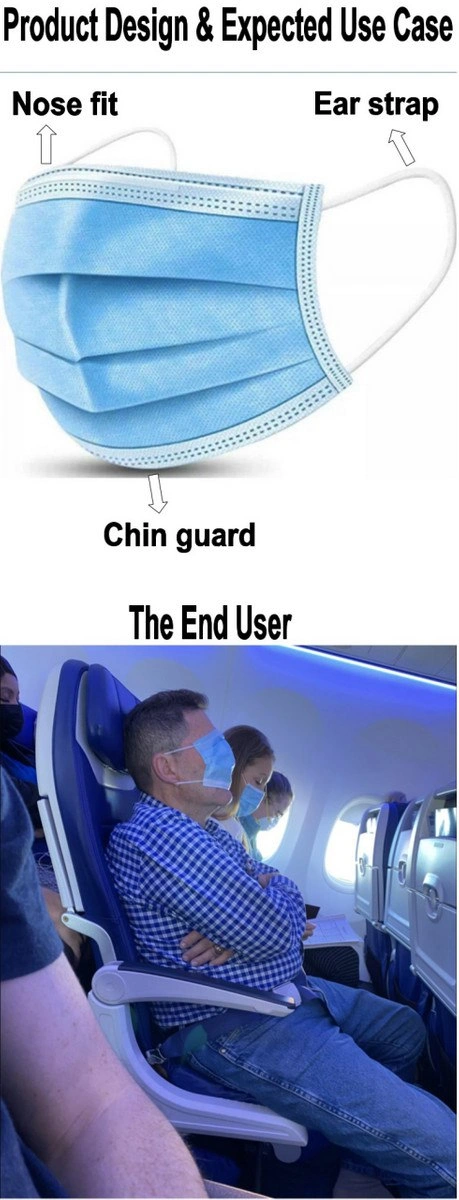
The top panel presents the tidy product story:
Product Design & Expected Use Case Nose fit Ear strap Chin guard
It is a clean diagram of a surgical mask, with arrows explaining exactly how each part is supposed to map to the human face. The bottom panel answers with:
The End User
and shows an airplane passenger wearing the mask over his eyes instead of over his nose and mouth. That is the whole UX horror show in two panels: the design team modeled the object around one use case, while the user discovered a completely different value proposition. Not infection control. Not policy compliance. Sleep aid.
The caption, "Definitely not a bug," makes it sharper because product teams use that phrase when behavior is technically possible but socially embarrassing. From a strict implementation standpoint, the mask has flexible loops and a soft rectangular body, so yes, it can be worn over the eyes. From a product standpoint, that is absolutely not the intended workflow. The meme sits right in the gap between requirements and real-world behavior.
This is why experienced engineers do not trust happy-path demos. The designer imagines the user reading affordances correctly: nose bridge goes near the nose, ear straps go around ears, bottom edge rests near the chin. The actual user is tired, seated on a plane, and solving a different problem with the same object. Real people do not interact with products as abstract personas in a slide deck; they interact as bored, rushed, distracted, uncomfortable mammals with incentives of their own.
The serious lesson under the joke is that usability testing is not about proving users are foolish. It is about discovering how a system behaves when the user's goal is not the same as the designer's goal. A button becomes a bookmark. A search box becomes navigation. A CSV export becomes an integration API. A mask becomes an eye shade. Somewhere, a backlog ticket is born, and someone in product says, "Can we call this an edge case?"
Description
The meme is split into two stacked panels. The top panel is labeled "Product Design & Expected Use Case" and shows a blue surgical mask diagram with arrows naming "Nose fit", "Ear strap", and "Chin guard". The bottom panel is labeled "The End User" and shows an airplane passenger wearing the mask over his eyes instead of his nose and mouth. The technical joke maps directly to UX and product design: even when a system's intended use is obvious to its designers, real users will discover behavior that no requirements document, happy-path demo, or acceptance test anticipated.
Comments
6Comment deleted
The spec said "nose fit," but production immediately found an undocumented face API.
That's fine actually, he just extended the functionality. Real end user will wear it instead of underclothes Comment deleted
Used the mask like that. Comfortable. Comment deleted
An example of conservative reuse of existing assets. Learn a framework and then employ it in every project no matter how well it fits. Comment deleted
its a feature Comment deleted
or maybe difference of UI and UX Comment deleted