Skip to content
DevMeme
3873 of 7435
The Developer's Flexible Definition of 'End of Day'
CorporateCulture Post #4217, on Feb 16, 2022 in TG

The Developer's Flexible Definition of 'End of Day'

Why is this CorporateCulture meme funny?

Level 1: Curfew Confusion

Imagine your mom says, "You need to be home by the end of the day." You might think that means you can stay out playing until right before bedtime — like until just before midnight — because technically the day isn't over until 12:00 AM. But your mom actually meant you should be home by dinnertime, say 6 PM, before it gets dark. Now picture you strolling in at 11:55 PM, proudly saying, "See, I'm home before the day ended!" Your mom would probably be really mad, because her idea of "end of the day" was much earlier. This meme is joking about that same kind of mix-up, but at work with a boss and a developer. The developer told his manager he'd work until "end of day," which to him meant about 6 PM (when work normally ends). But when he told his boss he'd finish a task by "end of day," he was thinking of the literal end of the day — right before midnight — to get it done. It's funny because he's using the same phrase in two different ways: first to avoid working late, and second to give himself extra time. It's like a kid using a vague rule to their advantage. The boss (like the parent) expected one thing, but the developer (like the sneaky kid) meant something else. The joke comes from that little trick with words and the confusion it causes.

Level 2: Acronym Ambiguity

Let's step back and decode the joke in simpler terms. First off, EOD is an acronym for End of Day. In a normal office setting, "end of day" usually means the end of the workday – roughly around 5 PM or 6 PM when people pack up and head out. Some companies even say COB, meaning Close of Business, to mean the same thing. It's corporate shorthand managers use in emails and chats, like "I need that report by EOD today," which most folks take as "I need it before the office closes this evening."

Now, here's where the ambiguity comes in: does EOD refer to the end of the work day or literally the end of the calendar day (midnight)? In theory, everyone should mean the same thing when they say it, but in practice, there's wiggle room. The meme plays on this confusion. The developer is joking that when they say they're working till EOD, they mean they're clocking out at 6 PM (the normal time to stop working). But when they promise to submit something by EOD, they really mean they'll deliver by 12 AM (right before the day officially ends). In other words, the developer is using the vagueness of "end of day" to their advantage:

  • "Work till EOD" = I'll work up to the normal quitting time (no overtime tonight, thanks!).
  • "Submit by EOD" = I'll take until the last minute of the day (even if I have to work late) to get it done.

Why is this funny? Because it's a pretty cheeky double-standard. Imagine hearing someone at work say, "I'll finish this by end of day." You might think that means by around closing time today. But they might interpret it as "before the clock strikes midnight." If nobody clarifies, you get a classic case of misaligned expectations. The manager usually expects that "by EOD" means they'll have it before people leave work for the night (so maybe by 5 or 6 PM). The developer, feeling the heat of the deadline, might be relieved thinking it means "I have until 11:59 PM tonight to make this perfect." This kind of misunderstanding is a textbook manager–employee expectation gap. Come 6 PM, the manager might be checking their watch angrily, while the developer is still happily coding away, assuming they're on track because technically the day isn't over yet!

These mix-ups are a common communication issue in workplaces. Acronyms and shorthand save time, but only if everyone agrees on their meaning. A junior developer might learn the hard way that terms like EOD or ASAP (short for as soon as possible) can be fuzzy. For example, a manager saying "ASAP" might really hope for "in the next hour," while the developer thinks it means "later today when I get a chance." Similarly, "Have it done by tomorrow EOD" could mean "by tomorrow around 5-6 PM," but someone else might take it as "before midnight tomorrow." All of these are examples of people defining the deadline differently in their heads.

In the meme's scenario, the humor also comes from the developer being very honest (in a jokey way). They're basically admitting to their boss: "When I say I'm working till the end of the day, I plan to shut my laptop at a normal hour. But when I say I'll finish something by the end of the day, I'm counting every hour up to midnight if I need to." It's funny and relatable because anyone who has dealt with a tight deadline knows that feeling. Sometimes you do end up working late into the night to keep a promise. Other times, you might use a vague term like "EOD" to give yourself a bit of a buffer without outright asking for more time. It's a little tongue-in-cheek trick.

If you're just starting out in a dev team, the lesson is: try to be clear about timing. You can avoid a lot of headaches by saying something like "I'll have this done by 6 PM today," or "I might need until midnight to finish this – is that OK?" And if you're the one assigning the task, it helps to clarify what you mean: for example, "By EOD, I mean before the office closes today." It might feel a bit silly to spell it out, but it's way better than a misunderstanding. This tweet became popular because it's a slice of developer humor – turning a bit of developer frustration with deadlines into a joke that everyone can nod along to. It's funny, but it also reminds us that clear communication is key. In short: don't let a tiny acronym cause a big mix-up!

Level 3: Deadline Doublethink

There's nothing quite like a good old EOD ambiguity to spice up a developer's day.

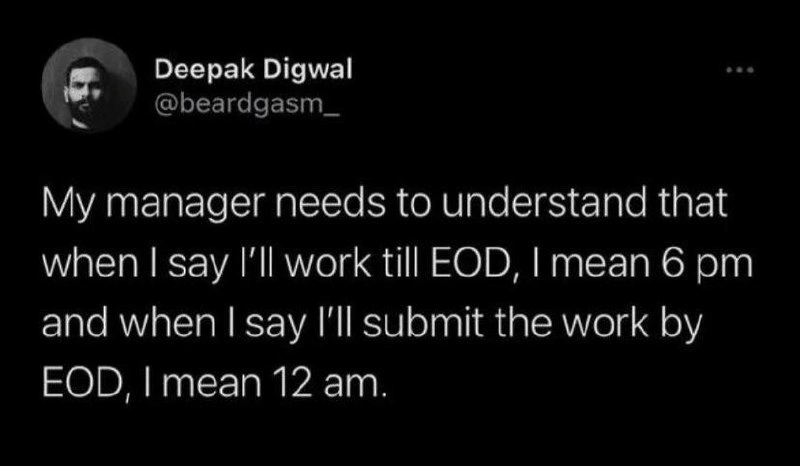
"My manager needs to understand that when I say I’ll work till EOD, I mean 6 pm and when I say I’ll submit the work by EOD, I mean 12 am."

This sardonic one-liner perfectly captures a communication breakdown in tech teams: the same acronym means two entirely different cut-off times depending on who's saying it (and what's at stake). It's humor with a bite, because any seasoned engineer recognizes the misaligned expectations here – and maybe even has abused this little timeline loophole themselves after experiencing too much deadline pressure.

At a senior level, we've all learned the hard way that "I'll have it done by EOD" can be a slippery phrase. EOD stands for End of Day, but notice how conveniently elastic that "day" becomes. When a developer says they'll work till EOD, they mean they'll peace out around the usual quitting time (let's say 5 or 6 PM, the end of the business day). No sane coder wants to code into the night unless absolutely necessary, right? But flip the scenario: when the same dev promises to submit something by EOD, suddenly that day miraculously extends right up until 11:59 PM. It's the classic engineer's sleight-of-hand – stretching the deadline to the last possible minute while technically sticking to the promise. Meanwhile, the manager likely assumed "by EOD" meant "before everyone heads home for dinner." Misaligned expectations? Oh, absolutely. The boss is tapping their foot at 6:01 PM with an empty inbox, while the developer is still polishing features, thinking "hey, I’ve got six more hours, what's the rush?"

Why is this scenario so real (and really funny) to developers? Because it shines a light on the unspoken games we play in software teams. Managers and PMs (Project Managers) often sling around acronyms like EOD, COB ("Close of Business"), or ASAP ("as soon as possible") without pinning down specifics, creating a time-definition discrepancy. They assume everyone shares the same interpretation. But developers under the gun have learned to exploit any vagueness to survive unrealistic timelines. If a feature isn't done by 5 PM, well, technically the day isn't over until midnight. It's an unwritten rule of deadline diplomacy: redefine "day" on the fly to secure a few extra hours. After all, dealing with unrealistic deadlines becomes a bit easier when you can silently upgrade "end of day" to "end of my day" (which ends when I'm too exhausted to continue).

This humor also highlights the eternal manager–employee expectation gap. The manager imagines a neat, orderly schedule: work is done by 6 PM so they can update the status or forward results to a client. The developer, on the other hand, hears a deadline and instantly considers the worst-case scenario – "I might need until midnight to get this done, so that's what I'll plan for." Neither explicitly says what "EOD" means in hours, and thus the stage is set for frustration. It's a mini communication breakdown where each party is technically correct in their own mind. And as any veteran dev knows, "technically correct" is both the best kind of correct and the kind that can get you into hot water with your non-technical manager.

Let's break down how each side interprets the very same phrase:

Phrase Developer's Interpretation Manager's Expectation
"I'll work till EOD." "I'll be offline after ~6 PM. I have a life." "They'll wrap up around 5-6 PM."
"I'll submit by EOD." "I can get away with delivering at 23:59." "It'll hit my inbox by 6 PM sharp."

See the EOD ambiguity at play? The developer has effectively double-booked the meaning of "EOD" – short-changing it when it comes to their work hours, but extending it like taffy when it comes to delivery time. It's a cheeky tactic born out of developer frustration with tight schedules. Seasoned engineers chuckle because they've seen this movie before: be it checking in code at 11:55 PM or sending that "Done!" email at midnight, just under the wire. It's the software equivalent of a student submitting an assignment online at 11:59 PM – technically on time, but barely. (Oh, the number of commit timestamps I've seen that read 23:59 would make you either laugh or cry.) In fact, here's a familiar sight in our world:

2022-02-16 23:58:47 - Commit: "Fix bug and finalize feature (delivered by EOD!)"

You can almost feel the developer sweating in that commit.

Ultimately, the meme gets a knowing nod from senior devs because it's too true: without clear communication, manager expectations and developer reality diverge. The humor is a bit cynical, pointing out how our workplace lingo allows for a sly form of scope creep on time itself. The developer isn't outright lying – they're leveraging a plausible interpretation. And if the manager calls them on it, well, the dev can shrug innocently and say, "I thought EOD meant end of calendar day, not just business day." It's a semi-snarky defense that any battle-scarred coder might deploy once in a while. The lesson under the laughter is one we've all learned through years of last-minute scrambles and slipped deadlines: clarify your terms, or prepare for those midnight deploys.

Description

A screenshot of a tweet from user Deepak Digwal (@beardgasm_). The tweet, presented as white text on a black background, humorously clarifies a common point of ambiguity in corporate communication. The text states: 'My manager needs to understand that when I say I'll work till EOD, I mean 6 pm and when I say I'll submit the work by EOD, I mean 12 am.' This meme resonates with software engineers and other salaried professionals who distinguish between the official end of their workday and the actual time they might need to submit their work to meet a deadline. The joke highlights the unstated expectation of working beyond normal hours to get a release or feature out the door, capturing the nuance of 'done' versus 'done-done' in a deadline-driven environment

Comments

14
Anonymous ★ Top Pick EOD is a temporal variable whose value is determined by the CI/CD pipeline's mood and how many last-minute bugs the product manager discovers
  1. Anonymous ★ Top Pick

    EOD is a temporal variable whose value is determined by the CI/CD pipeline's mood and how many last-minute bugs the product manager discovers

  2. Anonymous

    Explained to my PM that EOD is basically a human-scale CRDT: we promise eventual convergence by 23:59:59, but you’re not getting strong consistency before the next stand-up

  3. Anonymous

    It's the same timezone negotiation strategy we use for UTC timestamps in distributed systems - everything's relative until production breaks at 3am and suddenly everyone agrees on what "now" means

  4. Anonymous

    EOD is context-dependent like a timezone-naive datetime: everyone parses it in whatever local time benefits them

  5. Anonymous

    The classic EOD Schrödinger's deadline: simultaneously 6 PM when discussing work-life balance in sprint planning, and midnight when your PR is still in draft. It's not scope creep, it's temporal interpretation flexibility - a feature, not a bug, in the developer-manager communication protocol

  6. Anonymous

    EOD needs an RFC - PMs implement it as COB at 18:00, engineers ship LWW at 00:00; specify TZ and bounds or enjoy eventual consistency

  7. Anonymous

    EOD promises: managers see calendar close, devs see it as 'End of Denial' for unmerged PRs

  8. Anonymous

    EOD has distributed semantics: strong consistency for logging off at 6pm, eventual consistency for deliverables at 23:59:59 (preferably AoE)

  9. @myhandle0909 4y

    Same with me!!

  10. @trainzman 4y

    He works till EOF

  11. @crysknight 4y

    Everybody knows that till EOD means till stand-up next day

    1. @sylfn 4y

      so if you don't sleep you can delay 24 more hours

      1. @crysknight 4y

        Telling that myself every time

  12. @anilakar 4y

    TFW when bossman is up until 4 AM writing emails

Use J and K for navigation