Skip to content
DevMeme
3871 of 7435
The Data Science Tooling Bell Curve: From SQL to Python and Back
DataScience Post #4215, on Feb 16, 2022 in TG

The Data Science Tooling Bell Curve: From SQL to Python and Back

Why is this DataScience meme funny?

Level 1: Blender vs Spoon

Imagine you want to mix a glass of chocolate milk. A little kid and a wise old chef both just use a simple spoon to stir the milk – quick and easy, and it does the job just fine. But now picture an enthusiastic teenager who just got a new high-tech kitchen gadget: they insist on using an electric blender for this one cup of chocolate milk. The blender is loud, makes a mess, and afterward there’s a lot to clean up, even though in the end the chocolate milk isn’t any more mixed than if they’d used the spoon. It’s a bit silly, right?

That’s exactly the joke here. The simple solution (using the spoon, like using a basic SQL query) works well and everyone can see it. The overexcited middle person with the blender is like someone who uses a bunch of fancy Python tools for a basic data task – it’s like overkill. The funny part is both the small child and the seasoned chef look at the teenager and think, “You know, a spoon was fine for that!” In the meme, the beginner and the expert both say "SQL is fine" – just stick to the simple tool that works – while the person in the middle is going overboard. We laugh because we recognize ourselves or friends in that overboard stage, and it feels good (and a little humbling) to realize sometimes the simplest way really is the best way.

Level 2: Databases vs DataFrames

Let’s break down the key technologies and concepts in this meme, assuming you’re just getting started in data work:

  • SQL (Structured Query Language) – SQL is a language used to interact with relational databases (think of databases like very powerful spreadsheets that can handle huge amounts of data and let multiple people access them at once). With SQL, you write queries – for example, SELECT * FROM customers WHERE country = 'US'; – to retrieve or manipulate data using simple English-like commands. SQL has been around for decades and is fundamental in Databases for tasks like filtering records, joining tables, and computing summaries. When the meme characters say "SQL is fine," they mean that using this straightforward querying approach is perfectly acceptable (and often efficient) for getting the data answers you need.

  • Pandas – Pandas is a popular data manipulation library in Python. It lets you load data into a structure called a DataFrame, which you can imagine as something like an in-memory table of data (rows and columns), similar to an Excel sheet but much more powerful for programming. With Pandas, you can write Python code to do things like filter rows, compute new columns, and aggregate values. For example, instead of writing an SQL query, you might do:

    import pandas as pd  
    df = pd.read_csv('sales_data.csv')        # load data from a CSV file  
    usa_df = df[df['country'] == 'US']        # filter rows where country is US  
    total = usa_df['sales'].sum()             # compute sum of sales column  
    

    Pandas is extremely handy, especially in DataScience, because it works seamlessly with other Python libraries for things like plotting or machine learning. It’s part of why Python is so dominant in data analysis – you can do a lot in one environment.

  • NumPy – This is the fundamental package for scientific computing with Python. NumPy provides support for large, multi-dimensional arrays and matrices of numeric data, along with a library of mathematical functions to operate on these arrays efficiently. When you hear "NumPy arrays," think of a very efficient list of numbers (all of the same type) that Python can manipulate quickly (much faster than using regular Python lists) because most of the heavy lifting is implemented in optimized C code. Pandas is actually built on NumPy – under the hood, a column of a DataFrame is often a NumPy array. The meme’s middle character shouting "NumPy, Pandas" is basically saying "we should use Python with these libraries for data tasks." NumPy by itself is lower-level (just crunching numbers), while Pandas builds on it to handle higher-level data table operations.

  • Scikit-Learn – This is a powerful machine learning library for Python. It's used to create predictive models (like regression, classification, clustering, etc.) using clean APIs. For instance, with scikit-learn, you can quickly train a model to predict house prices or categorize images with just a few lines of code. It's part of the standard DataScience toolkit. However, scikit-learn isn't really about basic data manipulation (that's more Pandas' job); it’s about analyzing data and making predictions. In the context of the meme, including "Scikit-Learn" in that all-caps proclamation is a comedic exaggeration – it suggests the mid-level person might be reaching for every tool they know, even ones that aren't needed for a simple query, just to feel they're doing a "smart" solution. It’s like they’re saying, “I won’t just write a query; I’ll load data with Pandas, process with NumPy, and maybe even run a machine learning algorithm on it!” – even if the task at hand might simply be counting or summing some records.

Now, why would someone choose Pandas over SQL or vice versa? For a new developer or analyst, it often boils down to what you're comfortable with and where the data is. If the data lives in a database, using SQL is natural: you ask the database directly for what you need. If the data is in a file (like a CSV) or you’re already working in Python, using Pandas might feel easier since you can do everything in one Python script or Jupyter notebook. Early in your career, you might have been introduced to one approach and stick with it. Some people find SQL a bit weird at first (it’s not a full programming language, just a query language), so they lean on familiar Python code to get the job done. Others might start at a company where the norm is writing lots of SQL (say, if they’re working as an analyst or in a BI team) and they use the database for most operations.

A classic junior experience is pulling a dataset into Pandas to explore it. If it’s a small dataset, this is fine and very convenient. But as you deal with bigger data, you might hit performance issues – e.g., your Pandas script becomes slow or runs out of memory on large tables. One day you realize: "Hey, the database can compute this for me and send just the answer, instead of me downloading all the data." That’s when the light bulb about using the "right tool for the job" lights up. It’s a bit of learning: Databases are incredibly optimized for certain operations (like filtering, joining, grouping), so doing those operations in SQL can be way faster and use fewer resources than doing them in Python on your laptop.

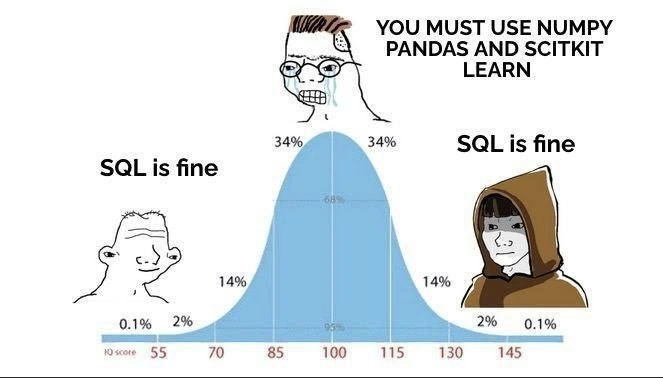
The bell_curve_meme format with the IQ distribution is essentially showing an exaggerated version of this learning journey. On the left, a person with not much experience just uses SQL because that’s what they know (or because it’s the straightforward solution given to them). In the middle, a person with some more knowledge insists on using the whole Python data stack (maybe they just learned it in a Bootcamp or master’s program and feel it’s the "proper" modern way). On the right, a highly experienced person comes around again to appreciating that simple SQL approach with all its built-in power. It’s a funny way of saying: Sometimes, as you become more experienced, you realize the value of the simple methods you started with. In tech we often joke about over-complicating things – and this meme is a prime example drawn from DataScienceHumor and TechMemes culture. It reminds both new and seasoned developers that fancy tools are great, but you shouldn’t use them blindly. Always ask: do I really need to load this into Pandas, or can the database do it for me? Often, "SQL is fine."

Level 3: Mid-Level Mania

For seasoned developers and data engineers, this meme hits on a familiar pattern: over-engineering in the middle of the skill curve. The bell-curve format jokes that both novices and experts agree "SQL is fine" for solving data problems, while the mid-level practitioner (our bespectacled Wojak in the middle) is adamant: "YOU MUST USE NUMPY, PANDAS AND SCIKIT-LEARN!" (caps lock and all). The humor comes from shared industry experience – we’ve all seen someone enthusiastically apply a whole arsenal of tools to do something that a single well-crafted SQL query could handle.

This scenario satirizes a common DataEngineering anti-pattern: pulling data out of a perfectly good database to process it in Python for no strong reason. The middle figure represents that phase in one’s career when you’ve just learned a bunch of powerful libraries in the DataScience stack and want to use them for everything. They might say: “Why use plain SQL when I can write a Python script with* Pandas** for data wrangling, NumPy for number crunching, and maybe toss in Scikit-Learn for some modeling!”* It's the overengineering_data_tasks tag come to life – using more complicated technology than necessary. The result is often an over-engineered pipeline: extra code, extra moving parts, and often worse performance, all to accomplish something that SQL, the tried-and-true workhorse of Databases, can do in one step.

Why is this funny (and painfully true) to experienced devs? Because we've watched this movie play out repeatedly. Imagine a data analysis scenario: say you need to calculate total sales by category for customers in France. Our intermediate data scientist might do something like:

import pandas as pd
# Pull all data from the database into a DataFrame
df = pd.read_sql("SELECT * FROM sales_data", db_connection)  
# ^ Mid-level approach: load entire table into memory, then filter in Python

# Filter and aggregate in Pandas instead of in SQL
france_df = df[df['country'] == 'France']
result = france_df.groupby('category')['sales'].sum()
print(result)

Meanwhile, an expert would raise an eyebrow and simply do:

SELECT category, SUM(sales) 
FROM sales_data 
WHERE country = 'France' 
GROUP BY category;

In the expert’s approach, the SQL database does the heavy lifting internally – filtering to only French customers and summing up sales – and just returns the final result. The intermediate approach, however, reads all the data (maybe millions of rows) into a Pandas DataFrame on your local machine and only then filters and sums it. The difference is stark: the Pandas route likely uses more memory, takes more time, and makes your laptop's fan go into overdrive (everyone in DataScienceHumor has joked about the laptop that sounds like a jet engine because of an overzealous pandas operation). The expert’s SQL solution is lean, usually faster, and doesn’t involve shipping tons of unnecessary data over the network.

This pattern isn’t just about performance – it’s about maintenance and clarity too. Seasoned developers know the value of the KISS principle (Keep It Simple, Stupid!). Using a simple SQL query means less code to maintain and fewer chances for bugs. Over in the middle, our eager mid-level friend has written a mini program (with multiple points of failure: database connection, data transfer, Python indexing, etc.) to do what a single declarative statement expressed. The meme exaggerates it by having the mid-level insist on NumPy and Scikit-Learn as well – suggesting they might even be reaching for machine learning models (scikit-learn) or low-level array manipulation (NumPy arrays) when not necessary. It’s poking fun at the tendency to apply the latest and greatest tools just because you can, not because the problem calls for it. This could be like someone insisting on using a neural network to compute a simple average – technically possible, but absolutely overkill.

The bell curve IQ distribution template highlights another inside joke: the idea that a little knowledge can be a dangerous thing. It’s reminiscent of the Dunning-Kruger effect – where people with intermediate knowledge become overconfident and complicated in their solutions, while true experts circle back to simple and robust methods (and true beginners often only know the simple method!). In the meme, the left end (low IQ) saying "SQL is fine" might be a person who hasn’t been exposed to all the fancy Python tools and just uses the straightforward solution given (maybe a junior who was taught SQL basics and sticks to them). The right end (high IQ, the hooded sage) represents the battle-scarred senior engineer or data architect who has been through the wars of convoluted ETL pipelines, seen the TechHumor tweets about memory errors, and come out the other side realizing that yes, plain old SQL works fine most of the time and often better for these tasks. Both ends of the curve share the same line, "SQL is fine," which is what makes it comically satisfying – the unlikely agreement of the newbie and the guru, with the poor mid-tier dev in the middle emphatically overthinking the solution.

Within DataScience and DeveloperHumor circles, this meme also reflects a cultural commentary: There’s often a divide between Data Engineers (who tend to favor SQL, pipelines on databases or distributed systems, and care about efficiency at scale) and some Data Scientists (who might be more comfortable in Python notebooks, using Pandas for data manipulation and scikit-learn for modeling). The meme isn’t saying one side is dumb – it’s saying that at an extreme level of expertise you appreciate both but choose the simpler tool for the job. It's a lighthearted jab that sometimes the people shouting the loudest about using this library or that framework might be missing the simple answer right in front of them. After all, why spin up a whole Python stack for a task your database can do in 0.2 seconds with one well-written query? The sage on the right has that faint smile because he knows: sometimes the most advanced thing you can do is go back to basics.

Level 4: Set-Based Sorcery

At the most fundamental level, this meme touches on the deep difference between declarative and imperative approaches to data. SQL (Structured Query Language) is a declarative language based on the relational algebra principles set out by E. F. Codd. When you write an SQL query, you only specify what result you want from a database (e.g. "give me all users from France and their total sales"). The database’s query optimizer then decides how to actually get that result – using decades of query optimization research, index structures, and set-theory operations under the hood. It's a bit of computational sorcery: the system automatically figures out efficient algorithms (like using an index, a hash join, or a sort-merge) without you spelling out each step. This set-based processing means the database can operate on large tables of data as whole sets, leveraging parallelism and disk optimizations that have been refined over years of database engine development.

On the other side, using tools like NumPy and Pandas in Python is a more imperative approach: you write step-by-step code to manipulate data, often by explicitly reading it into memory and looping or vectorizing over it. Pandas does implement a form of high-level vectorized operations (where you apply an operation over an entire array or column at once, which underneath uses optimized C loops through NumPy arrays), but you as the programmer are still orchestrating how the data flows through transformations. In essence, you are taking on the role of the query planner manually. For complex transformations, a seasoned database or SQL engine might find a more optimal strategy than an ad-hoc Python script because it has a global view of the data and available indices.

There’s also a data locality principle at play: move computation to the data, not data to the computation. SQL runs on the database server where the data lives, filtering and aggregating in-place so it only sends back the small result you asked for. In contrast, a Pandas approach often pulls all the raw data to your application first, then computes, which can be fundamentally less efficient. The meme’s joke at a deep level is about this elegant efficiency of databases versus reimplementing that work in Python. Advanced data engineers know that a simple SQL query can sometimes outpace a custom Python data pipeline, thanks to the database engine’s internal algorithms (O(log n) index lookups, query caches, etc.) that a homemade solution might not leverage.

Even the inclusion of Scikit-Learn (a machine learning library) in the meme’s middle panel hints at over-reaching for complex algorithms when they’re not needed. It’s as if the middle-tier practitioner might try to solve a straightforward data problem with a machine learning model, whereas the "enlightened" expert knows a basic query or rule-based logic would do. This highlights a broader computer science truth: the simplest solution that directly uses well-founded tools (like the relational database model) is often the most robust. In theoretical terms, the meme humorously points out a case of overfitting on tools – the mid-level engineer applies every fancy library they know, while the wise engineer applies the principle of parsimony, trusting the proven abstraction of SQL. It’s a little ironic and beautiful: the lowest and highest ends of the "IQ bell curve" converge on the same realization, reflecting an almost zen-like return to first principles (just use a good old established method) after exploring the noisy complexity in between.

Description

This meme uses the IQ Bell Curve (or 'Midwit') format to illustrate the evolution of a data professional's tool preferences. The image displays a large blue bell curve representing the distribution of IQ. On the far left, representing lower IQ, is a simple-minded Wojak character with the text 'SQL is fine.' At the peak of the curve, representing average IQ, is an angry, crying Wojak who insists, 'YOU MUST USE NUMPY PANDAS AND SCITKIT LEARN.' On the far right, representing high IQ, is a serene, hooded figure, with the same conclusion as the beginner: 'SQL is fine.' The meme humorously argues that novices start with SQL because it's accessible. Mid-level practitioners, having learned more complex tools, often become dogmatic and try to apply them everywhere. However, seasoned experts, with a deep understanding of trade-offs, performance, and simplicity, often return to SQL, recognizing it as the most powerful and efficient tool for many data manipulation tasks


Comments

26
Anonymous ★ Top Pick The data science journey: First you learn SQL. Then you spend five years trying to do everything in Pandas. Then you realize you should have just used SQL
  1. Anonymous ★ Top Pick

    The data science journey: First you learn SQL. Then you spend five years trying to do everything in Pandas. Then you realize you should have just used SQL

  2. Anonymous

    Architect-level revelation: the quickest path from raw table to insight is still a well-indexed SELECT … GROUP BY, not yanking the data across the wire into a 64 GB Jupyter pod just so pandas can rediscover hash aggregation

  3. Anonymous

    The junior dev who insisted we needed a full Spark cluster to process 50MB of CSV files just got promoted to architect and now wants to migrate our perfectly fine Postgres analytics queries to a "modern data lakehouse stack."

  4. Anonymous

    Midwit pipeline: export SQL to CSV, load into Pandas, group by, and reimplement - slower - the query the database already ran

  5. Anonymous

    After two decades of watching data teams bikeshed over tooling, I've learned that the junior who writes a clean SQL query and the architect who's maintained petabyte-scale systems both arrive at the same conclusion: sometimes a JOIN is just a JOIN. It's the mid-level engineer with six months of Pandas experience who insists on pulling 10GB into memory because 'SQL isn't real programming.' The real wisdom isn't in the tool - it's knowing when your sophisticated ML pipeline is just cosplaying as a GROUP BY with extra steps and a Jupyter notebook

  6. Anonymous

    Dunning-Kruger peak: seniors SELECT the simple path, while mid-levels JOIN the pandas parade

  7. Anonymous

    Career bell curve: start with “SQL is fine,” detour into Pandas to reimplement a query planner in Python, end with “SQL is fine” - and fewer laptops on fire

  8. Anonymous

    Experience is realizing two window functions and a CTE replace a 900-line pandas notebook and half the MLOps budget

  9. @dsmagikswsa 4y

    I don’t get it…..

  10. @escandium 4y

    LINQ is fine

    1. @xyzxcv 4y

      LINQ to sql btw

  11. P S 4y

    Why is nobody talking about Exel as a Database?

    1. @dugeru42 4y

      or as a game engine

      1. @dugeru42 4y

        i made my first turn based multiplayer family budget management game with random events and more than 10 interactive windows in excel so let me tell you this burn it with fire and never think about it again

  12. @Ivan_Kholodnyak 4y

    Where is json and .txt files?

  13. @feskow 4y

    Where is custom binary gang?

    1. @RiedleroD 4y

      this

    2. @dsmagikswsa 4y

      Capacitor is fine.

    3. @ulanov_show 4y

      Lol

  14. @captain_gaga 4y

    Writing from your memory is fine

  15. @sylfn 4y

    Tab symbol, comma, semicolon

    1. @sylfn 4y

      and space

  16. @sylfn 4y

    I use hiragana in my wifi password

    1. @sylfn 4y

      * should have used kanji, but android disallows to enter them to password field

  17. @sylfn 4y

    yes

  18. @sylfn 4y

    write it here

Use J and K for navigation