Skip to content
DevMeme
464 of 7435
The Ultimate Hardware-Based Virus Removal Tool
Security Post #534, on Aug 8, 2019 in TG

The Ultimate Hardware-Based Virus Removal Tool

Why is this Security meme funny?

Level 1: Not How It Works

Imagine you have a video game with a scary monster character you don’t like. Instead of deleting the monster in the game or turning off the console, you decide to deal with it by throwing your entire game console into a lightning storm to “electrocute” the monster. 😅 That sounds pretty silly, right? You’d just end up breaking your console, and the monster (which was just part of the game’s story) isn’t actually a real creature that can be hurt by electricity.

This meme is funny in the same way. It shows someone trying to “kill” computer viruses on a USB stick by zapping the USB with wall electricity. But computer viruses aren’t like real bugs or germs – they’re just bad instructions inside the device. You can’t scare or hurt them with a big electric shock like you might kill germs with heat. All that would do is destroy the poor USB stick. It’s like using a hammer to fix a tiny problem and ending up smashing the whole thing. The reason we laugh is because the solution is so over-the-top and wrong: the person in the meme is basically breaking their own gadget in an attempt to solve a problem that electricity won’t solve. In simple terms, they’re attacking the wrong thing – and that goofy mistake is what makes the joke!

Level 2: Frying the Flash Drive

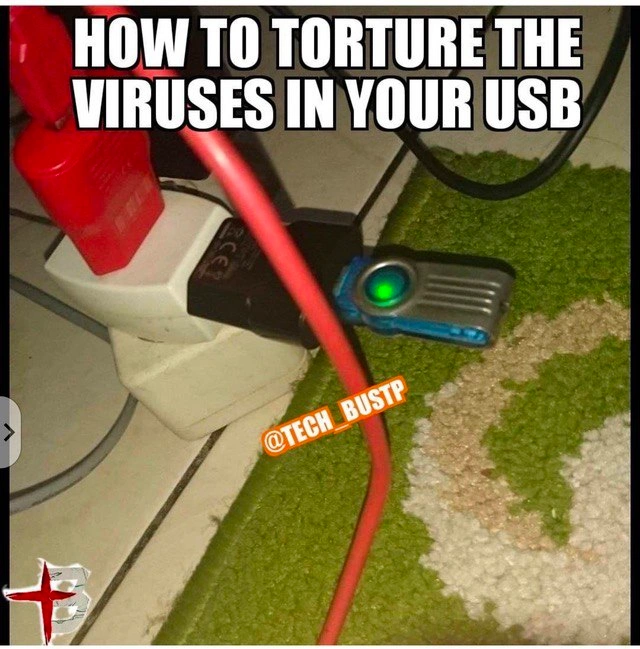
Let’s break down what’s happening in simpler terms. We have a USB flash drive – a small device that stores files (photos, documents, or in this case maybe some nasty malware files). Normally, you’d plug this USB stick into your computer’s USB port to access or clean those files. In the picture, however, someone plugged the USB stick into a USB-to-mains power adapter (the kind you use to charge your phone by plugging it into the wall). That adapter is itself plugged into an electrical strip on the floor. Essentially, the flash drive is being fed electricity from the wall without any computer in between. The meme jokingly calls this “torturing the viruses” on the drive – as if the malicious software on that drive could somehow feel the surge of power.

Now, a few key concepts for junior developers or the uninitiated: a computer virus is not a physical creature, but a type of malware (malicious software). It’s basically bad computer code that can copy itself and infect your files or system. Those virus files reside in the flash drive’s storage as data – ones and zeros – not as anything alive. So you can’t “hurt” a virus by zapping the device with electricity; there’s no little bug in there to shock or torment. The virus will only go away if you delete the malicious files, usually by using an antivirus program or by formatting (erasing) the drive’s storage. This is standard cybersecurity practice: you remove malware with software tools or by wiping the data, not by physically harming the device.

What happens when you plug a USB stick into a wall charger like this? A USB charger is designed to output a steady low voltage (about 5 volts DC) to power or charge devices. It’s not designed to transfer data or do anything to the files on a drive. In the meme’s photo, the fact that the flash drive’s LED is glowing green means it’s receiving power on its Vbus pin (the 5V supply from the charger). The drive has “power” just as if it were connected to a computer, but there’s no data connection. The file system on the drive (where the virus lives) isn’t being accessed or cleaned at all – the drive is essentially just sitting there, powered on but not communicating with any host. It’s like turning on a device without giving it any instructions. The virus is still present on the flash memory chips, completely unaffected. You could leave that poor USB stick plugged in all day and all you’d accomplish is warming it up a bit; the malware inside wouldn’t even know anything is happening.

Now, if someone were misguided enough to try mains_power_abuse – say by somehow bypassing the adapter’s safety and pumping the full 230V AC from the wall directly into the USB stick – the result would be hardware destruction. A flash drive is a delicate electronic gadget built for 5 volts, so feeding it 230 volts is like hooking a little LED lamp to a car battery: it will fry in an instant. The internal circuits would burn out, the memory chips would likely get physically damaged, and the drive would die (possibly with a pop or smoke). Yes, this would also “kill” the virus in the sense that if the storage chip is burnt to a crisp, the virus code is gone along with everything else. But at that point, the USB stick is essentially a tiny charcoal briquette – no one can use it, and whatever data (good or bad) was on it is lost forever. This is definitely not a controlled or smart way to clean malware! It’s a bit like burning down a house to get rid of mold: effective, but absolutely destructive overkill.

It’s worth noting how dangerous this is. Standard USB ports on computers have built-in limits and only supply 5V to protect devices. Wall outlets supply a much higher voltage (like 230V in many countries, or 120V in others) which is why we use chargers and adapters – they step down the voltage to a safe level. By using the charger block properly, the person in the meme isn’t directly exposing the flash drive to 230V (the adapter is preventing that by converting it to 5V). So in the photo as shown, the drive might actually survive being plugged into the charger (aside from possibly some confusion). But the whole idea is still comically pointless: the malware on that drive won’t be removed just because you powered the device from the wall. There’s no antivirus magic in a wall socket. If anything, doing weird things like this risks short-circuiting something or ruining your charger and drive. It’s definitely not a recommended cybersecurity tactic!

For junior techies, remember: to deal with a virus on a USB, you should scan the drive with security software or wipe it via formatting. For example, you might use Windows Defender or another antivirus to scan the USB for known malware, or use the command prompt to format it (e.g. format E: on Windows, or Disk Utility on Mac). In extreme cases where you suspect something like a firmware-level infection (which is rare, but possible with things like BadUSB exploits), the safer practice is to physically destroy or decommission the drive so no one accidentally uses it again – but that means shredding or crushing it, not plugging it into high-voltage outlets! The meme exaggerates that idea to make us laugh. It’s highlighting a malware_removal_satire: the notion of “electrocuting” a virus is as effective as yelling at your computer – it might feel cathartic, but it won’t actually fix the problem.

Level 3: Kill It With Volts

At first glance, this meme is an infosec inside joke taken to an absurd extreme. The image shows a USB flash drive jammed into a mains power charger, with bold text proclaiming "HOW TO TORTURE THE VIRUSES IN YOUR USB." Experienced developers and security professionals immediately recognize the dark humor: you don’t remove malware by electrocuting your hardware, but in moments of frustration we’ve all joked about "nuking it from orbit." This scene lampoons the scorched-earth approach to malware removal – an over-the-top parody of the idea that if a virus is too stubborn, you might as well just physically destroy the infected device. It’s a nod to that cynical sysadmin mantra: “the only truly secure computer is one that’s unplugged, powdered, and buried in concrete.” In practice, when a USB is crawling with persistent viruses (think of those old autorun.inf worms that hopped from stick to PC like digital cockroaches), the sane solution is to wipe or format it. But here, someone’s so fed up they’re literally blasting it with 230 V of wall power.

From a hardware perspective, this is hardware humor and horror at the same time. The USB stick’s green LED is glowing, meaning it’s getting power from the charger – a charger meant to output a regulated 5V DC for charging phones, not for data transfer or virus cleansing. Seasoned engineers know that applying a high voltage or improper current to electronics is a great way to release the magic smoke that makes them run (i.e., fry them). The meme plays on that knowledge: the “tortured” viruses won’t scream, but the flash drive’s circuits certainly might! In reality, a flash drive isn’t designed to handle mains electricity directly; doing so is a dangerously bad idea. It could short out, spark, or even explode, turning your malware problem into a literal fire hazard. The humor is in how glaringly wrong this is – a bit of malware_removal_satire poking fun at any notion that mains_power_abuse could ever be an antivirus strategy.

Experienced security folks also recall real-world analogs. Ever heard of the infamous USB Killer devices? Those are malicious sticks that charge up capacitors from a USB port and then discharge high voltage back into the computer to destroy it. They’re the flip side of this scenario – instead of zapping the USB, a “USB killer” zaps the host machine. Both rely on the same principle: misuse power lines to wreak havoc. So this meme winks at that concept too, but in reverse: here the poor flash drive is on the receiving end of a lethal jolt. It’s a dangerous_hardware_hack nobody should ever actually attempt, but it highlights the “just destroy it” instinct in a comically literal fashion.

There’s also an ironic subtext about misunderstanding technology. The meme text implies someone imagines viruses as little evil creatures hiding in the USB, creatures that can be tortured with electricity. It’s riffing on the gap between how non-techies sometimes picture “computer viruses” (almost like germs or bugs you can physically kill) and the reality that viruses are just binary code. An experienced developer chuckles because we’ve probably encountered panicked users who ask if they should microwave a virus-infected phone or dunk a laptop to “wash out” the virus. No, please don’t! We know that to remove malware, you use antivirus software, firmware re-flashes, or at worst you format the drive – you don’t break out a Tesla coil and start zapping. But that absurd image perfectly captures the exasperation malware causes. It’s the same energy as yelling at your computer or smashing a printer that’s acting up – an ultimate techie temper tantrum distilled into a meme.

Yet within the joke, there’s a kernel of tongue-in-cheek truth: physically destroying a compromised device does ensure the malware is gone. Security veterans might grimly joke that when you’re faced with an advanced persistent threat or something like the BadUSB exploit (where the USB’s own firmware is infected and can’t be cleaned by normal means), the only safe option is to dispose of the entire device. In fact, high-security facilities have protocols to shred or incinerate removable media rather than risk unseen firmware malware. So "killing it with volts" is a cartoonish exaggeration of real cybersecurity practices turned into a visual gag. The senior engineers laugh, nodding and cringing, because the meme captures that “last resort” vibe in the most electrically violent way possible. It’s a perfect storm of Security meets Hardware humor: knowing just enough about both domains makes the ridiculousness crystal clear.

Description

A meme depicting a nonsensical and destructive approach to cybersecurity. The image shows a blue and silver USB flash drive, its green indicator light on, plugged into a USB wall adapter which is then plugged into a power strip on the floor. The image has a bold white text overlay that reads, 'HOW TO TORTURE THE VIRUSES IN YOUR USB'. A watermark for '@TECH_BUSTP' is also visible. The humor stems from the absurdly literal interpretation of 'killing' a computer virus by applying electricity, a method that would only destroy the physical hardware. This joke satirizes bad tech advice and the gap in understanding between software threats and physical reality. The post's caption, 'Y'all need to remember your safe cyber security practices', adds a thick layer of irony

Comments

7
Anonymous ★ Top Pick This is the 'brute-force' attack vector security researchers never talk about. It has a 100% success rate at eliminating the virus... and the silicon it rode in on
  1. Anonymous ★ Top Pick

    This is the 'brute-force' attack vector security researchers never talk about. It has a 100% success rate at eliminating the virus... and the silicon it rode in on

  2. Anonymous

    Our new security workflow: run ClamAV, then give the thumb drive a 230-volt ACID test - Atomic, Consistent, Isolated, Disintegrated

  3. Anonymous

    Still more effective than the antivirus solution your CISO bought after watching a vendor's golf tournament demo

  4. Anonymous

    When your incident response plan escalates from 'quarantine and scan' to 'physically degaussing with a bicycle' - because sometimes the most effective air gap is the one between the USB and the pavement. NIST 800-88 guidelines never looked so kinetic

  5. Anonymous

    Zero-trust USB: plug it into 230V - NIST 800‑88 compliant, 100% malware removal, 0% data retention, and a little magic smoke for the postmortem

  6. Anonymous

    When rootkits survive every AV scan and shredder, senior devs know: nothing purges USB malware like a 220V hardware refactor

  7. Anonymous

    Classic security theater: feed 5V to VBUS with D+/D− floating so nothing enumerates - the only thing tortured is the device’s PHY waiting for reset, much like our rewrite roadmap

Use J and K for navigation