Skip to content
DevMeme
3404 of 7435
Untested Code Deployed, Brace for Impact
Deployment Post #3737, on Sep 23, 2021 in TG

Untested Code Deployed, Brace for Impact

Why is this Deployment meme funny?

Level 1: Bumpy Ride Ahead

Imagine you built a brand-new roller coaster in your backyard. đŸ—ïž You’re super excited to let people ride it. But here’s the catch: you never tried it out yourself, and you didn’t run any safety checks. You don’t actually know if all the loops and turns are safe or if the coaster will even stay on the track. Now, on opening day, a bunch of your friends jump into the coaster cars. You, the builder, are a bit nervous because, well, nobody tested this thing. As you’re about to start the ride, you call out: “Ladies and gentlemen, fasten your seatbelts!” 😬 In other words: hold on tight, we’re not sure how wild this is going to get!

Deploying untested code is just like that. The code is the roller coaster, and the users are your friends taking the ride. If you haven’t tested the code, it’s like not testing the roller coaster. Maybe it’ll be okay... or maybe it’ll be a disaster with a lot of screaming. Telling everyone to buckle up means you suspect there’s going to be trouble. It’s funny (and scary) because normally, before you let real people on a coaster (or real users on new software), you’d want to do a few empty test runs, right? Maybe send a dummy cart around the track a few times to see if everything works. Skipping that step and going straight to live people is clearly a bad idea. So when someone does the same with software — skipping tests and going straight to real users — it’s the same kind of shaky situation. The meme makes us laugh because we know exactly that feeling of, “Uh oh, this might be a bumpy ride.”

In simple terms: testing your code is like checking your homework or practicing a game before the big match. If you don’t do it, you’re basically winging it and hoping nothing goes wrong. And hope is not a great strategy! The meme shows a guy saying “fasten your seatbelts” because even he knows that without checks, the only thing you can do now is hold on and wish for the best. It’s a playful warning: if you don’t double-check your work (with tests), be prepared for things to get crazy.

Level 2: Works on My Machine

Let’s break down the situation in simpler terms. You’ve just finished writing some code, and now it’s about to be deployed straight to the production environment (which is just a fancy way of saying “the live system where real users use the software”). The catch? You did little to no testing on that code before shipping it out. This is generally a Big No-No in software development. Why? Because “testing” is how we catch mistakes before they affect everyone.

When developers talk about testing, they usually mean a few layers of checks:

  • Unit tests: small, focused tests that check individual pieces of your code (like functions or modules) to ensure they return the expected results for given inputs. For example, if you have a function add(a, b) that should return the sum of two numbers, a unit test might call add(2, 2) and verify it gets 4. If add(2, 2) suddenly returns 5, the unit test will fail and alert you to the bug before that code ever leaves your laptop.
  • Integration tests: these tests make sure different parts of the system work together correctly. Maybe your code calls an external service or works with a database. An integration test might simulate a real scenario (like fetching data, processing it, and saving it) to ensure all the pieces connect properly.
  • Manual testing / QA: sometimes real people (Quality Assurance engineers or even developers themselves) will use the application in a staging environment (a production-like testing environment) clicking buttons, inputting data, basically acting like end-users to see if everything behaves. They often have checklists: does the login work? Can a user buy a product? Does the new feature do what it's supposed to do? This human eyeballing can catch issues that automated tests miss, like a button that’s visible but not clickable, or a confusing error message.

Now, “little to no testing” suggests that few or none of these checks happened. Maybe the developer ran the program once on their own machine and saw no obvious errors and thought, "Looks good to me!" This is where the infamous phrase “Works on my machine” comes into play. It’s a tongue-in-cheek excuse developers sometimes use when code fails in a place that’s not their computer. In other words, “Hey, it runs fine on my computer, so the problem must be somewhere else (not my code).” This meme scenario is basically inviting a "works on my machine" outcome — because if you haven’t tested elsewhere, how do you know it’ll work on the production servers or for all the customers? Spoiler: often it doesn’t work, and then you have a problem.

Think of all the things that could go wrong if code isn’t tested:

  • Crashes and errors: Perhaps the code has a simple bug, like dividing by zero or calling something that doesn’t exist. On your machine, you never hit that bug because you didn’t try that exact scenario. But the moment a real user does something slightly different, bam! — the program might throw an error and crash part of the site.
  • Different environment: Your development machine might be Windows with certain settings, and production might be Linux with different settings. Or maybe you have version 1 of a library and production has version 2. Without tests (especially integration or staging tests), these differences remain unnoticed until deployment. Suddenly, that code that worked on your machine doesn’t work on a server configured differently.
  • Performance issues: Perhaps your code works fine for one user (you), but you didn’t test it under a heavy load. In production, hundreds or thousands of users might use the feature simultaneously. Code that isn’t optimized or has a slow database query could grind the system to a halt under that pressure. Testing (with load tests or at least some trial runs in staging) would reveal the bottleneck. Without it, your first hint of a problem might be the entire website slowing to a crawl.
  • Missing features or wrong results: Sometimes what we think our code is doing isn’t exactly what it’s doing. Tests act as an independent check. If you skip them, you might not notice that a calculation is slightly off or a feature isn’t actually saving data correctly. It might sort of work (no crashes), but give incorrect outputs. This can be just as bad, especially if it’s, say, financial software (imagine messing up an invoice because no one tested the math!).

Now, the meme’s bottom caption: “Ladies and gentlemen, fasten your seatbelts.” This is something you usually hear from a pilot when a plane is about to hit turbulence (bumpy air) or from a ride operator before a roller coaster takes off. It’s basically a warning: “Hold on tight, things might get rough!” In the context of deploying untested code, it means everyone — both the users and the developers — should brace themselves for a rough experience. The developer is half-jokingly, half-fearfully saying, “Alright, we’re pushing this live... who knows what’s gonna happen next!” It’s funny because it’s true — without testing, you genuinely don’t know what will happen, so you’re preemptively warning like an airline captain anticipating a storm. This kind of humor is tagged as DeploymentHumor or TestingHumor because it’s poking fun at a scenario that is all too common in software teams that cut corners.

For a junior developer (or anyone new to deployments), the key takeaway is: always test your code before it goes live. The meme exaggerates the situation to make a point. Realistically, most teams have some testing in place exactly to avoid the “fasten your seatbelts” deploy. If you ever find yourself in a situation where someone is deploying code that nobody tested, know that it’s a risky move. It’s like flying a plane that hasn’t been test-flown or releasing a product without quality checks. Sure, it might turn out fine... but if it doesn’t, you’ll wish you had put that seatbelt on (and also written some tests!).

Level 3: Brace for Turbulence

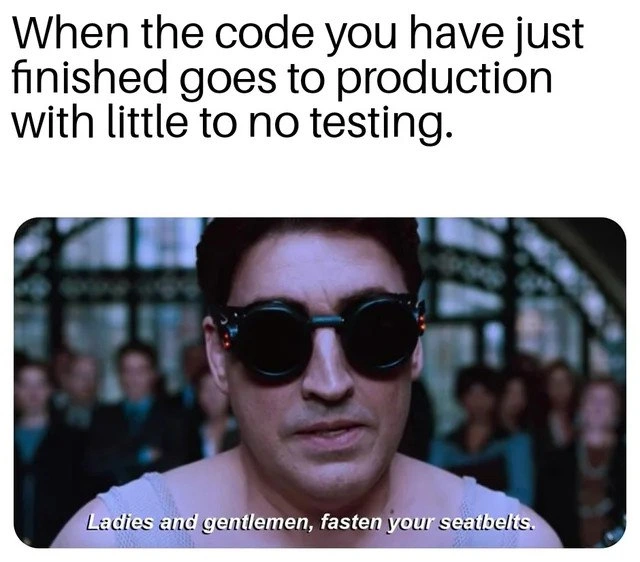
Every seasoned developer has that uh-oh moment when they hear, "We're deploying straight to production with no testing." It's the kind of statement that makes your heart skip a beat — you instinctively reach for an imaginary seatbelt because you know the ride is about to get wild. The meme captures this perfectly. The top text sets the scene: “When the code you have just finished goes to production with little to no testing.” The image below (a movie still of a character calmly saying “Ladies and gentlemen, fasten your seatbelts”) is dripping with irony. In a real airplane, that announcement means turbulence ahead; in the dev world, it means Production is about to get bumpy because of a sketchy deployment. This juxtaposition is darkly funny to developers: shipping untested code is essentially announcing, “Hang on folks, something’s gonna break.”

Why is this so relatable? Because skipping QA (Quality Assurance) and tests is a textbook recipe for a late-night disaster. Experienced engineers have learned (often the hard way) that code which "works on my machine" can spectacularly fail in the wild. Maybe it crashes the moment 100 users hit it simultaneously. Maybe it corrupts some data because of an unchecked edge case. Maybe it triggers a cascade of ProductionBugs that bring down other services. There's a sardonic saying in IT: “Deploy on Friday, recover on Saturday.” Deploying untested changes feels just like that — you’re basically scheduling an after-hours firefight. In fact, many of us have war stories: the 2 AM on-call phone ringing off the hook because an untested_code_in_production caused the database to lock up, or that one time a “quick” untested hotfix took down an entire e-commerce site during peak hours. The pain is real, and so is the DeploymentAnxiety. This meme gets a chuckle (or a groan) because it’s too real.

The image is actually a sly reference to the movie Spider-Man 2. The character speaking is Dr. Otto Octavius (a.k.a. Doctor Octopus) addressing a room full of people right before he powers up a highly experimental fusion reactor. His exact line: “Ladies and gentlemen, fasten your seatbelts.” Of course, moments later, that experiment goes terribly wrong — the reactor destabilizes, everything explodes, and Doc Ock ends up with metal tentacles fused to his spine. đŸ€Šâ€â™‚ïž It’s catastrophic because he was overconfident and underprepared. Sound familiar? Deploying untested code is the software equivalent of Dr. Octavius’s failed demo. You hype up a new feature (or at least you’re eager to ship it), you skip the safety checks, and you throw the switch. What follows is often a chaotic scramble to contain the damage. In the movie, people are running for cover; in production, users start encountering errors, alerts start blaring, and developers are scrambling to hit the rollback button or patch the code on the fly. The meme’s humor comes from this parallel. It’s a cheeky way of saying, “Heads up, this deploy might go off the rails, so be ready.”

This scenario also pokes fun at weak QA gates in some organizations. Ideally, any code going to production passes through multiple safety nets: code review, automated test suites, maybe a staging environment for integration testing, etc. If “little to no testing” is happening, it suggests those gates either don’t exist or were bypassed due to rush or pressure. Perhaps management said, “We don’t have time, just ship it now,” or the team was so confident (or naive) that they didn’t write tests at all. This is a classic anti-pattern. Skipping tests is like not proofreading an important document — except instead of a typo, you might crash your entire application. The meme caption basically announces the inevitable results of that anti-pattern: ProductionIssues galore.

Let’s talk about the emotional angle: DeploymentPainPoints are a thing. Even in a well-tested release, deploying new code can be stressful. There’s always that slight worry: Did we overlook something? Now imagine you know nothing was tested. The developers, if they have any sense, are deploying with one hand on the parachute ripcord. The phrase “fasten your seatbelts” alludes not only to turbulence for the users, but also turbulence for the dev and ops teams. It means ProductionFirefighting is likely on the itinerary. People might be sticking around late, watching logs scroll frantically for any error. You can almost hear a senior engineer muttering, “Alright, buckle up
 this is gonna be interesting,” right before hitting the deploy button. It’s that mix of gallows humor and genuine fear.

Technically, what kind of problems do untested deployments cause? It can be anything: a memory leak that wasn’t caught will start crashing the server after a few hours of usage. Or an uncaught exception in one of the new code paths could take down a critical process. Perhaps the deployment script itself was never tried on a production-like system and fails, leaving half the app updated and half still on the old version (incompatible states = chaos). In microservice architectures, one service with a bug can create a domino effect (e.g., overload a database or timeout other services), turning a small flaw into a system-wide outage. Senior devs have seen seemingly innocent changes — the ones that “surely won’t impact anything else” — turn into full-blown Production nightmares because nobody wrote even a basic test or tried a dry-run. This is why best practices like Continuous Integration/Continuous Deployment (CI/CD) pipelines include automated tests and staged rollouts. Skip those at your peril. The meme is basically the dark joke version of an RFC saying, “We skipped QA. Expect mayhem.”

In short, Level 3 unwraps why the meme is painfully funny: it satirizes that overconfident, shortcut-taking approach that every experienced dev has either witnessed or, regrettably, been part of. It highlights the industry’s shared trauma of late-night deploy disasters. “Buckle up, it’s deployment time and we have no idea if this will fly or crash” — as a community, we laugh, albeit nervously, because we’ve all been on that flight before. And trust us, once is enough to teach the lesson: Write tests, or prepare for turbulence.

Level 4: Schrödinger's Code

In theoretical terms, deploying untested code to Production is like running a physics experiment without any prior safety checks. It's the software equivalent of Schrödinger's cat: until users actually run the code in the live environment (i.e. open the box), the program is simultaneously working and broken — we just don't know which, because no one observed its behavior through tests. This meme pokes fun at that quantum-level uncertainty: by skipping testing, you're letting the code's true state remain undefined until the moment of deployment. Only when real traffic hits does the wavefunction collapse, often revealing a nasty bug (the "dead cat" outcome) that was hiding in the code.

From a computer science perspective, the humor hides a grim truth about software correctness. The space of possible inputs and states for any non-trivial program is astronomically large. Achieving exhaustive test coverage is usually computationally intractable — the number of scenarios grows combinatorially with each new feature or branch in the code. Verifying a program for all cases can be as hard as the Halting Problem (meaning there's no general algorithm to decide if an arbitrary program will run correctly in all situations). Because of this, even the best test suites are just sampling the infinite space of possibilities. A famous computer scientist, Edsger W. Dijkstra, once pointed out that testing can only prove the presence of bugs, not their absence. In other words: even if you test thoroughly, you can never be 100% certain your code is bug-free. So what happens if you do no testing at all? You're essentially maximizing uncertainty. It’s like flying blind through a storm at night — mathematically, you're almost guaranteeing that some combination of inputs or events will reveal a flaw you never considered. Murphy's Law (anything that can go wrong, will go wrong) stops being a tongue-in-cheek proverb and starts looking like a statistical near-certainty.

This is why entire subfields of computer science are devoted to catching bugs early. Formal verification and model checking attempt to mathematically prove program correctness; languages and tools (like TLA+, Coq, or even the type systems in Ada and Rust) help eliminate whole classes of errors. But these methods are hard, time-consuming, and require deep expertise — they're usually reserved for life-and-death software (pacemakers, aerospace systems, etc.). For everyday web apps and services, we rely on a more pragmatic approach: write unit tests and integration tests, use static analysis, run staging environments, and generally test code in as many ways as is reasonable before deployment. Skipping all that and YOLO-ing code straight to prod is like saying, "We’ll let the users and on-call engineers do the testing in production." It’s a paradigm sometimes jokingly referred to as Stochastic Quality Assurance or production debugging, and it’s about as fun as it sounds. Essentially, you're turning your live system into a chaotic experiment. (Ironically, there is a practice called Chaos Engineering where failures are injected into production on purpose, but even that is done in a controlled way to improve resilience. Here, by contrast, the chaos is unintentional — your lack of testing is the chaos monkey.)

Ultimately, the phrase "fasten your seatbelts" in the meme hints at an inevitability grounded in the laws of software entropy: untested systems tend toward failure. The turbulence is inevitable because no one did the work to mathematically or empirically establish stability. In reliability engineering terms, you've skipped directly to the highest-risk scenario. You haven't measured the system's Mean Time to Failure under real conditions — you're about to measure it in real-time with real users. It's like skipping all simulation and wind-tunnel testing on a new airplane and finding out in mid-flight if the wings stay on. In summary, the meme humorously exposes a serious concept: without testing, code correctness is a Schrödinger's cat scenario. You only find out if it's alive (works) or dead (crashes) when it's too late, and by then all you can do is buckle up and hope for the best.

Description

A two-part meme. The top text on a white background reads, "When the code you have just finished goes to production with little to no testing.". Below is an image from the movie Spider-Man 2 featuring the character Doctor Octopus. He is wearing dark, round goggles and looks directly at the viewer with a serious expression. Subtitles at the bottom of the image read, "Ladies and gentlemen, fasten your seatbelts.". The background shows a blurred audience, indicating he is making a public demonstration. This meme taps into the anxiety and dark humor surrounding risky deployment practices. Deploying code with "little to no testing" is a cardinal sin in software engineering, often forced by tight deadlines or poor project management. The "fasten your seatbelts" quote perfectly encapsulates the feeling of helplessness and anticipation of the inevitable production issues, crashes, and frantic debugging that will follow. For senior engineers, it's a grimly familiar scenario, resonating with experiences where they've had to brace for impact after a reckless 'yolo' deployment

Comments

7
Anonymous ★ Top Pick This is the moment you switch from 'git push' to 'God help us all' in your commit messages. The only thing faster than the deployment is the rollback
  1. Anonymous ★ Top Pick

    This is the moment you switch from 'git push' to 'God help us all' in your commit messages. The only thing faster than the deployment is the rollback

  2. Anonymous

    Friday deploy procedure: skip staging, kubectl apply --force, then stare at Grafana like an air-traffic controller while telling users, “please fasten your seatbelts.”

  3. Anonymous

    The best part about deploying untested code on Friday is you get to practice your incident response procedures with a live audience of paying customers

  4. Anonymous

    Ah yes, the classic 'test in production' strategy - where your monitoring dashboard becomes a real-time horror movie and your on-call rotation suddenly feels like a game of Russian roulette. Senior engineers know this feeling intimately: that moment when you merge to main at 4:45 PM on Friday, watch the CI/CD pipeline turn green (because you only have linting, not actual tests), and then spend the weekend with your laptop open, PagerDuty notifications enabled, and a growing sense of existential dread. The real kicker? When stakeholders ask why the deployment took so long, and you have to explain that 'testing' and 'hoping really hard' are not, in fact, the same thing - though both involve a significant amount of prayer

  5. Anonymous

    Skipping CI and canaries until the rollback hits an irreversible migration - the exact moment my SLOs claim the entire error budget

  6. Anonymous

    No tests? That's just ad-hoc chaos engineering - deploy, observe the blast radius, iterate on the post-mortem

  7. Anonymous

    We call skipping tests “Observability-Driven Development” - Datadog runs the tests, PagerDuty reports the failures

Use J and K for navigation