Vibe Coding in Production: Chernobyl Control Room Asks 'Roll Back to What?'
Why is this Production meme funny?
Level 1: Unbaking the Cake
Imagine three bakers staring at an oven that's on fire. One shouts, "Quick, put the cake back the way it was before!" The second asks, "Back to... what, exactly?" — because nobody wrote the recipe down. A machine invented it as they went, tossing in ingredients while everyone nodded and said "looks tasty so far." Now there's smoke everywhere and no way to know what the cake even was an hour ago. The joke is that panicked moment when fixing the mess is impossible — not because you can't undo, but because nobody knows what "undone" looks like.
Level 2: Rollback, Explained Before You Need It
- Production is the live environment serving real users — the reactor, in this metaphor. Things that go wrong here go wrong in public.
- A rollback means redeploying a previous version of the software when the current one is broken. It requires version control history (e.g., git tags, release artifacts) and knowing which version actually worked.
- Vibe coding is the practice of building software by prompting an AI and accepting whatever it produces based on whether it seems to work — coding by vibes rather than understanding. Great for prototypes; the meme is about what happens when those prototypes meet real traffic.
- A known-good state is a configuration you've verified works. Mature teams protect it with code review, tests, and staged deploys — the boring rituals that exist precisely so "to what?" always has an answer.
Early in your career, your first big outage teaches you the visceral version of this: the moment someone asks "what changed?" and the room goes quiet. The meme is that silence, in Soviet uniform. The lesson isn't "don't use AI" — it's that whoever deploys the code owns the understanding of it, however it was written.
Level 3: No Known-Good State, Comrade
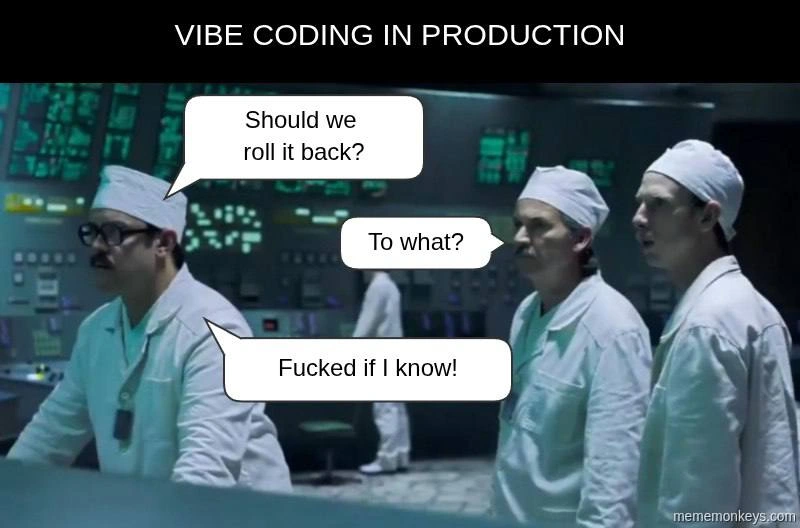
The still is from HBO's Chernobyl: three engineers in white uniforms and caps, bathed in the sickly teal glow of the reactor control room, surrounded by walls of Soviet-era switches and indicator lights. Overlaid speech bubbles script the incident call every modern on-call engineer recognizes:
"Should we roll it back?" "To what?" "Fucked if I know!"
Caption: VIBE CODING IN PRODUCTION. The meme's lethal accuracy is in the second bubble. Not "how do we roll back" — to what. Rollback is the cornerstone of incident response, and it rests on an assumption so basic nobody states it: that a known-good state exists and someone can identify it. Vibe coding — accepting LLM-generated changes at conversational speed without reading them — quietly destroys that assumption. The git history still exists, technically. But when the last fifty commits are claude: fix the thing (attempt 3), each one a diff no human reviewed, "known-good" becomes archaeology. You can git revert, but reverting to a state nobody ever understood is just choosing a different mystery.
The Chernobyl casting is more pointed than the usual disaster-movie reaction image. The reactor crew's defining tragedy was an observability gap: their instruments read 3.6 roentgen because that's where the dial ended, and the operators' mental model of the system (graphite tips, positive void coefficient) was catastrophically incomplete — they were operating machinery whose true behavior was known only to its designers. That's the precise failure mode of AI-generated systems: the "designer" was a model, the design rationale evaporated when the context window closed, and the humans in the control room are now operating panels they can describe but not explain. Incident response presumes someone on the call has a mental model. Vibe coding ships systems where nobody ever had one.
The industry pattern being satirized is older than LLMs — every team that's inherited an un-documented legacy system has lived "to what?" — but AI compressed the timeline. It used to take a decade of departed employees to produce code nobody understands; now a productive afternoon with an agent will do it. The fix everyone knows and skips: review the diffs, keep deploys small, tag releases, maintain rollback runbooks. The reason it gets skipped is the same incentive structure as always — velocity is measured, comprehension isn't, and the meltdown is some future sprint's problem.
Description
A meme captioned 'VIBE CODING IN PRODUCTION' using a still from HBO's Chernobyl: three engineers in white uniforms and caps stand in the reactor control room, surrounded by Soviet-era panels of switches and indicator lights. Speech bubbles read: 'Should we roll it back?' (engineer at the console), 'To what?' (engineer behind him), and 'Fucked if I know!' (first engineer again). Watermark: mememonkeys.com. The joke targets AI-assisted 'vibe coding' - shipping LLM-generated changes without understanding them or maintaining a known-good state, so when production melts down there is no comprehensible baseline to roll back to, mirroring the reactor crew's helplessness
Comments
6Comment deleted
Rollback plan: not great, not terrible - the last commit anyone understood was authored by Claude and reviewed by vibes
Make a new chat session for each new task. Easy Comment deleted
That is exactly the way they ended up there Comment deleted
You can go back to old chats and recover the code from context. Comment deleted
NixOS fixes this 🧌️️ Comment deleted
Nixon? Like the President? Comment deleted