Skip to content
DevMeme
3403 of 7435
The Spectrum of Useless Bug Reports
QA Post #3736, on Sep 23, 2021 in TG

The Spectrum of Useless Bug Reports

Why is this QA meme funny?

Level 1: The Baking Mystery

Imagine your friend gave you a recipe for cookies that they swear is perfect. You try to bake those cookies at home, following the same steps, but uh-oh – your cookies come out flat and burnt. You’re frustrated, so you start asking your friend a bunch of extra questions to figure out what went wrong. “Are you sure I set the oven to the right temperature? What kind of baking pan did you use? Was your kitchen maybe, I dunno, cooler than mine when you made them?” You even jokingly ask, “Seriously, was the room temperature like exactly 22°C when you baked them?” Now, obviously, the room’s temperature probably didn’t make the difference in how the cookies turned out – that’s a pretty silly detail. But you’re only asking because you’re stumped and trying to find any reason for the difference.

This is just like the meme: the developer is the confused baker, and the QA tester is the friend who had the original recipe. The developer couldn’t make the “recipe” (the software) go wrong the same way the QA did, so the developer jokes that maybe they need to know even the room’s temperature to get it to fail. It’s funny because we all know room temperature has nothing to do with cookie recipes (or software bugs!) in normal cases. The joke shows how people feel when they can’t repeat something weird someone else experienced – they start grasping at the craziest little details just to explain why they’re getting a different result. It’s a playful way of saying, “I can’t figure out this problem, so I might as well blame the weather!”

Level 2: Environment Variables IRL

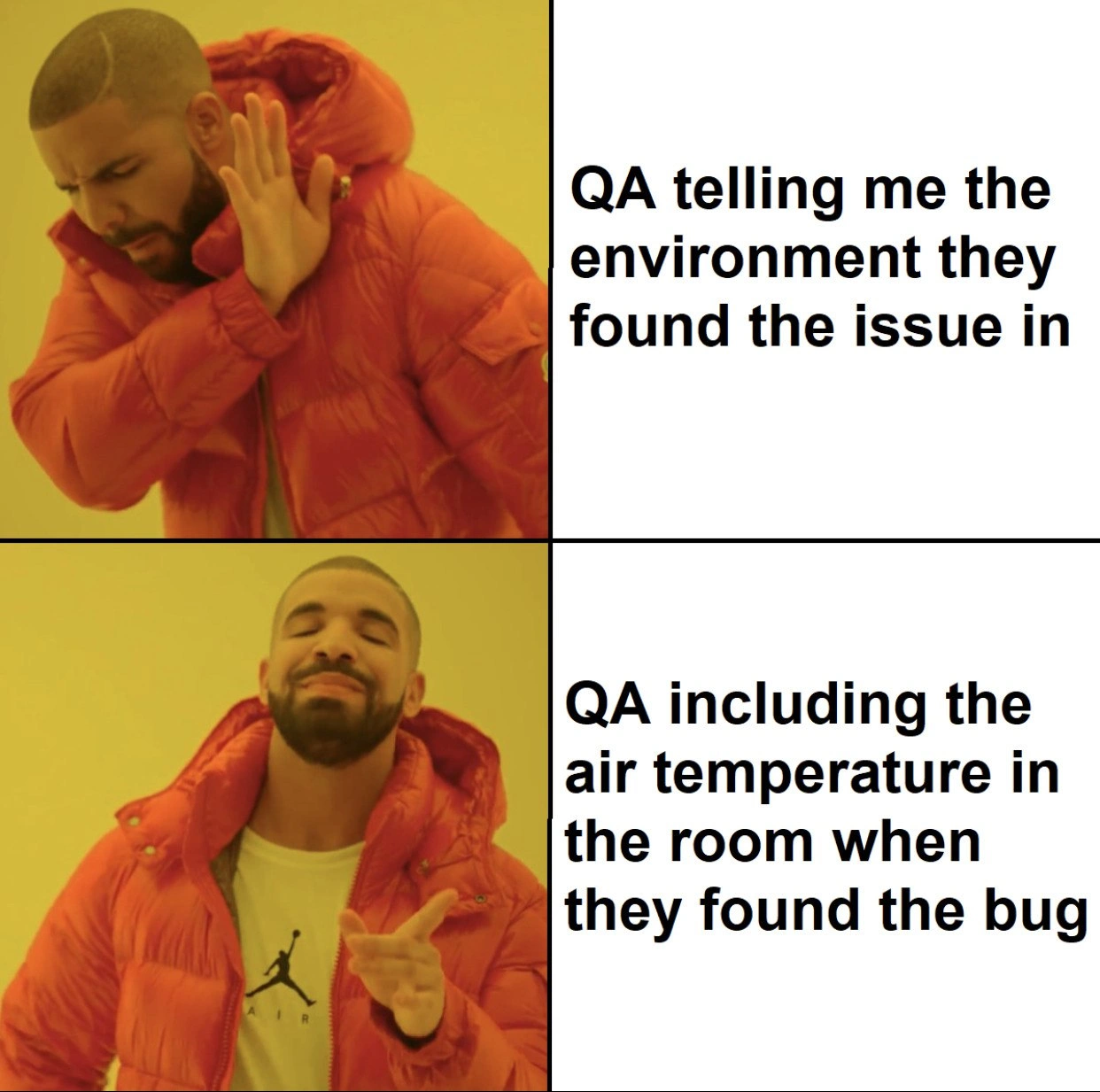
Let’s break down the meme in simpler terms. We have the popular Drake meme format (“Hotline Bling” two-panel image) used to show a preference. In the top image, Drake is waving his hand “No thanks”. The caption next to him says “QA telling me the environment they found the issue in.” This means a QA (Quality Assurance) tester is reporting a bug to a developer and mentions which environment the bug occurred in. In software, an environment is the setup or place where you run the code. Common ones are: a development environment (your local machine or sandbox), a QA/testing environment (a separate server where QA tests new builds), or production (the live system users actually use). Environments can have different settings, like different database connections, OS, or configuration.

So, QA might say something like, “I found this issue on our staging server (QA environment) using Chrome on Windows 10.” That’s useful info! But in the meme, the developer (Drake) is acting like that’s not enough; he’s dismissing it. It humorously implies the dev is thinking, “Meh, just knowing the environment isn’t helpful.”

Now, look at the bottom image. Drake is pointing approvingly with a pleased face. The caption says “QA including the air temperature in the room when they found the bug.” This is clearly a joke – it suggests the developer only gets happy when the QA provides an absurd level of detail about the bug. “Air temperature in the room” is not a normal thing you’d include in a bug report for software! Typically, QA will include details like steps to reproduce the bug, the environment (which server or device, OS version, browser version), maybe test data used, and any error logs or screenshots. For example, a bug report might say:

  • Issue: App crashes when submitting the form
  • Steps to Reproduce: 1) Open the app in Chrome 93 on Windows 10, 2) Go to the form page, 3) fill in data X, 4) click Submit, Result: error message or crash
  • Environment: QA Staging server, Version 1.2.3 of the app, Windows 10, Chrome v93, Logged in as regular user account
  • Expected Result: Form submits successfully
  • Actual Result: Application crashes with a null-pointer exception
  • Additional Details: (Maybe attach a screenshot or log snippet)

Notice that something like room temperature (22°C) is NOT on this list! 😄 The meme jokingly adds it. Why? To exaggerate the idea that the developer might ask for every possible detail if they can’t figure out the bug. It’s playing on a common TestingHumor trope: sometimes devs say “I can’t reproduce the bug, maybe you didn’t give me enough info,” and QA, a bit irritated, might respond “What else do you want, the room’s temperature?!” Here, QA preemptively includes a silly detail like that, as if saying “There, I’ve included all the info, even the air temperature. Happy now?” This is hyperbole (exaggeration) to make us laugh.

For a junior developer or someone new to the QA process, the meme highlights a real communication issue. When a tester finds a bug, they need to give the developer clear reproduction steps and relevant context so the dev can see the problem for themselves. If the dev can’t reproduce it, they might say, “It works on my machine.” This phrase is famous in dev culture – it means the developer didn’t see any issue when they ran the same code on their own computer, implying maybe the tester’s environment or procedure is different. “Works on my machine” can sometimes come off as dismissive – basically pushing the problem back to QA: “I think the problem might be on your side, not with my code.” That can frustrate QA folks, especially if they’re sure they found a real software bug.

So what happens next? Usually, the QA will double down and provide more information. They’ll confirm the exact environment, maybe try to reproduce it again and note anything specific: the user account used, the test data inputs, the time it happened, etc. In a healthy developer-tester relationship, both sides cooperate to nail down the issue. But in the jokey version of this meme, the dev is almost comically demanding, and the QA responds by going overboard — including “environmental metadata” that’s obviously irrelevant, like the literal environment’s temperature 😅.

This relates to a concept of environment metadata overload – providing so much detail about the testing environment and conditions that it becomes overkill. Usually, only certain environment details matter for a bug: things like OS version, browser type, app version, configuration settings, network conditions, etc. You generally do not need to report physical room conditions! However, the laughter comes from imagining a scenario where a bug is so impossible to pin down that a developer acts like even the air conditioning settings might be the culprit. It’s poking fun at how desperate we can get during a tough bug hunt.

Another angle: sometimes very new testers might actually include a lot of extraneous info in a bug report, thinking more is always better. A senior might chuckle if a bug ticket comes in with paragraphs of everything the tester observed (“the fan on my laptop was running loud, and one of the overhead lights was flickering at the time of test…”). The meme riffs on that too. It’s like saying: some developers claim they need “all the info,” so QA humorously obliges with way too much info. Both sides of this developer_vs_QA dance have felt the tension. This meme simply takes a light-hearted shot at it.

To a junior dev, the lesson hidden in the humor is: be specific but sensible when discussing bugs. If you’re QA, give the dev enough to work with – browser, OS, app version, steps, test data, logs. Don’t just say “it doesn’t work” with no details (that’s like telling a mechanic “my car broke” without saying anything else). Conversely, if you’re the developer, don’t dismiss the bug just because you can’t recreate it instantly. Instead of saying “works on my machine” and stopping there, you’d work with QA to figure out what’s different. Maybe spin up a similar environment or ask targeted questions. Demanding ridiculous levels of detail will just annoy everyone. The meme is a funny exaggeration of what not to do: the dev in the joke basically says “I don’t care about your normal bug report, but if you tell me even the room temperature, then I’ll listen.” It’s sarcasm.

Finally, note the cultural reference in the meme format: Drake’s meme is universally recognized. In developer meme culture, using Drake’s “No/Yes” panels is a quick way to communicate contrast. Here the contrast is between insufficient info vs. absurdly too much info in bug reports. Even without deep technical knowledge, one can see Drake prefers the second option in a tongue-in-cheek way. It’s just a fun example of DeveloperHumor where both developers and QA testers can share a laugh, acknowledging that the struggle to reproduce bugs can lead to some pretty ridiculous conversations.

Level 3: Works on My Machine™

In the top panel of this meme, Drake (standing in for a grumpy developer) is rejecting QA’s environment info. This is a nod to the infamous “Works on my machine™” excuse. It’s that senior developer Debugging catchphrase meaning: “If I can’t see the bug on my setup, it must be something wrong with your setup.” Here, QA says which environment had the issue – perhaps the QA environment (a testing server) vs. the developer’s local machine – and our dev is basically going “nah, not interested.” It’s a sarcastic take on those times when a developer waves off crucial context, suspecting the bug is a fluke or a config problem rather than a real code issue.

But in the bottom panel, Drake/dev is suddenly all smiles and finger-guns when QA includes even the air temperature in the room when they found the bug. Why would a dev demand such absurd detail? It’s poking fun at how, in heated Debugging/Troubleshooting sessions, developers sometimes act like they need every scrap of data to reproduce a tricky issue. We’ve all been there: that one bug that’s impossible to replicate, so in frustration you half-jokingly ask, “What was the exact temperature and humidity when this happened? Was Mercury in retrograde?” The QA, equally exasperated, might respond with an overly overly detailed bug report listing everything short of the office goldfish’s name. The meme exaggerates this dynamic to hilarious effect. It’s satire about bug reproduction steps turning into an information dump, where anything – no matter how irrelevant – might be the magic detail that explains why “it only fails on your machine, not mine.”

From a veteran developer’s perspective, there’s painful truth under the humor. Real-world bugs can be maddeningly environment-specific. We call some elusive glitches “Heisenbugs,” because observing or trying to debug them seems to change their behavior (a nod to the Heisenberg uncertainty principle). One classic example: a race condition in concurrent code that only manifests under certain timings – maybe it happens on the slower QA server but never on the fast dev machine. Or consider a memory leak that crashes QA’s smaller container but not the beefy dev box. Environment differences like these turn bug hunting into detective work. Here are a few real factors that can cause “works on my machine” syndrome:

  • Operating System quirks: The bug might appear on Windows but not on Mac/Linux (line endings, file paths, case sensitivity – fun times).
  • Dependency versions: QA’s environment might have a slightly different library version or database engine. One tiny version mismatch and 💥 SoftwareBugs emerge.
  • Configuration and data: The test environment could have feature flags or configs turned on/off, or a dataset that triggers an edge case (like that one null value your dev dataset never had).
  • Hardware & load: The QA server perhaps has less memory or CPU, so a performance bug or timing issue pops up only there. On a really bad day, you joke that even the CPU’s room temperature might affect timing.
  • Environmental factors (really!): On rare occasions, physical conditions do matter – e.g. an overheating CPU can cause bit flips, or a sensor might behave differently based on temperature. These are extremely uncommon in typical app development, but hey, after enough all-nighters, a dev starts considering solar flares and cosmic rays in their QAProcess.

So when the meme shows the dev demanding the air temperature, it’s riffing on this idea that any missing piece of context could be the key. It’s an absurd extension of “Give me the exact steps to reproduce!” – turning into “Give me the exact planetary conditions to reproduce!” This resonates with experienced devs because we’ve all had that bug where we half-jokingly say, “Maybe the user held their laptop at a 42° angle during the test – that’s why I can’t duplicate it!” It’s DeveloperHumor born from real frustration.

Notice the format is the Drake “Hotline Bling” meme – a staple of DeveloperHumor and TestingHumor. Drake’s “No/Yes” pose perfectly captures the tongue-in-cheek attitude shift: first panel, the dev doesn’t care about normal bug report info; second panel, they act like only an insanely thorough report (with useless tidbits) will satisfy them. It’s a playful jab at both developers and QA. On one hand, it’s saying some devs can be almost comically dismissive or demanding with QA. On the other hand, it pokes at QA folks too – suggesting they sometimes deliver environment metadata overload (piling on every detail, relevant or not, just to cover their bases or maybe to mock the dev’s obsession).

The QA vs Developer communication gap is the real butt of the joke. Instead of working together smoothly, both sides are shown engaging in a kind of exaggerated standoff: “You didn’t give me enough info” versus “Fine, here’s all the info, happy now?” The truth is, in a good QA process, you need the right balance – enough environment info and bug reproduction steps to reproduce the issue, but not so much that you’re listing the office Wi-Fi SSID and the QA engineer’s lunch order. This meme takes that balance and throws it out the window for comic effect. The dev character only pretends to be satisfied when the bug report includes something as ridiculous as the room’s temperature, highlighting how sometimes it feels like nothing short of omniscient detail will solve a tricky bug.

In sum, this meme hits home for anyone who’s struggled to replicate a pesky issue found by QA. It humorously exaggerates the lengths we wish we could go to squash a bug. BugHunting can turn professionals into conspiracy theorists — if a bug defies logic, we start eyeing everything with suspicion (time of day, user horoscope, server rack placement, you name it). After you’ve chased a few nearly unreproducible bugs, you get the dark joke here: “Maybe I do need the room’s thermostat reading to finally solve this.” It’s funny because it’s a dramatization of real DebuggingFrustration – when a software problem makes you so desperate that even absurd clues sound plausible.

Description

This is a classic 'Drake Hotline Bling' two-panel meme format, featuring the rapper Drake in a bright orange puffer jacket. In the top panel, Drake holds up a hand in a gesture of disapproval, with the adjacent text reading, 'QA telling me the environment they found the issue in'. In the bottom panel, Drake points approvingly, looking pleased, with the text: 'QA including the air temperature in the room when they found the bug'. The meme satirizes the eternal struggle developers have with bug reports. It contrasts a report that is technically correct but lacks sufficient detail (just the environment isn't enough) with one that provides an absurd, comical level of irrelevant information. For senior engineers, this joke is painfully relatable. It speaks to the countless hours wasted trying to reproduce issues from vague tickets and the gallows humor of imagining a bug so specific it's affected by atmospheric conditions - a 'Heisenbug' of the highest order. It’s a commentary on the fine art of writing a useful bug report, which is a skill often lacking in practice

Comments

12
Anonymous ★ Top Pick Finally, a useful bug report. Now I can confirm the bug only reproduces when the ambient temperature causes the server's crystal oscillator to drift by 0.01Hz. Closing as 'won't fix; requires HVAC team.'
  1. Anonymous ★ Top Pick

    Finally, a useful bug report. Now I can confirm the bug only reproduces when the ambient temperature causes the server's crystal oscillator to drift by 0.01Hz. Closing as 'won't fix; requires HVAC team.'

  2. Anonymous

    When the Heisenbug only shows up at exactly 22 °C and 40 % RH, you stop teasing QA’s “weather-as-a-service” logs and start budgeting for a climate simulator in CI

  3. Anonymous

    After 20 years in tech, I've learned that QA will meticulously document the office HVAC settings, lunar phase, and barometric pressure when filing a bug, but somehow 'steps to reproduce' remains a philosophical mystery worthy of Schrödinger himself

  4. Anonymous

    Ah yes, the classic QA report: 'Bug found at 2:47 PM, barometric pressure 1013 hPa, developer was wearing a blue shirt' - but was it staging, production, or the quantum superposition of both? The Heisenberg Uncertainty Principle of bug reports: you can know the room temperature OR the environment configuration, but never both with precision. Senior engineers know the real debugging starts when you have to reverse-engineer which of the seventeen 'dev' environments they actually meant, while the ambient humidity reading sits there mocking your attempts at reproduction

  5. Anonymous

    QA logged 22°C and we laughed - until the bug only reproduced when the AC was off and the CPU stopped turbo boosting. Our “environment variable” was the environment

  6. Anonymous

    Cool - no build SHA, no flag state, no browser version, but 22.4°C; I’ll add a thermostat to CI and try to reproduce

  7. Anonymous

    QA's repro: prod env, Thursday, 23°C, full moon. Dev: 'Reproducible - in the Twilight Zone.'

  8. @RiedleroD 4y

    there was actually a story where someone had to fix an issue with some Datacenters with notoriously failing HDDs - fixed by moving the HDDs to a lower altitude (Air pressure was the culprit) and one other one where the fix was to move away from the sea bc the air pressure was too high.

    1. @azizhakberdiev 4y

      Choosing instead of fixing HDD's fixing the location. Was it cheaper btw?

      1. @RiedleroD 4y

        they had to replace HDDs at an alarming pace already, whoever made the post only investigated further because of that. also I have no further information

  9. @gorqmorq 4y

    Each fukin time the tower is down because of shittiest cooling issues

    1. dev_meme 4y

      Just stop smoking weed in a server room!

Use J and K for navigation