When management drags you into leadership despite your claws out
Why is this Management PMs meme funny?
Level 1: Don’t Wanna Be The Boss
Imagine you’re a kid happily playing with your favorite toy in a cozy little corner. You’re in your zone, having fun, not bothering anyone. Suddenly, a teacher or parent comes over, picks you up, and says, “Hey, we need you to be in charge of this group project (or tidy up the playroom)!” You didn’t ask to be in charge – you were perfectly content playing by yourself. How do you feel? Probably scared, annoyed, or just plain “Nooo, I don’t want to!”
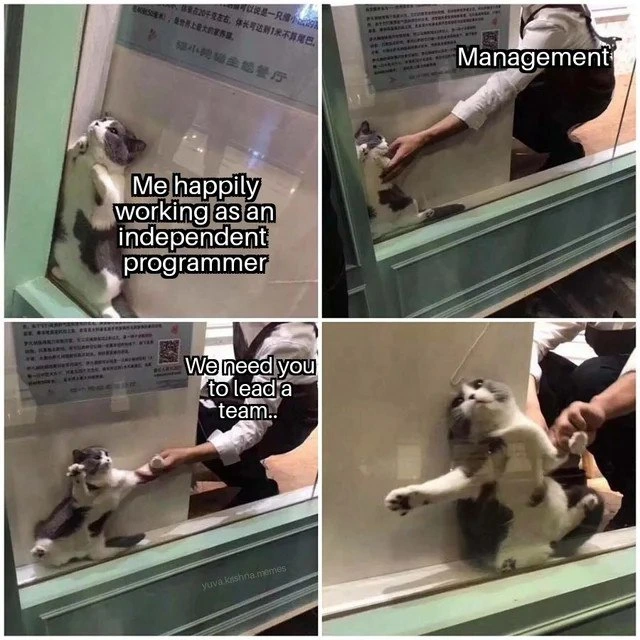
That’s exactly what’s happening in this funny cat picture. The cat is like a person who was really happy doing their own thing, and the hand grabbing the cat is like the boss or teacher saying, “Come on, you’re the leader now.” The cat is being pulled out of its little comfy spot (like you being pulled out of playtime), and it clearly does not want to go! Its legs are stretched out, claws gripping the sides, and its face looks totally panicked and upset. It’s basically saying, “I don’t wanna be the boss!” in the most dramatic cat way possible.
We find it funny because we know how stubborn cats can be when you try to make them do something they don’t want (ever try to put a cat in a bath or a carrier? They’ll do exactly what this cat is doing – spread out like a starfish and yowl in protest!). And we also laugh because we relate to it: even if you’re not a grown-up or a programmer, everyone’s had moments when they were perfectly happy doing one thing and an adult or someone in charge made them do something bigger or different that they really didn’t feel ready for. The cat’s big crazy-eyed expression is a silly exaggeration of that “No, please don’t make me!” feeling we all recognize.
So, in simple terms, this meme is like a cartoon of a very common situation: someone who loves their simple, happy job (or activity) being dragged into a leader role they never wanted. It’s funny and cute because it uses a real cat acting just like a reluctant person would – and let’s be honest, a flailing cat is always a bit comical to see. In the end, we’re laughing at the mix of “aww, poor kitty” and “haha, I know that feel!” The cat doesn’t want to be the boss, and sometimes, neither do we – and that shared feeling is what makes the joke work!
Level 2: From Coder to Manager
This meme highlights the very real struggle when a programmer is pushed into a management role against their will. On one side, we have an independent programmer (symbolized by the cat happily chilling behind the glass). Being an independent programmer – also known as an Individual Contributor (IC) – means you focus on writing code, solving technical problems, and generally working on your own or with a small team on features. You’re essentially responsible for your tasks and enjoy the creative flow of coding. The cat in panel 1 is labelled “Me happily working as an independent programmer” to show that content, stress-free state of just coding away in its own little world.
Then along comes Management (the person in the suit reaching in). In companies, “management” refers to bosses, team leads, project managers – people responsible for organizing work and leading people rather than doing the hands-on building themselves. The text “We need you to lead a team…” is something a lot of developers hear as they gain experience or do well in their role. It sounds flattering – management is basically saying, “You’re good at what you do, so we want you to be in charge of others doing it.” That’s the CareerGrowth path many assume is natural: you grow from being a solo coder to a team lead or manager. It’s meant to be a promotion, a sign of trust and responsibility.
However, not everyone actually wants that kind of promotion. Leading a team is a very different job from coding. Instead of spending your day crafting software, you’ll spend a lot more time in meetings, planning projects, coordinating team members’ work, dealing with deadlines, and even handling interpersonal issues (like mentoring juniors or resolving conflicts). Think of it this way: a coder’s day might involve focusing on a tricky algorithm for hours, while a manager’s day might be broken into ten different Zoom calls and writing status reports. The meme shows the cat actively resisting being pulled out – claws out, body stretched away – which perfectly represents an engineer’s reluctant_leadership moment. The engineer (cat) is basically saying, “Nope, I don’t want to leave my coding haven to do all that manager stuff!” This resistance can come from fear of losing the enjoyable part of the job (coding) and having to do things they might find boring or stressful (like budgeting, scheduling, or giving HR feedback).
The phrase “drag you into leadership” (as in the meme’s title) is pretty spot-on. Often management might pressure a developer into taking a lead role if the team needs it. This could be gentle persuasion (“You’re the best for this, we really need you to step up”) or sometimes not-so-gentle, like it’s the only way to get a raise or keep advancing. That’s why we see terms like forced_promotion or team_lead_pressure floating around – they describe when someone is essentially pushed up the ladder without truly opting in. The cat being dragged is a humorous exaggeration of how that pressure feels: you’re being pulled by the arm (literally, in the image) out of your safe spot. The cat’s distressed expression in the final panel says what a lot of developers feel inside: pure panic and discomfort.
This meme falls into DeveloperHumor and specifically ManagementHumor because it pokes fun at the common situation in tech companies where there’s a bit of a disconnect: managers think they’re offering a great opportunity, but the engineer feels like they’re losing something they love. It’s also a classic ManagementVsEngineering scenario. Management’s goal is to fill a leadership gap (“we need a team lead and you’re capable”), whereas the engineering mindset might be “I just want to build great products, why add all these extra obligations?” Neither side is wrong exactly – teams do need leaders, and good engineers do deserve to grow – but the humor comes from how differently each side views the situation. The manager (like the suited arm) is optimistic, thinking the cat should come along willingly. The engineer (the cat) is like “No way, I’m fine right here!”
For a junior developer or someone early in their career, the meme is a lighthearted cautionary tale. It’s saying: just because you’re great at programming doesn’t mean you’ll automatically love (or even like) managing a team. CareerGrowth in tech can branch into a people-management path or a technical-expert path. Some companies recognize this and offer dual tracks (so you can become a senior or principal engineer without managing people). But in places that don’t, the default promotion is often into management – which not everyone enjoys. There’s even a phrase “unwilling_manager” to describe folks who end up in managerial roles mostly due to expectation or pressure rather than personal desire. If you’ve ever had a teacher pick you as team captain when you’d rather just do your own assignment, you can relate to that feeling.
And why use a cat meme for this? Well, cats are famous for being independent and doing what they want. If you’ve ever tried to pick up a cat that doesn’t want to move, you know they spread their legs, dig in claws, and give you that “nope!” face – just like in the pictures. Developers are often (jokingly) compared to cats for that independent streak. So, visually, it’s hilarious and perfect: the cat is clinging to the last bits of its coder life, and management is trying to haul this fluffy, unwilling “new boss” out into the open. The contrast between the formal suit arm (professional management) and the squirming cat (free-spirited engineer) is both adorable and absurd, which makes the joke land so well.
In short, the meme is explaining in a funny way: being a great programmer doesn’t mean you want to be the boss. Sometimes the very thought of leading a team (with all the non-coding duties it brings) makes a programmer react just like that cat – claws out, resisting every inch of the way. And honestly, even for those who eventually choose the management path, we can all laugh at how accurately that cat’s face captures the initial shock and inner protest when the idea is first sprung on us. It’s a feeling many in tech know, which is why this meme is so popular and relatable in developer circles.
Level 3: Herding Cats IRL
In the tech world, there's a classic tug-of-war between Management and Engineering – a comedic conflict perfectly captured here by a literal cat being yanked out of its comfort zone. The cat behind the glass (“Me happily working as an independent programmer”) symbolizes a content developer thriving on code and solitude. Enter the suited arm labeled Management, reaching in like a well-meaning but clueless boss. The caption in panel 3 – “We need you to lead a team…” – is the ManagerExpectations bombshell every quirky coder dreads. Instantly, the scene turns into ManagementHumor gold: the cat (our engineer) goes full claws-out, resisting just as hard as a senior dev clinging to their keyboard while being dragged into yet another CorporateCulture experiment.
This is a textbook case of forced_promotion and reluctant_leadership. Management often assumes that a stellar programmer should naturally become a team lead – a leap of logic akin to thinking a cat will happily herd other cats. (Ever heard the phrase “managing developers is like herding cats”? Here it’s happening literally.) The humor cuts deep because it’s RelatableHumor born from real experience: many of us have seen a brilliant coder transformed into an unwilling_manager overnight, trading a world of IDEs and git commit for endless meetings and status reports. The cat’s desperate splay in panel 4 – limbs akimbo, face twisted in horror – is basically an engineer’s inner scream when told their CareerGrowth now means handling team_lead_pressure instead of code reviews. We recognize that wild-eyed look: it’s the face you make when you realize your reward for great coding is punishment a promotion into PowerPoint purgatory.
Let’s break down why this scenario hits so close to home for senior devs:
- Indie Coder Bliss vs. Manager Chaos: As an independent programmer, you enjoy deep focus time, clean commits, and the sweet solitude of the command line. As a new team lead, say hello to context-switching chaos – one minute debugging deployment scripts, next minute
debuggingmediating a dispute over who broke the build. - Technical Work vs. People Work: Instead of solving technical puzzles, you’re now solving people puzzles. Designing software is replaced by designing project timelines. You were writing Python scripts; suddenly you’re writing performance evaluations. The cat’s claws-out pose = your soul clawing to hold on to technical work.
- Freedom vs. Responsibility: That glass enclosure is a safe bubble of pure coding zen. Management’s hand represents responsibility pulling you out. It’s not just a physical tug-of-war – it’s a clash of mindsets. The engineer loves the freedom to tinker; management wants them responsible for others’ output. It feels like trading your comfy hoodie for a straitjacket of ManagerExpectations.
Under the hood, there are well-known industry reasons this dynamic keeps happening. Traditionally, many companies had a one-track ladder: to advance (better title, more pay), you eventually must manage people. It’s the infamous “climb the corporate ladder” pressure – here comically re-enacted as clawing up the ladder. The experienced folks among us recognize the Peter Principle lurking: promote a great engineer into a role they may hate (or lack the skills for) and you’ve got a recipe for a cat-astrophe. 🐱 DeveloperHumor often riffs on this because it’s so absurd yet common – like a cruel joke we all know the punchline to. The ManagementVsEngineering tension isn’t about who’s right; it’s about misaligned incentives. Management needs leadership slots filled; engineers need uninterrupted flow. When those collide, you get this darkly funny “management drag” scene.
In sum, the meme exaggerates a truth senior devs know too well: being dragged into leadership can feel like being hauled out of a safe little world by someone who just doesn't get why you're hissing. The cat's wide-eyed protest is every veteran coder’s reaction to “Congrats, you’re now in charge of the team!” – a mix of CareerGrowth anxiety and “please no, not my coding time” panic. It’s funny because it’s true, and a little painful because it keeps happening. The next time an engineer friend shares this meme, they'll likely do so with a wry smile – laughing to keep from crying, claws still out, hoping to stay in their happy coding glass box just a little longer.
Description
Four-panel meme: a glass enclosure with a gray-and-white cat inside, a suited arm reaching through a service hatch and grabbing the cat’s front paw. Panel 1 shows the cat being held while a large blurred rectangle obscures part of the background signage. Panel 2 zooms out; the human arm is labeled “Management.” Panel 3, with caption text above the cat’s head reading “We need you to lead a team..”, shows the cat stretching away in obvious resistance. Panel 4 captures the cat half-lifted, limbs splayed and face contorted in protest while the hand still pulls. The scene humorously visualizes the common tech experience of engineers being pushed into people-management roles they never asked for, highlighting tension between technical work and managerial expectations

Comments
6Comment deleted
Being “promoted” from principal IC to manager feels like kubectl cordon-ing your own node - you’re still online, but nothing that actually runs code can schedule on you anymore
The promotion where your commit frequency drops to zero but your calendar blocks hit 100% capacity
The classic IC-to-manager pipeline: one day you're optimizing algorithms in peaceful solitude, the next you're being dragged into sprint planning meetings and 1-on-1s. Management sees your technical competence and thinks 'perfect leadership material,' completely missing that the skills that make you a great independent contributor - deep focus, technical problem-solving, minimal context switching - are orthogonal to what makes someone want to manage people. It's the tech industry's version of the Peter Principle, except instead of rising to your level of incompetence, you're forcibly extracted from your level of contentment
From 100% code ownership to 0% commits and 100% blame - management's favorite breaking change
“We need you to lead a team.” Translation: you’ve been refactored into a human message queue - high fan-in, no commit access, and everyone blames you for backpressure
Nothing says scale like promoting the only engineer who keeps the monolith alive - now your fastest worker thread is a meeting scheduler