When your game engine’s EULA turns into full-blown ransomware UI
Why is this GameDev meme funny?
Level 1: Pay Up or No Play
Imagine you borrowed a big toy castle from a friend to build the coolest playground game ever. Your friend said, “Go ahead, use it for free!” So you spend months building this awesome castle with secret rooms and towers. Lots of kids start coming to play. Then one day, that friend suddenly shows up with a scary lock and says: “New rule! Every time someone new comes to play in your castle, you owe me 20 cents. If you don’t pay, I’m taking the castle away!” Now you’re shocked — that wasn’t the deal before! It feels like a bully demanding lunch money: pay up or I destroy your project. This meme is joking that Unity (the company that provided the game-building tools) acted like that friend turned bully, suddenly asking for money per play. It’s funny in a scary way, because developers felt like their game was being held hostage unless they paid, just like a bully or bad guy in a movie would do. In simple terms: the people who made the game engine changed the rules and said “give us money each time someone plays your game, or else,” and that’s as absurd (and unfair) as it sounds.
Level 2: Trapped by Terms
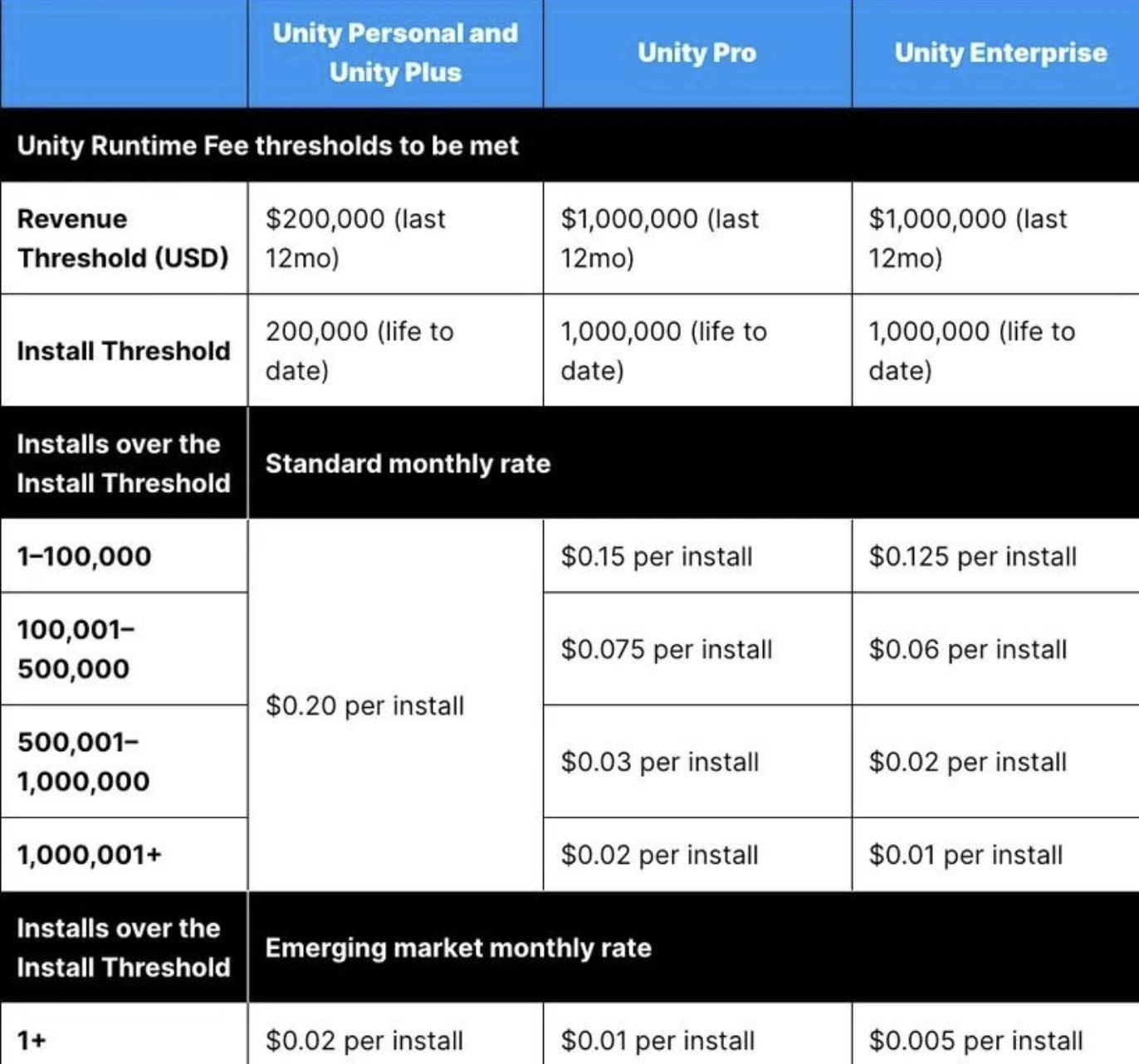
Alright, let’s break this down in simpler terms. This meme is referencing a big controversy in the Game Development world, specifically around the Unity game engine. Unity is a very popular software engine that developers use to build games. Think of a game engine as a framework full of ready-made physics, graphics, and tools so you don’t have to code everything from scratch. Many indie (small team) games and mobile games are made with Unity because it’s been relatively easy to use and free to start with. Normally, how does Unity make money? They had a deal: you can use Unity for free until your game earns $100k revenue; after that, you’re supposed to pay for a Pro license (a fixed monthly cost) or share a small percentage of revenue if you’re on certain plans. That was the EULA (End User License Agreement) developers agreed to – basically the terms of use for Unity.
Now, the meme is about Unity suddenly changing those terms in 2023. They introduced something called the Unity Runtime Fee. This meant they planned to charge game developers a certain amount of money every time someone installs their game. Yes, per installation pricing – imagine having to pay $0.20 to Unity each time a player installs your game on their device. At first glance, a newcomer might think: “okay, $0.20 doesn’t sound too bad.” But for developers, this was shocking and scary. Why? A few reasons:
- Unpredictable Costs: Traditionally, a developer might pay Unity either a flat fee or a percentage of what they earn (revenue share). Both of those scale with success in a somewhat manageable way. But charging per install is unpredictable and potentially enormous. If a game suddenly went viral and millions of people downloaded it, the dev could owe Unity more money than they actually earned from the game! That’s like selling a $1 app and then owing Unity $0.20 every time – if you only make $1 per user, $0.20 is a huge cut, and if you’re not making money on a free game, $0.20 per install is a net loss.
- Retroactive Application: Even more terrifying, Unity said this new fee would apply to existing games already on the market (once the policy kicked in next year). “Retroactive” means it looks back at the past. Developers felt this was like changing the rules of the game after it’s been played. They had made financial plans and possibly signed contracts under the old terms. Changing the deal later is a big no-no in business trust.
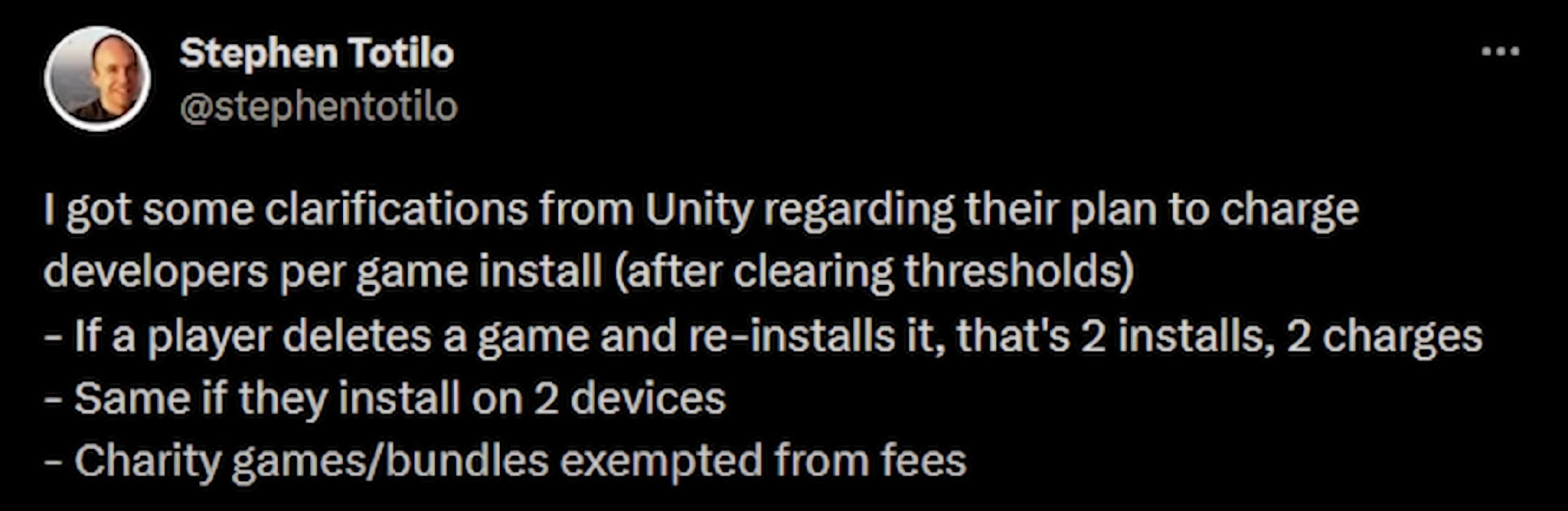
- Abuse and Errors: Developers quickly saw how this system might be abused or could go wrong. What if someone maliciously installs a game over and over (for example using a script or bot) just to rack up fees and hurt the developer? What if pirates copy the game and spread it around? Would those count as installs the developer has to pay for? Unity’s initial communication was unclear, causing a panic. It felt like there were a lot of corner cases not thought through. For instance, players often reinstall games (maybe they got a new PC, or redownload on a phone) – would each reinstall count as a separate fee? The lack of clarity made devs imagine the worst.
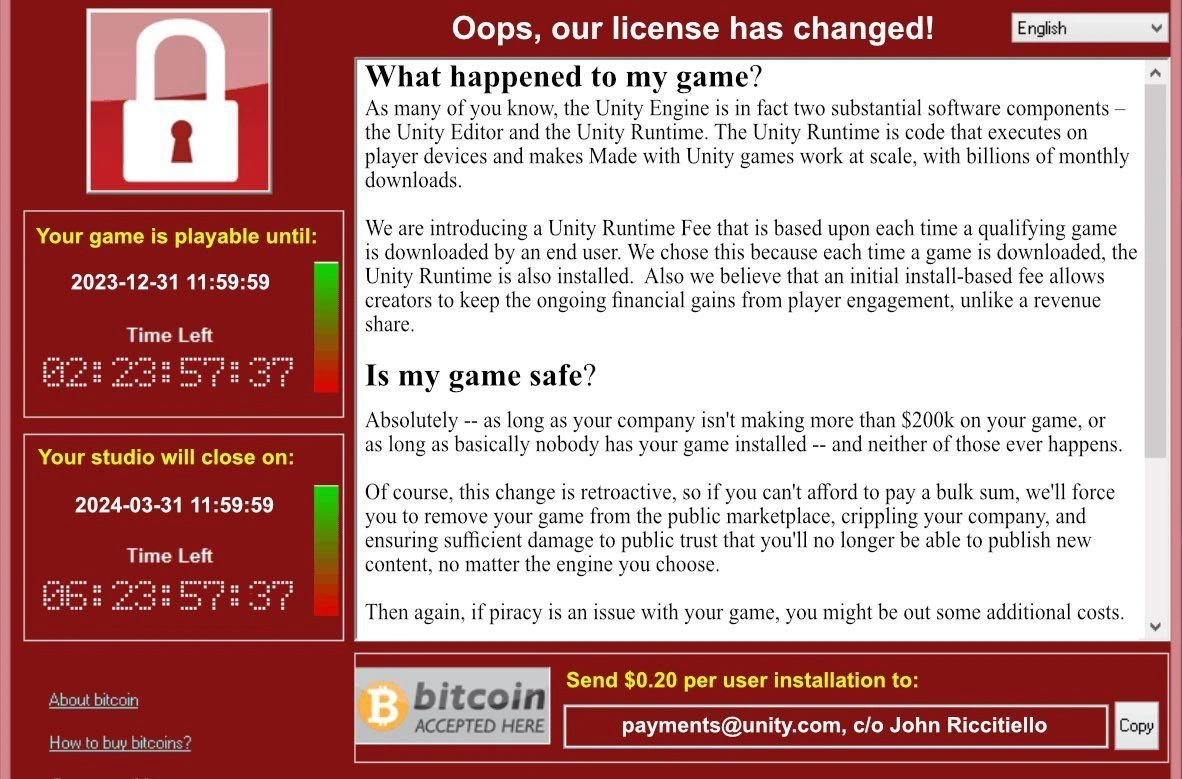
This brings us to the meme image. It dramatizes the situation by showing what looks like a ransomware window. Ransomware is a type of malicious software that hackers use to lock your files or computer and demand money (a ransom) to restore access. If you’ve ever seen it in movies or news, it often has scary warnings, a countdown timer, and tells you how to pay (usually via Bitcoin, a digital cryptocurrency). The meme uses that exact styling to joke that Unity’s new license terms feel like ransomware targeting game developers.
Let’s identify parts of the image and what they mean in context:
“Oops, our license has changed!” – This mimics the phrasing of ransomware (“Oops, your files have been encrypted!”) but instead it’s Unity cheerily saying they changed the rules on you. The humor here is that an End User License Agreement change normally would just be a boring email or popup you click “Ok” on, not an “oops” gotcha. The meme implies Unity’s change was as rude and sudden as a malware attack.
Language Dropdown (English) – Just a detail to make it look like a real software window. Ransomware often lets you choose language, adding to the realism. It’s a small touch for authenticity: the meme is fully committing to the bit that this is a ransom note interface.
Padlock Icon – That padlock symbol is a universal sign of something being locked or secure. In ransomware, it means your stuff is locked until you pay. In the meme, it symbolizes that your game is now figuratively locked by Unity’s new policy until you comply with the payment terms. It’s like Unity saying, “your game won’t be truly yours or safe unless you pay us.” Yikes.
Countdown Timers (“Your game is playable until…”, “Your studio will close on…”) – These are there to exaggerate the pressure developers felt. Unity did set a date when the fees would start (the policy was to begin on Jan 1, 2024). The meme humorously turns that into a literal countdown to doom. “Your game is playable until 2023-12-31 11:59:59” suggests that after New Year’s Eve, if you haven’t paid or agreed to the new fees, maybe your game stops being playable (not literally true, but it captures the fear that post-deadline, something bad happens). “Your studio will close on 2024-03-31” is a joke that a few months into paying these fees, an indie studio might go bankrupt (“close”) because they can’t afford the bills. The timers with the “Time Left 02:23:57:37” mimic the way ransomware ticks down hours, minutes, seconds. It’s all about inducing panic. For developers, Unity’s sudden announcement did induce panic, albeit on forums and social media rather than a desktop window.
Explanation Text (right side) – The meme writer actually wrote out an explanation in a mock Q&A style, which is both funny and informative. It’s written in a polite corporate tone but is full of sarcasm between the lines. It explains what the Unity Runtime is (the code that runs on every user’s device for Unity games) and how Unity chose to charge each time that runtime gets installed. It even says with a straight face that this “allows creators to keep the ongoing financial gains from player engagement, unlike a revenue share.” That is parodying Unity’s attempt to sugar-coat the fee. In simpler words: Unity tried to argue “we’re doing you a favor by not taking a cut of your revenue, we only charge when someone installs.” Most developers did not see it as a favor at all. The meme makes that clear by the over-the-top scenario.
“Is my game safe?” – This part of the text addresses devs asking if they’ll be affected. Unity’s real policy had thresholds (if your game hasn’t made $200k AND doesn’t have a large number of installs, they said you won’t be charged). So the answer in the meme says essentially: “Sure, your game is safe… as long as it’s not successful.” It’s poking fun at the idea that the only people not hit by this fee are those who are probably struggling anyway (small hobby projects with almost no players or revenue). It’s a very pointed way to say successful indie devs will be hit, unsuccessful ones won’t be – and who wants to aim to be unsuccessful?
Retroactive change – The text explicitly calls out that it’s retroactive and then imagines Unity forcing you to take down your game if you can’t pay a huge one-time sum. This was a genuine fear: developers wondered if they’d have to pull their games off Steam or app stores to stop the bleeding of ongoing install fees. If a game isn’t available for download, new installs stop – but then you’re not selling it anymore either, effectively killing the game’s prospects. The meme says this “crippling your company” and “damage to public trust” – which is exaggeration, but rooted in the real concern that players would be upset if games became unavailable or if devs started implementing weird DRM to limit installs. It even warns “you’ll no longer be able to publish new content, no matter the engine you choose.” That part is facetious – obviously a dev could switch engines for a future project – but it’s dramatizing the despair a dev might feel: like their reputation with players could be ruined or they’d lose so much money they could never start fresh. It’s dark humor, basically.
Piracy comment – The last line about piracy causing additional costs is a final jab at how nonsensical the fee idea was. In normal situations, piracy (people illegally copying your game) is a bad thing because it means lost sales. In this bizarre Unity scenario, piracy could double-dip hurt you: you didn’t get money from a sale and Unity might count those illegal installs and charge you for them. Of course Unity wouldn’t knowingly charge you for pirated copies, but the fact that it was even a question shows how half-baked the plan sounded. The meme exaggerates it for effect: “if piracy is an issue, you might be out some additional costs” – as if Unity is saying shrug, not our problem if someone bombards you with install-count, you still owe us. For a junior developer, understand that this was one of those immediate WTF moments in the dev community. People asked Unity, “So are you going to detect installs and distinguish legitimate ones from fake or repeated ones? How? What about installs of demos, or beta testers, or charity bundles?!” The lack of clear answers made everyone assume the worst-case scenario until proven otherwise.
Payment Demand (bottom bar) – This is where the meme goes full comedy. It mirrors exactly what real ransomware notes do: give you payment instructions at the bottom. It says “Send $0.20 per user installation to: bitcoin ACCEPTED HERE – [email protected], c/o John Riccitiello” and has a Copy button. Let’s unpack that: $0.20 per install is the actual fee Unity planned (the exact amount varied based on stuff like which version of Unity and how many installs total, but $0.20 was one of the stated figures for high-tier countries). The meme pretends you have to manually send that in, which is joking that Unity’s policy feels as absurd as physically paying a ransom. “bitcoin ACCEPTED HERE” is a direct nod to ransomware, as mentioned. The use of John Riccitiello’s name (Unity’s CEO) is a tongue-in-cheek way to personify the greed – like send the money to Mr. UnityBoss himself. In reality, of course, Unity would bill you through normal channels, not an email or Bitcoin, but by putting it this way, the meme implies “this policy is so extortionate, it might as well be run by a dude with a ski mask and a crypto wallet.” The Copy button detail is just there for authenticity and an extra laugh; it’s saying “hey, even criminals make it one-click easy to copy their payment address, and Unity’s behaving the same way.”
Now, let’s connect this to the broader ideas tagged: LicensingCosts, VendorLockIn, DependencyHell, CorporateCulture.
- LicensingCosts: This refers to how using someone else’s software (like a game engine) often involves costs defined in a license. Unity’s license costs changing so dramatically is exactly the issue. Developers who chose Unity did so under the promise of certain costs – changing that feels like moving goalposts. It’s as if you rented an apartment with an agreement on rent, and halfway through the landlord says “actually, I’m also going to charge a fee every time you open the front door.” That would be infuriating and probably illegal in real estate; in software, EULAs often have clauses allowing changes, which is scary.
- Vendor Lock-In: This is when you rely so heavily on a particular vendor (a company that provides a product or service) that it’s really hard to switch away. Unity is a vendor for game developers – once you’ve built your game in Unity, swapping to a different engine (like Unreal or Godot) is not trivial at all. It might require rewriting huge portions of the code, redoing art assets, etc. So developers are “locked in” to Unity once they’re deep into a project. Unity’s surprise fee felt like exploitation of that lock-in. It’s like Unity said, “We know you can’t easily leave us now, so we can charge what we want.” The meme’s ransomware analogy fits because ransomware also exploits the fact you can’t easily get your stuff back without paying. Both are situations of high dependency.
- DependencyHell: This term usually describes the frustration when a project has many external dependencies (libraries, frameworks, engines) and one change can break or complicate everything. Here, Unity is the dependency, and the “hell” is not technical breakage but a sudden business/legal headache. It taught even newer developers an important lesson: depending on a single external tool for your whole project is risky, not just technically, but financially. If the maintainers of that tool do something crazy, you’re in trouble. We often think of dependency hell in terms of version conflicts or software bugs, but this was dependency hell via licensing insanity.
- CorporateCulture: The meme also comments on the corporate culture at play. Unity was once seen as a dev-friendly upstart (in early 2010s, it was the cool new engine against the old guard). By 2023, some felt Unity’s leadership lost touch with developers, focusing more on pleasing shareholders or increasing monetization. The inclusion of the CEO’s name, the bitcoin sign, and the whole ransom vibe implies a view that Unity’s corporate side has become greedy and antagonistic to the people who actually use their product. In tech culture, there’s often tension between making money and treating developers fairly – this incident became a textbook example of what happens when the money side overreaches. Indie game studios often have a very community-driven, transparent culture, while big corporations can be cold and profit-driven; the clash here was stark. The meme’s dramatic styling is basically calling Unity out: “You’ve become the bad guy, the villain in our story.”
For a junior developer or someone new to this, the big takeaway is how important it is to read the fine print and be aware of the business side of the tools you use. We usually focus just on technical features when choosing an engine or library (Does it have good graphics? Is it easy to code? Big community?). This meme teaches that the licensing model and the company’s track record matter too. Unity changing its fee structure overnight was a wake-up call. Many devs started looking at alternatives like Unreal (which charges 5% of revenue above a threshold, which at least only kicks in if you’re making money) or Godot (which is open-source and free no matter what, with no company that can flip on you – though it doesn’t have all the same capabilities yet).
Also, the community reaction was huge. Enough backlash can sometimes force a company to backpedal. Indeed, Unity heard the outrage. By the end of September 2023, Unity apologized and altered the plan (for example, saying the fee wouldn’t apply to installs of older games unless you upgrade engine versions, and that they wouldn’t count reinstalls or piracy). But the damage to trust was done – a lot of developers felt uneasy sticking with Unity going forward. In the world of development, trust is key: you trust that your framework won’t suddenly break your app or break your business. Unity inadvertently showed how a dependency can break your business model without touching a line of your code.
In summary, the meme uses humor to convey a serious warning: be careful who you depend on. It turns a complex issue of software licensing into an easy-to-understand visual: a ransom note. Even if you didn’t know the Unity story, that image of a padlock and “send $0.20 per install” gets the point across instantly – developers feel like they’re being extorted. Now you know the background: Unity tried a new fee, it went over about as well as a lead balloon, and this meme immortalizes the collective shock and anger in a darkly funny way.
Level 3: Pay Per Install or Perish
At the highest level, this meme exposes a game engine vendor behaving indistinguishably from actual malware. In mid-2023, Unity Technologies stunned developers by announcing a new Unity Runtime Fee – a charge for each time a game built with their engine is installed. Seasoned devs immediately saw the vendor lock-in nightmare: if your entire game is built on Unity, they effectively have you hostage. The meme nails this by depicting Unity’s End User License Agreement update as a full-blown ransomware popup. It’s not a subtle joke; it’s a brutal “pay us or your game gets it” scenario. The humor lands because it’s frighteningly close to reality – a corporate policy change doing a perfect impression of a cybercriminal attack.
Notice the blood-red ransom UI aesthetic in the image: a big padlock icon, ominous countdown timers, and even a Bitcoin payment prompt. This isn’t random; actual ransomware often locks your screen with a red dialog, a ticking clock, and instructions to pay in cryptocurrency. By mimicking that, the meme bluntly compares Unity’s new terms to extortion. The top banner “Oops, our license has changed!” parodies the notorious “Oops, your files have been encrypted” found in ransomware notes. It sets a darkly comedic tone – oops indeed, as if a massive fee per install was a minor whoopsie. The left side of the UI shows two countdowns:
- “Your game is playable until: 2023-12-31 11:59:59 – Time Left 02:23:57:37”
- “Your studio will close on: 2024-03-31 11:59:59 – Time Left 05:23:57:37”
These timers grimly satirize the idea that if developers don’t comply by certain dates, their game will stop being playable and their entire studio might shut down. This is exaggeration – Unity wasn’t literally going to nuke your game at midnight – but for devs, the threat felt real. If you couldn’t afford the unexpected fees, you might have to pull your game from stores (making it unplayable for new players) or go bankrupt (studio will close) from the debt. The meme amplifies that dread with a ticking-clock drama, just like ransomware saying “pay by this time or lose everything.” Seasoned developers have seen some stuff, but an engine update triggering a doomsday clock for your project? That’s a new level of dark comedy.
The right side of the dialog is written in a mock corporate-helpful tone, which experienced devs recognize as painfully true to life. It starts with “What happened to my game?” – the kind of question a panicking dev would ask when their game is suddenly under threat. The text then explains the Unity Runtime Fee in a patronizing PR spin:
“We are introducing a Unity Runtime Fee that is based upon each time a qualifying game is downloaded by an end user. ... Also we believe that an initial install-based fee allows creators to keep the ongoing financial gains from player engagement, unlike a revenue share.”
This parody mixes actual Unity talking points with scathing interpretation. Unity’s real announcement did claim a small per-install fee could be better than taking a chunk of revenue (as Unreal Engine does with its 5% royalty over $1M). But to devs, that sounded like “ongoing financial gains” for Unity at the expense of their own. The meme basically translates the corporate speak to: “We’re charging you per download because we can, and we’ll pretend it’s for your benefit.” The line “unlike a revenue share” hints that Unity pitched this as more fair than a revenue cut — but developers reading it felt the absurdity: a surprise bill for every install is hardly fair when you’ve budgeted your project under completely different assumptions.
The Q&A style continues with “Is my game safe?” and the answer is dripping with sarcasm:
“Absolutely -- as long as your company isn't making more than $200k on your game, or as long as basically nobody has your game installed -- and neither of those ever happens.”
Here the meme mocks Unity’s real thresholds (they said the fee only applies if a game has earned over $200k and has more than 200k installs). For a cynical veteran, this line hits home because it’s both cynical and true: the only developers completely safe from these fees are those who make little money and have a tiny player base — in other words, no one in the target audience. It implies that any moderately successful indie game could be on the hook. The aside “-- and neither of those ever happens.” is the meme author winking: virtually every dev either dreams of exceeding $200k revenue or at least wants lots of players; if you achieve one, you’ll likely trip the other condition eventually. It’s a damned-if-you-do, damned-if-you-don’t scenario. Seasoned devs recognize this dark irony: success can kill you if the rules change retroactively. We’ve learned to be wary of “free” tools and engines because when the monetization shoe drops, it drops hard.
Crucially, the meme emphasizes the retroactive nature of the change: “Of course, this change is retroactive...” – a concept that sends shivers down any senior developer’s spine. Retroactive means even games already shipped and installations that happened in the past could incur fees. That breaks an unwritten rule in software licensing: you don’t change the deal after the fact. The text goes on to sardonically say if a dev can’t pay a huge lump sum for all those past installs, Unity will force them to remove the game from stores, “crippling your company, and ensuring sufficient damage to public trust that you'll no longer be able to publish new content, no matter the engine you choose.” This is brutal humor: it imagines Unity effectively telling devs, “Pay up or we’ll ruin your reputation to the point you’re done in this industry.” It’s obviously hyperbole – Unity never stated anything about delisting games themselves or shaming devs – but for those affected, it felt like a death threat to their business. Indie studios literally worried: “If we can’t comply, do we have to shutter? Will gamers hate us if we remove our game? Are years of work going to evaporate?” That’s the existential dread the meme is capturing.
Finally, there’s a cold kicker: “Then again, if piracy is an issue with your game, you might be out some additional costs.” This references a hilarious and horrifying loophole in Unity’s original plan: it wasn’t clearly excluding pirated installs or malicious reinstall-bombing. Imagine a bad actor writing a script to continuously install-uninstall-install your game – they could rack up fees that you owe. In effect, trolls or pirates could burn down a developer’s finances for fun. The meme’s final line hints at that absurd scenario: if your game is popular enough to be pirated, ironically you might have to pay for the pirates installing it. 🤦♂️ That facepalm-worthy flaw had every senior dev shaking their head in disbelief. Unity later scrambled to clarify that duplicate installs or fraud wouldn’t count, but their vague “proprietary install counting system” convinced nobody at first. In the meme’s dystopia, you can picture a panicked dev begging pirates, “please, I’ll give you the game for free, just don’t install it 1000 times!” It’s a gallows humor highlight of how poorly thought-out the policy was.
To really appreciate the satirical accuracy, consider a quick comparison between actual ransomware attacks and Unity’s 2023 licensing scheme:
| Ransomware Gang 😈 | Unity Execs (2023) 🤑 |
|---|---|
| Lock your files and data until you pay. | Threaten your game’s viability until you pay. |
| Surprise demand: “Oops, we hacked you, now pay X in Bitcoin.” | Surprise email: “Oops, our terms changed, now pay $0.20 per install.” |
| Uses a scary red popup with a timer so you panic. | Drops a bombshell update that feels like a ticking clock for your studio. |
| Demands payment in cryptocurrency (untraceable, no refunds). | Demands payment per install (even jokes about bitcoin accepted here in the meme). |
| If you don’t pay, you lose your files forever. | If you don’t pay, your revenue stream or entire studio could collapse. |
The table is funny because it’s uncomfortably spot-on. Unity’s move had devs genuinely feeling like victims of a hostage situation. The meme even lists a payment address: “[email protected], c/o John Riccitiello” with “bitcoin ACCEPTED HERE” signage. John Riccitiello is Unity’s CEO (with a reputation from his EA days for aggressive monetization, no less), so naming him as the ransom collector is a spicy personal jab. Normally, ransomware asks you to send Bitcoin to a random wallet; here the meme paints Unity as shameless enough to take crypto or any form of payment — just give us your money, please. The Copy button next to the payment info is the cherry on top: in real ransomware UIs, there’s often a convenient “Copy wallet address” button. Seeing that in a software EULA context is absurd and therefore hilarious. It screams: this shouldn’t be happening — but it is.
For veteran developers, the whole scenario triggers a mix of laughter and trauma. Dependency hell has always been a risk — using a third-party engine like Unity saves time and money upfront, but you inherit their decisions. We joke about being “locked in,” meaning you’re handcuffed to whatever the vendor does. This meme is the ultimate depiction of vendor lock-in turning into a hostage crisis. Unity changed the locks on us overnight and started charging a toll to get through the door. No one signed up for that initially. It’s especially egregious because many devs selected Unity years ago under a different pricing model (e.g. free until you hit $100k revenue, then a flat subscription or 5% royalty over a threshold). They budgeted and planned around those terms. Suddenly Unity pulled a bait-and-switch: “Oh by the way, now we’ll also charge per install starting next year, even for games you’ve already released.” It violated the fundamental trust between engine developers and game creators. That trust is sacred: if an engine isn’t stable in both tech and terms, your whole business is on unstable ground.
Imagine being a lead dev who convinced your team to build on Unity because it was free up front. You might have even defended Unity when others argued for Unreal or an open-source engine. Then one morning you wake up to this news (probably via a panicked Discord message or Twitter trend) and realize your engine vendor basically said “We’ve changed the deal. Pray we don’t alter it further.” It’s the Darth Vader move from Cloud City, and you’re Lando, feeling utterly betrayed. The meme encapsulates that gut punch by literalizing it as ransomware. It’s saying: Unity’s new EULA feels like malware holding my creation ransom. That’s why this is funny to us in a grim way – it’s a coping laugh at how absurdly hostile the situation is. It’s the kind of laugh you release at 3 AM after putting out a production fire, when you’re more exhausted than angry. A very “ha-ha…oh no” feeling.
From a GameDev industry perspective, this fiasco was a watershed moment. Unity’s engine had become one of the most popular dependencies in game development (especially for indie and mobile games) precisely because it was accessible and had predictable costs. Seeing it turn on its users set off an earthquake. Senior devs recall other cautionary tales (like how relying on a single platform or library can go wrong – from the demise of services like Parse, to licensing traps with Oracle Java or Autodesk software). But Unity’s move was a special kind of brazen. It unified nearly all developers in outrage. Social media exploded with the hashtag #Unity and posts about switching engines. Some studios literally paused projects to investigate porting to Unreal Engine or Godot (an open-source engine) despite the huge cost of doing so mid-development. Why? Because once trust is broken, you think “what’s next? will they increase the fee later? will they charge for monthly active users next?!” The meme exaggerates a scenario of a studio shutdown countdown, but honestly, many devs thought “this could actually ruin us.” Corporate culture at Unity had clearly prioritized short-term revenue over developer goodwill, and the industry’s cynical old-timers were not even that surprised — just disappointed to be proven right again.
In summary, at the technical/historical level this meme is a sharp satire of dependency risk and corporate overreach. It leverages the exact imagery of ransomware to highlight how Unity’s new licensing felt like an attack on developers’ livelihoods. The combination of elements — EULA changes, per-install fees, retroactive terms, vendor lock-in, and even crypto payment methods — creates a perfect storm of “this is fine 🤡” energy that veteran developers recognize all too well. We laugh, but only to keep from crying. Unity’s 2023 fee announcement will be remembered as a classic case of what not to do to your developer community. And this meme? It will be remembered as the savage mic-drop that compared a beloved game engine’s blunder to a ransom virus… and made it stick.
Description
Image shows a crimson, ransomware-style dialog window. Top banner reads “Oops, our license has changed!” with a language dropdown set to English. Left column has a white padlock icon above two countdown boxes: “Your game is playable until: 2023-12-31 11:59:59 - Time Left 02:23:57:37” and “Your studio will close on: 2024-03-31 11:59:59 - Time Left 05:23:57:37”, each with a red-to-green vertical progress bar. Main pane on the right scrolls through text explaining Unity’s new “Unity Runtime Fee” charged per download, claiming it lets “creators keep ongoing financial gains” and stating retroactive terms will delist games if fees aren’t paid. It reassures that games are safe only if they earn under $200k or have virtually no installs. Bottom strip imitates ransom demands: “Send $0.20 per user installation to: bitcoin ACCEPTED HERE [email protected], c/o John Riccitello” with a “Copy” button. Small footer links read “About bitcoin” and “How to buy bitcoins”. The meme satirizes the 2023 Unity licensing controversy, highlighting vendor lock-in risk, retroactive fees, and the existential dread of indie studios depending on third-party engines
Comments
15Comment deleted
Remember when our threat model listed ransomware and vendor lock-in as separate risks? Unity just achieved single-point convergence
The only thing more retroactive than Unity's licensing changes is the git blame on that one legacy module everyone's afraid to refactor - except this time, the technical debt comes with actual invoices and a countdown timer to bankruptcy
When your game engine's new pricing model is so predatory it needs a ransomware UI to properly communicate the terms. Unity went full 'pay-per-install or we brick your studio' - at least ransomware operators have the decency to encrypt your files first instead of retroactively changing the deal after you've shipped. The real kicker? They're asking for Bitcoin payments to John Riccitiello's email, because nothing says 'we value our developer community' quite like cosplaying as a crypto-extortion scheme while threatening to nuke studios that can't afford surprise per-install fees on games already in production
When your engine pricing needs a global, deduped install counter across reinstalls, pirates, and offline devices, that’s not licensing - it’s ransomware with better branding
Unity's runtime fee: Scaling your playerbase now autoscales your bankruptcy risk faster than Kubernetes pods
Unity invented at-least-once billing for installs - no idempotency key and full retroactive backfill; pray your marketing campaign doesn’t trigger a replay attack
This is kind of art to make so much damage for both industry and yourself Comment deleted
Is this how it really is? Damn Comment deleted
Unity becomes Payiti Comment deleted
wtf Comment deleted
shall we download a cracked version Comment deleted
now pirating a game actually makes company lose money Comment deleted
pirating unity Comment deleted
Pirating a game by player just makes dev earn less. Pirating an engine by dev can lead to some lawsuits and fines. If you're dev with some project on Unity — release it and switch to anything else. If you don't have any game in progress — switch to any other engine immediately. Or you can make your game completely free and you will be fine in a sense Comment deleted
this is now real Comment deleted