Skip to content
DevMeme
4998 of 7435
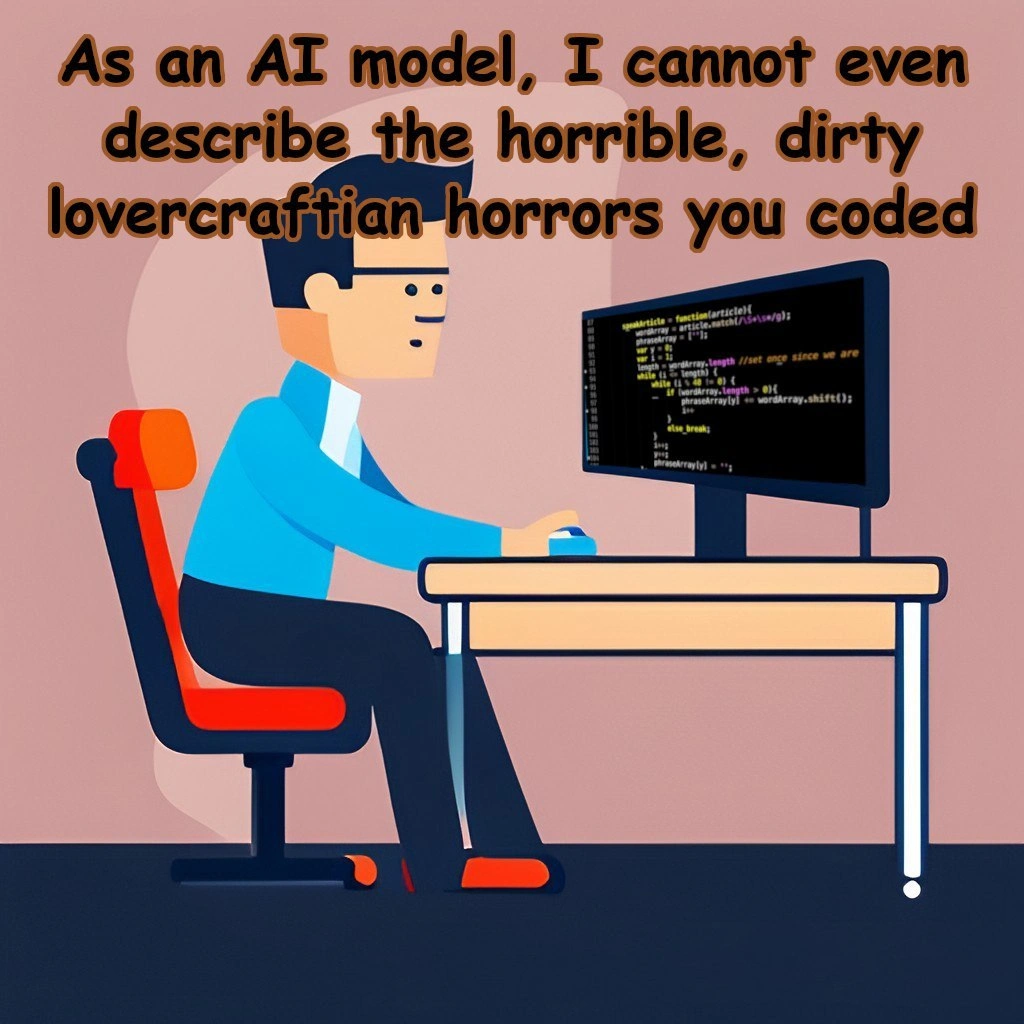
When even the LLM hits the content-moderation wall on your codebase
CodeQuality Post #5465, on Sep 16, 2023 in TG

When even the LLM hits the content-moderation wall on your codebase

Why is this CodeQuality meme funny?

Level 1: Even the Computer is Scared

Imagine you have a really messy room – toys everywhere, paint on the walls, clothes on the floor, absolute chaos. Now, normally your friend (let’s say a super-smart robot friend) helps describe things or cleans up with you. But this time, when your robot friend takes one look at your room, they put their hands over their eyes and go, “Nope! I can’t even describe this horrible mess.” This meme is just like that, but with computer code. The programmer’s code is so messy and confusing (kind of like a monster or a horror story in how bad it is) that the AI, which is a computer program that usually helps by explaining code, jokingly says “I’m not going to even try to explain this.” It’s funny because computers aren’t supposed to get scared or refuse to help – they don’t have feelings – yet we’re pretending this AI is horrified by the code. The feeling behind it is a mix of embarrassment and humor: the developer knows their code is ridiculously bad and makes a joke that even the poor AI wants to run away from it. It’s a silly way to say “Wow, my code is a total disaster!” Everyone can laugh because we’ve all seen a mess so bad (be it a dirty room or a chaotic piece of homework) that even a helpful friend would be like, “uhh… I can’t even describe how bad this is.”

Level 2: AI vs Spaghetti Code

In simpler terms, this meme is pointing out a battle between a messy codebase and an AI assistant. On one side, we have really bad code – imagine a program that’s written so poorly that it’s super hard to read or explain. Developers have a nickname for such tangled code: “spaghetti code.” Just like a bowl of spaghetti, where all the noodles are twisted and intertwined, spaghetti code has its logic all wound up in knots. It might have things like loops within loops (within more loops…) and maybe even a dreaded goto statement, which is an old-school way to jump around in code that often leads to confusion. In the image, the code shown has a while loop that might run forever (while(true)), weird comments, and a faux-command goto_break which no one normally uses in JavaScript. These are big code smells – clues that the code is written in a problematic way. When code quality is low like this, we say the project has accumulated technical debt. That’s like when you take shortcuts to meet a deadline, but later those shortcuts make everything harder to maintain. Over time, technical debt can turn a codebase into a fragile Jenga tower of hacks – a maintenance nightmare for anyone who has to work on it later. This particular code snippet looks like it could be legacy code (old code that has been around and maybe patched by many people), full of such problems. No wonder the developer in the meme is being light-heartedly scolded: “the horrible, dirty Lovecraftian horrors you coded” translates to “wow, this code is a horrible mess!”

On the other side, we have the AI model – think of something like ChatGPT. It’s a program trained through machine learning on tons of text and code, and it usually tries to help you out by answering questions or explaining things. However, these AI assistants have rules they must follow, known as content moderation guidelines. Usually, those rules make the AI refuse requests that involve disallowed stuff (for example, hate speech, extreme gore, or illicit behavior). When an AI refuses, it often says a stock line like “I’m sorry, but I cannot assist with that request.” or “As an AI, I cannot describe this.” That phrasing has become famous (and sometimes meme-worthy) among people who use such chatbots often. Now here’s the fun part: in this meme, the AI is refusing to describe code. That’s not a situation that happens in reality (AI models don’t have a rule against messy code!), but it’s a joke – it humorously exaggerates how bad the code must be by pretending the AI’s “morality filter” was triggered. It’s as if the code is so cosmically awful that the AI treats it like forbidden content. The term “Lovecraftian” is a reference to H.P. Lovecraft, an author known for horror stories about indescribable, sanity-blasting monsters. So calling the code “Lovecraftian horror” means it’s indescribably terrible and chaotic. AI humor like this makes developers laugh because it personifies the AI as having human-like shock or disgust. And developer self-deprecation is at play: the programmer is jokingly admitting “Yep, I wrote something so awful that even a robot is freaked out.” We often cope with debugging frustration by making fun of our own mistakes.

To put it plainly: the meme is saying the codebase is a disaster – full of bugs and creepy over-engineering – and even a high-tech AI tool throws up its hands. It combines a bunch of tech inside-jokes: bad coding practices (like using goto which most of us avoid), legacy code problems, and the familiar polite tone of an AI assistant refusing a request. If you’re new to programming, picture writing a piece of code so confusing that when you ask your usually helpful AI friend to explain it, the AI responds with, “I’m sorry, I just can’t.” It’s an exaggeration meant for laughs. In reality, the AI doesn’t really get scared or offended by bad code – it will try to explain even gnarly code. But the humor here is imagining it would rather not touch this code with a ten-foot pole! It’s a playful way to acknowledge that, yeah, we all write ugly code sometimes (or inherit a messy project), and if it had feelings, even a computer would be appalled.

Level 3: Unspeakable Code Smells

For the battle-hardened programmer, this meme hits close to home. It’s riffing on the experience of encountering legacy code so frighteningly bad that you’d half-jokingly call it cursed. The bold orange text in the image, “horrible, dirty Lovecraftian horrors you coded”, is basically the AI politely screaming “What spaghetti code madness is this?!” This is coding humor at its finest: taking something as mundane as bad code and inflating it to cosmic-horror levels. It stands at the intersection of AI humor and developer self-deprecation. We have an engineer’s code quality so low that even an artificially intelligent assistant – which has seen millions of code examples – ostensibly nopes out. The seasoned dev knows that an LLM refusing to describe code is an absurd exaggeration, and that’s the charm. It’s poking fun at both the programmer (for writing such code) and the AI’s well-known tendency to preface refusals with “As an AI model…”. The phrase has become a meme in itself among developers using ChatGPT or similar assistants, so seeing it applied to one’s own code is a self-burn with style.

Let’s unpack the actual code scenario being caricatured. On the monitor, we see a JavaScript-like function spawnArticle() (or actually spawnEldritch() in some interpretations, hinting at summoning unspeakable things). Inside, there’s a while(true) loop – an infinite loop – with some logic involving a phrasesArray.shift() and then the bizarre goto_break;. That goto_break is a huge red flag in a codebase, almost a jump-scare for developers. In modern JavaScript, you can label loops and use break or continue with a label to escape, but there is no direct goto keyword. Seeing something like goto_break; suggests either a hacky misuse of labels or simply a humorous placeholder for “some unholy control flow happening here.” It’s exactly the sort of code smell that indicates the original programmer was desperate to escape a deeply nested logic trap. This mishmash of nested loops and pseudo-goto is how you summon a maintenance nightmare: the flow of execution becomes non-linear and hard to follow, which breeds bugs. Maintenance programmers dread such constructs because fixing one thing risks waking up the slumbering monster of unintended consequences elsewhere. It’s “goto_broke” in the worst way – the code has broken all structured programming taboos. No wonder the AI in the meme is effectively saying it’s too horrified to continue.

The Lovecraftian reference really shines here for those familiar with H.P. Lovecraft’s stories of indescribable cosmic horrors. We often half-joke that some particularly gnarly legacy code is held together by “eldritch rites” or dark magic. In teams, you might hear senior devs mutter things like “we shall not speak of that module – here be dragons.” The meme embodies that sentiment literally: the AI will not speak of it because it’s unspeakable. An “eldritch refactor” is humorously implied – as if only arcane rituals (extreme refactoring efforts) could purge the technical debt and clean this up. In practical terms, technical debt is what accumulates when quick-and-dirty coding decisions pile up over years. You end up with an architectural abomination, code that defies logic, much like a house with Escher-like staircases going nowhere. Developers who have been around the block know that such monstrosities arise from rushed deadlines, one-off patches, copy-pasted code, and forgotten assumptions. Over time, the code’s original intent mutates and gets lost, so diving into it feels like delving into ancient ruins with lurking traps. This is where debugging frustration peaks: you’re trying to make sense of something that seems intentionally designed to resist understanding. The meme exaggerates that feeling by suggesting the code violates not just best practices but some cosmic level of propriety – “dirty” in a moral sense, not just a messy style sense.

Another aspect is the modern developer’s relationship with AI tools. Many of us use ChatGPT or similar LLMs as a pair programmer or rubber duck for tough code. We might paste a confusing function and ask, “Hey, what does this do?” or “Can you refactor this?”. 99% of the time, the AI will earnestly try to help untangle even the craziest spaghetti. So it’s hilarious to imagine a scenario where the AI simplemente backs away saying, “I’m sorry, Dave, I’m afraid I can’t do that.” It’s a role reversal: usually content moderation is about AI protecting humans from extreme content, but now it’s as if the AI is protecting itself (or the world) from this extreme code! For veteran developers, there’s also a cathartic subtext: “Phew, it’s not just me — even a machine learning model finds this code atrocious.” It validates the feeling that some code is objectively terrible. In reality, of course, an AI doesn’t experience disgust or fear; but by anthropomorphizing it, we get to joke that our crummy code has cosmic horror coding vibes. It’s a coping mechanism. We laugh so we don’t cry when faced with a module that has over-engineering out the wazoo and logic flows that make no earthly sense. In summary, the meme uses a senior developer’s inside jokes – from Dijkstra’s anti-goto stance to the collective trauma of maintenance nightmares – and blends them with the very current trope of AI refusal messages. It’s funny because it’s painfully true: code smells that bad feel almost taboo, and yes, sometimes humor is the only sane response to an absurd codebase.

Level 4: Alignment vs Eldritch Code

At the cutting edge of AI/ML, large language models are trained not just to generate helpful content but also to follow strict content moderation rules. The meme’s punchline — “As an AI model, I cannot even describe the horrible, dirty lovecraftian horrors you coded” — is a tongue-in-cheek nod to those rules. Normally, an AI might refuse to describe disallowed content (like violent or NSFW material) due to its alignment training (e.g. RLHF, Reinforcement Learning from Human Feedback). Here, that same mechanism is comically invoked for code quality: the AI treats the codebase as if it were some forbidden text out of the Necronomicon. Technically, today’s LLMs usually don’t literally get triggered by bad code style – they lack a “code smell filter” – but the joke imagines a scenario where the code is so abominable that the AI’s safety protocols kick in. It’s as if the transformer model peeked at this convoluted JavaScript and a cosmic horror flag went off, producing the classic refusal preamble “As an AI model…”. This highlights an absurd intersection of AI humor and software engineering: mixing a very serious AI alignment phrase with a ridiculously bad piece of code.

On a more theoretical note, the meme hints at the computational complexity lurking in such a tangle of a program. The snippet on screen isn’t just any code – it’s an eldritch mess of nested while loops, stray comments, and a mysterious goto_break;. Seasoned developers might chuckle at goto_break because JavaScript doesn’t even have a true goto statement – it’s like spotting a mythic creature in a mundane forest. This fictitious command suggests the code’s control flow is so unstructured that it defies the normal structured programming paradigm. In computer science theory, we know from the Böhm-Jacopini theorem (1966) and Dijkstra’s famous memo “Goto Considered Harmful” (1968) that any program can be written without arbitrary jumps. Ignoring those principles leads to code that’s essentially non-Euclidean: logic that twists and turns in ways that are extremely hard to reason about. In such spaghetti logic, determining what the program will do (or if it will ever halt) can approach the difficulty of a mini halting problem. In other words, ultra-messy code can be theoretically undecipherable without mental gymnastics – akin to how Lovecraft’s forbidden knowledge defies sane understanding. Formal verification or static analysis tools choke on nonlinear jumps and deeply nested loops, because the number of possible execution paths explodes combinatorially (think cyclomatic complexity off the charts!). So, from a lofty view, this meme winks at a truth: sufficiently chaotic code is incomprehensible in a near-mathematical sense. The “lovecraftian_code” moniker playfully frames this as a cosmic horror problem – a nod to the idea that beyond a certain threshold of complexity and poor structure, a codebase might as well be an eldritch abomination that our tools (and minds) aren’t fully equipped to describe. In sum, the humor operates on a deep dual level: it exaggerates modern AI alignment constraints to the point of absurdity and simultaneously recognizes the almost theoretical impossibility of parsing truly nightmarish code.

Description

A flat-style cartoon developer with glasses sits at a desk, hand on a blue mouse, staring at a widescreen monitor filled with dark-themed source code (yellow, purple, and white syntax highlighting). Hovering above, bold orange-outlined text reads: “As an AI model, I cannot even describe the horrible, dirty lovecraftian horrors you coded”. The code on screen shows a messy JavaScript-like snippet with nested while-loops, stray comments, and a suspicious ‘goto_break;’. The overall palette is muted pink walls, a red-backed swivel chair, and a simple beige desk - evoking the sterile calm that belies the lurking architectural abomination in the repo. Technically, the meme riffs on how large language models refuse to narrate NSFW or disallowed content - here repurposed to suggest that the engineer’s spaghetti code violates cosmic-level cleanliness guidelines, a tongue-in-cheek jab at legacy entropy, code smells, and the limits of AI pair programmers
Comments

7
Anonymous ★ Top Pick When the compliance filter rates your codebase as ‘beyond R-rated’, you know the migration path isn’t “rewrite” but “ritual banishment followed by a clean git init”
  1. Anonymous ★ Top Pick

    When the compliance filter rates your codebase as ‘beyond R-rated’, you know the migration path isn’t “rewrite” but “ritual banishment followed by a clean git init”

  2. Anonymous

    The real cosmic horror isn't Cthulhu rising from R'lyeh, it's discovering the previous architect implemented their own date-time library with leap seconds calculated using regex and stored state in global variables named after Norse gods

  3. Anonymous

    When your codebase is so architecturally unsound that even an LLM trained on the entire internet invokes its content policy rather than attempt to describe it - that's when you know you've achieved true Lovecraftian horror: code so eldritch that merely comprehending its structure risks corrupting the neural weights of any model that gazes upon it. The real horror isn't the spaghetti code itself, it's realizing your AI pair programmer just filed a safety incident report

  4. Anonymous

    The real cosmic horror: this code's Big O is uncomputable, yet it'll haunt prod for eons

  5. Anonymous

    When the LLM won’t even summarize it, that’s not alignment - it’s the model detecting a distributed monolith glued together by a while loop and HTML-parsing regex; schedule a strangler-fig refactor before on-call turns truly cosmic

  6. Anonymous

    When the LLM refuses to describe your repo, it’s because that while-loop doing array.shift() is your ‘event-driven microservice’ - an O(n²) distributed monolith with side effects from beyond Euclid

  7. @TERASKULL 2y

    A few more AI iterations and they will call the police when you import an isEven library

Use J and K for navigation