When All Unit Tests Pass But The System Is Broken
Why is this Testing meme funny?
Level 1: Mixed-Up Puzzle
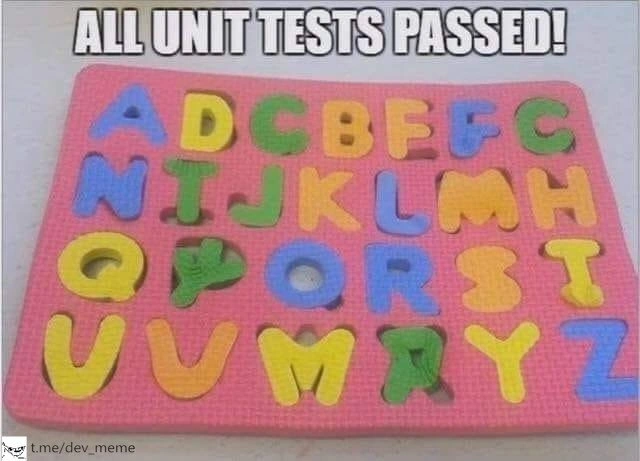
Imagine you’re doing a jigsaw puzzle, and you manage to force every single piece into the board somehow, even if it’s in the wrong spot. In the end, you excitedly say, “Look, I finished it, no pieces are left out!” But when you step back, the picture on the puzzle is all wrong and totally scrambled. That’s exactly what’s happening in this meme. Each puzzle piece (or letter) was put somewhere, so it seems “finished,” just like a computer program where every small test passed. But the pieces aren’t in the right places, so the final result is silly and messed up. It’s funny (and a little like “uh-oh!”) because it shows someone proudly thinking they did a great job, when anyone can see the puzzle – or project – is put together wrong. It’s like wearing your shoes on the opposite feet: yeah, you have shoes on (job technically done), but it’s clearly not how it’s supposed to be!
Level 2: Some Assembly Required
Let’s break down why this meme hits home for developers, especially those newer to Testing and code integration:
Unit tests: These are small, focused tests that check individual pieces of code (functions or classes) in isolation. Think of testing each letter block by itself: does letter A fit into a hole at all? Does the letter B piece physically fit into a slot on the board? A unit test might answer yes and pass, even if A isn’t in the A-shaped hole. In coding, a unit test could be like calling
addLetterToBoard(A, slot_D)and just asserting that now the board “has an A”. The test passes because A is indeed on the board, but notice it never checked which slot A went into. This is analogous to writing a test that doesn’t fully check the outcome’s correctness – it only checks something happened, not that the right thing happened.Integration tests: These tests check how multiple pieces of the system work together – essentially verifying the whole puzzle is assembled correctly. An integration test for the puzzle would check that A goes in A’s spot, B goes in B’s spot, and so on, spelling the alphabet in order. In software, this might mean running the actual application or significant parts of it to ensure different modules communicate correctly. For example, you’d test that the output of function X properly becomes the input of function Y. If our code was a login system, a unit test might verify “hashPassword() returns a hash,” whereas an integration test would ensure that creating a user, storing their password hash, and then verifying login all work in sequence with real components. Without integration tests, it’s like we never checked the letters in context – maybe our
hashPasswordworks alone and ourverifyPasswordworks alone, but if one expects uppercase and the other outputs lowercase, they’ll never match when combined! The meme’s humor comes from exactly this gap: we only did the first part (unit tests) and skipped making sure the whole thing works together.False sense of security: When all your unit tests are green (passing), it’s easy to feel confident. You might even brag about 100% test coverage. Coverage is a measure of how many lines of code or scenarios your tests execute. It’s a decent yardstick for effort, but it doesn’t guarantee those tests are meaningful. It’s possible to write many shallow tests – tests that execute code without asserting the important outputs. For example, I could reach 100% coverage on the puzzle by writing a test that puts every letter into some slot (hitting all code paths) and simply asserts “no errors occurred.” That would leave us with every letter placed (coverage complete) but no check that A is in A, B in B, etc. The system could be totally broken (the puzzle solved wrong), yet our test suite would still be all green. Many beginners (and even teams) fall into this trap: “Our tests passed, so the code must be perfect!” – not realizing the tests might be missing critical assertions about correct behavior. This is the meme’s sly lesson about CodeQuality: good tests don’t just execute code; they verify the code did the right thing.
Bugs and broken systems: A bug is any error or flaw in the software that causes it to produce an incorrect or unintended result. In our puzzle analogy, a “bug” is basically each letter being in the wrong place – it’s clearly not the intended result (the alphabet order is wrong). All unit tests passing means we didn’t catch those bugs with our tests. This often happens in real projects when each developer writes tests for their component but nobody tests the components working together. It’s like each person checked their letter and slot, but nobody checked the whole alphabet sequence. The outcome can be comically disastrous: the program might run without crashing (all pieces fit on the board), yet it produces nonsense (the assembled output is wrong). This meme is extremely relatable humor for developers because we’ve all had that confusing moment: “How is it broken? We ran all the tests!” The image with the puzzle makes it obvious – the tests were not checking the right thing.
In short: The meme uses the alphabet puzzle with letters in wrong slots to illustrate a software testing cautionary tale. UnitTesting alone only validates parts of a system in isolation. Without the “assembly” step of checking the integrated system, you can end up with perfect individual pieces that form a very imperfect whole. The top text “ALL UNIT TESTS PASSED!” is funny because it’s undeniably true in the scenario – and yet any observer can see the end result is objectively incorrect. It’s a reminder that in software, as in puzzles, just passing the basic checks isn’t enough to guarantee the final picture is correct. For junior devs, it underlines the importance of writing good tests (that actually verify correctness, not just execution) and adding higher-level tests that catch how components work together. It’s one of those DeveloperHumor moments that also teaches a lesson: when it comes to Testing and CodeQuality, some assembly is required to ensure all the pieces actually fit where they’re supposed to.
Level 3: Green Tests, Red Flags
All unit tests passed with flying colors, yet the system is completely haywire – every senior developer has seen this movie before. The meme’s foam alphabet puzzle is a spot-on toy-block analogy for a software project where each component was tested in isolation and shallow test coverage gave a false sense of security. In the image, every letter block is crammed into a slot (bright pink puzzle board with letters A, D, C, B, etc. all misplaced), and the top text shouts “ALL UNIT TESTS PASSED!”. This juxtaposition is TestingHumor capturing an painful reality: just because each piece individually “fits” somewhere doesn’t mean the whole system is correct. It’s a visual metaphor for a system where all the micro-checks are green, but the integration is utterly broken.
In real projects, UnitTesting means checking each module or function on its own, often using simplified conditions or mocked data. You might have a test confirming that the function for placing letter A doesn’t crash and that letter A ends up on the board. Great – assert true passes, green light! But did the test verify that A went into the correct A-slot? Probably not. This is the classic integration testing gap. Each letter (or module) passed its tests by fitting into a slot, but no test ensured it was the right slot relative to the others. It’s as if our code modules were alphabet pieces we never bothered to assemble in correct order during tests. We essentially proved that “every piece can go somewhere” while failing to check if the overall puzzle (the system) makes any sense. The result? SoftwareBugs that are hilarious in retrospect (like this jumbled alphabet) but nasty in production.
The humor here lands because it’s painfully relatable. Many of us have triumphantly announced, “All tests are green!”, treating it as a badge of CodeQuality, only to discover an epic failure when the application runs end-to-end. It’s DeveloperHumor anchored in truth: a suite of perfectly passing unit tests can disguise a broken system architecture. The code might have 100% coverage, but if those tests don’t assert meaningful behavior, you’re just covering nonsense with a veneer of success. In other words, 100% coverage of the wrong behavior is still 100% wrong. Seasoned engineers have learned (often the hard way at 3 AM) that a green build can be a red flag if testing stops at the unit level. You need integration tests, system tests – the whole alphabet in order – to avoid this false sense of security. The meme exaggerates it to comic effect: seeing the letters A, B, C... all out of place yet hearing “All tests passed!” is absurd. But that absurdity is exactly what makes it funny — and a bit sobering. It’s poking fun at our tendency to celebrate passing tests without asking “Did we test the right things?”.
This image is a critique of shallow CodeQuality metrics. High test pass rates and even 100% code coverage can become vanity metrics if we aren’t careful. It’s lampooning the scenario where a team focuses on unit tests (often the easiest to write and automate) but neglects integration testing and end-to-end validation. The result is a system that technically meets the “definition of done” on paper – all checks green – yet fails to meet real-world requirements. In a way, the puzzle’s letters are all present and accounted for (no missing pieces, analogous to full test coverage), but their incorrect positions render the final result meaningless. This is a jab at the “checkbox-driven development” mentality: just because you checked off the “write tests” box doesn’t mean the software actually works as intended.
Ultimately, the meme is calling out a common developer blind spot with a bit of dark humor. It reminds experienced devs of past deployments gone wrong and warns newer devs that quality assurance is more than just a bunch of unit tests turning green. It underscores the importance of testing the system as a whole. After all, an application isn’t a collection of independent letters; it’s an alphabet that needs to be in the right order to make sense. The image of the scrambled puzzle is hilariously exaggerated, but it perfectly captures that “Oh no…” moment when you realize your beautiful test report didn’t actually guarantee a working program. This mix of relatablehumor and a real lesson in Testing is why seasoned programmers smirk (or groan) at this meme – we’ve all been that person gleefully saying “It all passed!” while the app was quietly disintegrating.
Description
The image displays a children's foam alphabet puzzle. The puzzle consists of a pink rectangular foam board with cutouts for each letter of the alphabet. Colorful foam letters are placed into these slots. However, the letters are almost all in the wrong places - for example, the 'D' is in the 'B' slot, 'C' is in the 'E' slot, and so on, creating a jumbled, incorrect alphabet. Despite every slot being filled, the sequence is completely wrong. Across the top of the image, a caption in large, white, sans-serif letters reads, 'ALL UNIT TESTS PASSED!'. The meme serves as a powerful metaphor for a common software development pitfall. It humorously illustrates a situation where individual unit tests for each component of a system pass (each letter fits in *a* slot), but the integration of these components is a failure (the alphabet is not in order). For senior engineers, this is a relatable critique of relying solely on unit test coverage as a metric for quality, highlighting the crucial need for integration and end-to-end testing to ensure the system works as a whole
Comments
7Comment deleted
This is a classic case of 100% test coverage and 0% functional correctness. We successfully proved that every piece fits somewhere, just not where it's supposed to
Our 100% coverage proved each LetterService returned the right char under mocks - then staging revealed we’d accidentally shipped a distributed ROT13
After 15 years of writing tests, I've learned that 100% code coverage is like having all the puzzle pieces - it doesn't mean much when your junior dev puts them together upside down and your PM says 'ship it, the metrics are green!'
This perfectly captures the senior engineer's nightmare: 100% unit test coverage, all green checkmarks in CI/CD, yet production is an alphabet soup of chaos. It's the testing equivalent of having perfect type safety but forgetting to validate your business logic - technically correct is the worst kind of correct when your integration tests are non-existent and your E2E suite is 'we'll add that next sprint.' Remember: passing unit tests just means your mocks are well-behaved; it says nothing about whether your actual system can spell 'production-ready.'
Unit tests green: every peg fits its hole. Integration tests red: it's not even spelling 'API'
All unit tests passed - we tested fit(), not semantics; nobody wrote a property test that letters map one-to-one to slots
Green pipeline achieved by asserting insert(piece) doesn’t throw with everything mocked - 100% coverage, 0% domain invariants