Skip to content
DevMeme
1762 of 7435
The AI Paradox: Driving Cars vs. Clicking Images
AI ML Post #1969, on Aug 26, 2020 in TG

The AI Paradox: Driving Cars vs. Clicking Images

Why is this AI ML meme funny?

Level 1: Robot or Not

Imagine you have a super smart robot friend that can drive a car all by itself. Pretty cool, right? It can zoom down the street, stop at a red stop sign, turn at the right places – all without you touching the wheel. Now, picture this: you go on the computer to play a game or log into a site, and the website doesn’t believe you’re a real person. To check that you’re not a sneaky robot, it gives you a little quiz: it shows you a bunch of pictures and says “Hey, point out all the stop signs!” You have to click on the photos that have stop signs in them.

That situation is funny because it feels upside-down. We have robots smart enough to drive cars, but we still ask people to prove they’re people by doing something as simple as recognizing a street sign in a picture. It’s like if there was a robot that could bake an entire cake on its own, but a chef still had to prove they’re human by pointing at a picture of an egg. Silly, right? The meme is joking about how strange it is that both things are true: amazing Artificial Intelligence exists (cars driving themselves!), yet we rely on a very basic picture test to tell a human from a computer online. It makes us laugh because it shows technology can be both really smart and really dumb at the same time. In other words, the world has high-tech robots, but sometimes we still need low-tech tricks to sort out who’s a robot and who’s not – and that funny contrast is exactly why this meme makes people smile.

Level 2: Stop Sign Quiz

Let’s break down the two things being compared in this meme. First, self-driving cars: these are cars that drive themselves using advanced software, sensors, and machine learning algorithms. Companies have actually built cars that can do things like stay in lanes, adapt to traffic, recognize when a stop sign is in front of them, and then hit the brakes. They use cameras (among other sensors) to literally see the road and its signs, kind of like how you use your eyes. The car’s computer has been trained on millions of images (and other sensor data) to know, “Hey, that red octagon shape is a STOP sign, I should stop the car here.” This technology is a huge achievement in AI and engineering – it’s not science fiction; these cars exist on the road today in testing and even limited public use.

Now, on the other hand, we have CAPTCHAs. A CAPTCHA is that little test that often pops up on websites, usually when you’re logging in or signing up for something, that basically asks you to prove you’re a human and not an automated program (a bot). One very common type of CAPTCHA, especially in recent years (think of Google’s reCAPTCHA), is the image grid: you’re shown, say, 9 or 16 squares of photos and asked to click all the ones that contain a certain object – for example, “Select all squares that have a stop sign.” If you’ve ever had to click on all the pictures with traffic lights, or buses, or crosswalks, that’s exactly it. The idea is that most humans can recognize these everyday objects in pictures without too much trouble, but a lot of bots (which are just programs) would struggle with it unless they have some sophisticated image recognition capabilities. It’s a simple form of a test that uses our natural human vision skills as proof of our identity. Essentially, the website is saying: “I’ll trust you’re not a malicious automated software if you can do this visual task that, at the moment, humans are better at than computers.” It’s a basic question of Authentication on the web – confirming you are who (or what) you say you are, in this case a person and not a script.

So why is the meme funny? It points out that these two realities exist at once:

  • We have super advanced programs and AI that let computers drive cars and thus identify things like stop signs in the real world at highway speeds.
  • Yet the best way we’ve come up with to check on a website if you are a real person and not a computer is to… identify a stop sign in a picture.

It feels like a weird mismatch, right? If computers can do the hard thing (driving a car is really hard!), why are we still relying on people to do this seemingly easy thing (picking out a stop sign in a static image) to prove they’re not a computer? The key is that not all computers are equal here. The software driving a car is a very specialized, powerful AI that’s been trained extensively for that purpose. Your average spam bot or script that a hacker might write to crawl a website is not so advanced – it usually can’t just look at a random photo and know what’s in it. So CAPTCHAs take advantage of that gap. They’re essentially a security filter.

Another ironic twist: when we humans do these CAPTCHA image tasks, we’re actually helping improve AI. For example, Google’s reCAPTCHA system takes those clicks (which images we identified as stop signs, or crosswalks, etc.) and uses them as valuable data to train their image recognition algorithms (which could include things for self-driving car vision or Google Maps). In other words, by proving we’re human, we’re also teaching the machines in the background. It’s a bit of a running joke in the tech world that while you’re trying to convince Google you’re not a robot, you’re simultaneously helping Google’s robots (AI) get smarter at seeing the world. So the meme is highlighting this funny loop and the disparity in AI capabilities: some AIs can do amazingly complex tasks, yet we still find ourselves doing simple tasks to cover for where many AIs fall short. It’s a captcha_irony that makes you stop and chuckle.

Level 3: CAPTCH-22 Situation

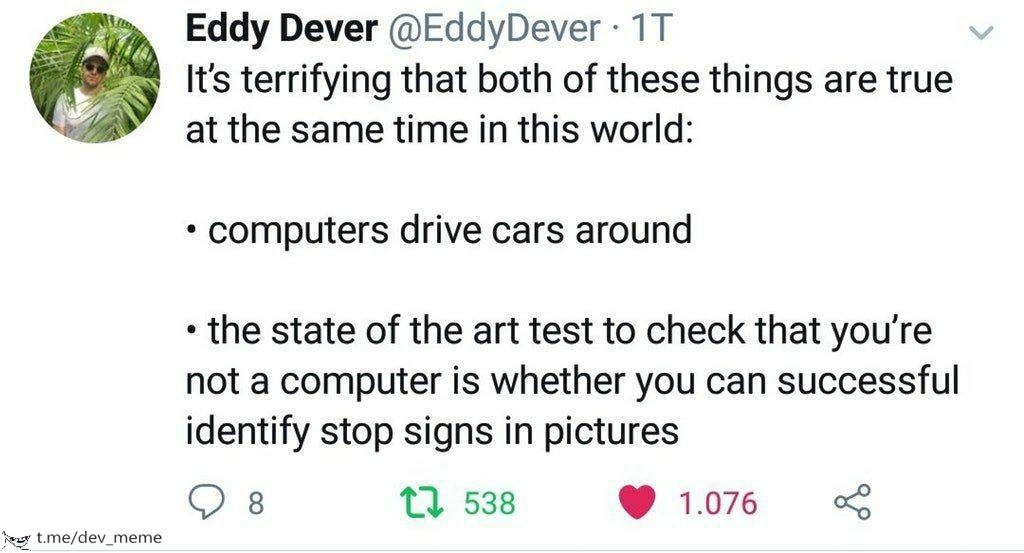
The humor here comes from an AI hype vs. reality clash that every seasoned developer can appreciate. On one hand, we live in a world where computers drive cars around reliably on public roads. That’s pretty sci-fi – think of systems like Tesla’s Autopilot or Waymo’s self-driving cars, packed with state-of-the-art sensors and machine learning models making split-second decisions. On the other hand, we’ve all been stopped in our tracks by a simple website security check: “Select all images containing a stop sign.” It’s such a mundane puzzle, almost childlike, yet it’s officially the “state of the art” way to prove you’re not a malicious bot. The tweet in the meme highlights this absurd contrast in bullet-point form, and it strikes a chord because it’s so true. We routinely toggle between marveling at AI’s abilities and cursing at how that same realm of tech makes us tick a box saying “I am not a robot.”

From a senior dev perspective, it’s a wry commentary on how uneven technological progress can be. We have narrow AI that absolutely excels in a specialized domain (driving, in this case), while basic authentication on the web still depends on exploiting what current AI can’t easily do. It’s a classic HumanVsAI scenario. We’ve seen CAPTCHAs evolve over the years: first they were squiggly printed words (to stump early OCR), then came those grids of images we have today. Why images of street signs, of all things? Because those are the very tasks typical spam bots and web scrapers aren’t usually trained to solve. Your average email-spamming script isn’t running a full-blown image recognition deep network to bypass login forms – that would be overkill (and computationally expensive). Meanwhile, companies like Google are running massive image-recognition networks, and funnily enough the data from our CAPTCHA clicks helps train them. The situation is a bit ironic: the Security measure we use to keep bad bots out also doubles as crowdsourced labeling to improve AI. It’s the captcha_irony the meme points out: we test humans with tasks that help make machines smarter, because the machines aren’t quite smart enough yet.

Every experienced developer or tech enthusiast has likely experienced this paradox firsthand. You might be working on a cutting-edge MachineLearning project by day and boasting about the latest AI breakthroughs, then in the evening you’re furiously clicking on every image with a traffic light just to log into some account. It’s both comical and slightly frustrating. The meme’s author calls it “terrifying” in a tongue-in-cheek way. It’s not that we’re literally scared of CAPTCHAs, but there is a subtle unease knowing that these two realities coexist: advanced AI that can make life-or-death decisions in traffic, and the fact that the best way to distinguish a human from an AI online is a mini vision quiz a toddler could probably pass. It’s a gap in AI capabilities laid bare.

What really makes tech folks smirk here is that this juxtaposition exposes the AIHypeVsReality so perfectly. Self-driving cars have been hyped as an AI triumph (and they are!), yet truly reliable general-purpose vision – the kind you’d need to universally replace CAPTCHAs – is still not solved outside those specialized contexts. It’s a reminder that Artificial Intelligence is not one monolithic thing you either have or don’t; it’s a collection of skills. An AI can be brilliant at one very hard task (like driving via stop_sign_detection, lane finding, etc.) and clueless at another “easy” task (like recognizing a crosswalk in a weirdly cropped web image) if it hasn’t been trained for it. The meme’s dark humor also whispers an even deeper question to seasoned engineers: if we can’t make an AI that easily passes a simple human vision test in all cases, what does that say about AI judging or controlling safety-critical systems like cars? In practice, of course, the self-driving systems are extremely specialized and heavily tested for those specific recognition tasks, whereas CAPTCHAs are generalized and intentionally somewhat quirky or degraded images to trip up machines. Still, that cognitive dissonance — between what some AIs can do and what other AIs cannot — is what we’re laughing (and maybe shaking our heads) about.

In short, the meme lands so well in developer circles because it highlights an everyday annoyance (CAPTCHAs) with an absurd tech twist. It’s the quintessential AI humor: pointing out that for all the incredible MachineLearning feats out there, we’re still stuck with goofy little picture puzzles as our bulwark against bots. It’s both a reality check and a geeky joke. We’ve come so far, yet here we are — “Click all the stop signs”. You can practically hear a collective sigh and chuckle from programmers everywhere who deal with this contrast between high-tech dreams and low-tech solutions daily.

Level 4: Reverse Turing Test

At the cutting edge of AI/ML, we’ve essentially built vehicles that drive themselves through complex city streets, yet we still rely on a low-tech gatekeeper: the CAPTCHA. This contrast touches on fundamental concepts in computer science, like the Turing Test and its inversion. In a classic Turing Test, a human judge tries to determine if they’re talking to a machine or a person. A CAPTCHA (which tellingly stands for “Completely Automated Public Turing test to tell Computers and Humans Apart”) flips this around – now it’s a computer testing us with a problem that’s easy for people but (supposedly) hard for bots. It’s a brilliant if ironic piece of security design: leveraging tasks at the fuzzy boundary of AI capability as a form of authentication.

Why stop signs? Identifying a stop sign in a photo is a task rooted in image recognition – a subset of machine perception that was notoriously difficult for early AI. This difficulty is a textbook example of Moravec’s Paradox: things humans find trivial (like vision or recognizing everyday objects) have historically been incredibly hard for machines, while tasks we find hard (like crunching large numbers or playing perfect chess) turned out easier for computers. Self-driving cars became possible only after major breakthroughs in machine learning – particularly deep learning with convolutional neural networks – which gave computers something resembling visual perception. These vehicles use advanced models (processing camera feeds, LIDAR, radar, etc.) to detect and interpret road signs, pedestrians, and other vehicles in real time. In academic terms, their stop_sign_detection systems achieve super-human reaction times and pretty high accuracy under ideal conditions. Research papers on autonomous driving delve into sensor fusion and neural network architectures that allow a car’s computer to recognize a stop sign from various angles and lighting conditions – an ability that was science fiction not too long ago.

Yet, the CAPTCHA on a website isn’t dealing with a cutting-edge autonomous driving AI; it’s usually defending against everyday scripts and bots. There’s an almost Catch-22 (or rather CAPTCH-22) situation here: as soon as AI gets good at a task, that task is no longer a reliable human validator. Early CAPTCHAs showed warped text because reading distorted letters was easy for humans but hard for OCR algorithms. Once machine learning caught up and bots learned to read funky text, the tests evolved into things like identifying road signs or picking out cats and dogs in images. It’s an ongoing arms race in security: advances in machine learning force advances in CAPTCHA design. In fact, the very images of street signs and storefronts you click through in a reCAPTCHA are often harvested from real-world data (like Google Street View). By solving them, humans are not just proving they’re not bots – they’re also helping to label data that trains the next generation of AI vision models. Irony alert: we humans solve CAPTCHAs to show we’re human, and those answers feed the machines so they can become more human-like in their vision! This meme perfectly captures that AI_capabilities_gap: one computer system drives a car autonomously through a city, while another computer system can’t be sure it’s talking to a human unless that human successfully identifies a stop sign in a grainy photo. It’s a mind-bending reminder of both how far AI has come and how far it still has to go.

Description

This image is a screenshot of a tweet from user Eddy Dever (@EddyDever). The tweet presents a striking observation about the current state of artificial intelligence. It reads: 'It's terrifying that both of these things are true at the same time in this world: • computers drive cars around • the state of the art test to check that you're not a computer is whether you can successful identify stop signs in pictures'. The meme's power lies in this sharp, ironic contrast. On one hand, AI is sophisticated enough to handle the complex, life-critical task of autonomous driving, which involves advanced computer vision to identify road signs. On the other hand, the primary method for distinguishing humans from bots (CAPTCHA) relies on that very same, seemingly simple, image recognition task. For experienced engineers, this highlights the fascinating and often absurd paradoxes in AI development, the limitations of the Turing test in practice, and the ironic feedback loop where humans are used to train the very AIs that are supposedly less capable than them
Comments

7
Anonymous ★ Top Pick The ultimate Turing test will be when a self-driving car tries to log into a website and gets stuck on the 'select all images with traffic lights' CAPTCHA
  1. Anonymous ★ Top Pick

    The ultimate Turing test will be when a self-driving car tries to log into a website and gets stuck on the 'select all images with traffic lights' CAPTCHA

  2. Anonymous

    Our Level-5 autonomy stack can spot a stop sign at 90 mph, but the login microservice still pipes me through a 2006 PHP CAPTCHA asking which blurry tiles are… stop signs - proof that tech debt isn’t in the model, it’s in the org chart

  3. Anonymous

    We've trained neural networks on billions of stop signs to achieve 99.9% accuracy in autonomous driving, but we still use the same task to prove you're human because the 0.1% failure rate is what makes you authentic

  4. Anonymous

    We've reached peak AI absurdity: our production systems can navigate rush hour traffic at 70mph using convolutional neural networks trained on millions of images, but we still gatekeep our login forms by asking humans to prove they're not robots by... identifying the same stop signs those self-driving cars see perfectly. It's like requiring a pilot's license to prove you can't fly

  5. Anonymous

    Shipping a Level-4 autonomy stack that fuses lidar/radar at 60Hz, yet access to the design doc is gated by select_all_images_with_stop_sign() with worse human recall than our shadow model

  6. Anonymous

    Neural nets pilot Teslas through stop-signed chaos, yet reCAPTCHA's warped thumbnails gatekeep humanity - edge cases at scale

  7. Anonymous

    Only in our industry: a model does real‑time sensor fusion and MPC to drive a 2‑ton car, but SSO blocks me because I missed one pixel of a stop sign - AI safety and login separated only by an SLA and a lawyer

Use J and K for navigation