Unicode Standard, Vendor Attitude
Why is this UX UI meme funny?
Level 1: Same Word, Different Faces
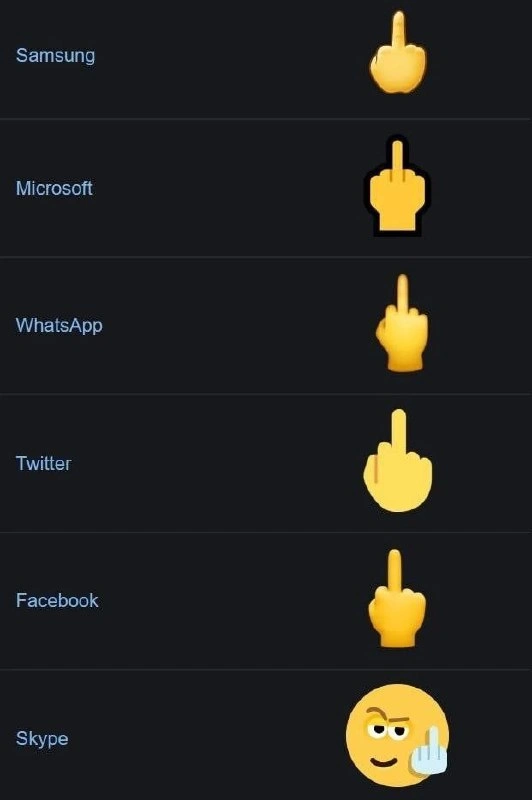
This is like six artists being asked to draw the same rude hand sign. They all understand the request, but each drawing feels a little different. Skype is the funniest because it adds a cheeky face, so it looks less like a symbol and more like someone enjoying the insult.
Level 2: Text Becomes Artwork
Unicode is a standard that lets computers represent text consistently. It covers letters, symbols, punctuation, and emoji. Without a shared standard, one system's character might become nonsense on another system. Unicode helps make sure the same underlying character can travel through messages, databases, files, and APIs.
An emoji is not just plain text in the visual sense. The computer stores a character or sequence of characters, but the screen shows a drawing from a font or emoji set. Different companies create their own emoji artwork to match their product style. That is why the image can show the same rude gesture in rows labeled Samsung, Microsoft, WhatsApp, Twitter, Facebook, and Skype, while each one looks different.
For developers, this matters when building anything users read or send to each other. A chat app, mobile app, web page, or notification system may show emoji differently depending on the operating system, browser, app version, and font support. You cannot assume that the visual result on your phone is exactly what another user sees.
The Skype version is funny because it adds a smirking face beside the hand. The others mostly say "gesture." Skype says "gesture, but with personality." That extra expression changes the tone from a simple symbol to a tiny act of mockery.
Level 3: One Code Point, Many Attitudes
The image lists Samsung, Microsoft, WhatsApp, Twitter, Facebook, and Skype, with each row showing a different rendering of the same middle-finger emoji. Most rows show a yellow hand with different proportions, outlines, shading, and pose. The Skype row goes further: a smirking yellow face holds up the gesture, turning the emoji from a symbol into a tiny character with intent. The post message says, "After years Skype is still the best one imho," and visually it is easy to see why: Skype did not merely render the insult; it gave the insult eyebrows.
The developer joke is that Unicode standardizes text identity, not emotional vibes. A Unicode character gives systems a shared way to represent "this is the middle-finger emoji" as text data. It does not force Samsung, Microsoft, WhatsApp, Twitter, Facebook, and Skype to draw the same hand in the same style. Each platform's emoji font or image asset applies its own design language, which is why one message can feel blunt, cartoonish, playful, aggressive, or weirdly smug depending on where it is displayed.
This is a compact lesson in cross-platform UI. Developers often think of text as stable because a string value looks deterministic in code. Then rendering enters the room carrying fonts, fallback rules, OS versions, emoji libraries, vendor assets, skin-tone modifiers, variation selectors, unsupported glyph boxes, and screenshots from users asking why production "changed the meaning" of a message. The data may be identical, but the presentation is not.
Emoji are especially dangerous because their job is semantic softness. They carry tone, sarcasm, anger, flirtation, irony, and social context. A small artwork difference can change how a user perceives a message. In this image, Microsoft's thick outlined hand feels more icon-like, Twitter's larger hand reads bolder, Facebook's narrow version feels more compact, and Skype's face adds personality. They are all recognizably the same gesture, but they do not produce the same social effect. Standards gave us interoperability; vendors supplied the attitude problem.
The systemic issue is that product teams often test whether text renders, not whether it renders with equivalent meaning across platforms. For chat apps, social feeds, moderation systems, customer support logs, and notifications, that distinction matters. If your product stores emoji as text but users consume them as artwork, then the UI layer is part of the meaning. Naturally, this gets discovered after someone sends the "same" emoji across three clients and starts a design review no one budgeted for.
Description
A dark comparison image lists platform names on the left: "Samsung," "Microsoft," "WhatsApp," "Twitter," "Facebook," and "Skype." Each row shows a different rendering of the same middle-finger emoji: most are yellow hands with varying shape, shading, and outline style, while Skype uses a smirking yellow face holding up the gesture. The meme highlights how a single Unicode character can have surprisingly different visual semantics depending on vendor artwork and app rendering. For developers, it is a compact reminder that standards define code points and intent, but cross-platform UI still depends on implementation-specific assets.
Comments
22Comment deleted
Unicode gave us one code point; product design gave it six different threat models.
Where is Telegram? Comment deleted
🖕 Comment deleted
What is Skype 😏 Comment deleted
baby don't hurt me Comment deleted
don't hurt me Comment deleted
no more Comment deleted
Durak online Comment deleted
i swear i had those somewhere Comment deleted
tysm Comment deleted
Skype is Microsoft Comment deleted
Skype was bought and killed by Microsoft Comment deleted
It was greatest and more decentralized than most of todays "decentralized" platforms Comment deleted
Basically SIP with STUN/TURN? The "one client" strategy was good for compatibility but also allowed for it to get destroyed so easily. Comment deleted
There was much more to it than just regular way of establishing connection Eg communications with all other available Skype clients within local network and in case one of them had access to the internet then other clients used that one with access basically as a proxy server for all kind of communications Comment deleted
Yeah, that's nice. Check out "Yggdrasil network" for that. Comment deleted
1) Size of the network 2) Year when it was done compared, because context is important Comment deleted
Oh sure. Just that if you wanted that today 1) it's out there and FOSS 2) any IPv6 capable app can run over it OOTB. Comment deleted
And keep in mind that we were no where from ssl becoming wide-spread or whatever but Skype had communications covered with proper encryption There was nothing really centralized besides login server Comment deleted
damn, there has to be a Skype sticker pack as well Comment deleted
:mooning: Comment deleted
Best Skype smile ever Comment deleted