Peak Air-Gapped Cybersecurity Leadership
Why is this Security meme funny?
Level 1: The Guard Who Never Saw a Door
This is like hiring someone to guard a building, then learning they have never used a door key and do not know what a key is. The joke is funny because the job title sounds very serious, but the person seems unfamiliar with the simplest tools involved. In cybersecurity, that gap feels scary as well as absurd.
Level 2: The USB Problem
Cybersecurity is the practice of protecting computers, networks, data, and systems from misuse, theft, disruption, and unauthorized access. It includes technical work like patching, monitoring, encryption, backups, access control, and incident response. It also includes policy: deciding what is allowed, who is responsible, and how risks are handled.
A USB drive is a small removable storage device. People use it to move files between machines. Security teams care about USB drives because they can carry malicious files, copy sensitive data, or connect systems that were meant to stay separate. In secure environments, USB usage is often restricted, logged, scanned, disabled, or controlled through approved devices.
The image is funny because the official's title and the missing basic knowledge clash. It is like hearing that a food safety inspector does not know what a refrigerator is. Maybe that person can still supervise experts in theory, but everyone immediately worries about the quality of the questions being asked.
For junior developers and early security learners, the lesson is that security is not only about fancy exploits. It also depends on everyday understanding. Passwords, USB drives, laptops, updates, admin permissions, backups, and phishing emails are basic, but basic things are where many real incidents begin.
Level 3: Governance Without Handles
Japan's Top Cybersecurity Official Has Never Used a Computer
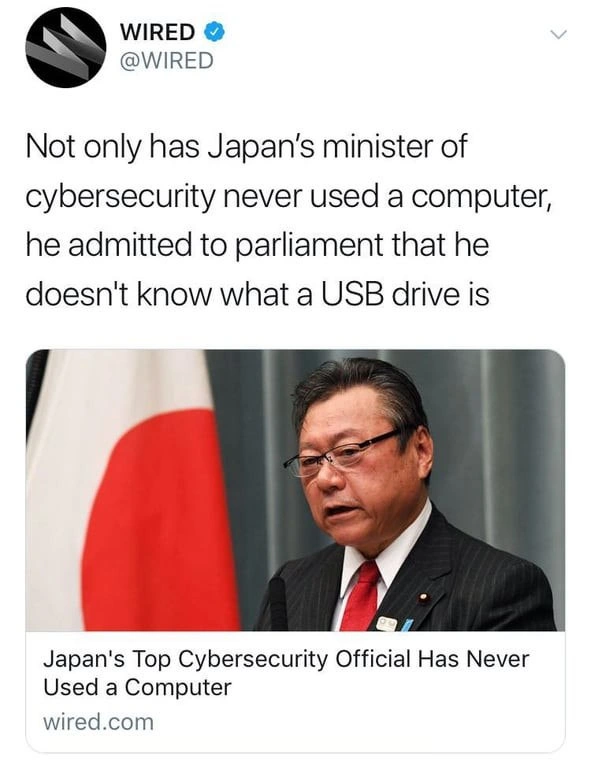
The screenshot shows a verified WIRED tweet and an article card with a Japanese official standing in front of a Japanese flag. The visible claim is that Japan's cybersecurity minister had "never used a computer" and did not know "what a USB drive is." The joke is brutally simple: the person associated with cybersecurity leadership appears unfamiliar with the basic objects cybersecurity is supposed to protect, govern, and regulate.
This is management-versus-engineering satire, but it is sharper than the usual "boss does not code" complaint. A cybersecurity leader does not need to personally write kernel mitigations, reverse malware, or configure every firewall rule. Strategic roles involve budgets, regulation, incident response coordination, national risk, procurement, staffing, and accountability. But basic operational literacy matters because security decisions are full of concrete trade-offs. If a leader cannot reason about computers or removable media at all, they are forced to manage abstractions they cannot interrogate.
The USB detail is what makes the meme especially painful. USB drives are not obscure specialist equipment; they are everyday removable storage devices, and they have a long security shadow. They can move data across air gaps, carry malware, bypass network controls, exfiltrate files, and introduce risk into sensitive environments. The question of whether critical facilities allow USB usage is not trivia. It touches endpoint policy, physical security, supply-chain risk, operator behavior, and the ancient enterprise ritual of finding a mystery thumb drive in a drawer and hoping nobody says "plug it in and see."
The post message calls this the "Strongest cybsec professinal," with the typo adding to the deliberately unserious tone. The meme's deeper target is security theater: organizations and governments often create roles, committees, policies, and titles that sound reassuring, while the actual competence, incentives, and technical feedback loops remain unclear. A title can say "cybersecurity," but systems are defended by people who understand threat models, failure modes, dependencies, and the messy human habits that turn policy into reality.
There is a fair nuance here: democratic governments often appoint generalists to technical portfolios, and a good leader can rely on expert advisors. The problem is not "non-engineers must never lead." The problem is leadership that cannot ask useful follow-up questions. Cybersecurity is adversarial. Vendors oversell, departments underreport, dashboards compress risk into comforting colors, and attackers exploit whatever nobody understood well enough to challenge. When the person at the top cannot distinguish a USB drive from a vague office object, the whole risk conversation starts with a missing vocabulary.
Description
A tweet screenshot from the verified WIRED account says, "Not only has Japan's minister of cybersecurity never used a computer, he admitted to parliament that he doesn't know what a USB drive is." The embedded article card shows a suited Japanese official in front of a Japanese flag and the headline "Japan's Top Cybersecurity Official Has Never Used a Computer," with "wired.com" underneath. The post jokes about the real 2018 story involving Yoshitaka Sakurada, whose lack of hands-on computer familiarity became a symbol of nontechnical oversight in technical policy roles. The technical relevance is the gap between cybersecurity governance titles and basic operational literacy, especially when even removable media risk is outside the official's vocabulary.
Comments
17Comment deleted
The safest USB policy is apparently appointing someone who treats USB like an unpublished RFC.
aha Comment deleted
best protection is not using it Comment deleted
You get it! Comment deleted
just like members of our "comitee of defining online criminal content" Comment deleted
security through obscurity Comment deleted
He is a minister, a very high level political person who can lead his ministry on general terms. His subordinates is who must know everything and have competence. That's all kind of stupid but ministers can change every 3-5 years, but most of the other stuff - stays and does the job Comment deleted
That's actually true. Minister is simply for signing bills, looking up major finances, etc Comment deleted
Actually… no Comment deleted
How's he gonna decide which project to support with govt money and which one is a scam by his subordinates? Comment deleted
Welcome to the desert of real 😁 Comment deleted
Looks like in those deserts, ministers better have at least some understanding of a field. Comment deleted
The good/bad news is that ALL politicans are like that. Comment deleted
“There is no truth” “Who did say that the Earth is not flat?!” And other bullshit Comment deleted
Very true, it's not that uncommon to find MBA managers who have no tech background even in big tech companies. Comment deleted
Parece no BR Comment deleted
Your computer won't get hacked if you do not have a computer. Comment deleted