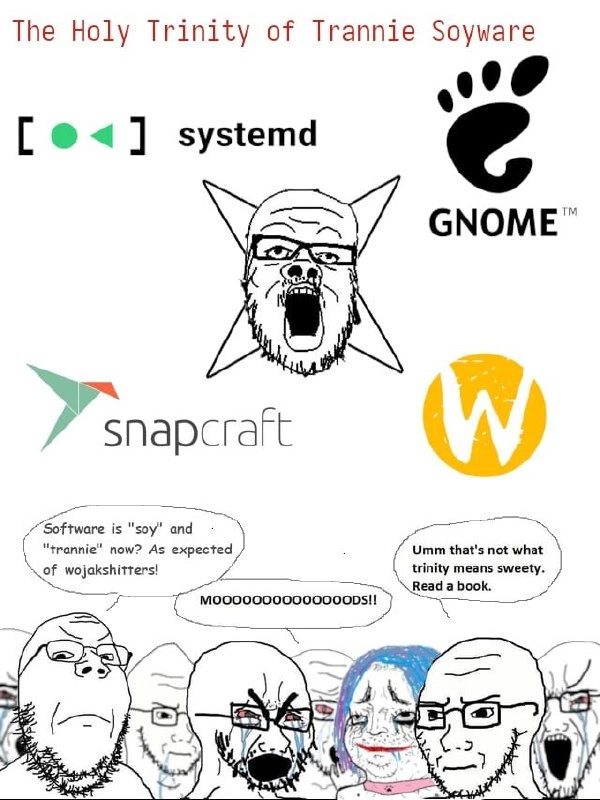
Edgy meme attacking Linux components with slurs and wojak outrage
Why is this OperatingSystems meme funny?
Level 1: Name-Calling on the Playground
Imagine a group of kids on a playground arguing over some new rules for their favorite game. The teacher introduced a new rule and a couple of new toys to make the game more modern and fair. Some of the kids are really upset about it because they liked the old way better. One angry kid starts yelling, calling the new toys stupid and saying only “losers” would use them. He’s basically using mean names instead of explaining why he hates the new stuff. This is like a kid version of what’s happening in the meme: instead of calmly saying “I don’t like these new Linux tools,” the person just hurls insults. Now, when that kid starts name-calling, the playground erupts. Other children jump in to respond: one kid gets upset and yells back at the bully, another runs off shouting “Teacher! Teacher!” to get the playground monitor, and a third kid just rolls their eyes and says “You don’t even know what you’re talking about – learn your words before you insult someone!” Pretty soon, nobody is even playing the game; they’re all arguing and calling names. It’s a big noisy mess. The meme is showing a scene just like this, but with software instead of toys, and developers instead of school kids. It’s humorous in a face-palm way because grown-ups in tech sometimes act just like kids on a playground – getting so worked up over changes or new “toys” that they start calling each other silly (or even nasty) names. The core joke is that a fight about something as nerdy as computer software can turn into a childish shouting match, complete with tattling to moderators and snarky comebacks, just like kids fighting over who gets to use the new swing.
Level 2: Linux Holy Wars 101
Let’s break down what’s going on in simpler terms. This meme is talking about Linux – an operating system – and some big parts of it that people argue about. The four logos shown (systemd, GNOME, Snapcraft, and Wayland) are all important technologies in modern Linux. The meme’s creator doesn’t like them and is using mean internet slang to insult them. To understand the joke, we need to know what each of these things is and why anyone would be mad about them:
| Technology | What is it? | Why it’s controversial |
|---|---|---|
| systemd Init system & service manager |
The program that boots up and manages all other background services on a Linux system (replacing the old simple scripts). | Some feel it’s too complex and controlling. Detractors say it breaks the traditional Unix way of keeping things small and modular. They blame it for being “bloat” and for making many programs depend on it. |
| GNOME Desktop environment (GUI) |
The graphical user interface for Linux (windows, icons, menus). GNOME is one of the most popular desktops that comes with distributions like Fedora and Ubuntu. | Critics find newer GNOME versions too restrictive or heavy. It removed customization options and needs decent hardware. Detractors claim it’s designed by big companies (like Red Hat) for casual users, not power users – which rubs some Linux veterans the wrong way. |
| Snapcraft (Snaps) Package management system |
A way to install apps on Linux, developed by Ubuntu’s company. Snaps bundle apps with their dependencies in one package (kind of like mini-containers). | Some Linux users dislike snaps because they can be slower to start and use more disk space. Also, Ubuntu made snap the default for some apps, which felt forced. People who prefer other packaging tools (like apt, Flatpak, or AppImage) see Snap as an unwanted Tooling change and worry it centralizes control to Ubuntu’s servers. |
| Wayland Display server protocol |
The system that displays graphics on your screen (windows, etc.). Wayland is the modern replacement for the old X11 display server. It handles how applications draw on the screen and communicate with the GPU. | Some users find Wayland unfinished for their needs. Not all apps worked perfectly with it initially (especially older or specialized programs). For example, remote desktop or screen-sharing was tricky at first. People who were used to the old X11 system (which had 30+ years of features) felt Wayland was dropping or delaying features they relied on. |
Now, why call these things “soyware” or use a slur? The term “soyware” is not a technical term at all – it’s an insult. It’s derived from the insult “soy boy,” which is internet slang used to mock men as being not masculine enough (based on a misguided idea that eating soy affects hormones). Basically, calling something or someone “soy” implies they’re weak, effeminate, or overly subservient. It’s a derogatory, arguably silly term that has nothing to do with technology. By labeling those Linux components “soyware,” the meme-maker implies that these tools (and perhaps the developers or users of them) are weak or inferior in some ideological way. It’s not a logical critique; it’s pure name-calling to convey “I hate this stuff and the culture around it.”
The word “trannie” in the title is a highly offensive slur for transgender people. It has absolutely no connection to software. Its use here is meant to shock and provoke – it drags a real-world marginalized group into a tech argument just as an insult. The person who made the meme is basically using the worst language they can to malign these Linux projects, suggesting maybe they think these projects are supported by people they politically or culturally dislike. This is a form of transphobic_meme trolling – bringing hate speech into a technical debate. In developer communities (which are part of society, after all), we sometimes see these broader culture-war conflicts spill over. It’s not that systemd or GNOME are inherently related to any gender issues, of course; it’s that the argument has turned ugly, using anything to discredit the other side, even irrelevant slurs.
So, the top part of the meme sets the stage by calling systemd, GNOME, Snap, and Wayland the “Holy Trinity” of bad software (in the meme maker’s view). By “Holy Trinity,” they mean these are the top three (or four, actually) offenders — like saying “these are the big ones” — though ironically they listed four items while saying trinity, which normally means three. This mathematical mistake becomes part of the joke later on. The red text and the starburst around the yelling face give it an over-the-top dramatic tone, like “These are the ultimate evils of Linux!” It’s purposely absurd and inflammatory.
Now look at the bottom third with all the drawn faces – those are Wojak characters. Wojak is a meme character: a simple outline of a bald-headed guy that people redraw to represent various personalities (there are many variants like “Angry Wojak,” “Crying Wojak,” “Soyjak” with a bearded excited face, etc.). In this image, each Wojak is acting like a different forum commenter reacting to the incendiary post above. It’s basically a cartoon of a comment thread blowing up. Let’s interpret what each of those speech bubbles means in a normal tone:
- “Software is ‘soy’ and ‘trannie’ now? As expected of wojakshitters!” – This is one commenter responding with disbelief and scorn. They’re saying, “Really? You’re calling software ‘soy’ and ‘trannie’ now? Figures, this is just what I’d expect from people who post Wojak memes.” The term “wojakshitter” is itself an insult aimed at the meme-maker, implying that anyone who uses Wojaks in this way is a low-quality contributor (posting “shit”). So this commenter is fighting fire with fire: calling out the original post as garbage and slamming the poster.
- “MOOOOOOOOOOOOOODS!!” – This is another commenter basically screaming for the moderators. In online forums or chat, yelling “Mods!” means “Moderators, please come do something about this!” The extended “O”s indicate a dramatic, drawn-out scream, as if the person is really upset. They find the original post so offensive (or so disruptive) that they want a higher authority to step in and remove it or discipline the poster. It’s depicted as a kind of over-the-top, perhaps hysterical reaction – in memes, people cry “MOOOOODS” to mock those who can’t handle free speech, but it’s also genuinely what people do when someone breaks the rules.
- “Umm that’s not what trinity means sweety. Read a book.” – This line is dripping with condescension. The commenter here is pointedly correcting the original poster’s misuse of trinity. They’re saying, “By the way, ‘trinity’ means three, not four, dear. Educate yourself.” Calling someone “sweety” (with that spelling and tone) is patronizing, implying the person is ignorant or child-like. “Read a book” is an idiom for “you’re uneducated.” This response doesn’t even engage with the content of the original insult – it sidesteps the hatefulness and just mocks the OP’s intelligence (or lack thereof) by highlighting a dumb mistake. It’s like ignoring a person’s screaming and just calmly pointing out they used the wrong word, which is a common way to deflate trolls.
Together, these reactions illustrate a common pattern in dev_community fights:
- Someone says something extreme or offensive about a technical topic (here, calling important Linux components nasty names).
- Others jump in to push back: some angrily insult the poster back, some call for rule enforcement, and some make snarky corrections to undermine the poster.
- The original technical topic often gets lost in the chaos, replaced by personal attacks and meta-arguments about behavior and language.
The meme is exaggerating reality, but if you’ve ever browsed a heated thread on, say, a Linux forum or a Reddit community like r/Linux or certain imageboards, you’ll recognize these roles. The init_system_debate and the desktop_environment_wars have indeed produced threads where one side calls systemd “cancer” or Snap “garbage,” and the other side replies with “stop spreading FUD” or “mods, please lock this thread,” etc. Here it’s just turned up to 11 with slurs and caricatures.
It’s also worth noting the edgy_meme_format choice: using Wojak comics is popular in certain internet circles that enjoy dark, offensive humor. It’s almost a given that when you see Wojaks with slurs in a meme, the meme’s creator is intentionally courting controversy. They’re blending technical grievances with culture war memes. This reflects a real subset of the OpenSourceCulture debate where some individuals feel that big tech companies or “woke” culture are taking over Linux (for example, there were controversies when Linux kernel contributors introduced a Code of Conduct to make the community more inclusive – some people reacted very negatively, seeing it as an outside political imposition). The meme doesn’t directly mention those events, but the use of a transphobic slur hints at that mindset: the idea that these technologies (systemd, GNOME, etc.) are part of some despised modern trend, which the meme-maker conflates with social liberalism or “softness” (hence words like soy and trans slurs). In reality, systemd or Wayland have nothing to do with gender or soy milk – they’re technical projects – but in an internet arguer’s mind, it’s all part of one big cultural enemy.
For a junior developer or someone new to Linux, this meme can be bewildering. Why are people so upset about these tools? To summarize in simpler terms: some longtime Linux users have very strong opinions about how things should work. When new technology comes along that changes how they do things, they might get defensive or angry, especially if they feel the change is imposed on them without their agreement. Systemd changed how you manage services on Linux (you now use systemctl commands instead of older shell scripts). GNOME changed how your desktop looks and behaves (you might need extensions to get back old features). Snap changed how you install programs (you might notice snap apps take a bit longer to open). Wayland changed how graphics are handled (some old screen-sharing apps or remote X forwarding might stop working). Each of these changes brought improvements for many, but also headaches for some. Instead of calmly saying “I prefer the old ways because X,” internet forums often see dramatic flares of resentment. This meme is basically a nasty, humorous take on that resentment, pushed into the realm of insult comedy. It’s telling an insider joke about how ridiculous these fights look: painting the anti-systemd crowd as over-the-top bigots, and the pro-modern crowd as shrill and pedantic – with both sides yelling past each other.
If you strip away the insults, the underlying message could be read as: “Some folks treat systemd, GNOME, Snap, and Wayland as a kind of unholy alliance ruining Linux, and when they say so in nasty ways, it triggers a big community fight.” The use of the word “Trinity” (despite four items) and the religious imagery (the star around the shouting face like a saint’s halo) is mocking the almost religious fervor of these debates. And the fact that one of the cartoon characters immediately points out the “trinity means three” mistake is poking fun at how quickly these discussions devolve into point-scoring and derailing.
In conclusion for this level: The meme is about an init_system_debate and related Linux tech arguments presented in a deliberately offensive, exaggerated manner. It references real Linux components (systemd, GNOME, Snap, Wayland) which a newcomer might not know, but we’ve explained those. It also references internet meme culture (Wojak characters, “soyboy” insults) which comes from forums outside pure tech. The humor (if you can call it that) comes from recognizing the scenario: it’s funny (and cringey) because it’s true that tech forums can explode exactly like this over relatively mundane technical disagreements. It’s like a sketch of a very bad day on a Linux message board, where the conversation has gone off the rails spectacularly.
Level 3: The Great Linux Schism
In this meme we witness a Linux community flame-war, blending technical disputes with internet toxicity. At its core, it satirizes a clash over several modern Linux Operating System components (like systemd, GNOME, Snapcraft, Wayland) that some users love to hate. The meme’s title, “The Holy Trinity of Trannie Soyware,” drips with irony and hostility. It invokes religious imagery ("Holy Trinity") to label these technologies as a unified cult of “soyware” (a derogatory mashup implying “software for soy-boys”) and even uses a transphobic slur (“trannie”) to amplify the insult. This is a prime example of dev community toxicity: a technical disagreement mutating into a culture-war battleground. The slurs aren’t about the software’s code at all; they’re meant to demean people associated with it, showing how DevCommunities debates can devolve into personal attacks. The meme format itself – with Wojak cartoon figures screaming in outrage – parodies the outrage cycle in online developer forums. It’s the OpenSourceCulture version of a bar fight: instead of breaking bottles, they’re breaking each other’s morale with insults.
What’s actually being argued about? The meme targets four big pieces of Linux tooling that have each been controversial: systemd (the init system), GNOME™ (a desktop environment), Snapcraft (Ubuntu’s app packaging system), and Wayland (a display server protocol). These are foundational technologies in many modern Linux distributions (especially Ubuntu and its relatives), and each has been called bloated or un-Unixy by detractors. For context, systemd replaced the traditional text-based init scripts with a unified service manager (introducing things like parallel service startup, cgroups integration, and binary logs). It’s technically sophisticated, but many veteran Unix admins saw this as heresy against the UnixCulture of “small, sharp tools”. They accused systemd of being a monolithic black box that violated the “do one thing well” principle. Similarly, GNOME 3 (the iteration represented by that black foot logo) took a radical departure in desktop design around 2011, removing many customization options. Power users who adored the lightweight, tweakable nature of Unix desktops felt betrayed by GNOME’s opinionated design – some even forked GNOME 2 into the MATE desktop to keep the old style alive. Snapcraft (often just “Snaps”) is an app packaging format introduced by Canonical (Ubuntu’s parent company) that containerizes applications along with their dependencies. It aimed to simplify software installation across different Linux distributions, but skeptics call it heavy and dislike its implicit centralization (Snap packages by default come from Canonical’s store). When Ubuntu started pre-installing snaps (like the Firefox browser) and making some apps only available as snaps, parts of the community rebelled – Linux Mint (a popular Ubuntu derivative) even disabled Snap support entirely as a protest. Finally, Wayland is the new display server intended to replace the aging X11 system. It improves security and performance (clients can’t snoop on each other’s inputs and frames the way they could on X11), but it’s a significant paradigm shift. Early Wayland lacked features like easy remote desktop or robust driver support, which led many to grumble that it wasn’t ready for prime time. Thus, each element of this “holy trinity” (or rather quartet) represents a modernization that rubbed some longtime users the wrong way. The meme exaggerates this sentiment by lumping them together as if they’re a cabal of evil.
There’s a rich historical context to such reactions. Open source politics can be as heated as actual politics. The term “holy war” isn’t far-fetched – Linux and Unix circles have long engaged in intense ideological debates over system design and tool choice. The init system debate referenced here (systemd vs alternatives like SysV init, OpenRC, runit, etc.) was so contentious around 2014 that it caused what you might call a schism in the community – for example, the Debian community’s adoption of systemd prompted dissenters to fork an entire new distro (Devuan) that eschewed systemd in favor of “traditional” init. Similarly, the desktop environment wars (e.g. GNOME vs KDE vs others) and the Ubuntu Snap controversy are chapters in the ongoing saga of how much change the community will accept, and who gets to decide. The meme captures the feeling that these technologies are seen by a vocal minority as a betrayal of Linux’s roots – hence the quasi-religious betrayal theme. Calling them the “Holy Trinity” is tongue-in-cheek: it implies these are the three (actually four – math clearly took a backseat to rage here) pillars of some hated orthodoxy. (Yes, naming four items a trinity is a bit of an off-by-one error – not just in counting, but in logic.) The red text and the central star behind a screaming bearded face parody a dramatic, almost Inquisition vibe – as if these tools are devils to be exorcised from “real Linux.”
Now, the bottom part of the meme brings in the Wojak characters to portray the community reaction. Wojaks are simple cartoon figures used in memes to represent various stereotyped internet personalities. Here they’re all drawn crudely (anguished faces, tears, glasses, blue hair) to amplify the absurdity. It’s an edgy_meme_format often used on imageboards and forums to caricature forum users. The things these Wojaks are saying encapsulate a typical toxic thread:
- One figure incredulously asks, “Software is ‘soy’ and ‘trannie’ now? As expected of wojakshitters!” – This voice is pointing out the ridiculousness of labeling software with slurs, and in turn insults the meme-maker as a “wojakshitter” (someone who uses low-effort Wojak memes to troll). It’s meta: using an insult in response to an insult, calling out how dumb the discourse has become.
- Another is crying out, “MOOOOOOOOOOOOOODS!!” – a dramatization of someone screaming for moderators to intervene. This implies that the original post was so offensive that people want it removed (or, from a sarcastic view, it mocks those who “can’t handle” the edgy content and go call the internet lifeguard). The elongated “MOODS” is a common way trolls imitate someone whining for help.
- A third voice snidely corrects, “Umm that’s not what trinity means sweety. Read a book.” – This one takes a condescending tone, nitpicking the misuse of the word “trinity” (since a trinity is three things, not four). By calling the original poster “sweety” and telling them to read a book, this person is essentially dunking on the OP’s intelligence/education. It’s a classic forum comeback: focusing on a dumb mistake (like bad grammar or, here, bad math) to undermine the troll.
These Wojak avatars embody how an outraged DevCommunity might respond: some with exasperated counter-insults, some appealing to authority (moderators), and some with patronizing corrections. The humor (albeit dark humor) comes from recognition – if you’ve spent time in Linux forums or other open-source community boards, you’ve likely seen exactly this type of argument unfold. The meme exaggerates it with caricatures, but not by much! It’s pointing at the theater of it all: one troll lobs a grenade (“systemd/GNOME/Wayland are part of soyware conspiracy!”) loaded with culture-war terms, and immediately the thread descends into chaos with people yelling and moralizing. It’s a send-up of linux_culture_wars that have been playing out in slow motion for years.
Importantly, this meme format is self-aware and incendiary. By using a transphobic slur and “soy” name-calling, the creator is practically begging for reactions – they’re parodying the very outrage they’re causing. It’s a kind of double-layered irony: they depict the flame war while simultaneously stoking it. This edginess is a hallmark of certain fringe tech communities that overlap with broader internet culture wars. In these circles, calling software “soyware” or developers “soyboys” is a way to signal contempt for what they perceive as mainstream or “weak” influences in tech. The slur “trannie” is especially jarring – it’s aimed at transgender individuals, a protected group far removed from any actual technical argument. Its presence here is a tell that this isn’t a good-faith tech critique at all, but a deliberate attempt to provoke. Essentially, the meme is throwing a Molotov cocktail of culture war into the normally dry world of system initialization and package management. It highlights how discussions about open-source tools can become proxies for larger ideological battles (inflammatory language about gender politics, assumptions about one’s masculinity or “wokeness” based on software preferences, etc.).
So, at Level 3 we see the full picture: a SystemAdministration controversy painted as a cultural holy war. It’s the Great Linux Schism dramatized in meme form. The OperatingSystems components (systemd, GNOME, Snap, Wayland) are the flashpoints, and the community’s reaction ranges from anger to derision. Technically, each of these tools represents a change that some portion of the community finds distasteful – whether due to technical reasons (performance, design philosophy) or simply resistance to change. But instead of a civil debate on merits, the meme shows it devolving into tribalism and name-calling. The absurdity is the point: anyone outside this bubble would find it ridiculous that init systems and display servers are being argued about in the language of wojak_parody and hate speech. Yet, for those inside, it’s an all-too-familiar spectacle. The meme holds up a funhouse mirror to the Linux community, reflecting its dev_community_toxicity in an over-the-top way that’s both cringe-worthy and darkly comic.
As a final historical note: this kind of conflict has parallels throughout tech history. The passionate, almost religious fervor with which developers defend their favorite tools (or the “old ways”) is nothing new. We’ve seen:
- Editor wars – e.g., vim vs Emacs, where each side treated text editors like a life philosophy.
- Operating system wars – Windows vs Linux vs macOS, complete with fanboy name-calling on all sides.
- Tabs vs Spaces – yes, even whitespace has seen holy wars, as humorously portrayed in HBO’s Silicon Valley.
- Init wars & Desktop wars – SysV init vs systemd, GNOME vs KDE vs XFCE, etc., which our meme here directly taps into.
Each of those debates generated countless forum battles, forked projects, and yes, memes. What’s changed recently is the injection of broader culture-war jargon (like “soyboy” or slurs) into tech disagreements – a crossover from sites like 4chan/8chan and the darker corners of Reddit into developer discourse. This meme is very much a product of that crossroads between OpenSource tech arguments and internet troll culture. It uses shock value and bitterness to lampoon the current state of affairs. Seasoned developers will recognize the pattern and perhaps chuckle (or groan) at how accurately the meme’s Wojak chorus captures real online squabbles. It’s a sardonic commentary on both the tools we build and the human foibles that come with building them in a community.
Description
White background meme titled in red text: “The Holy Trinity of Trannie Soyware.” Below the title are four logos: the systemd logo with the word “systemd,” the GNOME foot logo with “GNOME™,” the Snapcraft paper-fold logo with “snapcraft,” and the yellow circle Wayland “W.” At center, a blurred photo of a bearded person is framed by a cartoon star outline. The bottom third shows multiple crudely drawn Wojak characters arguing. Speech bubbles read: “Software is ‘soy’ and ‘trannie’ now? As expected of wojakshitters!”, “MOOOOOOOOOOOOOODS!!”, and “Umm that’s not what trinity means sweety. Read a book.” The meme disparages these open-source Linux technologies using a transphobic slur, depicting a culture-war argument common in developer forums
Comments
26Comment deleted
Linux 2025 checklist: systemd spawns 237 units, Wayland handshakes the compositor, GNOME pings xdg-portals, Snap mounts a squashfs - all so you can finally launch xeyes and confirm the event loop still blinks
The real trinity here is: the init system that logs everything but the kitchen sink, the desktop that removes features faster than you can file bug reports, and the package format that mounts a loopback filesystem for a calculator app. Meanwhile, we're still waiting for the year of the Linux desktop while arguing about display protocols that took 15 years to support screen recording properly
Ah yes, the four horsemen of 'I'm switching to Arch' posts: systemd (because PID 1 should definitely manage your DNS), GNOME (where removing features is a feature), snapcraft (nothing says performance like mounting 47 squashfs loops at boot), and Wayland (it'll be ready next year, we promise). Meanwhile, the greybeards are still running OpenRC with dwm on X11, wondering why everyone's so angry about software that actually works
New Linux-desktop CAP theorem: with systemd, GNOME, and Wayland you must choose one to blame, one to fork, and one to write a 300-comment postmortem about - Snap just gets paged
Linux desktop CAP theorem: pick two - systemd boots fast, Wayland renders everywhere, Snapcraft packages sanely; ask GNOME for the third and the toggle disappears
Systemd does it all, GNOME hides the seams, Snaps sandbox your soul - Linux desktop's CAP: Controversy, Annoyance, Perpetual load
you forgot asahi Linux & much of mesa Comment deleted
and rust trannyware and rust itself Comment deleted
but wait, systemd wasn't made by transsexual... or there's something I don't know about Pottering? Comment deleted
afaik systemd isn't technically trannyware *yet* Comment deleted
For sure it was made by gays to overcome the init.d normis tyranny. Comment deleted
REAL AF, visit soyjak.party for more of these! Comment deleted
what's wrong with wayland Comment deleted
made by transgender people, so, nothing Comment deleted
shiiit I thought it was based removing it rn Comment deleted
along with mesa? aight. ig you're switching to windows now Comment deleted
wait what? Comment deleted
Associating political ideology with software is cringe... but anything GNU is libertarian :P Comment deleted
install gentoo Comment deleted
I do use gentoo :P on ALL of my PCs and laptops :P Comment deleted
Quadrity bruh Comment deleted
I like my penguins fast. Comment deleted
Does it have something to do with your last name?) Comment deleted
All hail ReiserFS! Comment deleted
No systemd. No gnome. All fine Comment deleted
Can't escape trans and furries on tech They have the most free time to be contributing to these codebases Comment deleted