Uncommented Legacy Code Comes Due
Why is this LegacySystems meme funny?
Level 1: Missing Instructions
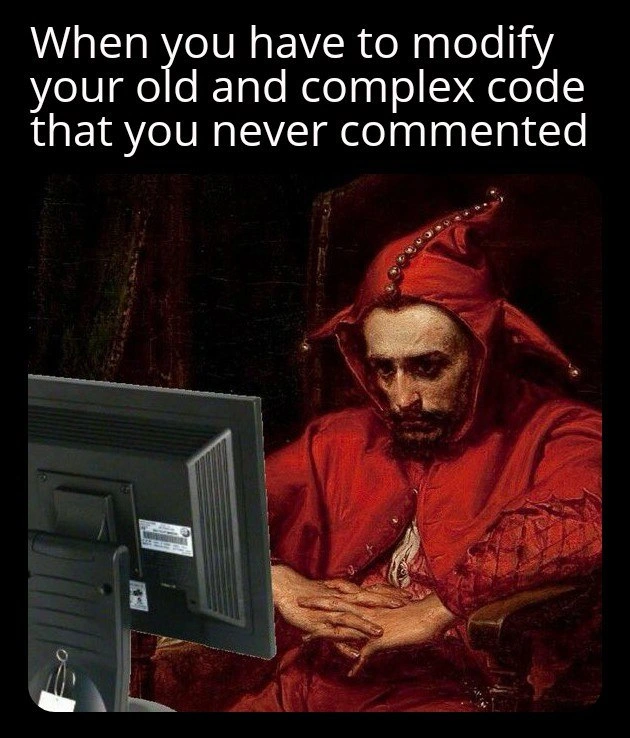
Imagine building a complicated toy, putting it in a closet, and throwing away the instructions because you are sure you will remember how it works. Months later, someone asks you to fix one tiny part, and now you are staring at your own toy like a confused clown. That is why the meme is funny: the programmer did not leave notes, and future-them has to pay for it.
Level 2: Comments As Memory
Legacy code is code that already exists and must be maintained. It might be old, but age is not the real problem. The problem is that people rely on it, and changing it can break things you did not know were connected.
Code comments are notes written near the code to explain something a future reader needs to know. Good comments do not repeat what the code already says. They explain decisions, assumptions, edge cases, and warnings. For example, a comment like // add 1 to x is useless if the next line is x += 1. A comment explaining that x += 1 compensates for an external system using one-based indexing is useful.
For newer developers, this meme captures the first time you return to your own clever code and realize "clever" is not the same as readable. The jester image works because the developer is both the victim and the culprit. You created the puzzle, forgot the answer, and now have to solve it under the calm encouragement of a production deadline.
Level 3: Future-You Review
The caption says, When you have to modify your old and complex code that you never commented, and the image answers with a red-clad jester staring at a monitor like he has just discovered who signed the architecture decision record. The post message, And now you the entire circus, makes the self-own explicit: the fool is not the framework, the deadline, or the mysterious previous developer. It is you, six months later, trying to reverse-engineer your own confidence.
This is technical debt in its purest form: a reasonable shortcut that compounds interest when the code survives longer than expected. Most developers do not skip comments because they hate future maintainers. They skip them because the logic feels obvious while it is still warm in their head, the ticket is due, the tests are green enough, and the pull request already looks bigger than anyone wants to review. Then the business asks for "one small change" after the mental cache has been evicted, and the codebase responds with a riddle in five helper functions and a boolean named flag2.
The joke is not really "comments good, no comments bad." Experienced engineers know comments can rot, lie, or narrate the obvious. The deeper pain is missing intent. A useful comment explains why a weird branch exists, what invariant must never be broken, which external system forced the shape, or why the simple solution failed. Without that, modification becomes archaeology: infer the original constraints, map hidden coupling, inspect tests for superstition, and decide whether a strange line is essential or just fossilized panic.
That is why refactoring pain is so recognizable here. Old complex code often has invisible contracts: data arrives in a half-normalized shape, a downstream consumer depends on ordering, a retry loop masks a flaky API, or a date calculation exists because one customer did something cursed in 2017. Changing it without documentation is not programming so much as negotiating with a locked door that used to be your own idea.
Description
A black-background meme shows large white text reading, "When you have to modify your old and complex code that you never commented." Below the caption, a somber figure in a red jester outfit from a classical-looking painting sits in front of a modern computer monitor, hands folded as if bracing for punishment. The visual contrast between old portraiture and a workstation frames the developer as both author and victim of their own undocumented system. The technical joke centers on returning to complex legacy code without comments, where maintenance becomes archaeology and every change risks breaking forgotten assumptions.
Comments
1Comment deleted
The worst reviewer of your design is future-you, because they remember none of the invariants and still have merge rights.