Skip to content
DevMeme
1596 of 7435
Force Push Needs Jedi Training
VersionControl Post #1784, on Jul 17, 2020 in TG

Force Push Needs Jedi Training

Why is this VersionControl meme funny?

Level 1: Changing The Shared Notebook

Imagine a group notebook where everyone writes pages in order. A normal update adds your new page at the end. A force push is more like replacing earlier pages with your own version, even if other people already copied them. The joke is that the command sounds like magic power, but it is really a risky way to change the group's shared memory.

Level 2: Dangerous Push

Git stores project history as commits. A merge combines work from one branch into another. If you make the wrong merge or want the history to look different, you might use git reset to move a branch back to an earlier commit, then redo the merge in a different way.

The command --no-ff means "no fast-forward." It tells Git to create a merge commit even if it could simply move the branch pointer forward. Some teams like this because it makes it clear when a feature branch was merged.

A force push uploads your local branch state even if it does not line up cleanly with the remote branch. That can overwrite history other people are using, so it is powerful and risky. The meme is funny because the learner asks "How do I force push" like it is a normal button, and the mentor answers as if learning "the Force" requires mystical training. In real life, the training is mostly reading Git's warnings and developing a healthy fear of shared branches.

Level 3: Rewrite The Timeline

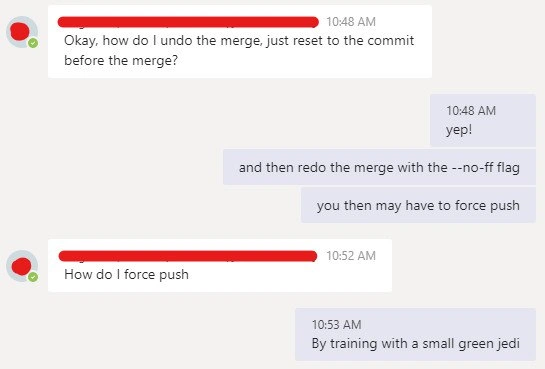
The chat begins with a perfectly normal Git question: Okay, how do I undo the merge, just reset to the commit before the merge? The reply walks through redoing the merge with --no-ff, then adds the dangerous little sentence: you then may have to force push. The final question, How do I force push, gets the answer By training with a small green jedi, turning Git's force into a Star Wars pun while quietly pointing at one of version control's classic rites of passage.

The joke works because git push --force sounds like just another command until you understand that it can rewrite shared branch history. A normal push says, "Here are commits after the remote's current tip." A force push can say, "Replace the remote's current idea of this branch with mine." If teammates have based work on the old history, the branch can suddenly stop matching their local clones. Now everyone gets to learn reflog, conflict recovery, and the specific flavor of silence that follows "who force-pushed main?"

The --no-ff detail adds authenticity. A fast-forward merge can move a branch pointer without creating a merge commit; --no-ff preserves an explicit merge commit even when Git could fast-forward. Teams use that to keep feature boundaries visible in history. Undoing and redoing a merge for that reason is not absurd, but once the original merge has already been pushed, correcting it may require rewriting public history or creating a revert-and-remerge sequence. One is cleaner in the log; the other is less likely to make coworkers consider moving to farming.

This is why mature Git workflows treat force pushing as a controlled operation, not a personality trait. On personal feature branches, it is common after rebasing or cleaning commits. On shared branches, it needs coordination, branch protection, and usually --force-with-lease instead of raw --force. That variant checks that the remote branch still points where you think it does before replacing it, which is Git's way of saying, "Are you sure no one else touched this lightsaber?"

Description

A cropped chat screenshot shows a developer asking, "Okay, how do I undo the merge, just reset to the commit before the merge?" A reply says "yep!" followed by "and then redo the merge with the --no-ff flag" and "you then may have to force push." The original sender then asks, "How do I force push," and the reply jokes, "By training with a small green jedi." The meme uses Git terminology as wordplay, turning the dangerous `force push` operation into a Star Wars-style physical force ability while still hinting at risky history rewriting.

Comments

1
Anonymous ★ Top Pick Every team has a Git rite of passage: learning that `--force` is not a workflow, it is a trust exercise with reflog as the safety net.
  1. Anonymous ★ Top Pick

    Every team has a Git rite of passage: learning that `--force` is not a workflow, it is a trust exercise with reflog as the safety net.

Use J and K for navigation