The futile war against software abstraction layers
Why is this CS Fundamentals meme funny?
Level 1: Fences and Freedom
Imagine you have a puppy that loves to run everywhere. To keep the puppy safe (and your house in one piece), you build a little fence around a play area. This fence is like the encapsulation in our story – it sets a boundary so the puppy can play without getting into dangerous trouble. Now, picture the puppy as our silly trollface character: the puppy is jumping and barking, “I hate this fence! Let me roam free!” The puppy doesn’t understand that the fence (like abstraction layers in code) is there for a good reason – to protect him from the big bad world (or protect the house from chaos!). The UN peacekeeper in the story is like the pet owner calmly saying, “Sorry pup, we have you safely enclosed for your own good.” It’s funny because we see the puppy (or troll) protesting something that’s actually there to help. In everyday terms, it’s like a kid yelling “I hate rules!” while the parent knows the rules are what keep things orderly and safe. The humor comes from that mismatch: the helper (fence/encapsulation) is viewed as the bad guy by the one being helped. In the end, the meme is joking that sometimes we all feel like that puppy or trollface — hating the rules or walls — even though they’re the very things keeping our world from turning into total chaos.
Level 2: Why Abstraction Matters
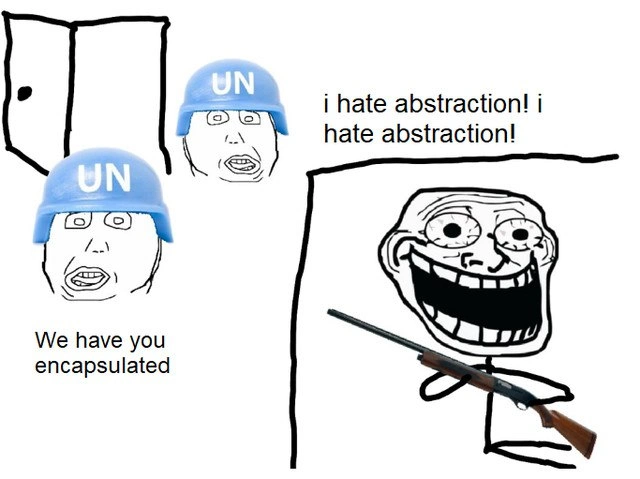
This meme uses a silly rage comic drawing to illustrate a fundamental programming lesson from CS Fundamentals: why we use encapsulation and abstraction in the first place. On the left side of the image, the two stick-figure soldiers with blue “UN” helmets represent developers (or best practices) trying to keep code complexity under control. The caption "We have you encapsulated" is a play on words — in action movies you’d hear “We have you surrounded,” but here they say encapsulated because they’re containing the chaotic code (or coder) inside a safe boundary. Encapsulation in programming means exactly that: wrapping up the internal details of a component so others can’t directly mess with them. For example, a class in OOP will keep its data (fields) private and only expose certain methods to interact with that data. It’s like putting the logic in a capsule (hence encapsulation), so the rest of the program can only access it through the capsule’s well-defined interface. This ensures one part of the code can’t accidentally break things in another part by tinkering with its internals. It’s a key part of CodeAbstractionPrinciples taught in any introductory programming course: hide the details, expose only what is necessary.
On the right side, we have the famous Trollface character — a big grinning, fiendish meme face — holding a shotgun and yelling, "I hate abstraction! I hate abstraction!" at the top of his lungs. The trollface is a symbol of someone being deliberately provocative or causing trouble (originating from early internet meme culture), so here it represents a developer who intentionally hates the very idea of abstraction layers. Abstraction in coding means simplifying complexity by providing a simpler interface, or by focusing on concepts at a high level and ignoring lower-level details. A common example: you use a sort() function to sort a list without having to know the intricate sorting algorithm it uses internally – that’s abstraction; it saves you from dealing with all those details each time. But the troll in the meme doesn’t want that. He’s like the developer who says: “This is all unnecessary! I want direct control over everything!”
So why is that funny? It’s the contrast: the “UN peacekeepers” (which usually stop conflict in real life) are stopping the troll from wreaking havoc in the code. They’re enforcing a kind of abstraction ceasefire – meaning they want the troll to stop attacking the abstraction layers. In plainer terms, the UN guys = the programming rules that say “keep things encapsulated and organized,” and the troll = a coder who breaks those rules because he finds them annoying or limiting. This resonates as developer humor because many of us remember times when we or our colleagues felt frustrated with design rules. For instance, a newbie programmer might wonder, “Why can’t I just make this variable public so I can change it from anywhere? Writing a special method to change it (a setter) feels like overkill!” The answer, as experience shows, is that if you don’t encapsulate, your code can turn into a spaghetti mess where anything can affect anything else — very hard to debug or maintain.
Let’s break down the terms with a simple example:
Encapsulation: Imagine a
Userclass that has apasswordfield. We mark the password asprivateand provide a methodchangePassword(oldPass, newPass). This way, the class controls how the password is changed (maybe it checksoldPassfor security, etc.). Code outside the class can’t just douser.password = "12345"because that’s encapsulated. If a mischievous coder tries to directly accessuser.password, the program (or compiler) will stop them – "Access Denied!". Encapsulation protects the data from inappropriate access or unpredictable changes.Abstraction: Now consider you have a complex piece of code to send an email. You could expose every little detail (connect to SMTP server, format headers, handle authentication, etc.) every time someone wants to send mail, which is tedious. Instead, you provide a simple function
sendEmail(to, subject, body). Other parts of the program can call that one function without needing to know how it works inside. That’s abstraction – providing a convenient, simplified view and hiding the nitty-gritty. The rest of the system can trust “sendEmail” to do its job without seeing all the inner machinery.
In the meme, the trollface yelling "I hate abstraction!" is like a kid throwing a tantrum saying, "I don’t want to press the button, I want to see all the gears!". It’s funny to developers because sometimes we do meet people (or sometimes are people) who find all these nice CodeQuality practices cumbersome. They might say things like, “This framework is doing too much, I’d rather write my own code from scratch,” or “Why do we need an API? Let’s just directly connect these two modules and share all variables.” Usually, that approach backfires as projects grow. The chaos that results is exactly what encapsulation and abstraction try to prevent.
To illustrate the point, here’s a tiny code example in Java-like pseudocode showing encapsulation in action:
// Proper encapsulation in a class:
class BankAccount {
private double balance = 0.0; // internal state hidden
public void deposit(double amount) { // public method to change state safely
if (amount > 0) {
balance += amount;
}
}
public double getBalance() { // public method to access state
return balance;
}
}
BankAccount acct = new BankAccount();
acct.deposit(1000); // using abstraction (method) to modify balance
System.out.println(acct.getBalance()); // prints 1000
// Trying to break encapsulation (what the troll wants to do):
// acct.balance = -5000; // ERROR: balance has private access in BankAccount
In the above snippet, balance is private, meaning code outside BankAccount can’t touch it directly – it has to go through deposit or getBalance. The trollface developer hates that; he’d prefer to just write acct.balance = -5000 or set any value he wants whenever. If we remove encapsulation (say make balance public), nothing stops a programmer from setting acct.balance = -5000 (which might not make sense for a bank account!). That could introduce silly bugs (like negative money) because there’s no protective check. Encapsulation forces you to go through the deposit method, which can have checks (like amount > 0). It’s a safeguard.
So, in simple terms:
- Encapsulation = Containing complexity in a capsule (only certain operations are allowed, others are off-limits).
- Abstraction = Don’t worry about how it works inside, just know what it does and use it.
The UN soldiers in the meme enforce those rules, telling the troll “We have you encapsulated” — meaning “We’ve boxed in your chaos, you can’t break out and mess up other parts of the program.” The troll yelling “I hate abstraction!” is the part of a developer that gets frustrated with rules or layers they don’t fully understand or that seem to slow them down. It’s a tongue-in-cheek way to poke fun at that frustration. After all, almost every programmer goes through a phase of thinking “Why do I need all these patterns and practices? I just want to get the job done!” Only later do we often realize those practices exist to save us from big headaches. The meme captures that learning moment in a comical war-like scene, making a dry concept like abstraction vs. encapsulation memorable and funny.
Level 3: Encapsulation Under Fire
For seasoned developers, this meme hits home as a depiction of the battle between clean code practices and chaotic quick hacks. The scene of UN peacekeepers cornering a trollface is a humorous metaphor for senior engineers (the “code peacekeepers”) trying to enforce encapsulation and abstraction in a codebase, while a rogue developer (the troll) roars in defiance, weapon in hand, ready to blast through all those carefully constructed layers. We chuckle because we’ve all seen some form of this standoff in real life.
On one side, we have the good software design principles (encapsulation, abstraction) acting like a blue-helmeted peacekeeping force in our projects. Just as UN peacekeepers try to maintain order and prevent warring factions from causing destruction, good devs use encapsulation to keep different parts of the code from interfering with each other’s internals. It’s about keeping the peace in a system: for example, one module can’t unexpectedly muck with another module’s variables because they’re encapsulated (tucked safely inside, accessible only through proper channels). This leads to code that’s easier to maintain and reason about — basically higher CodeQuality and fewer “surprise” bugs. The meme’s phrase “We have you encapsulated” is a clever play on the action movie cliché “We have you surrounded,” but here it’s code architecture surrounding the would-be chaos maker. It implies the encapsulation soldiers have contained the complexity (the troll) in one room, preventing it from spilling out and wreaking havoc across the codebase.
On the other side, we have the trollface developer hollering “I hate abstraction! I hate abstraction!” at the top of his lungs. This is a caricature of that engineer (or team) we’ve encountered who despises “all these layers and abstractions” in a project. You know the type: if there’s a neatly designed interface, they want to bypass it and tweak the guts directly; if there’s a well-structured system of classes, they complain it’s over-engineered and they’d rather have one big script where they can change anything at will. It’s the anti-abstraction rant we’ve heard in meetings or code reviews: “Why do we need all these getters and setters? Just make the field public!” or “This framework is too much magic, I’d rather write raw SQL or low-level code myself.” The trollface’s comically exaggerated hatred for abstraction perfectly captures that sentiment. It’s funny because it’s true — many of us have had an inner troll at 3 AM muttering “To heck with it, I’m hardcoding this!” when frustrated by a complex abstraction that isn’t working.
The humor works on multiple levels of developer experience. Encapsulation vs. a troll with a shotgun is absurd, but it symbolizes real tension: maintaining discipline vs. taking shortcuts. Senior devs nod knowingly because they’ve fought this fight to protect a codebase. Perhaps a teammate once insisted on a quick hack that broke the encapsulation of a module, causing a chain reaction of bugs. Or maybe an old codebase they inherited was a free-for-all mess — global variables and tight coupling everywhere — the result of someone who “hated abstraction” and just crammed everything together. Untangling that kind of code is a nightmare; it’s like defusing a bomb after the ceasefire was ignored. In those moments, we all wished for a squad of UN Code Peacekeepers to step in earlier and enforce some structure!
Consider a real scenario: a large application has a well-defined API for the database (say using an ORM or repository pattern), but an impatient developer bypasses it to write direct SQL queries scattered all over because “ORM is too slow/abstract.” Initially, things work fine — until the day you need to change the database schema or switch database systems. Suddenly those hidden SQL queries break, and you’re on the hook for a massive refactor. The abstraction layers that were there as a safety net (the API/ORM) were ignored, and chaos ensued. The trollface in the meme embodies that developer firing off shotgun blasts at the abstraction layer, yelling that he hates it, while the rest of the team (the UN soldiers) facepalm and try to contain the fallout: “We had things encapsulated for a reason!”
To break it down, here’s what good practice vs. troll practice looks like, and why the peacekeepers try to enforce the rules:
| Solid OOP Practice | Trollface’s Approach | What Could Go Wrong? |
|---|---|---|
Keep data private in a class |
Make every field public |
External code changes things unexpectedly; bugs multiply. |
| Use methods (getters/setters) to access or modify state | Directly read and write the data fields | No checks or invariants; e.g., setting an invalid value breaks object’s logic. |
| Rely on a stable interface or API | Reach into internals (use reflection or global variables) | Tight coupling; any internal change can crash everything that pokes around. |
| Embrace abstraction layers (e.g., use a library or framework to handle complexity) | “Reinvent the wheel” with custom hacks for full control | More code to maintain, potential security holes, and missed bug fixes that a standard tool would have handled. |
In short, the UN blue helmets stand for the senior dev mentality: “let’s enforce some discipline and abstractions so we don’t shoot ourselves in the foot later.” The trollface with a shotgun is the unruly coder impulse: “screw rules, I want it all open right now!” The meme exaggerates it to the level of an armed standoff, and that dramatic imagery is what makes it hilarious. It’s an inside joke about CodeQuality: we know abstraction is usually for our own good, but it can feel like a restriction, and some folks really, really don’t like being restricted. The text “I hate abstraction!” repeated is basically the rallying cry of every developer who ever complained that a codebase was too “enterprise” or too locked-down for their liking. And the UN saying “We have you encapsulated” is the perfect punchline — a mix of technical jargon and action-movie trope that translates to, “We’ve contained your craziness; drop the global variables and come out with your hands up!”
Team Lead: "We need to keep these components separated and talk only through interfaces. It's safer."
Rebel Dev (Trollface): "No way! Interfaces, layers… I hate all that abstraction! Let me at the code, I’ll change whatever I want directly!"
Seasoned devs laugh (and maybe cry a little) because they’ve been in that exact conversation. The meme distills a real-world tech management problem into a comical hostage situation. The context tags hit the mark: abstraction_vs_encapsulation is precisely the theme – the difference between the two is being dramatized. We also see trollface_character (the embodiment of mischief) and un_peacekeeper_helmet (symbol of enforced order) in opposition. It’s developer humor blending with a rage-comic aesthetic to drive home a point: good software engineering practices are sometimes upheld only by a thin blue line of determined engineers, and there will always be a troll ready to break the truce.
Ultimately, at the senior level we appreciate that while abstraction and encapsulation add some formality and sometimes frustration, they are there to protect us from ourselves. The troll’s anti-abstraction rant makes us laugh because we’ve all felt that sentiment in moments of vexation — but we also know that giving into it too often will lead to an unmaintainable, war-torn codebase. The battle depicted may be exaggerated, but the ceasefire it jokes about — an abstraction ceasefire — speaks to a truth: in software projects, peace and progress are easier to achieve when everyone agrees to respect the abstraction barriers (at least most of the time).
Level 4: Information Hiding Treaty
At the deepest level, this meme echoes the classic computer science doctrine of complexity containment. In the world of Object-Oriented Programming (OOP), encapsulation is essentially an information hiding treaty: it’s the principle that an object’s internal state should be guarded behind a well-defined interface. Decades ago, pioneers like David Parnas advocated that modules hide their inner workings — a concept formalized in his 1972 paper on modular design. The idea is to prevent cascading complexity: if the details are hidden (encapsulated), changes inside a module won’t break code elsewhere. This is a cornerstone of maintainable software architecture.
Meanwhile, abstraction is the broader strategy of managing complexity by layering and simplifying: you present only the necessary features and omit the gory details. Think of abstraction as a peace treaty that says, “Let’s agree to only worry about high-level instructions, not every little operation underneath.” In theoretical terms, abstraction and encapsulation together create abstraction layers or interfaces that separate different levels of concern. A classic example is how high-level languages abstract away machine code, or how an API abstracts away the implementation details. Each layer is like a demilitarized zone, isolating the complexity below from whoever is using it above.
From a theoretical CS perspective, breaking encapsulation is almost heretical: it violates the abstraction barrier. This barrier is a conceptual line that shouldn’t be crossed if you want to keep systems predictable. For instance, in type theory and language design, strong encapsulation and type safety prevent one part of a program from arbitrarily messing with another’s memory. It’s like a UN ceasefire agreement in code: one module doesn’t intrude on another’s territory. Languages like Java enforce these rules strictly (you literally cannot access a private field from outside without resorting to special tricks like reflection). Breaking that rule is akin to using a backdoor or exploit in a theoretical sense — it subverts the guarantees the language is trying to provide about program correctness and safety.
Yet, the trollface character screaming "I hate abstraction!" represents a very real countercurrent in computing history. There have always been those who chafe against too many layers or rules. In academic lore, it’s reminiscent of debates like structured programming vs. spaghetti code in the 1970s or even high-level languages vs. assembly. Abstraction is powerful but comes at a price: it can introduce overhead and sometimes obscure what’s really happening (Joel Spolsky’s Law of Leaky Abstractions tells us no abstraction is perfectly airtight). That means occasionally, devs encounter performance hits or tricky bugs due to layers of abstraction — and the temptation to “punch through” all those layers grows. The trollface’s shotgun literally blasting through abstraction is a cartoonish depiction of that urge to tear down the abstraction barriers and get direct access to the guts of the system. It’s the theoretical unstoppable force (the coder’s demand for absolute control) meeting the immovable object (the laws of good software engineering).
In essence, this highest level view frames the meme as a commentary on the eternal war between complexity and control. Encapsulation and abstraction are intellectual weapons to tame the exponential complexity of software systems (without them, large programs would collapse under the weight of interdependencies). The UN peacekeepers in blue helmets enforcing an abstraction ceasefire symbolize those fundamental design principles stepping in to avert chaos. And the trollface is the embodiment of chaos itself, harkening to the age-old hacker ethos of “closer to the metal, no rules, I do what I want.” It’s a playful take on a serious principle: if you ignore the theoretical foundations of software design, you might win a small battle (quick, unfettered access!) but you’re undermining the long-term peace and stability of your codebase.
Description
A two-panel meme depicting a conflict between programming principles. On the left, two crudely drawn figures wearing blue UN peacekeeper helmets stand outside a door, stating, 'We have you encapsulated'. This visually represents the object-oriented principle of encapsulation. On the right, inside a room, the classic rage-filled trollface meme character holds a shotgun and yells, 'i hate abstraction! i hate abstraction!'. The overall image is a surreal and humorous take on a developer's occasional frustration with high-level programming concepts. The joke resonates with experienced engineers who sometimes find that layers of abstraction, while intended to simplify, can obscure underlying problems, making debugging difficult. It humorously portrays the desire to break through these layers and deal with the raw, underlying code, even if it means resorting to 'brute force' methods

Comments
7Comment deleted
I love abstractions. Every time I find a bug, it's like a fun little game of 'which of these 17 layers of indirection is lying to me?'
Architecting clean interfaces feels like a UN peacekeeping mission - until a drive-by PR swaps a private field to `public static` and shotgun-blasts your entire abstraction treaty
After 15 years of debugging enterprise Java factories that produce factories, you realize the real abstraction was the layers of indirection we accumulated along the way - and sometimes that developer with the rifle has a point about just writing the damn SQL query directly
The beautiful irony here is that encapsulation was supposed to free us from complexity, yet we've built such elaborate abstraction fortresses that we're now hostages to our own architectural decisions. It's like spending years perfecting a black box, only to realize you're the one locked inside when production breaks at 3 AM and you can't remember which of the seventeen layers is actually causing the issue. The real kicker? The abstraction you're cursing today is probably the 'clean architecture' you proudly defended in last quarter's design review
Responding to “I hate abstraction” with “we have you encapsulated” is peak enterprise: private fields around a leaky interface, and everyone calls it architecture
Hating abstraction? Encapsulation just made your complaints private and immutable
Those blue helmets are named private and internal; they deploy the moment someone yells “abstraction is bad” and tries to blast holes through your API with reflection