Skip to content
DevMeme
3088 of 7435
Jira's Unfortunate 'allopenissues' URL Problem
Bugs Post #3403, on Jul 11, 2021 in TG

Jira's Unfortunate 'allopenissues' URL Problem

Why is this Bugs meme funny?

Level 1: When Words Stick Together

Think of it like this: you have a phrase made of a few words, and you decide to write them all together without spaces. Sometimes, when you do that, the letters from the end of one word and the start of the next word can line up to spell something you didn’t expect. It’s like putting two puzzle pieces together and suddenly seeing a new picture you didn’t mean to make. In our case, a software had a section called “all open issues,” but they squished those words into “allopenissues” as one big word. Hidden inside that jumbled word was a surprise word that made people giggle because it was a bit rude. Imagine writing a sign with two words stuck together and then realizing it accidentally forms a silly or naughty word – you’d feel embarrassed and quickly want to fix it! That’s exactly what happened here: the developers are being asked to add some hyphens or spaces (like turning it into “all-open-issues”) so that the unfortunate hidden word disappears and everyone can use the software without any awkward laughs.

Level 2: Lost in Concatenation

Let’s break down what’s happening in simpler terms. Jira is a popular software tool that teams use as a bug tracking system – basically, it keeps track of tasks, issues, and bugs in projects. In Jira, certain pages or filters have specific names that show up in the URL (the web address you see in your browser). One such name is allopenissues, which is meant to indicate a list of all open issues in a project. The problem is that Jira wrote this name as one long word with no separators. When you write multiple words stuck together like this (allopenissues), sometimes a substring (a smaller string of characters within the larger string) can spell something unintended. Here, if you look carefully at allopenissues, you can spot the letters p-e-n-i-s appearing in order in the middle. That spells a word which is, well, a bit embarrassing to see in a professional tool’s URL!

Why did this happen? It’s a simple case of string concatenation, which means joining strings end-to-end. Jira took the words “all”, “open”, and “issues” and concatenated them into one identifier. Computers don’t automatically know where one word ends and the next begins unless we clearly separate them. In many naming conventions (rules for naming things in code or URLs), developers use characters like hyphens - or underscores _ to separate words for clarity. For example, writing it as all-open-issues or all_open_issues would make the individual words clear. In this situation, no separator was used, so the boundary between “open” and “issues” became muddled, and the letters formed an accidental offensive substring in the middle. It’s an innocent mistake – the code didn’t “know” any better – but it led to a funny outcome that could make users do a double-take. This is definitely a relatable developer experience: even a small naming goof can slip past code reviews and end up in a live application, causing awkward moments.

To put it plainly, the Jira page’s URL was showing something like “.../allopenissues...” which a reader’s eye might parse as “...allopenissues...”. Not great for a serious work environment! A junior developer can learn a key lesson here about naming conventions and avoiding unintended meanings. Always double-check how a combined name might be read by others. A good practice is to use kebab-case (hyphen-separated) or snake_case (underscore-separated) for multi-word identifiers in things like URLs, so each word is clearly divided. In fact, the user who reported this suggested exactly that fix: change allopenissues to all-open-issues. Then the word “penis” would no longer appear at all when reading the string. We can even demonstrate this with a bit of code:

console.log("allopenissues".includes("penis"));    // true (oops, found it!)
console.log("all-open-issues".includes("penis")); // false (hyphens to the rescue)

The first line shows that the string "allopenissues" indeed contains the substring "penis" (JavaScript returns true for the check). The second line, with the hyphenated "all-open-issues", returns false – meaning the unwanted word is gone. This little example confirms how a tiny change in the naming convention can dodge an awkward situation. It’s a funny reminder that developers even have to think about inappropriate word filters in their own code. The meme resonates with developers because we’ve all been there: maybe you named a variable or a URL innocently, only to have someone point out “Uh, do you realize this spells something funny?” Learning to spot these things is part of developing a good eye (and maybe a slightly immature sense of humor!) in a coding career.

Level 3: Naming Things Is Hard

At a deep technical and industry level, this meme highlights the notorious difficulty of naming things in software. In an Atlassian JIRA bug tracker entry (ID JRASERVER-65811), someone has raised a request to rename a URL slug because it accidentally contains a very awkward substring. Specifically, the JIRA filter string allopenissues (intended to mean "all open issues") contains the substring "penis" when read continuously. This kind of slip-up perfectly illustrates the classic developer adage: “There are only two hard things in Computer Science: cache invalidation and naming things.” Here, naming conventions (or the lack thereof) have created a bug that’s more about embarrassment than broken code. JIRA’s interface ended up exposing an unfortunate sequence of letters in a professional context, leading to giggles in the back row and a real issue report to fix it.

From a senior developer’s perspective, the humor comes from the absurd formality of the issue versus the childishness of the problem. The JIRA ticket’s summary is written in a serious tone — “Change the string 'allopenissues' to not include the word 'penis'” — as if it were any normal bug. Imagine being the developer reading that ticket with a straight face! The status is marked GATHERING INTEREST, meaning Atlassian isn’t rushing a fix, but will consider it if enough users care. This hints at a pragmatic concern: renaming a URL slug might break existing links or integrations, so even an awkward substring might not be immediately resolved without sufficient demand. It’s a trade-off between Developer Experience (DX) polish and backward compatibility. Veteran developers recognize this scenario: an obvious textual gaffe in production, yet not urgent enough to justify a quick change. The issue lingers unassigned and unresolved, an open joke on the backlog, until someone musters the will (and user votes) to address it.

Technically, this is a string concatenation blunder and a lesson in naming conventions. When multiple words are concatenated (joined without separators), you risk creating accidental substrings at the boundaries. In this case, "all"+"open"+"issues" ran together inadvertently produced a rude word spanning the junction of “open” and “issues”. A simple solution (as the reporter suggests) is using a clearer delimiter: for example, "all-open-issues" with hyphens. In code or URL design, adding hyphens or underscores (like all_open_issues) would separate the words and eliminate the accidental “penis” lurking inside. This practice falls under good URL scheme design for readability and professionalism. The meme tickles developers because it’s a real-world example of how a benign feature (a filter name in a bug tracker) can become a source of developer humor. It’s relatable: every seasoned coder has a tale of a variable name or concatenated string that sounded fine until it was seen by others in a different light. This JIRA incident is essentially an inside joke for anyone who’s struggled with naming: even a huge company’s product can stumble into a penpitfall that feels straight out of a comedy sketch.

Description

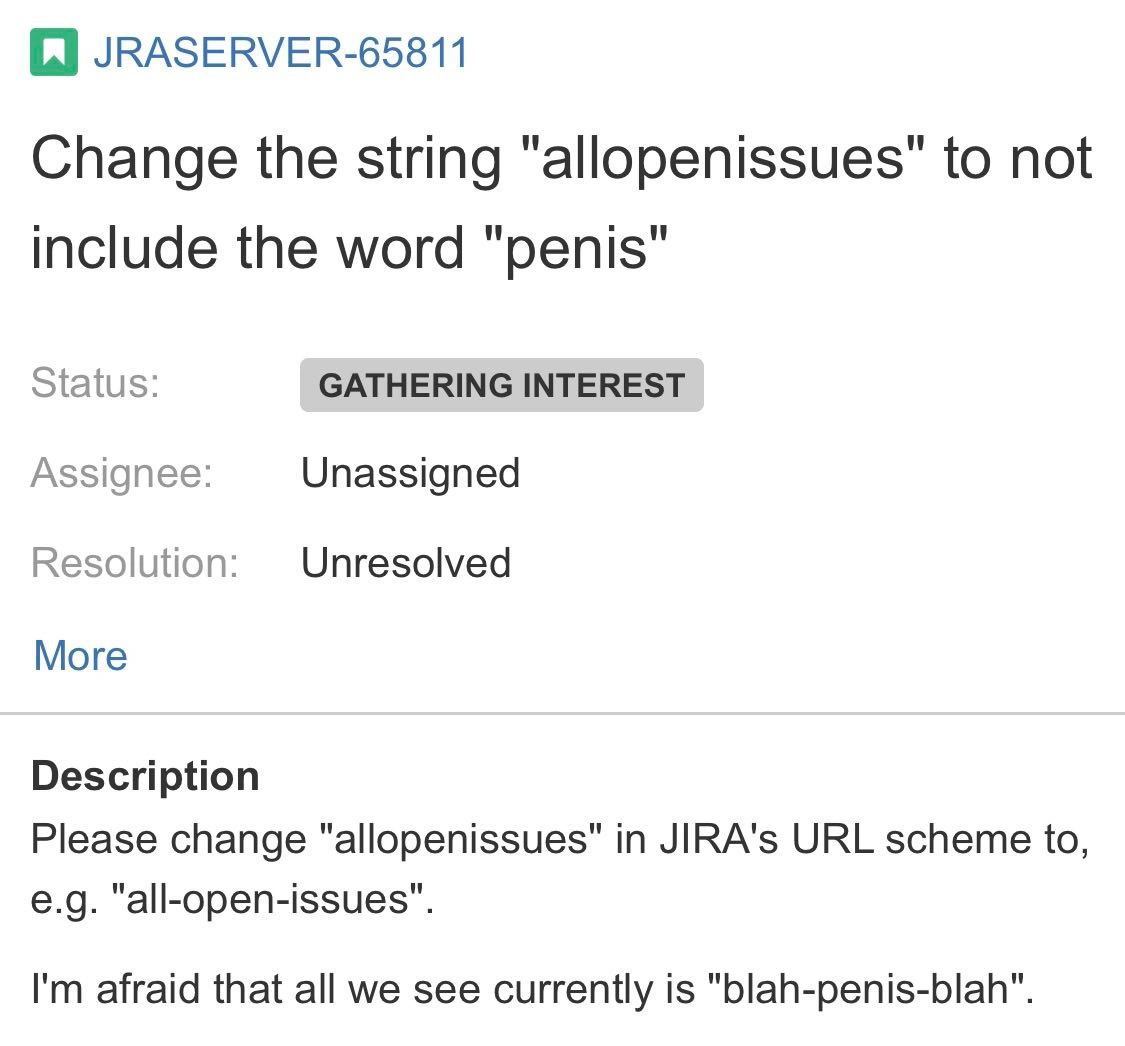
This image is a screenshot of a real Atlassian Jira issue, ticket JRASERVER-65811. The issue's title is 'Change the string "allopenissues" to not include the word "penis"'. The main body of the ticket shows its status as 'GATHERING INTEREST', with the description politely requesting a change to the URL scheme from 'allopenissues' to 'all-open-issues'. The reporter humorously adds, 'I'm afraid that all we see currently is "blah-penis-blah"'. This is a classic example of the 'Scunthorpe problem,' where an innocent string contains an unfortunate or obscene substring. The humor for experienced developers comes from multiple layers: the juvenile discovery, the formality of creating a bug ticket for it, and most significantly, the infamous 'GATHERING INTEREST' status, which is corporate-speak for 'we will likely never fix this.' It perfectly captures the minor but irritating flaws in enterprise tools that developers are forced to live with
Comments

22
Anonymous ★ Top Pick Status: GATHERING INTEREST. Translation: We've added this to the backlog, and it's now aging gracefully like a fine milk. We'll get to it right after we finish redesigning the logo for the fifth time
  1. Anonymous ★ Top Pick

    Status: GATHERING INTEREST. Translation: We've added this to the backlog, and it's now aging gracefully like a fine milk. We'll get to it right after we finish redesigning the logo for the fifth time

  2. Anonymous

    Nothing highlights that naming is harder than distributed consensus quite like discovering your /allopenissues endpoint sneakily spells “penis” in every audit log

  3. Anonymous

    After 20 years in tech, you realize the hardest problems aren't distributed systems or CAP theorem - it's naming things without accidentally creating HR incidents when someone inevitably removes the hyphens from your perfectly reasonable URL parameters

  4. Anonymous

    This is what happens when you concatenate strings without delimiters and forget that humans are excellent pattern-matching machines - especially for inappropriate patterns. The ticket has been 'GATHERING INTEREST' since forever, which really means it's in the engineering backlog purgatory where it will remain until someone's CEO notices it during a board presentation. Classic case of technical debt that's more embarrassing than expensive, yet somehow still unresolved because 'it's just a URL scheme' and 'nobody looks at URLs anyway' - until everyone does

  5. Anonymous

    JIRA's URL tech debt: so phallic-ly obvious, yet trapped in 'gathering interest' purgatory like every enterprise hygiene ticket

  6. Anonymous

    Proof that kebab-case isn’t bikeshedding - it’s a compliance control; skip the dashes and your route escalates from 404 to HR

  7. Anonymous

    All open issues → allopenissues: ignore UAX #29 and you’ve built a profanity generator - pretty URLs go NSFW and your triage board becomes HR’s backlog

  8. @solwayfirth8956 5y

    people are retards

    1. Deleted Account 5y

      coming up with anything entertaining to not die from boredom

  9. @tarasssssssssssssss 5y

    а

  10. @pavloalpha 5y

    Nah, u can't. Wash dishes in the kitchen, weak and depended.

  11. @beton_kruglosu_totchno 5y

    Барбара Стрейзанд? Кто это?

    1. @pavloalpha 5y

      We speak only English here

      1. Deleted Account 5y

        horosho barbara streizad? Kto eto?

        1. @pavloalpha 5y

          Idk

      2. @beton_kruglosu_totchno 5y

        fuck i mixed up the chats lol

  12. @beton_kruglosu_totchno 5y

    Barbasa Streisand? Who is that?

    1. @RiedleroD 5y

      the Streisand effect is when the act of hiding something leads to more people knowing about the thing you're trying to hide. Comes from a rich asshole named Barbara Streisand who wanted a photo of her villa a guy took off the internet, tried to sue him, and in the process, the media reported on it by showing the image.

      1. @beton_kruglosu_totchno 5y

        exacttly

      2. @Roman_Millen 5y

        Now the word from the meme actually makes new sence, if you put it like allo, penis sues

  13. @dsmagikswsa 5y

    But it is really more clear😂

  14. @alexseeko 5y

    unASSigned

Use J and K for navigation