A Severe Case of Needing to Rubber Duck a Problem
Why is this Debugging Troubleshooting meme funny?
Level 1: Toys to the Rescue
Imagine you have a really hard puzzle to solve, and you just can’t figure it out. You might start feeling frustrated or stuck. Now, think about gathering all your favorite toy animals and lining them up, then explaining your puzzle to them one by one. Sounds silly, right? But as you tell the story of the puzzle out loud to your toys, something magic happens — you suddenly see the piece you were missing! The toys didn’t say anything or give you new clues, but just talking it out helped you understand the problem better.
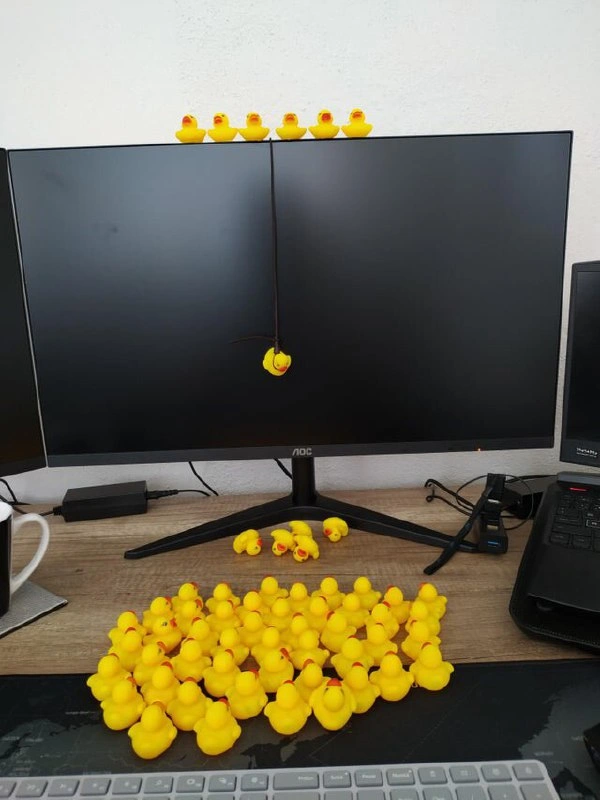
This picture is joking that one little rubber duck toy wasn’t enough to help a programmer solve a tough coding problem, so they brought a whole crowd of duck toys to listen. It’s funny because usually people might talk to just one toy or even just talk to themselves to figure something out. Seeing dozens of bright yellow ducks all over the desk is like saying, “Wow, this problem is so hard, I need all the help I can get, even if it’s from a bunch of quiet little ducks!” In simple terms, it’s showing that when you’re stuck on something tricky, sometimes explaining it out loud — even to a toy — can help you figure it out. And the more stuck you feel, the more “listeners” you wish you had, even if they’re just pretend. It’s a playful way to say that when we’re confused, just sharing the problem (even with a toy) can make it easier to solve.
Level 2: Rubber Duck Debugging
Let’s break down the concept of rubber duck debugging, which is the crux of this meme’s joke. In software development, rubber duck debugging is a technique where you explain your code or problem out loud to an inanimate object (traditionally a little rubber duck) as if it were a curious colleague. Why a duck? It started as a humorous example, but any object or even an imaginary friend will do. The key is that by verbalizing each step of your code and your assumptions, you often catch the mistake or realize what you’ve been overlooking. It’s like having a patient, silent listener that lets you work through the logic without interruption or judgment. The duck won’t solve the bug for you — but it will force you to slow down and articulate things clearly, which often leads to a solution.
How does it work in practice? Say you have a mysterious error in your program. You’d put your rubber duck on the desk and start explaining: “Okay Mr. Duck, when the user clicks ‘Save,’ this function updateRecord() should run. It takes the input, validates it… oh wait, if the input is empty, I never initialized the default value! That might be it!” In walking the duck through the code, you often stumble upon the bug yourself. This method is such a staple of debugging that many developers keep a duck at their workstation. In fact, spotting a lone rubber duck on a monitor is practically a sign of a programmer’s desk — a quirky but effective developer experience hack for troubleshooting problems.
Now, the meme image takes this normal one-duck scenario and multiplies it. We see five ducks lined up on top of the monitor, one duck dangling in front of the screen on a cable, and a whole crowd of ducks covering the desk. It’s as if the first rubber duck’s help wasn’t enough, so the developer kept adding more “listeners.” Of course, in reality adding more ducks doesn’t increase brainpower — one attentive duck is the same as fifty in terms of logical process. The humor here is in the exaggeration: it’s portraying that feeling when a bug is so perplexing you joke that you’ll need an army of ducks to conquer it. This could also be referencing an office prank: maybe the developer’s teammates caught wind that they were stuck debugging and jokingly volunteered an entire brood of rubber duckies to support them. The tag rubber_duck_army directly describes this scene — a playful swarm of toy ducks as debugging assistants.
Let’s identify some elements from the picture in real-world terms. The desk setup is pretty typical for a developer: a dual-monitor setup (the main one here is an AOC brand monitor), with a keyboard in front, a coffee mug to fuel long coding sessions, and a laptop docked to the side. The monitors are off, which probably means the coder stepped away or turned them off to stage this funny scene (or maybe in frustration, they powered down the screens to say “I’m done looking at code for now”). The empty monitor screens draw our attention to the ducks themselves. There’s one duck hanging by a cable at the center of the screen — that’s not a usual place for a duck! It’s a goofy detail likely achieved by tying a duck to, say, a USB cable or headphone cable and letting it dangle. This could be the “main” rubber duck, front and center, so the developer literally can’t ignore it while explaining the problem. The five ducks sitting on top of the monitor might represent the panel of experts (imagine them nodding along sagely as you explain each line of code). And the mass of ducks at the base? That’s the peanut gallery or the cheerleading squad, providing moral support through sheer numbers. It’s as if each duck is a tiny therapist helping talk the coder through the debugging frustration.
Why do developers find this so relatable? Because it captures the sometimes absurd lengths we go to when debugging. It’s an inside joke: non-developers might be baffled seeing a colony of rubber ducks on someone’s desk, but developers immediately get the reference and find it hilarious. Many programmers have stories of talking to a duck (or a teddy bear, or a houseplant – anything that listens quietly). It’s a rite of passage in coding life to discover that sometimes the act of explaining is what fixes the bug, not a fancy tool or someone else’s advice. This method empowers programmers, especially juniors, to troubleshoot issues on their own before running to a senior engineer for help. In fact, some workplaces jokingly mandate: “Ask the duck before you ask me.” It encourages careful thought: often juniors, in the process of explaining the issue to a rubber duck on their desk, realize “Oh! I see the problem now!” and solve it without having to interrupt anyone. That eureka moment feels great — and the duck sits there with its permanent little smile, as if taking pride in your progress.
In summary, the meme is a funny exaggeration of a real debugging technique. Rubber duck debugging is about breaking down the problem and teaching the duck what the code is supposed to do. The act of teaching forces you to understand the problem better yourself. And when one little yellow duck isn’t cutting it… well, why not imagine bringing in a whole battalion? It won’t actually give you more solutions, but it perfectly illustrates the emotion of a bug hunt that has gotten out of hand. This DeveloperHumor meme uses that over-the-top visual to say, “We’ve all had those days where even the duck needed reinforcements.”
Level 3: Duck Overflow
In this meme, a developer has escalated rubber duck debugging to a comically extreme level. Traditionally, you’d have one trusty rubber duck on your desk to talk through a tricky code issue. But here we see an entire rubber duck army assembled — a tongue-in-cheek signal that this bug is truly the boss battle of debugging. The dual monitors are powered off and blank, suggesting that no amount of staring at code on screen helped. Instead, the developer has turned to an absurd council of ducks for insight. This playful exaggeration resonates with seasoned engineers because it captures a familiar shared pain: that one nightmare bug which refuses to budge despite all logic.
Why is this funny to experienced devs? It’s referencing the well-known inside joke that explaining your problem out loud often leads to the solution. When one duck isn’t enough, it implies the bug is so stubborn you need to narrate it to a whole conference of ducks. It satirizes the desperation of late-night debugging sessions. We’ve all been there: Debugging a perplexing issue at 3 AM, you’ve tried the debugger, added countless print statements, scoured Stack Overflow, and still nothing makes sense. At that breaking point, a programmer might jokingly say, “Time to bring in a rubber duck battalion for this one.” The meme takes that quip and literally shows dozens of ducks swarming the workspace, as if each duck represents one more attempt to explain the code. It’s an over-the-top visual metaphor for how convoluted some bugs feel — you’ve explained your code so many times you might as well be addressing a whole auditorium of listeners.
There’s an undercurrent of developer humor here about the lengths we go to for a solution. The ducks perched on top of the monitor like attentive little code reviewers, and one duck hanging by a cable in front of the screen (perhaps the lead duck or a sacrificial offering to the bug-fixing gods), create a duck hierarchy reminiscent of an agile stand-up meeting gone quacky. The dozens of ducks crowded at the base form an audience or perhaps an army preparing to march into battle against the bug. This scene humorously mocks the Debugging/Troubleshooting process: when simple tactics fail, we escalate — not by immediately blaming a teammate or throwing the computer out the window (tempting as that is) — but by explaining the problem again and again, even if that means recruiting more “listeners.”
For veteran developers, the image also hints at office prank culture and coping mechanisms in tech. It’s not unheard of for teammates to surprise a particularly bug-afflicted coder by populating their developer workspace with rubber ducks. That’s a way of saying, “We feel your pain, here’s more moral support (in duck form) for your epic debugging session.” The empty monitors emphasize that this is a purely mental battle now — no code onscreen can save you, only raw reasoning and a bit of absurd humor. In essence, the meme is nodding to the reality that debugging isn’t just about tools and code; it’s a psychological war against frustration. And sometimes, embracing something as silly as a flock of rubber ducks can break the tension and lead to that “aha!” moment. It’s a classic piece of developer experience (DX) lore: when you’ve run out of ideas, talk it out (even if it’s to a toy), and you might just find the answer hiding in plain sight. This absurd scenario gets a knowing laugh from seasoned coders because it’s a perfect storm of CodingLife and InsideJokes — we recognize both the absurdity and the underlying truth that sometimes debugging truly feels like needing a miracle (or an army of tiny yellow consultants).
Description
A photograph of a developer's desk setup, which has been humorously overrun with small, yellow rubber ducks. Two large black monitors form the centerpiece. A line of six rubber ducks sits neatly on top of the monitors. Another duck is suspended by a string, dangling right in the middle of the screen. At the base of the monitor stand, a large flock of dozens of ducks is gathered, with a few more scattered around. This image is a visual gag that escalates the well-known software engineering practice of 'rubber duck debugging.' This technique involves a developer explaining their code, line-by-line, to an inanimate object (like a rubber duck) to gain a new perspective and find bugs. The sheer quantity of ducks in the photo humorously implies that the developer is facing an extraordinarily complex or frustrating problem that requires an entire army of ducks to solve

Comments
7Comment deleted
You know you're in deep when you've explained the problem to the entire flock and the one dangling from the string whispers back, 'Have you tried invalidating the cache?'
Single-duck debugging couldn’t break the deadlock, so I spun up a full RAFT quorum - now every breakpoint gets majority ack
When your debugging methodology scales horizontally - if one rubber duck can help you solve problems, clearly 50 rubber ducks can handle enterprise-level debugging across microservices architecture. Peak DevOps is load-balancing your frustration across multiple ducks
When your tech lead said 'we need more rubber duck debugging sessions,' they probably didn't mean you should requisition the entire supply chain. But hey, with this many consultants on retainer, you're guaranteed to find that off-by-one error - even if it takes explaining your recursive algorithm to duck #47 at 2 AM. At least they never interrupt with 'have you tried turning it off and on again' or schedule unnecessary sync meetings
We upgraded from single‑duck debugging to a Raft‑backed HA flock - the dangling duck is the leader, and merges wait for beak quorum that usually votes “it’s a requirements bug.”
Scaling rubber duck debugging horizontally - because one duck can't grok a microservices meltdown
We replaced single‑duck debugging with Raft: three ducks must quack “ACK” before merge - latency rose, MTTR dropped