Skip to content
DevMeme
505 of 7435
A New Challenger in the Programming Case Style Wars
Languages Post #582, on Aug 18, 2019 in TG

A New Challenger in the Programming Case Style Wars

Why is this Languages meme funny?

Level 1: Silly Name Game

Imagine two friends arguing about the best way to write a name on a sign. One friend says, “You should use all lowercase letters for each word.” Another friend disagrees: “No, each Word should Start with a Capital letter instead.” They’re both very serious about their way being the best. Now picture a third friend (maybe a goofy cartoon character like SpongeBob) who comes along. This friend writes the name on the sign by mixing big letters and small letters randomly, even throwing in a random symbol, so it looks like: “BeSt nAmE eVeR!”. The result looks completely silly and is hard to read. The third friend is doing this on purpose to make fun of how serious the other two sound. It’s like saying, “If you guys are going to be ridiculous, I’ll be really ridiculous!” Everyone can laugh because it shows how silly it is to fight over such a small detail. In the same way, the SpongeBob picture with mixed-up letters is joking about programmers arguing over naming styles. It’s funny because it reminds us not to get too upset about tiny differences — otherwise we might end up looking as silly as that mixed-up writing!

Level 2: Camel vs Snake vs Sponge

This meme hinges on naming conventions – the rules for how we NameThings like variables and functions in code. The question “Best programming case type?” refers to different ways you can combine uppercase and lowercase letters (and underscores) when naming identifiers. Developers have a few common styles:

  • camelCase – Each new word starts with a capital letter, except the first word which is lowercase. Example: bestProgrammingCase. (It looks like a camel’s hump in the middle – hence the name.) Many languages like Java, JavaScript, and C# use camelCase for variable and function names.
  • snake_case – All letters are lowercase, and words are separated by underscores (resembling a snake slithering on the ground). Example: best_programming_case. Languages like Python and C often use snake_case for variables and functions.
  • PascalCase – Every word starts with a capital letter, including the first word. Example: BestProgrammingCase. This is often used for class names (e.g. in Java, C#) or constants in some conventions. It’s like camelCase but starting with a big letter.
  • kebab-case – All letters lowercase but separated by hyphens (like best-programming-case). This isn’t used in most programming languages’ variables (because - might be subtraction), but you see it in file names, URLs, or config (for example, CSS classes or JSON keys).
  • Mocking SpongeBob case – Not an official style at all, but the meme’s invented casing: alternating upper and lower case randomly, sometimes throwing in an underscore for chaos. Example: BeSt_pRoGrAmMiNg_caSe. This style is only used for jokes or sarcasm, not in real code, because it’s nearly impossible to read or type consistently!

In real projects, teams pick one of the first few styles and stick to it because consistency in naming is crucial for CodeQuality and readability. If you mix styles, code gets confusing quickly. Imagine a Python codebase where some variables use userCount and others use user_count – a newcomer would wonder if there’s a difference between them (even if there isn’t). Consistent naming acts like a common language for developers; once you know the convention, you can guess what things are called and understand code faster. That’s why most projects have a CodeStyleGuide or follow language community standards. For example, the Python style guide (PEP 8) explicitly says to use snake_case for function and variable names. Java’s conventions say use camelCase for methods and variables, and PascalCase for class names. These guidelines prevent the scenario where during a code review someone comments, “Hey, you used the wrong case style here.” With an agreed convention, everyone formats names the same way, and petty arguments are minimized.

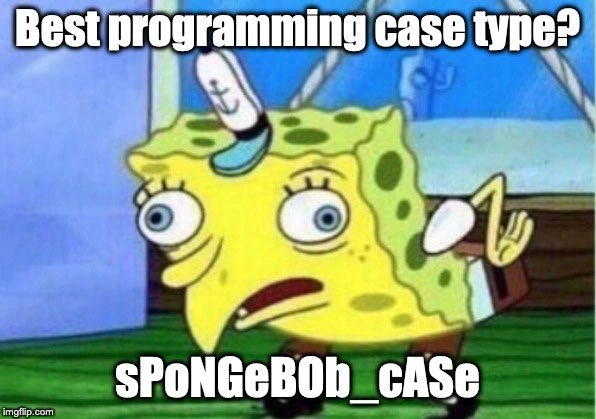
Now, the meme is funny to developers because it parodies those naming convention debates by suggesting an obviously terrible choice as “the best.” The top text asks which case style is best (a question that has sparked many heated discussions on forums and in offices). The bottom text answers with sPoNGeBOb_cASe, written in alternating goofy caps. This text style comes from the popular spongebob_mocking_meme: when someone wants to mock a phrase or idea online, they repeat it in a mix of capital and small letters to mimic a sarcastic, derisive tone (often with the SpongeBob image). Here, SpongeBob’s wonky pose and the mixed-case caption imply a mocking voice: “BeSt PrOgRaMmInG cAsE tYpE? sUrE, LeT’s uSe ThIs!”.

For a junior developer or someone new to coding, the humor works on two levels:

  1. Recognizable argument: You might have already seen or been part of discussions about naming conventions (like seniors telling you to rename MyVariable to my_variable to follow the standard). It’s a rite of passage in programming to learn these conventions, sometimes the hard way during a code review. This meme takes that familiar situation to an extreme for comedic effect.
  2. Obvious silliness: Even if you don’t know all the terms, you can tell that sPoNGeBOb_cASe looks wrong and is hard to read. It’s not a serious suggestion. The absurdity of it makes the joke accessible. Essentially, it’s saying “Arguing about the best way to capitalize letters in code is as silly as this SpongeBob text style.” You don’t need deep technical knowledge to see that alternating caps in a variable name would be a nightmare (readability_nightmare indeed!). It’s a form of CodingHumor that anyone who’s typed code can chuckle at, because consistency in how you write names is one of the first things you learn.

In summary, this meme uses a famous cartoon and an intentionally bad naming style to poke fun at DeveloperHumor culture. It’s highlighting the sometimes over-the-top arguments programmers have about trivial style points. The tags like NamingConventions and NamingThings are directly referenced: in software, deciding on naming conventions can weirdly feel like a big deal. By throwing SpongeBob-case into the mix, the meme reminds us (in a friendly teasing way) that we shouldn’t take those squabbles too seriously. After all, the goal is to write code that others can read — and nobody can read SpongeBob’s gibberish casing with a straight face! So we laugh, learn to follow the style guide, and move on to coding things that actually matter. 😄

Level 3: Bikeshedding in Style

In the hierarchy of programming holy wars, naming conventions rank right up there with tabs vs spaces. The meme asks, “Best programming case type?” and then answers with the ridiculous sPoNGeBOb_cASe to lampoon these endless debates. This is a classic case of developer bikeshedding – pouring excessive passion into trivial issues like whether to use camelCase or snake_case for variable names. By presenting a deliberately absurd style as “the supreme programming variable style,” the meme uses the Mocking SpongeBob format (alternating upper/lowercase text + a goofy posture) to deliver pure sarcasm. It’s essentially saying, “You think your favorite case is so superior? Sure, let’s all use this illegible SpongeBob case – that’ll fix everything!”.

Experienced developers chuckle because we’ve all been in code reviews or style discussions that got way too intense. Perhaps you’ve seen a pull request derailed by a variable_case_wars thread:

  • Reviewer A insists on user_id (snake_case)
  • Reviewer B demands userId (camelCase)
  • Reviewer C suggests UserID (PascalCase) for a constant or class name
    Meanwhile, the actual logic of the code gets overshadowed by these cosmetic preferences. The meme exaggerates this bikeshedding by picking a sarcastic_case_style no sane team would allow. It’s poking fun at how defensive devs can get over something as simple as letter casing. We recognize that exasperated tone: “Oh you want the best case style? Fine, let’s do iT liKe tHiS!” — a perfect DeveloperHumor eye-roll.

From a CodeQuality perspective, consistent naming is more than vanity – it’s about readability and maintainability. Inconsistent casing in a codebase is a known anti-pattern; nothing sabotages code comprehension like having fetchData(), fetch_data(), and FetchData() all in the same project referring to similar things. It’s a readability_nightmare. Seasoned engineers know that establishing a single naming convention (via team CodeStyleGuides or linters) avoids such confusion. Each programming Language community has its conventions: e.g. Java and JavaScript favor camelCase for variables, while Python insists on snake_case for identifiers per PEP 8 style guide. The whole point is to make sure that when you scan code, the variable names don’t distract or mislead. Good naming is part of clean code. As the meme hints, mixing styles — let alone using something as chaotic as SpongeBob-case — would be terrible for code clarity. If you ever encountered sPoNGeBOb_cASe in a code review, you’d probably file a bug report on the spot (after laughing, of course).

Yet the humor here also comes from how relatable this squabble is. Arguing over naming can feel comically petty, but it’s so common. There’s even a famous saying in software engineering:

“There are only two hard things in Computer Science: cache invalidation and naming things.” – (plus those off-by-one errors, ahem).

Wise senior devs cite this quote to remind us that NamingThings is inherently challenging. We strive for names that are descriptive but concise, consistent but not rigid. So it’s ironic that after all that effort, teams still get into heated arguments over formats of names (the variable_case_wars). The SpongeBob meme mocks this by reducing the argument to absurdity. It highlights a truth: in the grand scheme, whether you capitalize your variables one way or another shouldn’t be a make-or-break issue if you stick to one standard. The real enemy is inconsistency (and maybe spending an hour debating Camel_Snake_Case while production is on fire).

Ultimately, experienced developers find this meme funny because it nails a core inside joke of coding culture: the endless, almost religious debates over trivial style choices. We laugh because we’ve been there—pouring energy into naming bikesheds while the big architectural barn catches fire behind us. :fire: The RelatableHumor cuts deep. By crowning sPoNGeBOb_cASe as “the best,” the meme reminds us not to take these style squabbles too seriously. After all, the purpose of a naming convention is to make code understandable to humans; if we’re mocking each other with SpongeBob voices, we might have lost sight of that goal. Consistency matters, but let’s not turn it into a cartoonish fight.

Description

This meme uses the 'Mocking SpongeBob' or 'Spongemock' format, which features a close-up of SpongeBob SquarePants with a distorted, chicken-like posture and a mocking expression. The image is captioned with a question and an absurd answer. The top text asks, 'Best programming case type?'. The bottom text mockingly replies, 'sPONGeBOB_cASE'. This new 'case type' is written with alternating upper and lower case letters, characteristic of the meme's mocking tone, and is combined with snake_case. The humor lies in sarcastically proposing a chaotic and unreadable naming convention as a solution to the long-standing, often trivial debates among developers about standard case styles like camelCase, PascalCase, or snake_case

Comments

7
Anonymous ★ Top Pick I'm thinking of proposing a new RFC for sPONGeBOB_cASE. It's technically self-documenting; the variable's emotional state is encoded in its capitalization
  1. Anonymous ★ Top Pick

    I'm thinking of proposing a new RFC for sPONGeBOB_cASE. It's technically self-documenting; the variable's emotional state is encoded in its capitalization

  2. Anonymous

    The linter demands camelCase, the DB’s locked in snake_case, and now PM wants sPoNGeBOb_cASe “for brand consistency” - no wonder my résumé is already in PascalCase

  3. Anonymous

    Finally found the perfect naming convention for our legacy codebase - it already matches what happens when three different offshore teams maintain the same module over a decade without enforcing linters

  4. Anonymous

    When your junior dev asks why we enforce naming conventions in code reviews, just show them sPoNgEbOb_cAsE and watch their linter have an existential crisis. It's the naming convention equivalent of 'works on my machine' - technically valid syntax, absolutely unacceptable in production, and guaranteed to make every senior engineer's eye twitch during PR review. The real horror? Some legacy PHP codebase out there probably uses this unironically

  5. Anonymous

    Twenty years in, the only cross-team naming standard we ever achieve is DB in snake_case, JSON in camelCase, and one brave soul who 'normalized' it all to sPoNGeBOb_cASe during a Friday PR

  6. Anonymous

    SpongeBobCase: emerges when 15-year legacy code absorbs styles from every ex-dev who touched it

  7. Anonymous

    Architecture council ended the API/DB/ORM casing war by standardizing on sPoNGeBOb_cASe - at last, a convention that breaks ESLint, Prettier, and the DBA equally

Use J and K for navigation